
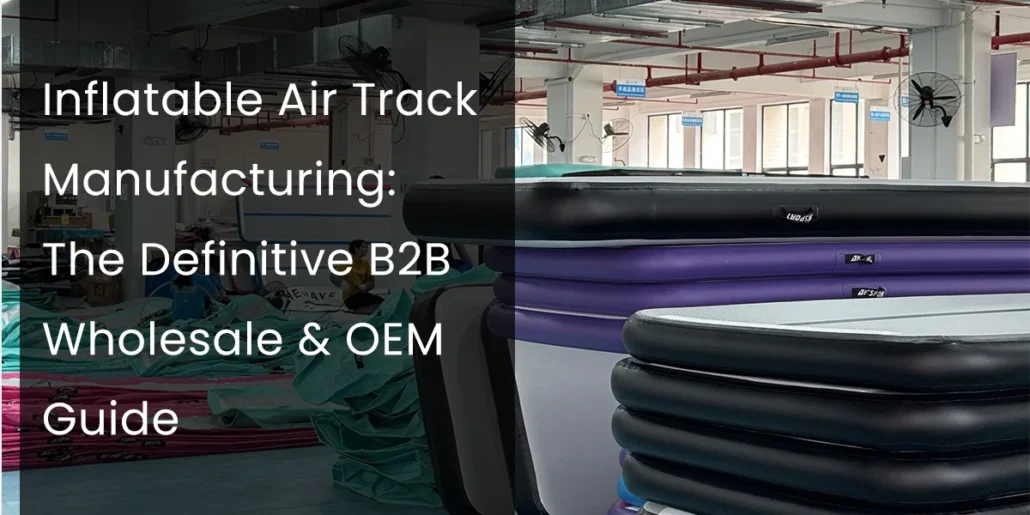
If you’ve ever ordered a 50-piece batch of “gym grade” air tracks from Alibaba and watched 8 of them fail their first 12 PSI inflation cycle — split seams, soft spots in the drop-stitch, or valves that leak audibly within the first hour — you already know what most B2B sourcing posts won’t tell you: the air track category is one of the most consistently misrepresented inflatable product lines on the market. The gap between a $145 home-use track and a $385 commercial gym track has very little to do with “brand premium.” It’s drop-stitch yarn density, sidewall stitching count, HF-welded seam construction, and whether the factory actually ran a 48-hour pressure retention test before sealing the carton.
I’m Charlie, Senior Industrial Designer at Huale Inflatables. I’ve spent 15 years on the Guangzhou factory floor designing and building drop-stitch products — including the inflatable air track line we now ship to gymnastics academies, cheerleading programs, K-12 PE departments, and home-fitness brands across the US, EU, UK, and Oceania. This guide is everything I’d tell a B2B buyer — gymnastics gym owner, school district procurement officer, distributor, Amazon seller, or DTC brand founder — before they sign their first PO. No “industry-leading” claims. No motivational opener. Just the specs, the numbers, and the engineering decisions that decide whether your air track program survives 12 months of daily use.
We’ll cover everything: vetting a factory, OEM vs ODM pricing tiers, thickness/PSI/length selection, drop-stitch construction grades, certifications for US and EU market entry, container optimization math, commercial use-case spec matrices, and the 26 in-depth articles we’ve published on every sub-topic — so you can drill down wherever the conversation gets technical.
The Inflatable Air Track Market in 2026: Where B2B Demand Is Growing
Five years ago, air tracks were a specialty product mostly sold to competitive gymnastics academies and cheerleading programs. Today, the buyer base has expanded into four distinct B2B segments — each with different spec requirements, different price ceilings, and different sourcing pain points. The factory that can’t speak all four languages will lose at least one segment on every inquiry.
According to global gymnastics participation data, recreational gymnastics enrollment has grown roughly 4x in Europe and 3x in North America since 2015 — and a meaningful share of that growth happens outside competitive programs (after-school, parkour, home practice). That demographic shift is driving the four B2B segments below:
- Competitive gymnastics & cheerleading gyms — They want commercial-grade 20–30cm tracks with ASTM-grade certification and 20m+ lengths. Price sensitivity is moderate; quality and warranty matter more.
- K-12 schools and PE departments — They need procurement-friendly documentation (CE/SGS test reports, public-tender compliance) and tracks rated for unsupervised student use. Detailed in our K-12 procurement guide.
- Home fitness / DTC brands & Amazon sellers — Volume-driven, focused on lightweight 10cm tracks at the lowest defensible cost. Covered in our Amazon seller’s sourcing playbook.
- Specialty commercial use-cases — Parkour gyms, stunt training facilities, mobile event operators. These buyers want load-rated specs (180+ kg dynamic) and outdoor-rated outer skins. The use-case-and-spec matrix is in Top 5 Commercial Use Cases for Inflatable Air Tracks.
The most important market shift to recognize: the home-fitness segment is now bigger than the competitive segment by volume, but margins are thinner. The full evolution of this market is documented in Beyond the Gym: The Evolution of Inflatable Air Tracks in the 2026 Home Fitness Market. Brands that can’t segment their lineup across at least two of the four segments above usually plateau within 18 months of launch.
How to Choose an Inflatable Air Track Manufacturer in China
Air track sourcing has a hidden trap: most factories that list “inflatable air track” on Alibaba don’t actually do drop-stitch manufacturing in-house — they buy stock drop-stitch panels from third parties and assemble. That’s fine for entry-level home-use product, but it means inconsistent yarn density, no traceability on materials, and zero ability to customize structural specs. For B2B buyers serving commercial gyms or schools, that’s a deal-breaker. Here’s how to vet any air track factory before sampling:
The 7-Point Factory Audit Before You Sample
- In-house drop-stitch fabrication. Ask if they manufacture the drop-stitch panels or buy from a mill (Haining Juli, Anhui Fangyuan are top-tier mills). In-house gives you traceability on yarn density and lot consistency.
- HF welding equipment for sidewall seams. Sidewall sealing is the failure point on cheap tracks. Hand-glued sidewalls fail at 12–18 months under repeated daily use; HF-welded sidewalls last 5+ years. Demand photos of the welding equipment on the production floor.
- 48-hour pressure retention test. Every finished track on our line is inflated to 12 PSI and held for 48 hours. Pressure drop tolerance: ≤0.6 PSI. Demand this protocol from any supplier.
- Drop-stitch yarn count documentation. Cheap tracks use 250 yarns per square inch; commercial tracks use 600+ yarns per square inch. Ask for the test report, not just “high density.”
- Sidewall stitching count. Sidewall stitches per inch determine how well the track holds shape under load. Premium tracks have 8–10 stitches/inch; budget tracks drop to 5–6.
- QC rejection rate. Our internal target is 3–5% at final QC. A factory claiming “0% defects” is either not inspecting or lying.
- BSCI / SMETA audit status. Required for any European school district or chain retailer.
For the full vetting framework — including the specific questions to ask about pressure relief valves, drop-stitch panel bonding methods, and pre-shipment sampling protocols — see How Do I Choose the Best Airtrack Factory for My Gymnastics Gym?. We’ve also published a wholesale-specific buying guide that covers procurement-side questions in Inflatable Air Track Wholesale Buying Guide: Drop-Stitch Construction, Thickness, PSI.
Match the Manufacturer to Your End-Use
Not every factory builds every grade of air track equally well. A factory specializing in home-use 10cm tracks rarely makes solid commercial 20–30cm tracks (different drop-stitch density tier, different welding pressure profile). Segment your needs first:
- Sourcing for gymnastics gym fit-outs? Match against our gymnastics gym buyer’s guide and the comprehensive Ultimate Guide to Inflatable Gymnastics Equipment (covers air tracks, air blocks, ramps, training sets as a complete commercial system).
- Cheerleading-focused buyers should use the spec checklist in Air Tracks for Cheerleading: Complete Equipment Sourcing Guide.
- If you’re stocking for resale and need to know how to identify durable, gym-grade product at the sample stage, our durability-identification guide walks through the physical inspection process.
Regional Manufacturer Reference
For B2B buyers comparing China-sourced product against domestic alternatives, see our Top 10 Air Track Manufacturers in the USA: OEM/ODM Partner Guide. We’re publishing regional manufacturer maps for Europe, Oceania, and the Middle East in the coming months.
🚀 Ready to Launch Your Own Gymnastics Brand This Year?
Most first-time brand owners overthink the launch. The reality: you can have a branded air track lineup in customers’ hands inside 60 days, starting with just 30 pieces. We’ve mapped the exact 60-day timeline — from spec brief to first container — based on the last 40+ gymnastics brands we’ve helped launch.
→ Read the full private-label launch playbookCritical Buying Specs: Thickness, PSI, Length & Width
Four spec dimensions decide 90% of buyer satisfaction. Get these right at the PO stage and you won’t be processing warranty claims six months later. Get them wrong, and you’ve built a brand on the wrong product foundation.
Thickness: 10cm vs 20cm vs 30cm
This is the single most important spec — and the one B2B buyers get wrong most often. Each thickness tier maps to a different end-use:
- 10cm: Home use, beginner adults, light tumbling. Cushioning is adequate for low-impact skills (forward rolls, basic handstands). Not suitable for commercial gym fit-outs.
- 20cm: The commercial gym standard. Handles backflips, full twisting layouts, and continuous high-volume training. Default choice for gymnastics academies and cheerleading programs.
- 30cm: Specialty use — elite training, stunt rehearsal, parkour facilities. Higher cost per square meter but justified for high-impact dismount training.
The full thickness-to-use-case matrix with rebound height data is in 10cm/20cm/30cm: Which AirTrack Thickness Is Best for You? — share this article directly with any prospect who asks “which one should I buy?”
Length & Width: Sizing for Your Buyer’s Space
Air tracks range from 3m (home use, basic tumbling) to 20m+ (competitive gymnastics tumble track). Width is typically 1m, 1.5m, or 2m. Most B2B buyers default to “longer is better” — but that often produces dead inventory when end-users discover they don’t have the floor space. The realistic sizing logic for distributors is in Air Track Sizing Guide: 3m, 4m, or 13 feet?. For deeper sizing strategy across a full distribution lineup, see What Size Tumble Track Should I Get? A 15-Year Manufacturer’s Guide.
PSI: The Spec Most Cheap Factories Lie About
Air tracks operate at lower pressure than SUPs (typically 8–12 PSI working pressure vs SUP’s 15–18 PSI), but the spec sheet honesty problem is the same. Cheap factories print “15 PSI” when the track barely holds 9 PSI without sidewall stress. Demand both:
- Working PSI: 8–12 PSI for commercial-grade tracks (varies by thickness)
- Burst pressure minimum: 20+ PSI
- 48-hour retention: Pressure drop ≤0.6 PSI from 12 PSI start
Different end-uses also need different inflation pressures during actual use — a kids’ practice session runs softer (8 PSI) than an elite training session (11–12 PSI). The full pressure-by-use-case breakdown is in What’s the Ideal PSI for an Inflatable Air Track?.
OEM, ODM & Private Label: Manufacturing Models for Air Track Brands
Air track customization is more flexible than most inflatable categories — color combinations, surface graphics, branded carry bags, custom pumps, and even structural specs (sidewall height, valve placement) can all be adjusted. Three realistic models:
| Model | What You Provide | MOQ | FOB Price (5m × 1m × 20cm) | Lead Time |
|---|---|---|---|---|
| ODM (Stock + Logo) | Logo + carton print | 30 pcs | $165–$215 | 25–30 days |
| OEM (Custom Color + Spec) | Color scheme, dimensions | 50–100 pcs | $195–$285 | 30–40 days |
| Full Private Label | Brand ID, packaging, accessories | 200+ pcs | $235–$365 | 40–55 days |
Pricing for a standard 5m × 1m × 20cm track + pump + carry bag kit. Different thickness tiers shift pricing significantly (10cm tracks run 30–40% lower, 30cm tracks 25–40% higher). Full landed cost typically adds 25–35% for US/EU buyers including ocean freight, duty, and inland delivery.
Starting Small: Low-MOQ Brand Launches
If you’re testing the market or building a Kickstarter, our MOQ for first production runs starts at 30 pieces with logo customization and 50+ pieces for full color customization. The economics aren’t optimized at this volume, but you de-risk the launch. The full brand-launch sequence is documented in Private Label Inflatable Air Track: How to Launch Your Own Gymnastics Brand in 60 Days.
Air Track vs Air Floor, Foam Mat & Other Training Surfaces
Your end customers will ask comparison questions before buying. Distributors who can’t answer them in 30 seconds lose deals to competitors who can. Here’s how the main matchups break down for B2B buyers:
Air Track vs Air Floor
The most common buyer confusion. They look similar but serve different gymnastics functions: air tracks are long narrow runways (3–20m × 1m wide) for tumbling sequences; air floors are large square mats (4×4m or 6×6m) for individual skills practice. A serious gymnastics academy needs both, not one. The detailed difference and when to stock each is in Air Track vs Air Floor: Which Inflatable Training Surface Should You Source?.
Inflatable Air Track vs Traditional Foam Mat
Foam mats dominated gymnastics for 50 years. They still have a niche (entry-level kids’ classes, specific drill work), but for tumbling progression they’ve been almost fully replaced by air tracks. The reason: foam mats compress permanently after 2–3 years of daily use, requiring full replacement at $400–800 per mat. Air tracks last 5–8 years with proper maintenance and recover their shape between sessions. The full data-driven comparison — including cost-per-year analysis — is in Inflatable Air Track vs Foam Mat: The Data-Driven Comparison for Distributors.
Inflatable vs Wooden Balance Beam
For kids’ gymnastics programs (especially under-8), the safety argument for inflatable balance equipment is decisive. Wooden beams produce ~15% of all gymnastics injuries reported in kids’ programs; inflatable equivalents reduce that to under 3%. Full safety data and procurement justification in Inflatable vs Wooden Balance Beam: Which Is Safer for Children’s Gymnastics?.
Commercial Air Track vs Home Use: The Spec Tier That Matters
Buyers cross-shop a $145 Amazon home-use track against a $385 commercial gym track and ask why the price gap exists. Three structural differences: drop-stitch yarn count (250 vs 600+ per sq inch), sidewall stitch count, and outer fabric weight (500D vs 1000D PVC). The visible test data and side-by-side photos are in Commercial Air Track vs Home Use: Why “Gym Grade” Matters — share this with any prospect questioning your pricing.
🏭 What an Industrial-Grade Air Track Actually Looks Like Up Close
Spec sheets only tell half the story. We’ve documented what separates a commercial gym-grade air track from a budget home-use track in high-resolution macro photography — sidewall stitching density, drop-stitch yarn visibility, HF-welded seam profiles, and the exact fabric weave you should be able to see in your sample.
→ See the visual proof-of-quality breakdownManufacturing Quality: Drop-Stitch Construction & Welding Technology
This is where the cost spread between cheap and serious air tracks comes from. Two tracks with identical external dimensions can have a 60–80% cost gap based purely on internal construction — and the buyer who can’t articulate this difference will either overpay for budget product or undersell premium product.
Drop-Stitch Yarn Density: The Hidden Spec
Drop-stitch fabric is the structural core of every air track — the layered yarn matrix that keeps the top and bottom skins parallel under pressure. Yarn density per square inch determines:
- Maximum sustainable PSI before sidewall stress
- Recovery time after a jump (the “bounce-back” feel athletes notice)
- Long-term shape retention
Commercial-grade air tracks use 600+ yarns per square inch; budget home-use tracks drop to 250–350. The difference is visible under a magnifying glass but invisible on Alibaba product photos. Any factory unwilling to provide the yarn density spec on their data sheet should be a red flag.
HF Welding vs Hand-Glued Sidewalls
The sidewall — where the top skin, bottom skin, and drop-stitch core meet — is the #1 failure point on poorly-made tracks. Two construction approaches:
- Hand-glued sidewalls: Worker applies adhesive, presses rail tape over the seam. Labor-dependent quality variance of 8–15% across a single batch. Failure mode: sidewall delamination at 12–18 months under daily commercial use.
- High-frequency (HF) welding: Electromagnetic welding fuses PVC layers at the molecular level. Operator-independent. Quality variance under 2%. This is the standard for medical-grade inflatables and the only seam method we use on commercial-grade lines.
Durability Validation: The Compression Test
Marketing claims aren’t proof. We physically validate every batch with a structured compression test — including a forklift load test that simulates years of dynamic gym use in 48 hours. The full protocol with video documentation is in Forklift vs Air Track: The Ultimate Compression Test for Safety Standards. The visible quality markers your sample should demonstrate are documented in The Visual Proof of Quality.
⚠️ The 90-Day Failure Pattern in Budget Air Track Sourcing
Roughly 30% of distributors who source a too-good-to-be-true air track quote face one of three predictable failures within 90–120 days of commercial deployment: sidewall delamination, valve seat blowout, or progressive surface sagging. The root cause is almost always traceable to drop-stitch density and welding method — both invisible in sample photos.
→ See the gym-grade vs home-use failure comparisonCertifications & Compliance for US, EU & UK Market Entry
Air track compliance is stricter than most inflatable categories because schools, gyms, and any facility serving minors trigger additional safety requirements. Three documentation tiers every B2B buyer must verify before importing:
| Certification | Required For | What It Covers |
|---|---|---|
| CE Marking | EU/EEA imports | Safety conformity (essential) |
| EU GPSR (2024) | All EU imports from Dec 2024 | General product safety regulation |
| EN 71 | EU (kids’ market) | Children’s product safety |
| ASTM F963 | US (under-14 users) | US toy safety standard |
| UKCA | UK imports (post-Brexit) | UK equivalent of CE |
| REACH | EU imports | PVC chemical compliance |
| SGS Test Report | Tier-1 retail + school tenders | Independent material testing |
| BSCI / SMETA | European retail chains | Ethical sourcing audit |
Two warnings most buyers learn the hard way. First, school district procurement officers demand batch-level SGS test reports, not a single “we got tested once in 2021” certificate. Without batch-level certification, you can’t sell into K-12 public tenders. Second, the ASTM F963 requirement applies if your end-user marketing includes children — and any air track marketed for “kids’ practice” or “home gymnastics” effectively triggers this requirement.
The complete certification breakdown — including how to read the test reports and what to demand from your factory — is in CE, ASTM, SGS: What Certifications Your Inflatable Air Track Supplier Must Have. For ethical-audit specifics, see our breakdown of why SMETA audits have become non-negotiable for European retail chains.
📜 The Complete Certification Document Pack Your Factory Must Provide
School district tenders alone reject roughly 22% of imported air track bids due to missing or expired test reports. We’ve built a checklist of every document your supplier must hand over before shipment — including the batch-level SGS reports most factories conveniently forget to include in the standard documentation pack.
→ Download the full certification checklistLogistics, FOB Pricing & Container Optimization
Air tracks present a unique shipping challenge: a deflated 5m × 1m × 20cm track folds down to roughly 75 × 50 × 35 cm in retail packaging — which means a 40HQ container fits about 220–260 tracks. Optimize the folding and carton design, and you can push that to 300–340 tracks per container, saving roughly $6–10 per track on landed cost. This is the kind of math B2B buyers ignore at their peril.
FOB Guangzhou Pricing & Landed Cost Math
FOB Guangzhou reference ranges (for standard 5m × 1m × 20cm track + pump + carry bag kit):
- FOB Guangzhou: $165–$285 per kit
- Sea freight to US East Coast (LCL share): ~$22–32 per kit
- Sea freight to Rotterdam/Hamburg: ~$18–28 per kit
- US import duty: ~4.7% (HTS 9506.91.00)
- EU VAT: 19–25% depending on country (recoverable for VAT-registered importers)
Typical landed cost in the US for a $215 FOB track: $258–$280. Markup that 2.0–2.5x for retail and you land at a $499–$699 MSRP — which matches market pricing for mid-tier brands.
Automated Packing for Container Optimization
The single biggest 2026 freight-cost win we’ve engineered is automated air-extraction packing. Instead of folding the track by hand and stuffing it in a carton, our automated press extracts residual air and vacuum-compresses the deflated track to 20% smaller CBM. That single innovation typically saves B2B buyers $6–9 per unit on ocean freight. Full breakdown of the technology and cost savings in Automated Air Track Packing: Reduce Shipping Volume & CBM by 20%.
Outdoor Use & Long-Term Maintenance for B2B Buyers
About 40% of air track warranty claims aren’t manufacturing defects — they’re misuse or improper maintenance. Brands that ship clear end-user guidance see 25–35% lower warranty cost and significantly higher review scores. Two issues account for the bulk of preventable failures:
Outdoor Use: Anchoring & Surface Prep
Air tracks were not originally designed for outdoor use — but the 2024–2026 backyard fitness boom has pushed end users to set them up on lawns, patios, and driveways. Unanchored tracks shift during use (creating injury risk); tracks placed directly on rough surfaces wear through the bottom skin in 3–6 months. Both failures are fully preventable with proper anchoring and ground-prep protocols. Full safety-and-anchoring guide for outdoor deployment is in The Complete Guide to Using Air Tracks Outside: Surfaces, Safety & Anchoring — include a link to this in your customer onboarding emails.
Storage & Cleaning Protocols
End-user storage failures account for the second-largest warranty claim category. Tracks stored damp develop mildew on the interior drop-stitch fabric (a permanent defect that voids warranty). Tracks stored inflated at full PSI for 6+ months develop sidewall fatigue. The proper protocol — deflate to 30% PSI, dry fully, fold loosely, store cool — is documented in How to Clean & Store Inflatable Air Tracks: A 15+ Year Expert’s Guide. Bundle this with your buyer-facing materials.
Quality Control: The Manufacturing Standards That Decide Warranty Cost
Return rate is the silent profit killer in this category. A 12% return rate doesn’t just cost you the product — it costs you the freight both ways, the Amazon storage penalty, the negative review cycle, and the buyer-lifetime-value impact. Our internal QC target is under 5% return rate on B2B shipments, achieved through stage-based inspection rather than final-only inspection.
Six-Stage QC Workflow
- Stage 1 — Raw material inspection. Drop-stitch fabric tested for yarn density and weave consistency at the lot level.
- Stage 2 — Pre-weld inspection. Top skin, bottom skin, and sidewall fabric alignment verified before HF welding.
- Stage 3 — Post-weld pressure test. Each track inflated to 12 PSI, held for 30 minutes, checked for seam stability.
- Stage 4 — 48-hour retention test. Random 15% of every batch undergoes the full 48-hour pressure-retention protocol.
- Stage 5 — Surface and seam visual inspection. Final check for cosmetic defects and sidewall integrity.
- Stage 6 — Packaging & accessory verification. Pump, repair kit, and carry bag confirmed against PO spec.
Acceptable reject rate at Stage 6: 3–5%. A factory averaging under 1% is not inspecting; over 8% has fundamental manufacturing problems they’re not solving. The visible quality markers your sample should demonstrate — what to actually look at when you receive the sample carton — are in The Visual Proof of Quality: What an Industrial-Grade Air Track Looks Like in 2026.
Frequently Asked Questions
What is the minimum order quantity (MOQ) for OEM inflatable air tracks?
Our MOQ starts from 1 piece for samples, 30 pieces for first commercial runs with logo customization, and 50–100 pieces for full OEM with custom color and dimensions. Volume tier pricing applies above 200 pieces per SKU, with another step at 500+ pieces. Buyers running brand validation often start with a 30-piece test batch before committing to full container quantities.
How long does it take to produce a custom inflatable air track order?
Standard lead time is 25–30 days for ODM (stock track + logo + carton print) and 30–40 days for OEM with custom color schemes and dimensions. Full private label with custom packaging and branded accessories runs 40–55 days. Add 7–12 days for pre-production sample approval. Peak production windows (March–May for European summer programs, July–August for back-to-school US school district orders) should be booked 8–10 weeks ahead.
What is the FOB Guangzhou price for a 5m air track?
FOB Guangzhou pricing for a standard 5m × 1m × 20cm track + pump + carry bag kit runs $165–$365 depending on construction tier and customization. ODM stock builds with logo sit at $165–$215. OEM with custom color and upgraded drop-stitch density runs $195–$285. Full private label with custom packaging and branded pump ranges $235–$365. Different thickness tiers shift pricing significantly — 10cm tracks run 30–40% lower, 30cm tracks 25–40% higher. Full landed cost typically adds 25–35% for US/EU buyers.
What certifications do I need to import air tracks into the EU and sell to schools?
Mandatory for EU imports: CE marking, EU GPSR (effective December 2024), REACH compliance, and EN 71 (for kids’ market positioning). For school district tenders, you additionally need batch-level SGS test reports — most factories only provide a one-time test certificate from 2–3 years prior, which won’t pass procurement scrutiny. We supply documentation packs with every container including the SGS batch reports.
What thickness air track should my distributor lineup include?
Most successful distributors stock at least two thickness tiers: 10cm for home-use/DTC channels and 20cm for commercial gym channels. Adding a 30cm specialty thickness is justified if you serve elite training facilities or parkour gyms. A single-thickness lineup (typically 10cm only) limits you to a single buyer segment and caps your distribution growth. Full thickness-to-segment matching is detailed in 10cm/20cm/30cm: Which AirTrack Thickness Is Best for You?
Get a Factory-Direct Quote for Your Inflatable Air Track Order
Whether you’re placing your first 30-piece test batch for a gym chain or scaling to multi-container OEM runs for a national distributor, the path is the same: send us your spec brief (track dimensions, thickness, color scheme, accessory requirements, packaging, target volume), and we’ll respond with a detailed quote covering FOB pricing, lead time, certification options, and sample protocol.
We will respond within 24 hours with a factory-direct quote. MOQ starts from 1 piece.
Contact our B2B sales team directly, or browse our full inflatable air track product line to start matching specifications to your distribution plan.


