
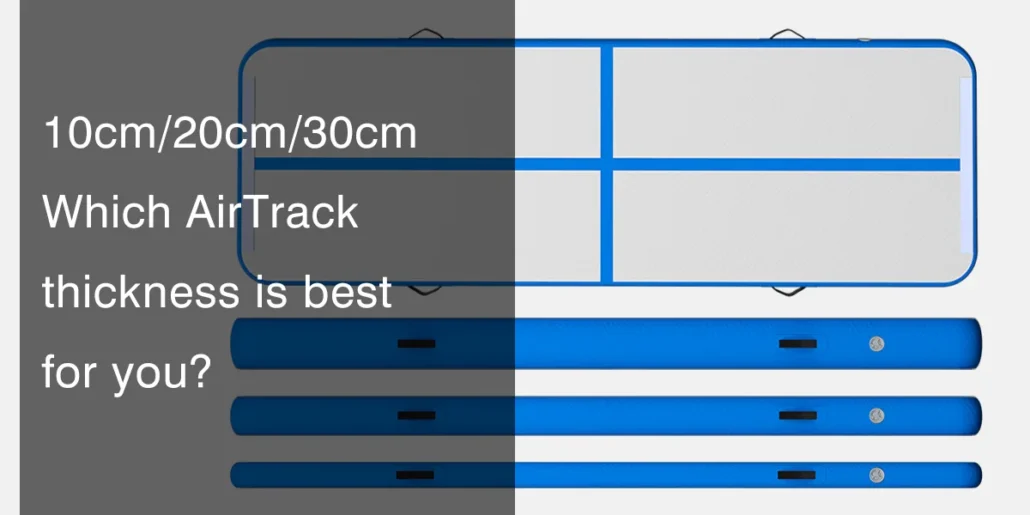
Many buyers search for an air track thickness guide because they are not sure whether to choose a 10cm, 20cm or 30cm air track mat. The answer is different for a home training brand, a school, a gymnastics gym, a cheer club, a rental operator or a wholesale distributor.
I’m Charlie, and we manufacture inflatable drop-stitch training mats for B2B buyers who need stable quality, repeat orders, custom size, private label, packing control and fewer after-sales issues. Thickness is not only about comfort. It affects rebound, cushioning, PSI feel, carton volume, freight cost and target user level.
This guide explains how to choose between 10cm, 20cm and 30cm air track mats from a factory sourcing angle. It also covers buyer questions such as airtrack 10 or 20 cm, air track thickness for tumbling, airtrack 20cm, airtrack 30cm and what size air track should I get.
If you need a full product range before comparing thickness, start with our custom inflatable air track manufacturer page.
10cm or 20cm Air Track: Which Thickness Should Buyers Choose?
Short answer: 10cm is usually considered when portability, lower packed volume and lighter training use are priorities. A 20cm Air Track gives buyers a deeper platform and is commonly considered for schools, cheer programs and gyms serving a wider range of users.
The better choice depends on more than thickness. User level, mat length, working pressure, floor surface and the type of tumbling drills all affect how the Air Track feels in practice.
- Consider 10cm when the product is intended for beginner drills, home training, stretching, lighter practice or a more compact retail SKU.
- Consider 20cm when the buyer needs a broader commercial training position for schools, cheer programs, gymnastics clubs or multi-user facilities.
- Consider 30cm only when the deeper platform matches a specific training or commercial requirement and the buyer has also considered packing volume and handling.
For B2B buyers, we recommend testing the final thickness together with the intended mat length and pressure setting instead of treating thickness as an isolated specification.
When Should Buyers Choose a 10cm Air Track?
A 10cm air track is usually chosen when the buyer needs a lighter, more compact and more price-sensitive product. It can work for beginner training, basic movement practice, stretching, low-impact drills and entry-level online retail SKUs.
For B2B buyers, 10cm thickness is often about market positioning. It can help brands offer a lower entry price, but it should not be sold as the same training surface as a 20cm or 30cm commercial mat.
Best-fit use cases
- Beginner tumbling practice
- Home training product lines
- Light school or PE use
- Stretching and warm-up drills
- Lower-cost online retail SKUs
Buyer risks to check
- Less cushioning for higher-impact landings
- Lower commercial positioning compared with thicker mats
- More careful user guidance needed for training level and floor surface
- Different pressure feel compared with 20cm and 30cm air tracks
If the buyer wants a compact product for home training or small school spaces, a 3m air track for home and school training can be a useful starting point. If the target market includes advanced gymnasts, cheer teams or commercial training facilities, 10cm may work better as a secondary SKU rather than the main product.
When Is 20cm the Better Air Track Thickness?
Short answer: a 20cm Air Track is often considered when the buyer needs a balance between cushioning, commercial training use, storage and product positioning.
In our B2B projects, 20cm requests commonly come from gymnastics clubs, schools, cheer programs and distributors that want one thickness to cover a relatively broad user range. That does not mean 20cm is automatically the best option for every buyer.
Where 20cm Often Fits Well
- Gymnastics clubs serving mixed skill levels
- School and PE training programs
- Cheerleading and tumbling practice
- Distributors building a core commercial Air Track SKU
- Private-label brands that want a middle thickness between entry and specialist products
What Buyers Should Confirm Before Choosing 20cm
- Target user level and training drills
- Final mat length and width
- Working pressure for the selected model
- Available storage space
- Pump and accessory requirements
- Packed size for wholesale or e-commerce distribution
For buyers comparing common commercial lengths, a 4m Air Track or 5m Air Track can be useful sample references, but thickness should still be confirmed against the actual training application.
When Does a 30cm Air Track Make Sense?
Short answer: a 30cm Air Track should be selected because the application benefits from a deeper platform—not simply because a thicker mat sounds more professional.
For B2B buyers, 30cm usually makes more sense when the product is being positioned for a specific commercial training environment, specialist program or premium product line. The additional thickness also affects packed volume, storage and handling, so these factors should be reviewed before sampling.
Applications Where Buyers May Consider 30cm
- Gymnastics or tumbling facilities evaluating a deeper training platform
- Cheer programs with defined training requirements
- Rental or event operators that need a clearly differentiated commercial product
- Private-label brands building a premium or specialist SKU
Before Ordering a 30cm Sample, Confirm
- Target user level and drill type
- Mat length and width
- Required pressure setting for the final structure
- Folded dimensions and storage route
- Pump specification
- Carry bag and carton dimensions
For larger commercial training spaces, you can also review our 6m Air Track as a length reference. Length and thickness should be selected together rather than independently.
Air Track Thickness for Tumbling: Rebound, Cushioning and PSI
Many buyers search for air track thickness for tumbling because they want to know whether a thicker mat gives better rebound. The answer is more detailed than thickness alone.
A thinner mat may feel faster and closer to the floor. A thicker mat can provide more cushioning and a different landing feel. Rebound and cushioning also depend on drop-stitch structure, material quality, air pressure, mat length, user weight, training surface and inflation method.
| Factor | What It Changes | B2B Buying Note |
|---|---|---|
| Thickness | Cushioning depth, sidewall height and product positioning | Match thickness with user level and target market. |
| PSI | Firmness, rebound feel and landing response | Confirm rated PSI by model before publishing specs. |
| Drop-stitch structure | Shape stability and pressure response | Ask the factory how the mat is built and tested. |
| Mat length | Run-up space and training sequence length | Thickness and length should be quoted together. |
| User level | Landing force and skill progression | Advanced training usually needs more careful spec selection. |
For pressure planning, connect this page with our ideal PSI for inflatable air tracks guide. PSI should be confirmed by final model, thickness and intended use.
How Do Air Track Thickness and Length Work Together?
Short answer: thickness and length solve different purchasing problems. Thickness affects cushioning depth and pressure feel, while length determines how much space the athlete has for entry, tumbling sequences and landing.
A 3m or 4m Air Track may fit shorter drills and smaller spaces, while 5m, 6m and longer models provide more training distance. The correct thickness still depends on the user level, pressure setting and training application.
For a complete comparison of 3m, 4m / 13ft, 5m, 6m and custom lengths, use our Air Track Size Guide .
Width is a separate sizing decision. For 1m, 1.5m, 6ft and 2m comparisons, including the difference between an exact 6ft width and a 2m width, use our Air Track Width Guide .
Thickness by Buyer Type: Gyms, Schools, Cheer Clubs and Sellers
Different buyers use air tracks in different ways. A school may need safe, durable and easy-to-store equipment. A cheer club may care more about rebound and landing comfort. An e-commerce seller may need a clear thickness ladder for product listings and price tiers.
| Buyer Type | Suggested Starting Point | Why | Factory Note |
|---|---|---|---|
| Schools and PE Programs | 20cm | Balanced cushioning and general training use | Check storage space, pump access and staff handling. |
| Gymnastics Gyms | 20cm or 30cm | Depends on skill level and drill intensity | Sample testing is useful before bulk order. |
| Cheer Clubs | 20cm or 30cm | Rebound and landing comfort matter for drills | Confirm length and pressure together with thickness. |
| Home Training Brands | 10cm or 20cm | Needs price range and lighter packing | Use clear product page guidance to reduce wrong-use complaints. |
| Distributors | 20cm as core SKU, 10cm and 30cm as extensions | Covers several price and user levels | Plan carton size, MOQ and repeat-order stock by thickness. |
If your buyer is comparing tumble track length and use case, send them to our what size tumble track should I get guide for a length-based view.
Why Should Thickness and PSI Be Confirmed Before a Quote?
Short answer: thickness cannot be quoted accurately in isolation. The final Air Track specification also includes length, width, construction and working pressure, all of which affect material use, production and packing.
For example, two 20cm Air Tracks can require different quotations if their length, width, construction, accessories or branding requirements are different. Buyers should therefore compare suppliers using the same confirmed specification.
For a broader discussion of MOQ, OEM pricing, packaging and wholesale purchasing, use our Inflatable Air Track Wholesale Buying Guide .
Can Private-Label Brands Offer Multiple Air Track Thicknesses?
Short answer: yes. A private-label Air Track range can use different thicknesses to create clearer product tiers, but each thickness should serve a defined customer rather than existing only as another SKU.
For example, a brand may use a thinner model for compact or entry-level training, a 20cm model as the main commercial option, and a 30cm model for a more specialist or premium position. The final range should still be tested against real customer demand, packing requirements and product performance.
Logo methods, color planning, private-label packaging, MOQ and launch strategy are covered separately in our Private Label Air Track Guide .
Sample Testing Before Bulk Air Track Orders
Thickness decisions should be tested before bulk order. A sample gives the buyer a real feel for rebound, cushioning, surface grip, valve performance, packing size and user feedback.
As a 15-year OEM/ODM factory, we recommend that B2B buyers test the sample with the same user group they plan to sell to. A school, cheer club and advanced gymnastics gym may respond differently to the same thickness.
What to check on the sample
- Inflation and deflation time with the selected pump
- Rebound feel at the confirmed pressure setting
- Cushioning for the target user level
- Valve sealing after repeated use
- Surface grip and line-marking quality
- Welding and seam area before packing
- Bag and carton size for storage and shipping
- Logo and color accuracy for private-label orders
If buyers need production-side guidance before sample approval, our inflatable air track wholesale buying guide covers drop-stitch construction, thickness, PSI and sourcing questions.
FAQ: Air Track Thickness Selection
Is a 10cm or 20cm Air Track better for tumbling?
Neither thickness is automatically better for every user. A 10cm Air Track is commonly considered for lighter, more compact training products, while 20cm provides a deeper platform and is often considered for broader school, cheer and gym applications. User level, mat size, PSI and training style should be reviewed together.
What thickness Air Track should I choose for a gym?
Many gym buyers compare 20cm and 30cm models, but the correct choice depends on athlete level, training drills, mat length, pressure setting, storage and the facility’s operating requirements. Sample testing is recommended before bulk production.
Does a thicker Air Track always give better rebound?
No. Rebound depends on more than thickness. Working pressure, drop-stitch construction, mat dimensions, user weight and the surface underneath the mat also influence how the Air Track responds.
What PSI should I use for a 10cm, 20cm or 30cm Air Track?
Use the working pressure specified for the final Air Track model. Buyers should not copy one PSI setting across different thicknesses or constructions without confirming it with the manufacturer and testing the sample.
Can I order 10cm, 20cm and 30cm Air Tracks under one private label?
Yes. Different thicknesses can be used to create separate product tiers. Each model should have its own confirmed specification, sample, target user and packing plan before bulk production.