
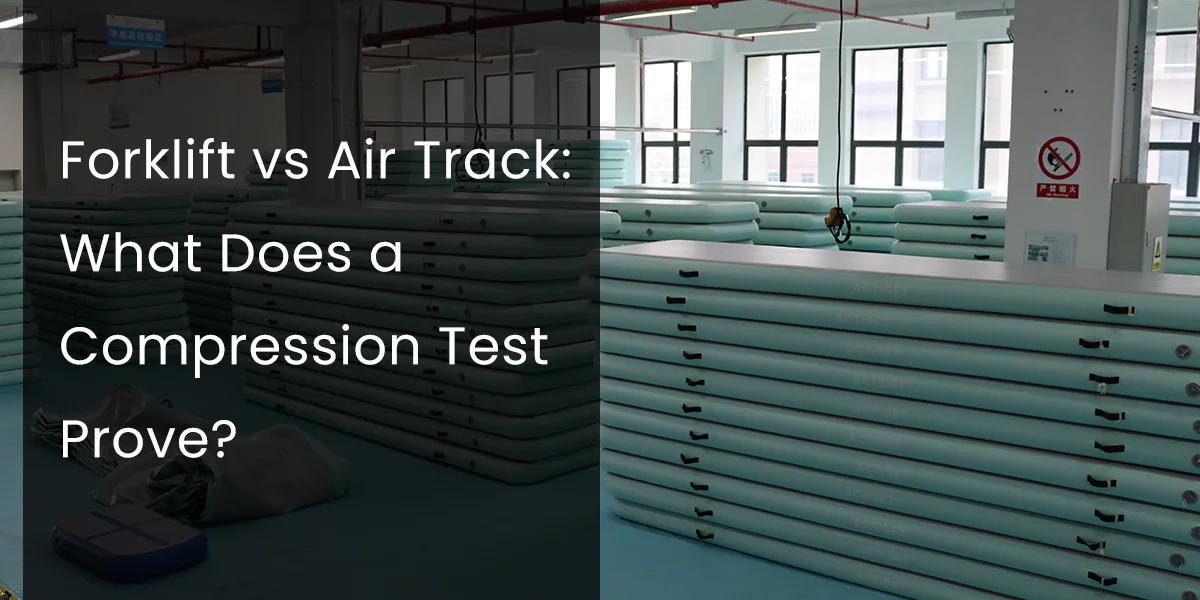
A forklift rolling over an inflatable air track makes a striking demonstration. But for a gymnastics equipment distributor or gym owner, the real question is not whether the mat looks impressive under a vehicle. It is what the demonstration actually proves about the product being purchased.
I’m Charlie from Huale. We manufacture inflatable drop-stitch air tracks for gymnastics businesses, equipment brands, schools and distributors. In manufacturing, a visible demonstration and a controlled product test serve different purposes. Both can be useful, but they should never be presented as the same evidence.
Short answer: a forklift compression demonstration may show how one inflated air track responds to a particular wheel load under specific conditions. It does not, by itself, establish athlete landing safety, long-term durability, seam strength, impact absorption or compliance with a gymnastics-mat standard.
For a B2B purchase, the useful evidence is a documented sample specification, a defined test method, recorded observations and relevant product inspections. This guide explains how to separate those elements before approving an OEM sample or bulk order.
What Does a Forklift Compression Test Actually Prove?
A forklift demonstration can provide a visual observation of a particular inflatable product under an unusual external load. If the demonstration is properly documented, buyers can review how the sample compressed, whether visible damage occurred and how the product appeared after the load was removed.
However, the observation is limited to the tested sample and the conditions of the demonstration.
| What May Be Observed | What It Does Not Automatically Prove |
|---|---|
| Visible compression under a particular wheel load | A rated maximum user load or approved training capacity |
| No obvious surface tear in the footage | No hidden material or seam damage |
| The mat appearing to recover its shape | Long-term dimensional stability or fatigue resistance |
| The sample remaining inflated during the demonstration | Passing a defined air-retention or leakage test |
| A visual response to industrial loading | Compliance with a sports-equipment safety standard |
The correct interpretation: a heavy-load demonstration is supporting visual evidence, not a replacement for model-specific quality testing or a training-safety assessment.
It should never be repeated by a gym owner or end user. Industrial loading demonstrations, where undertaken, require an appropriate controlled environment and qualified personnel.
Why Is Forklift Weight Alone Not a Valid Air Track Test Result?
The phrase “three-ton forklift test” sounds precise, but it is incomplete without a clear explanation of what the number represents.
A forklift’s rated lifting capacity is not necessarily its operating weight. The load transferred to an inflatable mat also depends on the actual vehicle mass, load distribution, number of wheels, tire geometry and which wheels contact the mat.
For a documented heavy-load demonstration, we would want to identify:
- Actual forklift model
- Vehicle operating mass
- Whether the vehicle carried an additional load
- Wheel and tire configuration
- Which wheels contacted the air track
- Approximate contact location
- Air track dimensions and construction
- Initial inflation pressure
- Loading sequence and duration
- Condition of the air track before and after loading
Vehicle mass is not the same as pressure at the contact surface. A wheel load is distributed through a contact area that can change with the tire and the supporting surface. The air pressure inside the mat is another separate measurement.
Without those details, buyers cannot calculate a meaningful contact load or reproduce the demonstration.
Is Forklift Compression Comparable to a Gymnast Landing?
No. A forklift moving slowly over a mat and an athlete landing after a tumbling movement create different loading conditions.
Athletic landings involve dynamic forces. The impact depends on factors such as movement, body position, landing area, contact duration, mat response and the supporting floor.
A heavy vehicle may apply a substantial local load, but this does not reproduce the impact response of a gymnastics landing.
Compression Resistance
This concerns how a structure responds when an external load compresses it under defined conditions.
Impact Attenuation
This concerns how a surface responds to an impact and the acceleration transmitted through the tested system.
Repeated Loading
This concerns changes in performance or condition after a defined sequence of loading cycles.
Each question requires its own suitable evaluation method.
For example, ASTM F355 describes procedures for measuring impact attenuation under specified test conditions. It includes applications involving sports mats, but the standard and test configuration must be checked for relevance to the actual product.
ASTM F355 impact-attenuation test method
A forklift demonstration should not be advertised as equivalent to testing under ASTM F355 or another sports-mat standard.
Which Air Track Tests Are More Useful for Commercial Buyers?
For an OEM or wholesale order, the testing plan should be built around the actual product specification and intended use.
No single demonstration provides enough information to approve the full product.
| Evaluation | Main Purpose | Evidence to Request |
|---|---|---|
| Inflation and Air Retention | Check whether the inflated structure maintains pressure under agreed conditions | Pressure, time, ambient conditions and inspection result |
| Dimensions and Shape | Confirm the finished product matches the approved specification | Measurement record and sample identification |
| Seam and Rail Inspection | Identify workmanship defects and assess agreed joint requirements | Visual checklist and any applicable seam test record |
| Impact Performance | Evaluate response to impacts under defined conditions | Relevant test method, specimen details and results |
| Valve and Fittings | Check installation, function and visible condition | Inspection or functional-test record |
| Packaging Inspection | Confirm accessories, labels and shipping configuration | Approved packing specification and inspection checklist |
Relevant European gymnastics-mat standards, such as the EN 12503 series, address specific performance and safety characteristics for defined categories of mats. Applicability must be established for the product being assessed; the existence of a standard does not mean every inflatable air track automatically meets it.
DIN EN 12503-1 gymnastics-mat standard overview
For separate information about regulatory classification and supplier documentation, use our air track compliance and testing documentation guide.
Why Air Retention and Seam Quality Need Separate Evidence
A heavy-load demonstration may draw attention to the strength of an inflated structure, but it is not a substitute for checking air retention and seam workmanship.
An inflatable air track depends on several components working together:
- Drop-stitch core and coated fabric
- Top and bottom outer surfaces
- Sidewall and rail assembly
- Valves and valve installation
- Reinforcement around applicable fittings
- Connections between materials and components
Air Retention
An air-retention check should record the approved inflation pressure, test duration, ambient conditions and acceptance criteria. Temperature changes can affect pressure readings, so the test procedure should account for those conditions.
A mat remaining inflated during a short visual demonstration does not prove that it passed a longer air-retention test.
Seam and Rail Workmanship
The buyer should review the actual rail construction and joining process used for the selected model. Heat welding, adhesive bonding and material lamination should not be treated as interchangeable terms.
If we compare different manufacturing methods, the comparison needs to identify the actual materials, joint structure, process conditions and inspection method.
A statement such as “zero glue means the product cannot fail” is not a technically useful purchasing specification.
For the approved pressure and firmness of different mat configurations, refer to our air track pressure and PSI guide.
What Records Would Make a Forklift Demonstration Credible?
If a supplier presents a forklift-on-air-track video, the buyer should be able to connect the footage to a specific physical sample and a documented set of conditions.
For a credible demonstration, we recommend the following evidence structure.
1. Sample Identification
- Product model and drawing revision
- Finished dimensions and thickness
- Material and construction specification
- Serial number, sample code or other traceable identifier
2. Loading Conditions
- Actual equipment model and operating mass
- Wheel configuration and contact location
- Whether the vehicle carried additional weight
- Inflation pressure before loading
- Loading sequence and duration
3. Before-and-After Checks
- Visual condition before loading
- Photographs or video of the complete demonstration
- Visible deformation during loading where recorded
- Surface, rail and valve inspection after loading
- Air-retention check after the demonstration, if performed
- Recorded damage, repair or other observations
Information that was not measured should be identified as not measured. A video cannot establish a numerical deflection result, wheel contact pressure or air-retention performance unless those measurements were actually taken.
If the video and test record cannot be linked to the same sample, the material should be treated as an illustration rather than controlled quality evidence.
Can a Forklift Test Prove That One Drop-Stitch Construction Is Better?
Not without a controlled comparison.
Air tracks can use different drop-stitch cores, coating systems, rail structures and joining methods. These choices affect manufacturing and performance, but a single forklift demonstration cannot identify which design feature caused the observed result.
To compare two constructions, buyers should first align:
- Mat length, width and thickness
- Operating pressure
- Applied load and measurement method
- Test environment
- Sample condition
- Measurement and inspection criteria
Then the buyer can review the actual differences between the products.
Drop-Stitch Core
The internal connecting yarns help maintain the inflated geometry of the mat. Their configuration is part of the structure, but terms such as knitted, woven or V-shaped construction do not replace measured performance evidence.
Outer Material
The coated fabric should be described using an identifiable material specification. Buyers should not assume that a higher-denier yarn count alone guarantees better finished-product performance.
Rails and Joints
Rail strength and air tightness depend on the actual materials, joint design, production process and workmanship. A welded connection should still be inspected and tested against its approved criteria.
If material chemical compliance is required for the destination market, that should be supported by relevant documentation. Mechanical compression does not establish REACH compliance or chemical safety.
How Should B2B Buyers Approve an Air Track Sample Before Bulk Production?
For gyms, schools and equipment distributors, a sample should establish the reference specification for the production order.
The approval should not depend on a forklift video, promotional photograph or a general statement about product durability.
The sample review should cover:
- Finished length, width and thickness
- Inflated geometry and surface condition
- Approved working pressure
- Drop-stitch and outer material specification
- Rail and seam workmanship
- Valve installation
- Handles and connection points where applicable
- Surface graphics and logo placement
- Air-retention procedure and agreed acceptance criteria
- Applicable performance-test evidence
- Accessories and repair items
- Final packed dimensions and gross weight
Where the intended use requires specific impact-performance evidence, the buyer should agree on a relevant test method and sample scope before bulk approval.
Once the physical sample is accepted, the specification and artwork revision should be recorded for production.
For bulk production, inspections should compare the manufactured units with that approved reference. This is more useful than assuming that a visual demonstration proves every unit in the order will perform identically.
For our air track manufacturing and QC information, visit the Huale air track factory page.
How Can Buyers Turn Durability Claims Into Verifiable Purchasing Requirements?
Before making a commercial decision, convert every product-quality claim into a question that the supplier can answer with evidence.
| Supplier Claim | Evidence to Request | What the Buyer Should Decide |
|---|---|---|
| “Heavy-duty construction” | Material specification, structure and relevant test records | Does the construction match the proposed application? |
| “Passed a forklift test” | Sample ID, actual load details, procedure and observations | Is this a controlled test or a visual demonstration? |
| “Strong seams” | Rail specification and applicable inspection or test records | How are production joints evaluated? |
| “No air leaks” | Defined air-retention procedure and acceptance criteria | Was the actual model tested under stated conditions? |
| “Safe for gymnastics” | Intended-use specification, applicable performance evidence and operating instructions | Does the evidence support the intended training activity? |
| “Reliable bulk quality” | Approved sample, production checks and inspection records | Can the supplier reproduce the approved specification? |
The strongest sourcing decision is not based on the most dramatic marketing demonstration. It is based on whether the supplier can connect product claims to the actual sample, technical specification and production records.
What Should Gyms, Brands and Distributors Do With Heavy-Load Test Claims?
Use them as a reason to ask better technical questions, not as the sole basis for a purchase order.
For Gym Owners and Schools
Prioritize suitability for the intended activities, correct product specification, operating instructions, inspection procedures and relevant performance evidence. A forklift demonstration does not establish that a mat is appropriate for every athlete, landing or training activity.
For Equipment Distributors
Request documentation that can be connected to the exact models being stocked. Product claims made in sales materials should be supported by the approved configuration and evidence available for that SKU.
For Private-Label Brands
Review material and construction claims before adding them to packaging, listings or advertising. If an OEM modification changes the construction or intended use, confirm whether existing test evidence remains applicable.
For Bulk Order Planning
After technical approval, compare the sample requirement, MOQ, accessory package, current production schedule, packaging and after-sales arrangement for the selected model.
For a project requiring custom dimensions, graphics or connection details, see our custom air track development page.
For a range of mats intended for distribution or commercial purchasing, review our wholesale air track program.
FAQ: Air Track Compression and Durability Testing
Can an inflatable air track support the weight of a forklift?
A particular inflated air track may withstand a particular forklift loading demonstration, but the result cannot be generalized to every mat. The actual equipment mass, wheel loading, mat construction, inflation pressure and test conditions must be known before the observation can be evaluated.
Does passing a forklift compression test mean an air track is safe for gymnastics?
No. A forklift demonstration does not replace relevant impact-performance evaluation, product inspection or assessment of the intended training use. Compression under a vehicle and an athlete’s dynamic landing are different loading conditions.
What tests should I request from an air track manufacturer?
Request evidence relevant to the approved model, including dimensions, material and construction specifications, seam and rail inspection, inflation and air retention, valve checks and applicable performance testing. Match the test records to the actual SKU and intended application.
Can a forklift test prove that heat-welded air tracks are better than glued models?
Not by itself. Comparing joining methods requires defined materials, equivalent sample configurations, comparable testing conditions and recorded results. A single demonstration does not isolate seam construction from other product variables.
How do I verify the durability claims of a wholesale air track supplier?
Ask for the sample specification, manufacturing details, testing procedure, acceptance criteria and traceable inspection records. Confirm that the evidence applies to the model you intend to purchase and that bulk production will be inspected against the approved reference.
Need to Verify an Air Track Specification Before Ordering?
Send us your intended application, mat dimensions, thickness, target users, quantity, branding requirements and destination market. We can review the required sample specification and discuss the appropriate manufacturing and inspection information for your project.
For factory capability and production control, visit our air track manufacturing page. For OEM modifications, review our custom air track options.
Sample, MOQ, test scope and bulk lead time should be confirmed against the final product specification and current production schedule.