
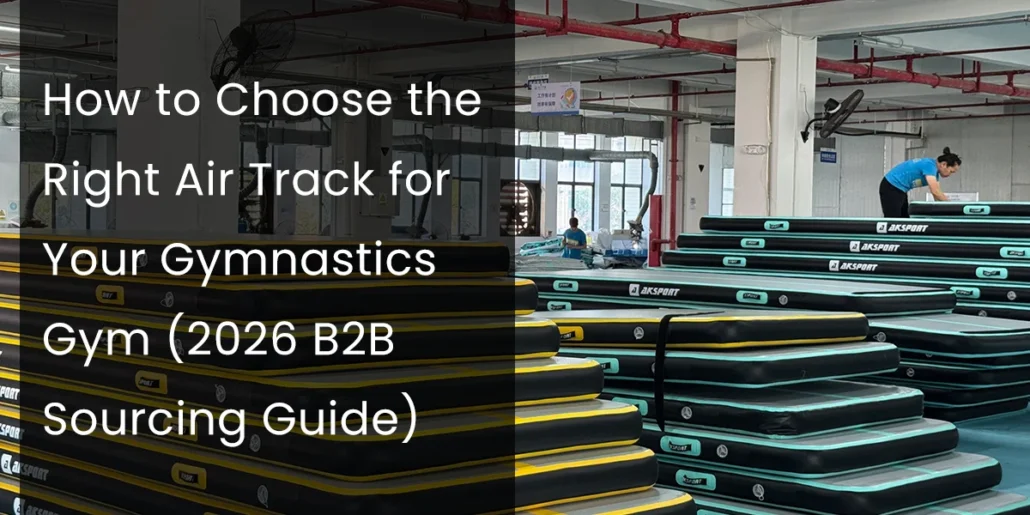
Most gymnastics gym owners I talk to make their first air track buying decision wrong. They look at Alibaba, sort by lowest price, and order something that fails 14 months in — peeling EVA, soft spots in the bounce, valve leaks during peak class hours. Then they call us asking how to fix it.
I’m Charlie, a senior industrial designer at Huale Inflatables. I’ve spent 15 years on the factory floor making drop-stitch products for gymnastics gyms, cheerleading programs, schools, and home training markets across the US, EU, and Australia. We currently produce around 4,500 commercial-grade air tracks per month from our Guangzhou facility, and the gymnastics gym segment is our largest single buyer category.
This guide is what I’d tell a gym owner walking into our showroom for the first time. It covers what construction specs actually matter, what thickness fits which training level, how to evaluate MOQ flexibility, and what FOB pricing looks like for commercial-grade orders. No sales pitch — just the technical reality of sourcing air tracks for a working gym.
Why Air Tracks Replaced Traditional Spring Floors and Foam Mats
Twenty years ago, a serious gymnastics gym ran spring floors and crash mats — both expensive, both fixed in place, both requiring permanent floor space. Air tracks changed the unit economics of opening a gym.
A 10m commercial-grade air track at FOB Guangzhou costs USD $480–650 per unit depending on thickness and finish. A traditional spring floor with equivalent training surface costs $8,000–15,000 plus installation. The capability gap between these two products has narrowed dramatically since 2018, particularly with double-wall fabric (DWF) construction now reaching 18-20 PSI operating pressure.
What air tracks give you that traditional mats can’t:
- Modular reconfiguration — connect two 5m tracks via Velcro coupling for a 10m floor, then split them again for two simultaneous skill stations
- Storage when not in use — deflate, fold, store on a shelf during open-floor classes
- Bounce tuning — vary inflation pressure between 5–15 PSI to match athlete weight and skill level
- Lower replacement cost — when wear shows after 3–5 years, you replace one $480 unit, not a $12,000 floor system
The trade-off is lifespan. A spring floor maintained properly lasts 15–20 years. A commercial-grade air track in daily gym use lasts 3–5 years before bounce degradation becomes noticeable to advanced athletes. For most growing gyms, the cash flow advantage of air tracks justifies the shorter cycle. For established elite training facilities, both technologies often coexist — air tracks for skill progression, spring floor for competition prep.
The 4 Construction Specs That Determine Air Track Lifespan
Most “wholesale air track” listings on Alibaba look identical at first glance. Same gray surface, similar dimensions, similar photos. The difference between a track that lasts 18 months and one that lasts 5 years comes down to four specs that aren’t visible from the outside.
1. Drop-Stitch Thread Density
The internal structure of an air track is thousands of polyester threads connecting upper and lower PVC layers. Thread density determines bounce consistency and how the track resists soft-spotting under repeated impact.
- Budget construction: 1,200–1,400 threads per square meter — soft spots appear within 6–12 months of daily use
- Standard commercial: 1,800–2,000 threads per m² — what we manufacture as our baseline gymnastics gym spec
- Elite training grade: 2,200+ threads per m² — minimum visible deflection under advanced tumbling impact
Trading companies rarely disclose thread density because most of them don’t know what their sub-factory used. A direct factory will tell you the spec without hesitation.
2. Outer PVC Thickness
The outer skin handles all the surface abrasion — chalk dust, athletes dragging onto the track, repeated foot traffic at landing zones.
- 0.6mm PVC: Home use only. Visible scratches within 2–3 months of daily commercial use.
- 0.9mm PVC: Our standard commercial gym specification. Holds up to 4–6 hours daily traffic across multi-class rotation.
- 1.1mm PVC: Elite training facilities running 8+ hours daily. About 18% material cost premium over 0.9mm.
3. Seam Construction: HF Welded vs Hand-Glued
This is the single biggest predictor of lifespan. The upper and lower PVC layers must be joined along the rails, and there are two methods to do it:
- Hand-glued seams (budget): Adhesive bond along the edge. Under sustained 24/7 inflation pressure plus heat cycling between summer/winter gym temperatures, glue eventually fails. Visible seam separation typically appears at 14–24 months.
- High-frequency (HF) welded seams (commercial): The two PVC layers are mechanically fused at 140–160°C into a single piece. There is no adhesive joint to fail. We use HF welding on all commercial-grade tracks as standard.
Visual inspection of a finished track won’t tell you which method was used — both look similar from outside. Ask the manufacturer directly, and ask for production line photos showing the welding equipment.
4. Valve Quality
The valve handles 1,000+ inflation/deflation cycles over the track’s life. Cheap valves are the most common single point of failure.
- Zinc-plated valve cores (budget): Corrosion appears within 12–18 months of regular use, particularly in humid gym environments. Sticky valves cause inflation pressure inconsistency.
- Stainless steel valve cores (commercial standard): 5+ year service life under normal commercial conditions. We use Halkey-Roberts compatible stainless valves on every commercial track we ship.
For a serious gym, the cumulative cost difference between budget specs and commercial specs is roughly 18–22% at unit cost — but the commercial track lasts 2–3x longer in your environment. The math heavily favors commercial-grade for any facility planning to operate beyond a 12-month horizon.
The 4 Construction Specs That Determine Air Track Lifespan
Most “wholesale air track” listings on Alibaba look identical at first glance. Same gray surface, similar dimensions, similar photos. The difference between a track that lasts 18 months and one that lasts 5 years comes down to four specs that aren’t visible from the outside.
1. Drop-Stitch Thread Density
The internal structure of an air track is thousands of polyester threads connecting upper and lower PVC layers. Thread density determines bounce consistency and how the track resists soft-spotting under repeated impact.
- Budget construction: 1,200–1,400 threads per square meter — soft spots appear within 6–12 months of daily use
- Standard commercial: 1,800–2,000 threads per m² — what we manufacture as our baseline gymnastics gym spec
- Elite training grade: 2,200+ threads per m² — minimum visible deflection under advanced tumbling impact
Trading companies rarely disclose thread density because most of them don’t know what their sub-factory used. A direct factory will tell you the spec without hesitation.
2. Outer PVC Thickness
The outer skin handles all the surface abrasion — chalk dust, athletes dragging onto the track, repeated foot traffic at landing zones.
- 0.6mm PVC: Home use only. Visible scratches within 2–3 months of daily commercial use.
- 0.9mm PVC: Our standard commercial gym specification. Holds up to 4–6 hours daily traffic across multi-class rotation.
- 1.1mm PVC: Elite training facilities running 8+ hours daily. About 18% material cost premium over 0.9mm.
3. Seam Construction: HF Welded vs Hand-Glued
This is the single biggest predictor of lifespan. The upper and lower PVC layers must be joined along the rails, and there are two methods to do it:
- Hand-glued seams (budget): Adhesive bond along the edge. Under sustained 24/7 inflation pressure plus heat cycling between summer/winter gym temperatures, glue eventually fails. Visible seam separation typically appears at 14–24 months.
- High-frequency (HF) welded seams (commercial): The two PVC layers are mechanically fused at 140–160°C into a single piece. There is no adhesive joint to fail. We use HF welding on all commercial-grade tracks as standard.
Visual inspection of a finished track won’t tell you which method was used — both look similar from outside. Ask the manufacturer directly, and ask for production line photos showing the welding equipment.
4. Valve Quality
The valve handles 1,000+ inflation/deflation cycles over the track’s life. Cheap valves are the most common single point of failure.
- Zinc-plated valve cores (budget): Corrosion appears within 12–18 months of regular use, particularly in humid gym environments. Sticky valves cause inflation pressure inconsistency.
- Stainless steel valve cores (commercial standard): 5+ year service life under normal commercial conditions. We use Halkey-Roberts compatible stainless valves on every commercial track we ship.
For a serious gym, the cumulative cost difference between budget specs and commercial specs is roughly 18–22% at unit cost — but the commercial track lasts 2–3x longer in your environment. The math heavily favors commercial-grade for any facility planning to operate beyond a 12-month horizon.
How to Specify Length, Width, and Thickness for Your Gym
The three dimensional specs are length, width, and thickness. Each one is driven by a different aspect of how your gym operates. I’ll cover them in the order most gym owners actually decide them.
Track Length: Match Your Skill Inventory
Length is determined by what skills your athletes are training. Here’s the breakdown we see across our gymnastics gym client base:
| Length | Skill Coverage | Best For |
|---|---|---|
| 3m | Front rolls, cartwheels, basic walkovers | Children’s program, mommy-and-me classes |
| 5m | Back walkovers, isolated handsprings, individual skill drills | Skills station for intermediate/advanced classes |
| 6m | Connected skill combinations, short tumbling passes | Most popular all-around length for mid-size gyms |
| 8m | Multi-skill tumbling passes, round-off back handspring sequences | Competitive team training |
| 10m | Full tumbling passes equivalent to competition floor | |
| 15m | Elite-level tumbling progression, twisting passes | Established competitive gymnastics academies |
For a gym serving beginner through intermediate skill levels, the best fleet configuration is one 5m track for individual skill work plus one 10m track for tumbling pass practice. This covers about 90% of training needs at roughly $1,000–1,200 FOB Guangzhou for both units in commercial spec.
Track Width: Spotter Positioning Matters
Width options are 1m, 1.2m, and 2m. Width is less about athlete safety than about spotter positioning.
- 1m wide: Single-athlete tumbling. Spotter must run alongside outside the track. Acceptable for intermediate athletes practicing skills they’re confident with.
- 1.2m wide: Slight margin for spotter to step onto the track edge during catch. Most popular width for general gymnastics training.
- 2m wide: Spotter can stand fully on the track surface during skill drills, particularly important for beginners learning back handsprings or aerial skills. About 35% material cost premium over 1m.
Thickness: 10cm vs 20cm vs 30cm
Thickness affects bounce response and impact absorption. The right thickness depends on your athlete weight range and skill level.
- 10cm: Children’s programs, recreational adult classes, mommy-and-me. Soft enough for falls without excessive bounce that throws off skill execution.
- 20cm: The commercial gym standard. Balanced bounce response for beginner through advanced athletes. This is what most gyms order.
- 30cm: Elite/competitive training. More bounce for high-amplitude skills. Stronger landing absorption for athletes practicing complex combinations. About 30% material cost premium over 20cm.
For a typical gymnastics gym serving recreational through team levels, 20cm thickness handles 95% of training applications. Going to 30cm only makes sense if you have a competitive team practicing multi-twist passes or advanced aerials. Going below 20cm makes sense only for dedicated children’s classes.
MOQ, FOB Pricing, and Lead Times
This is where I see the most confusion between what trading companies quote and what direct factory orders actually look like. Let me give you the real numbers we work with.
Our MOQ Structure
- Sample order: 1 piece — for buyers who want to physically evaluate construction quality before committing volume
- Logo-only customization: 5 pieces — your logo UV-printed on existing track design, our most common entry point for new gym buyers
- Color-customized order: 20 pieces — non-standard surface colors, two-tone finishes, custom stripe patterns
- Full ODM with custom dimensions: 50 pieces — non-standard length, width, or thickness specifications
For comparison: most Alibaba listings quote MOQ of 20–50 pieces minimum because trading company economics require larger orders to make their margin profitable. Direct from our factory, you can place a 5-piece commercial order without paying middleman markup.
FOB Guangzhou Pricing Tiers (2026)
Below is approximate FOB pricing for commercial-grade air tracks in our standard 0.9mm PVC + 1,800 thread DWF specification:
| Order Volume | 5m × 1m × 20cm | 10m × 2m × 20cm | Discount Tier |
|---|---|---|---|
| 5–19 pcs | $280–340 | $580–680 | Standard rate |
| 20–49 pcs | $260–315 | $540–630 | ~6% discount |
| 50–99 pcs | $245–295 | $510–595 | ~10% discount |
| 100+ pcs | Contact for quote | Contact for quote | 15%+ discount + Net 30 terms |
Landed Cost for US/EU Importers
FOB Guangzhou is the price at the port of departure. To estimate landed cost at your warehouse, add the following:
- Ocean freight: $25–40 per air track for full container shipments to US West Coast / EU continental ports; $40–60 per unit to US East Coast / UK Felixstowe
- Import duties: HS Code 9506.91 — 4.6% US tariff, 2.7% EU tariff (verify current rates with your customs broker)
- Customs clearance & drayage: $200–500 flat per container plus per-pallet drayage to your warehouse
- Marine insurance: 0.3–0.5% of cargo value
Total landed cost typically runs 25–35% above FOB unit price for orders shipping to US/EU/UK warehouses. For a 50-piece order of 10m commercial tracks, that’s roughly $620–680 per unit landed, vs $510–595 FOB.
Lead Times
- Sample production: 7–10 working days
- 5–50 piece orders: 25–35 working days from deposit
- 50–200 piece orders: 35–45 working days
- Ocean freight: 18–22 days to US West Coast, 25–30 days to EU continental, 28–32 days to UK Felixstowe
- Customs clearance at destination: 3–7 days
Total order-to-warehouse timeline: roughly 8–11 weeks for typical commercial gym orders. Add 2 weeks of buffer for unexpected delays. Plan ordering 12–14 weeks before you need the equipment in your gym.
Quality Control: What Separates Commercial Specs From Budget Production
The single most important QC step for an inflatable product is the pressure retention test. This is where most budget factories cut corners.
The 48-Hour Pressure Retention Test
Every air track we produce undergoes a mandatory 48-hour pressure retention test before it ships. The track is inflated to operating pressure (10–15 PSI depending on configuration) and left for 48 hours in our QC bay. Pressure loss greater than 0.4 PSI in that window means the unit is rejected — not sold at discount, rejected.
Our current rejection rate runs 3–5% of total production. Typical failures are minor seam imperfections invisible to visual inspection but detectable through pressure loss. Budget factories that skip this test ship those units to customers, which is why the failure rate at the gym is so much higher than it should be.
Compliance Documentation You Should Demand
For a commercial gymnastics gym in the US, EU, or AU markets, the documentation package shipping with your order should include:
- CPSC compliance + ASTM F963-17: Required in the US for any equipment used by athletes under 12 years old. Most gymnastics gyms serve children, so this is non-negotiable. Read the standard at the ASTM F963 standard reference.
- CE marking to EN ISO 25649-1:2017: Mandatory for EU import.
- REACH and RoHS: Material chemistry compliance, particularly important for products with skin contact.
- ISO 9001:2015: Quality management system certification — verifies the factory has documented production controls. ISO 9001 explained.
- amfori BSCI social audit: Increasingly required by Western retailers and insurance carriers; verifies fair labor practices in the manufacturing facility.
Always ask for the underlying test report PDFs, not just the certificates. A factory that has nothing to hide will send both within one business day. A factory that can only produce certificates but not test reports is using recycled documentation from earlier product runs — those certificates may no longer be valid.
Insurance and Liability Considerations
US commercial gym insurance carriers increasingly audit equipment compliance during incident reviews. Equipment without current CPSC documentation has been cited in coverage exclusions when injury claims are filed. Whether or not the equipment caused the injury, insufficient documentation can result in claim denial.
For gyms operating under franchise agreements (USA Gymnastics affiliated programs, similar institutional structures), the equipment compliance documentation is also typically required as part of the franchise inspection process.
Two Buying Strategies for New and Established Gyms
The right sourcing strategy depends on whether you’re outfitting a new gym or replacing equipment at an established facility. The cash flow profiles are different and the right approach is different.
Strategy 1: New Gym (First Order, Capital-Constrained)
If you’re opening a gym, your goal is to start with a working equipment fleet at the lowest justifiable upfront cost, while preserving the option to expand later as enrollment grows. The right strategy here:
- Order 1 sample first: $280–340 for a 5m × 1m × 20cm commercial track. Inflate it at your facility, run beginner classes on it for 2 weeks, evaluate construction quality firsthand.
- Then place a 5–10 piece initial order: One 10m track for tumbling passes, one 5m track for skills station, one 3m track for children’s program. Approximately $1,400–1,800 FOB plus shipping.
- Add inventory in year 2 as enrollment scales. Your manufacturer will archive your spec sheet, so reorders are identical to your first order.
This strategy minimizes initial capital outlay and lets you validate gym economics before committing to a full equipment fleet. Many of our gymnastics gym buyers follow this exact pattern.
Strategy 2: Established Gym (Replacement Order)
If you’re replacing aged equipment at an existing facility, your priorities are different. You already know what equipment configurations work in your space, and you’re comparing the lifetime cost of commercial spec vs budget spec replacement cycles.
- Order full fleet at 50–100 piece scale: Take advantage of volume pricing tier — about 10–15% per-unit savings vs single-track replacement orders
- Specify commercial-grade across the board: For a busy gym, the lifecycle math heavily favors 0.9mm PVC + 1,800 thread DWF. The 20% upfront premium pays back through 2–3x longer service life.
- Negotiate Net 30 terms on second order: After your first order is paid in full and shipped, our finance team can review for credit terms on subsequent orders.
- Plan replacement cadence: Replace 1/3 of your fleet annually rather than waiting for catastrophic failure. This smooths cash flow and ensures consistent equipment quality across your training surfaces.
What to Avoid
The single most common mistake we see new gym owners make: ordering from Alibaba based on the lowest quoted price. Most low-price listings are trading companies that don’t run their own production — they accept your order, then shop it to whichever sub-factory has capacity that week. Quality varies between batches, and warranty resolution becomes complicated because the trading company has to negotiate with the factory on your behalf.
Direct factory sourcing eliminates this variability. The factory that produced your first order produces every subsequent order, with the same materials, the same QC process, the same team. Whether you source from us or another direct factory, this is the more important sourcing distinction than country of origin.
Frequently Asked Questions
What length air track is best for a beginner-to-intermediate gymnastics gym?
For a gym serving beginner through intermediate skill levels, the optimal fleet is one 10m commercial track for full tumbling passes plus one 5m commercial track for individual skill drills. This covers approximately 90% of training applications across recreational and team programs. The combined cost runs about $1,000–1,200 FOB Guangzhou for both units in commercial 0.9mm PVC + 1,800 thread DWF specification, with 25–35 day production lead time before shipping.
Can I connect two air tracks together for a longer training surface?
Yes. Every commercial air track ships with Velcro coupling strips along the lateral edges, plus optional buckle connectors for a more permanent join. Two 10m tracks connect end-to-end to create a 20m training floor. Connected tracks must match thickness and width — you cannot cleanly join a 20cm thick track to a 10cm thick track, or a 1m wide to a 2m wide. The connection seam is flush with the track surface so athletes don’t trip during tumbling passes. Many established gyms use this configuration to extend training length without ordering a single oversized track.
What thickness should I order if my gym serves children’s programs and competitive teams?
For a mixed-use gym, 20cm thickness is the right baseline — it handles children’s recreational classes safely while providing adequate bounce for competitive team training. Ordering 10cm tracks alongside 20cm tracks creates inventory complexity (different inflation pressures, different feel for athletes transitioning between tracks). The 30cm thickness is rarely necessary unless you specifically train advanced multi-twist or aerial passes. We recommend most mixed-use gyms standardize on 20cm across their fleet.
How long should a commercial air track last in daily gym use?
A commercial-grade air track (0.9mm PVC, 1,800+ thread density DWF, HF welded seams, stainless steel valve cores) used 4–6 hours daily across multi-class rotation typically lasts 3–5 years before bounce degradation becomes noticeable to advanced athletes. Primary failure modes in order of frequency: surface abrasion (cosmetic, not structural — appears at 12–18 months), valve wear (replaceable component, $25 per valve), seam integrity (HF welded seams rarely fail; glued seams typical on budget tracks fail at 14–24 months). Plan replacement cadence at year 4 for elite-use tracks and year 5 for standard recreational tracks.
Do you provide compliance documentation for institutional and franchise procurement?
Yes. Every commercial gym order ships with the full compliance package: CPSC Children’s Product Certificate, ASTM F963-17 compliance test report, CE EN ISO 25649-1:2017 declaration, REACH SVHC declaration, RoHS statement, ISO 9001:2015 quality management certificate, and amfori BSCI social audit certificate. For institutional buyers (school districts, university athletic departments, USA Gymnastics affiliated programs), we also provide W-9 equivalent documentation, capability statements, and references from prior institutional orders on request. Read more about international compliance at the International Gymnastics Federation.
Ready to Source Air Tracks for Your Gym?
Send us your gym’s specifications — number of tracks, lengths, thickness preferences, target delivery date, destination port. We’ll respond within 24 hours with a factory-direct FOB quote, sample availability, and earliest production slot.
For new gyms still validating equipment specs, we recommend starting with a single sample order. MOQ starts from 1 piece, sample fee credited against your first bulk invoice. No commitment to bulk volume until you’ve physically evaluated the construction at your facility.
Visit us in person during the Canton Fair (April and October each year) — most of our international gym buyers combine factory tours with the fair. Airport pickup, factory walk-through, and specification review all included at no cost.