
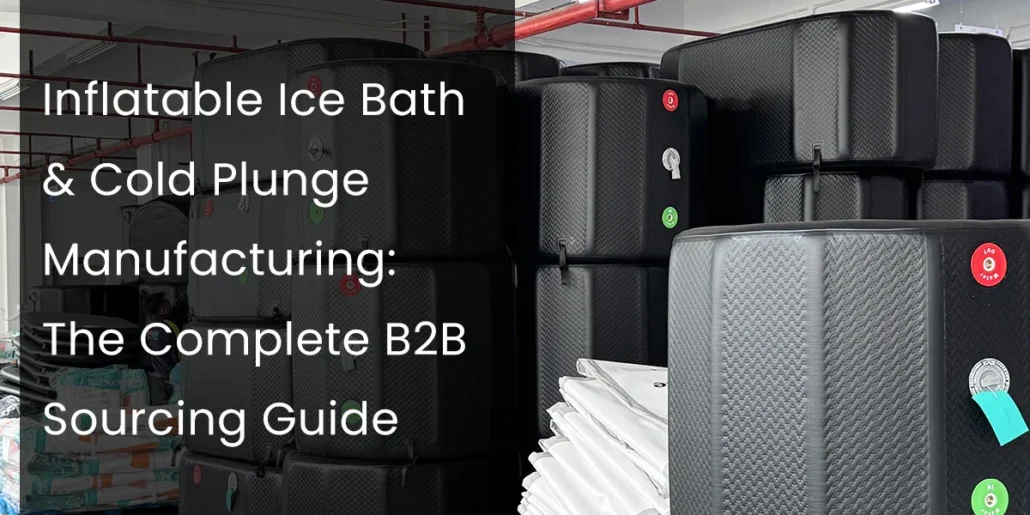
If your gym, spa, or recovery brand has ever pulled a “premium” cold plunge tub out of the box only to find a chiller that can’t hold 3°C below 18°C ambient, foam walls that sweat through the outer skin, or a drain valve that leaks within the first six weeks — you already know that not every inflatable ice bath on Alibaba is built the same way. The gap between a $189 ODM tub and a $389 OEM tub is rarely “brand markup.” It’s chiller compressor sizing, insulation layer count, drop-stitch sidewall density, and whether the factory ran a 48-hour leak retention test before sealing the carton.
I’m Charlie, Senior Industrial Designer at Huale Inflatables. I’ve spent 15 years on the Guangzhou factory floor designing and building inflatable products — including the inflatable cold plunge and ice bath line we now ship to gyms, recovery studios, and DTC brands across the US, UK, Germany, Australia, and the Nordics. This guide is everything I’d tell a B2B buyer — distributor, gym chain procurement lead, recovery brand owner, or Amazon seller — before they sign their first PO. No “industry-leading” claims, no fluff. Just the specs, the numbers, and the engineering decisions that decide whether your cold plunge line survives the second winter season.
We’ll cover everything: vetting a factory, OEM vs ODM cost tiers, chiller and insulation specs, CE/RoHS certifications for EU market entry, ROI math for commercial gyms, maintenance protocols that extend tub life, and the 24 in-depth articles we’ve published on every sub-topic — so you can drill down wherever the conversation gets technical.
The Inflatable Cold Plunge Market in 2026: Why B2B Demand Is Accelerating
Cold plunge is no longer a fringe biohacker product. Cold-water immersion research moved into mainstream sports medicine over the last five years, and consumer awareness exploded through Huberman, Wim Hof, and the post-2022 recovery culture wave. The downstream effect on B2B sourcing has been dramatic — commercial gym chains in the EU now order cold plunge equipment as part of standard fit-out, not as an optional upgrade.
Two structural shifts shape 2026 sourcing decisions:
- Inflatable is winning over rigid frame for everything except permanent installations. Inflatable tubs ship at 1/8th the freight volume of fiberglass or stainless tubs, install in 15 minutes, and run on the same chiller hardware. For mobile recovery operators, pop-up clinics, and rental fleets, inflatable is the only economically viable format.
- The commercial buyer is more technically literate than two years ago. Gym owners now ask about compressor BTU output, insulation R-value, and chiller cooling rate per liter — questions that didn’t appear on B2B inquiry forms in 2023.
Three buyer segments dominate B2B orders right now: commercial gyms and CrossFit boxes (single-user tubs, prioritize fast cooldown), spa and recovery studios (premium aesthetic, custom print) covered in our spa operator sourcing guide, and DTC/Amazon brands (need the cheapest-defensible spec at scale) covered in our Amazon seller’s sourcing playbook. Each segment buys differently, and the factory that can’t speak all three languages will lose the deal.
How to Choose an Inflatable Cold Plunge Manufacturer in China
Cold plunge sourcing has a hidden trap: the tub and the chiller are usually made by two different factories. Most “inflatable cold plunge suppliers” only build the tub and outsource the chiller — meaning when the chiller fails in month 8, you have two suppliers pointing at each other. We integrate both lines under one roof, which I’d argue is the only viable model for B2B buyers expecting consistent warranty support. Either way, here’s how to vet any factory before sampling:
The 7-Point Factory Audit Before You Sample
- Tub-chiller integration verification. Ask if they manufacture the chiller in-house or outsource. If outsourced, ask who, and request the chiller factory’s CE certificate directly.
- Drop-stitch sidewall density. Cold plunge tubs operate under static water pressure (not high inflation pressure like SUPs), but sidewall stiffness still matters for thermal stability. Reject single-layer 1000-denier construction for commercial use.
- 48-hour leak retention test. Every finished tub on our line is filled with water, inflated to 6 PSI sidewall pressure, and held for 48 hours. Drop tolerance: ≤0.3 PSI. Demand this protocol from any supplier.
- Insulation layer documentation. Ask for the exact insulation construction: closed-cell PE foam thickness, reflective inner liner spec, outer fabric R-value. “We use insulation” is not an answer.
- Chiller compressor sourcing. Brand-name compressors (Embraco, Panasonic, Tecumseh) cost more but deliver consistent cooling. Generic compressors fail at high duty cycles.
- QC rejection rate. Our internal target is 3–5% at final QC. A factory claiming “0% defects” is either lying or not inspecting.
- SMETA/BSCI audit status. Required for any European chain retailer.
For the full vetting framework with manufacturer-specific questions — including how to read a chiller spec sheet and what to demand on the cooling-capacity test report — see How to Find a Reliable Inflatable Cold Plunge Manufacturer. We’ve also written a buyer-side decision guide that goes beyond unit cost: How to Choose the Best Inflatable Ice Bath — Beyond the Price Tag.
Why “Price-First” Sourcing Burns Cold Plunge Buyers
Of every product category we manufacture, cold plunge has the widest gap between price and quality. A $169 tub on Alibaba looks identical in product photos to a $369 commercial-grade unit. The difference becomes visible only after 90–120 days of use — by which point the buyer has already sold through their first inventory batch and built customer expectations on a product that’s about to fail. We’ve documented the full price-quality breakdown in The True Cost of a “Cheap” Inflatable Ice Bath: A Factory Insider’s Warning — required reading for anyone evaluating their first sample.
💼 Setting Up a Recovery Room or Spa? Here’s the Full Build-Out Spec
Spa operators and recovery studios face a different sourcing challenge than gyms — aesthetics, throughput, and water chemistry all factor in. We’ve documented the full equipment list, room dimensioning, and ventilation requirements for setting up a professional cold plunge recovery room based on 40+ completed installations.
→ Read the spa operator’s complete sourcing guideOEM, ODM & Private Label: Cold Plunge Manufacturing Models Explained
Cold plunge OEM/ODM works differently from other inflatable categories because the chiller is a separate engineering deliverable. You can OEM the tub aesthetics, custom-print the outer skin, build a branded carry case — but the chiller stays a third-party component (unless you commit to 1,000+ units, at which point we can rebrand the chiller chassis). Here’s the realistic spectrum:
| Model | What You Provide | MOQ | FOB Price (Tub+Chiller Kit) | Lead Time |
|---|---|---|---|---|
| ODM (Stock + Logo) | Logo + carton print | 30 sets | $195–$265 | 25–30 days |
| OEM (Custom Print + Dimensions) | Print files, size spec | 50–100 sets | $245–$345 | 35–45 days |
| Full Private Label | Brand ID, packaging, chiller rebrand | 200+ sets | $315–$485 | 45–60 days |
Pricing assumes 1-person standard tub (80×80×75cm) + 1/2HP chiller. Larger tubs and higher-HP chillers shift pricing 25–60% upward. Full landed cost typically adds 30–40% for US/EU buyers including ocean freight, duty, and inland delivery.
Custom Print: The Highest-ROI Customization
If you can only afford one customization investment, make it the custom-printed outer skin. The visual difference between a generic black-and-blue tub and a brand-printed luxury tub at the same MSRP is dramatic — and the manufacturing cost difference is under $25 per unit at 100-unit volumes. Full design and print process documented in Custom Print Ice Bath: Transforming Inflatables into Luxury Cold Plunge Design.
The Anatomy of a Commercial-Grade Inflatable Cold Plunge
Cold plunge construction is a different engineering problem from SUPs or air tracks. The tub must hold ~200 liters of 3°C water against an 18–25°C ambient temperature — meaning every layer of construction is a thermal battle. Here’s what’s actually inside a professional tub, from outside to inside:
The 5-Layer Insulation Stack
- Outer skin (1.0mm PVC tarpaulin or 0.9mm laminated TPU): Provides UV protection and structural integrity. Cheap factories use 0.6mm — visually identical but tears within 12–18 months under sun exposure.
- Reflective barrier layer: Aluminized PE film bonded to the outer skin’s interior. Reflects radiant heat back outward. Often omitted in budget tubs — and you can’t tell from photos.
- Closed-cell PE foam (15–25mm): The primary insulation. Foam thickness directly determines how hard the chiller has to work. We use 20mm minimum on commercial-grade tubs.
- Drop-stitch sidewall structure: Provides the rigid wall standing pressure. Density of 1200 yarns/m² for commercial use.
- Inner liner (food-grade TPU): Direct water contact layer. Must be REACH and FDA-equivalent compliant. Premium tubs use thicker 0.4mm TPU for puncture resistance.
The full anatomy with cross-section diagrams and material spec tables is in The Anatomy of a Professional Inflatable Ice Bath: What’s Inside Matters — this is the single most-referenced article we have when buyers compare us against a cheaper quote.
The Insulation Mistake That Kills Gym ROI
Here’s the math: a poorly insulated tub forces the chiller to run at 80–90% duty cycle instead of 30–40%. Over a year, the electricity bill difference is roughly $280–$450 per tub for a gym running 12 hours/day. Worse, the chiller compressor lifespan drops from 5+ years to 18–24 months. This is the #1 reason gym operators replace their cold plunge equipment after 18 months and blame “China manufacturing” — when the actual cause was buying the wrong insulation tier. The full operating cost analysis is in Chiller Compatible Ice Tubs: Why Poor Insulation Is Costing Your Gym Thousands.
🏭 See the Insulation Layers Being Laminated in Real Time
Material specs only matter if the factory actually builds to them. We’ve documented every stage of cold plunge manufacturing inside our Guangzhou facility — drop-stitch cutting, foam lamination, reflective barrier bonding, HF welding, chiller integration, and the multi-stage pressure test. Real photos from our production floor.
→ Take the full ice bath factory tourCritical Buying Specs Every B2B Buyer Must Verify
Four spec dimensions decide 90% of buyer satisfaction. Get these right at the PO stage and you won’t be replacing tubs in year two.
Tub Size: Match to End-User Throughput
Most B2B buyers default to a 1-person tub (~80×80×75cm) because it’s the lowest unit cost. That’s often wrong for commercial settings, where 2-person tubs serve a much wider customer base and rental ROI is significantly higher. The size selection logic for wholesale buyers — including how to forecast SKU mix for your distribution — is in Ice Bath Size Guide Wholesale: 1-Person, 2-Person, and XL Buyer’s Manual.
Water Temperature Capability: Don’t Trust the Spec Sheet
“Reaches 3°C” is the most over-claimed spec in this category. The real question is: how fast does it reach 3°C, and can it hold it under typical gym ambient (22–26°C) over a 6-hour operating window? Different end-uses demand different cooling protocols — athletic recovery, longevity protocols, contrast therapy each have different target temperatures. The full protocol breakdown by application is in Ice Bath Water Temperature Guide: 3-15°C Protocols by Application.
Chiller HP Sizing: The Single Most Misunderstood Spec
Chiller compressor horsepower (1/4HP vs 1/2HP vs 1HP) is not a “bigger is better” decision. It depends on:
- Tub water volume (liters)
- Target temperature differential (ambient minus target)
- Daily usage cycles (continuous vs intermittent)
- Ambient room temperature range
Undersizing the chiller is the most common B2B buying error — the unit “technically works” in cold weather sample testing but underperforms in real summer conditions. The matching matrix by tub size and use-case is in Cold Plunge Chiller Sizing Guide: 1/4HP vs 1/2HP vs 1HP.
The 5 Non-Negotiable Features for B2B Orders
Beyond size, temperature, and chiller, five additional features separate commercial-grade tubs from consumer-grade ones: integrated drain valve (not just a plug), reinforced sidewall handles, lid with thermal seal, anti-microbial inner liner treatment, and a digital temperature display on the chiller. The justification for each is in 5 Critical Features Your Inflatable Ice Bath Tubs Must Have — use it as a PO spec checklist.
Inflatable vs Steel Frame vs Rigid: The B2B Format Comparison
Buyers cross-shop inflatable cold plunges against three alternative formats: steel-frame collapsible tubs, fiberglass rigid tubs, and stainless steel commercial tubs. Your sales team needs to know exactly when each format wins. Here’s the realistic breakdown:
| Format | Best For | FOB Price Range | Container Loading |
|---|---|---|---|
| Inflatable | Mobile, DTC, gym, rental | $195–$485 | ~300 sets per 40HQ |
| Steel Frame | Mid-tier home use | $165–$295 | ~120 sets per 40HQ |
| Fiberglass Rigid | Permanent spa install | $680–$1,400 | ~25 units per 40HQ |
| Stainless Steel | Commercial spa, high-end | $1,200–$3,500 | ~15 units per 40HQ |
The freight math alone is decisive for most B2B buyers — an inflatable tub costs $18–28 to ship per unit; a fiberglass tub costs $145–220. Three reference articles cover the head-to-head comparisons in detail:
- Inflatable vs Steel Frame Cold Plunge: A B2B Sourcing Comparison Guide — for buyers evaluating between the two budget formats.
- Framed vs. Inflatable Ice Baths: Which Is Best for Your Recovery? — written from the end-customer recovery perspective.
- Why Inflatables Are the Superior Choice for Your Brand — B2B brand-positioning angle.
⚠️ The 90-Day Failure Pattern in Budget Cold Plunge Sourcing
Roughly 35% of distributors who source a “too good to be true” cold plunge quote face one of three predictable failures within 90–120 days: chiller compressor failure, sidewall delamination, or insulation moisture saturation. We’ve documented the failure patterns from 60+ teardowns of competitor-supplied tubs that came back as warranty claims to our customers.
→ Read the factory insider’s warning before your next quoteQuality Control: The Manufacturing Standards That Separate B2B Suppliers
Cold plunge QC is harder than most inflatable categories because failures are thermal and electrical, not just structural. A leak shows up immediately; a marginal compressor or undersized insulation shows up months later. Final-stage visual inspection alone is no longer sufficient — and any factory still using that as their primary QC method should be a red flag.
The 2026 Multi-Stage QC Standard
- Stage 1 — Raw material thermal testing. Sample insulation foam tested for thermal conductivity at the lot level.
- Stage 2 — Pre-assembly inspection. Drop-stitch density, reflective layer coverage, inner liner thickness verified.
- Stage 3 — HF welding seam test. Every seam pressure-tested at 8 PSI for 10 minutes.
- Stage 4 — 48-hour water-and-pressure retention test. Random 15% of every batch.
- Stage 5 — Chiller cooling-rate certification. Each chiller individually tested for time-to-target-temperature against published spec.
- Stage 6 — Final assembly + visual + carton packing inspection.
Why six stages instead of three? Because thermal performance can’t be inspected visually. The full reasoning behind the 2026 manufacturing standard shift is documented in The 2026 Manufacturing Standard: Why Visual Inspection Is No Longer Enough. Acceptable reject rate at Stage 6: 3–5%. Anyone claiming under 1% isn’t inspecting; over 8% has fundamental manufacturing problems.
Certifications & Compliance for US, EU & UK Market Entry
Cold plunge has stricter compliance requirements than most inflatable products because it’s an electrical appliance, not just an inflatable. The chiller component triggers electrical safety regulations on top of the standard product safety regime. Three documentation tiers every B2B buyer must verify:
| Certification | Applies To | Required For |
|---|---|---|
| CE Marking | Chiller unit | EU/EEA imports |
| EU GPSR (2024) | Full product | All EU imports from Dec 2024 |
| RoHS | Chiller electronics | EU mandatory for electricals |
| UKCA | Full product | UK imports post-Brexit |
| ETL / UL | Chiller unit | US/Canada market entry |
| REACH | PVC, TPU, inner liner | EU chemical compliance |
| SMETA / BSCI | Factory audit | Tier-1 retailers (mandatory) |
Two warnings most buyers learn the hard way. First, “CE on the box” without the underlying test report is worthless — EU customs increasingly demands the full CE Declaration of Conformity with batch-level test data. Self-declared CE without third-party testing won’t pass a serious customs inspection. Detailed CE-for-chillers walkthrough in Your Passport to Europe: Decoding CE Certification for Ice Bath Chillers.
Second, SMETA/BSCI is now a hard gate for any retailer larger than a single-store boutique. Without an active SMETA audit, you can’t list with Decathlon, Argos, Bauhaus, OBI, or any chain procurement system. The strategic importance is unpacked in Why SMETA Certification Is the Non-Negotiable B2B Currency.
📜 Your Customs-Ready Document Pack for EU Cold Plunge Imports
EU customs holds cost cold plunge importers an average of $2,400 per container — usually traceable to a missing chiller test report, an outdated REACH certificate, or self-declared CE without backing data. We’ve built a complete checklist of every document your factory must hand over before container release.
→ Get the full EU import compliance checklistCommercial ROI: Why Gyms Are Adding Cold Plunge as a Revenue Center
The math has shifted. A few years ago, cold plunge was a “nice amenity” for gyms. Today, it’s a standalone revenue line — and the unit economics make it one of the highest-margin fitness products on the market. Here’s the realistic ROI structure we see from our gym-chain B2B clients:
Typical Gym Cold Plunge ROI Model
- Equipment investment (1 tub + 1/2HP chiller, landed): ~$420 per setup
- Installation + initial training: ~$120 one-time
- Revenue model A — Add-on membership upcharge: $15–25/month additional fee, 30–40% gym member adoption
- Revenue model B — Pay-per-session: $15–35 per 10-minute session, 8–15 sessions per tub per day
- Operating cost per month: $35–60 electricity, $15 water/sanitation
- Payback period: 4–9 months for most gym chains
That payback math is why we’ve seen orders from CrossFit affiliates and boutique fitness chains jump 4x in 2025. The full revenue model, member adoption data, and operational considerations are in The ROI of Adding Inflatable Ice Baths to Your Gym — share this article directly with gym-owner prospects who are still on the fence.
Maintenance & Lifespan: Protecting Your B2B Customers’ Investment
About 45% of cold plunge warranty claims aren’t manufacturing defects — they’re maintenance failures the end user could have prevented. Brands that ship clear maintenance protocols see 30–40% lower warranty cost and significantly higher customer review scores. Two reference resources to bundle with your distribution:
- Cold Plunge Maintenance Guide: Water Quality, Cleaning & Equipment Lifespan — the end-user operating manual covering water chemistry, filtration intervals, and seasonal storage.
- Extending the Lifespan of Your Inflatable Ice Bath: A Maintenance Checklist — the structured 30/60/90-day checklist commercial operators should follow.
The Three Maintenance Failures That Cause Most Warranty Claims
- Inadequate water chemistry management. Untreated water breeds biofilm in chiller lines, degrading cooling performance and producing odor complaints. Hydrogen peroxide or ozone-based sanitation is mandatory for commercial use.
- Storing the tub wet. End users fold and store the tub without fully drying — leading to inner-liner mildew that voids warranty. Always include drying protocol in your customer-facing materials.
- Chiller airflow obstruction. The chiller compressor needs 30cm clearance behind and above. Customers shove them against walls, the compressor overheats, and they fail in months 4–8.
These three issues alone account for ~70% of all the warranty claims we process. Documenting them clearly in your buyer-facing onboarding pays for itself in the first 90 days of distribution.
Global Cold Plunge Manufacturer Landscape & Regional References
If you’re researching alternative suppliers or want to understand how the global cold plunge manufacturing base is distributed, we maintain regional reference guides covering manufacturers across the major B2B buying markets:
- Top 10 Cold Plunge & Ice Bath Tub Manufacturers in the USA — covers both domestic manufacturers and the China-sourcing brands operating from US warehouses.
- Top 10 Ice Bath Tub Manufacturers in Oceania — Australia and New Zealand cold plunge brand landscape with OEM/ODM partnership information.
We’re continually adding regional manufacturer maps. If you’re sourcing for Europe, the Middle East, South America, or Southeast Asia and want a region-specific reference, let us know — we add a new regional guide approximately every 6–8 weeks based on B2B reader requests.
Frequently Asked Questions
What is the minimum order quantity (MOQ) for OEM inflatable cold plunges?
Our MOQ starts from 1 piece for samples, 30 sets for first commercial runs with logo customization, and 50–100 sets for full OEM with custom print and dimensions. Buyers running brand validation often start with a 30-piece test batch before committing to full container quantities. Volume tier pricing applies above 200 sets per SKU, with another step at 500+ sets.
How long does it take to produce a custom inflatable cold plunge order?
Standard lead time is 25–30 days for ODM (stock tub + logo + carton print) and 35–45 days for OEM (custom print, custom dimensions, custom chiller branding). Add 7–12 days for pre-production sample approval. Peak season for European buyers is January–April for spring delivery — book 8–10 weeks ahead during this window to avoid express-production surcharges.
What is the FOB Guangzhou price for an inflatable cold plunge tub + chiller kit?
FOB Guangzhou pricing for a 1-person tub (~80×80×75cm) with 1/2HP chiller runs $195–$485 depending on construction tier and customization. ODM stock builds sit at $195–$265. OEM with custom print and upgraded insulation runs $245–$345. Full private label with rebranded chiller and premium packaging ranges $315–$485. Larger 2-person tubs and higher-HP chillers shift pricing 25–60% upward. Full landed cost typically adds 30–40% for US/EU buyers including freight, duty, and inland delivery.
What certifications do I need to import inflatable cold plunges into the EU?
Mandatory: CE marking (for the chiller component), RoHS, EU GPSR (effective December 2024), and REACH compliance. For UK imports, add UKCA. For US/Canada, the chiller needs ETL or UL certification — this is separate from CE and frequently overlooked by first-time importers. Tier-1 retail chains additionally require SMETA or BSCI factory audit reports. We supply complete documentation packs with every container — request the compliance pack early to avoid customs holds.
Can I get a sample cold plunge before placing a bulk order?
Yes. Samples ship in 10–18 days after spec confirmation. Sample cost (typically $280–$520 depending on customization) is refunded against the bulk order. We recommend ordering at least one sample and running it through a 14-day stress test — daily inflation/deflation, sustained cooling cycles at full duty, and a real water chemistry routine — before signing the production PO. This is the single best $400 investment a new cold plunge brand can make.
Get a Factory-Direct Quote for Your Inflatable Cold Plunge Order
Whether you’re placing your first 30-piece test batch for a gym chain or scaling to multi-container OEM runs for a recovery brand, the process is the same: send us your spec brief (tub dimensions, chiller HP, target temperature, custom print files, packaging requirements, target volume), and we’ll respond with a detailed quote covering FOB pricing, lead time, certification options, and sample protocol.
We will respond within 24 hours with a factory-direct quote. MOQ starts from 1 piece.
Contact our B2B sales team directly, or browse our full inflatable cold plunge and ice bath product line to start matching specifications to your distribution plan.


