
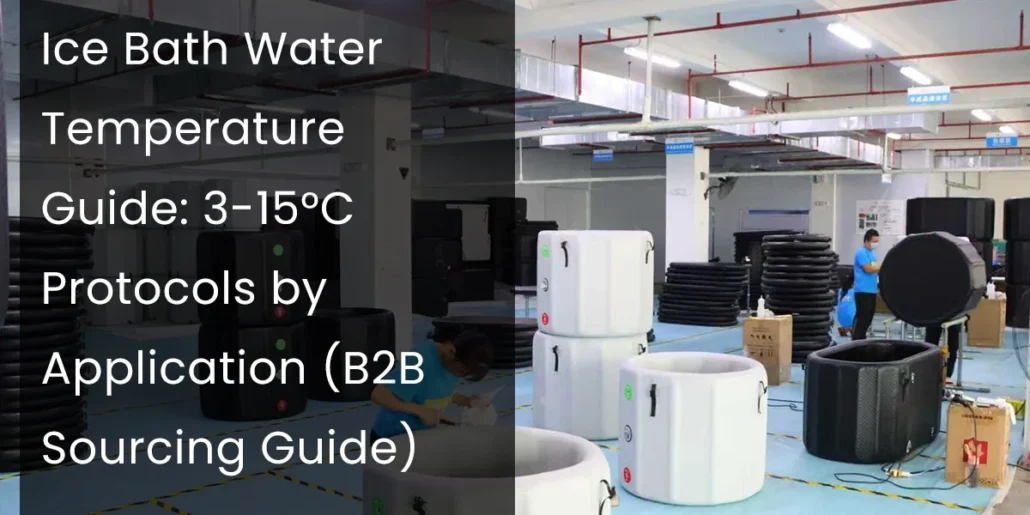
The most underrated specification in wholesale cold plunge sourcing has nothing to do with PVC thickness or chiller HP. It’s water temperature target. I’ve watched B2B buyers spend $4,500 on a tub-and-chiller bundle, then operate it at 7°C because they read somewhere that “around 5-10°C is the sweet spot.” Their customers report tepid water complaints. Their member retention drops. The equipment is fine — the protocol is wrong.
I’m Charlie, a senior industrial designer at Huale Inflatables. I’ve spent 15 years on the factory floor manufacturing drop-stitch products including inflatable cold plunge tubs for B2B buyers across the US, EU, and Australia. Since 2019 we’ve shipped wholesale cold plunge orders to 120+ international B2B clients, and the water temperature question comes up in roughly 40% of pre-order specification calls. The right answer depends entirely on what your customers will use the cold plunge for.
This guide covers what water temperature actually means at different points in the 0-15°C spectrum, how to match temperature targets to specific commercial applications, what protocol guidance to give your customers post-installation, and how temperature decisions affect chiller specification and operational electricity cost. Numbers come from sports medicine literature plus our production data across recovery facility, spa, and home-market deployments.
Why Water Temperature Targets Decide Customer Outcomes
The cold plunge benefit profile changes substantially across the 0-15°C range. Your customers experience completely different physiological effects depending on where you set the target — and the right temperature for an athlete recovery facility is wrong for a wellness spa, which is wrong again for a home-use DTC listing.
The Temperature-Effect Spectrum
- 0-3°C (Extreme cold): Maximum vasoconstriction response, rapid hypothermia onset within 5-8 minutes, used only by elite athletes and Wim Hof method practitioners. Inappropriate for general wellness or home use.
- 3-5°C (Athletic recovery): Standard pro athlete recovery target, strong inflammation reduction effect, manageable session duration of 5-12 minutes for trained users.
- 5-7°C (Commercial recovery standard): Boutique recovery studio sweet spot, balances effective recovery benefits with broader user tolerance, accommodates first-time plunge users alongside experienced athletes.
- 7-10°C (Wellness spa standard): Aesthetic spa applications, contrast therapy following sauna, accessible to most adult users without prior cold exposure training, session duration 8-15 minutes.
- 10-13°C (Beginner / home wellness): Entry-level home cold plunge, sufficient for blood circulation benefits without intimidating beginner users, session duration 10-20 minutes.
- 13-15°C (Cool recovery only): Below this threshold the cold plunge provides only marginal physiological benefit beyond a cool shower; not appropriate for products marketed as “cold plunge” or “ice bath.”
The B2B Implication
Your wholesale cold plunge product is part of a larger customer experience your B2B clients are selling. A boutique recovery studio charging $35 per session needs to deliver the recovery benefit their members expect. A luxury spa charging $200 per treatment needs to deliver the aesthetic experience their guests expect. A DTC home brand selling at $499 retail needs to deliver the result their reviews promise. The water temperature target is the single biggest determinant of whether customers feel they got what they paid for.
For an Amazon DTC seller specifically, customer reviews mentioning “not as cold as expected” account for roughly 18-25% of negative cold plunge reviews — the largest single category of complaints after delivery damage. The right temperature target in your product specification (and the right user education in your packaging) prevents most of these complaints before they hit your listing.
Water temperature is one piece of the sourcing decision; for how it fits alongside size, specs, chiller and budget, see our overview on how to choose an inflatable ice bath tub.
3-5°C: The Pro Athletic Recovery Standard
Professional sports teams, college athletic departments, and serious recovery facilities operate cold plunge at 3-5°C. This is the documented research-supported target for inflammation reduction following intensive training or competition. Sports medicine consensus across multiple major leagues (NBA, NFL, NHL, MLS, professional cycling teams) has converged on this range as the standard.
Protocol Specification at 3-5°C
- Session duration: 5-12 minutes for trained athletes; first-time users start at 2-3 minutes
- Frequency: 2-3 times per week post-training, daily during peak competition periods
- User screening: cardiac history review for users above age 50 or with hypertension diagnosis; gradual progression from 8°C if first-time
- Maximum tolerance: even trained athletes show diminishing returns beyond 12 minutes; physiological benefit plateaus while hypothermia risk increases
What 3-5°C Means for Your Equipment Specification
- Chiller requirement: 1HP minimum for facilities maintaining 3-5°C continuously; 1/2HP can sustain 5°C target but struggles to drive water below this threshold during peak hours
- Insulation criticality: at 3-5°C, ambient heat absorption becomes the dominant thermal challenge — every degree of insulation improvement directly extends chiller efficiency
- Tub material specification: dual-layer 0.9mm PVC with thermal insulation layer is required; single-layer budget tubs lose temperature too rapidly even with adequate chiller HP
- User-side accessories: digital thermometer with audible alarm at upper limit, athletic recovery stopwatch with vibration alert at session end, neoprene foot covers for sensitive feet
The Pro Team Operational Reality
Pro sports teams running cold plunge protocols at 3-5°C cycle athletes through the tub at high frequency during recovery blocks. A typical NFL post-game cold plunge protocol involves 12-18 athletes plunging in sequence over a 90-minute window. The chiller must recover water temperature between users — 3-5 minutes between sessions is the practical recovery time with a 1HP chiller in this temperature range.
For institutional sports facilities outfitting team training centers and pro performance facilities, see our wholesale team ice bath tubs with multi-athlete capacity and quick-drain configurations rated for the demanding 3-5°C protocol.
5-7°C: The Commercial Recovery Studio Standard
Boutique recovery studios, CrossFit boxes, recovery service providers, and small-format wellness centers operate at 5-7°C. This range balances effective recovery benefits with broader user tolerance — your customers include first-time plungers alongside experienced practitioners, and the protocol must accommodate both.
Why 5-7°C Beats Both 3-5°C and 7-10°C for Commercial
- vs. 3-5°C: First-time plungers find sub-5°C water genuinely shocking. Drop-out rate during early sessions is 30-40% higher at 4°C vs. 6°C among adults with no prior cold exposure. For paid recovery facilities, dropout means refund requests and negative reviews.
- vs. 7-10°C: Above 7°C, the recovery benefit profile becomes noticeably weaker. Members notice they don’t feel the same post-session refresh and reduced muscle soreness compared to colder facilities. Member retention falls accordingly.
Protocol Specification at 5-7°C
- Session duration: 5-15 minutes (longer than 3-5°C protocol because of higher tolerance)
- Frequency: 2-4 times weekly for regular users
- Recovery time between users: 8-12 minutes with adequate chiller
- First-time user onboarding: start at 8-9°C for first session, progress to 6°C over 3-4 sessions
Equipment Specification at 5-7°C
This range is what we recommend as the default specification for commercial cold plunge orders unless your B2B customer specifies otherwise:
- Chiller: 1/2HP for boutique studios with 15-20 daily plunges; 1HP for higher-volume facilities approaching 25+ daily plunges
- Tub: 110cm Commercial Heavy specification with 0.9mm PVC and dual-layer construction
- Member-facing accessories: digital wall-mount thermometer (so members verify temperature themselves), branded session timer, recovery protocol card
- Sanitation: 5-7°C water has slightly faster bacterial growth than colder ranges — daily water replacement protocol or continuous UV sanitization recommended
The Operational Math at 5-7°C
A boutique recovery studio open 12 hours daily with 18 daily plunges (typical for a single-tub facility) generates the following heat load on the chiller:
- 18 plunges × ~380 BTU per 5-minute plunge = ~6,840 BTU/day from users
- 12 operating hours × ~400 BTU/hr ambient absorption = ~4,800 BTU/day from environment
- 2 water replacement cycles × ~1,200 BTU thermal mass replacement = ~2,400 BTU/day
- Total daily chiller load: ~14,000 BTU
A 1/2HP chiller (5,000-6,000 BTU/hr capacity) handles this load running at 35-45% of rated capacity across operating hours. This is the sweet spot — chiller has headroom for unexpected demand without operating at maximum continuously.
For boutique recovery studios and CrossFit operations sourcing cold plunge equipment, see our wholesale commercial ice bath tubs with chiller pairings optimized for the 5-7°C operating range.
7-10°C: The Wellness Spa Aesthetic Standard
Luxury spas, wellness centers, hotel spa programs, and destination retreat facilities operate cold plunge at 7-10°C. The slight temperature increase compared to recovery studios reflects different customer expectations — spa guests expect refreshment and aesthetic experience, not the hard-edged recovery benefit profile that justifies sub-7°C water in athletic contexts.
Why Spas Don’t Operate at Recovery Studio Temperatures
- Customer demographic: Spa clientele skews older (35-65) with broader health backgrounds. Sub-7°C water creates legitimate cardiac risk for unscreened older guests. Spa operators self-regulate to 7-10°C as a liability management decision.
- Session pairing with sauna: Most spa cold plunge installations pair with sauna for contrast therapy. Guests transition from 75-85°C sauna to cold plunge — the contrast at 8°C is dramatic and thermally satisfying without the shock of 4°C water.
- Session duration tolerance: Spa guests want 8-15 minute sessions for the experience value. At 4-5°C, even trained users tap out at 8 minutes. At 8-9°C, the same user tolerates 12-15 minutes — a better aesthetic experience for the price point.
- Insurance considerations: Hotel and resort insurance carriers (and franchise standards from major hospitality brands) increasingly require cold plunge installations to operate above 6-7°C as a baseline injury-prevention measure for unscreened guests.
Protocol Specification at 7-10°C
- Session duration: 8-15 minutes typical, with sauna pairing extending total wellness ritual to 30-45 minutes
- Frequency: most spa guests use cold plunge 1-2 times per visit; regular spa members 1-2 times weekly
- Aesthetic considerations: spa cold plunge installations prioritize visible water clarity, ambient lighting integration, and aromatherapy compatibility — all of which influence equipment specification beyond raw cooling performance
Equipment Specification at 7-10°C
- Chiller: 1/2HP for single-installation boutique spa; 1HP for multi-tub luxury spa with 2-3 cold plunge stations sharing a manifold
- Tub aesthetics: this is where spa-specific specification diverges sharply from commercial recovery — wood-grain finish, marble-effect surfaces, custom Pantone-matched colors, designer cover integration
- Lighting: integrated LED accent lighting for therapy programs and ambiance
- Premium accessories: matched-aesthetic robe and slipper kit, hotel-tier towel presentation, leather-bound user instruction guide
For luxury hospitality customers sourcing cold plunge equipment matching premium spa aesthetics, see our wholesale spa cold plunge program with custom finishes, designer covers, and white-glove installation services.
10-13°C: The Beginner and Home Wellness Range
The 10-13°C range serves entry-level home cold plunge users, wellness customers without prior cold exposure training, and broad consumer-market DTC products targeting accessibility over hardcore positioning. This is where most Amazon home cold plunge listings should set their default protocol guidance.
Why 10-13°C Is the Right Default for Home Markets
- Beginner accessibility: First-time cold plunge users need 5-7 sessions to develop tolerance for sub-10°C water. Starting at 11-12°C for the first 2-3 sessions builds confidence and consistent practice habits.
- Practical chiller economics for home: Maintaining 11-12°C requires significantly less chiller capacity than 5-7°C. A 1/4HP home chiller handles this range easily; the same chiller struggles to maintain 5°C in summer ambient conditions.
- Electricity cost reasonableness: At 11°C, a 1/4HP chiller running 8-10 hours daily uses approximately 2.5-3 kWh — about $0.60-0.90 daily electricity cost for the home user. At 5°C, the same chiller would run 14-16 hours daily, doubling electricity cost to roughly $1.20-1.80 daily.
- Customer satisfaction with realistic expectations: Amazon reviews for home cold plunge products operating at 11°C with appropriate user education are dramatically better than reviews for products promising sub-5°C water that customers can’t actually achieve.
Protocol Specification at 10-13°C
- Session duration: 10-20 minutes (the longer durations at warmer temperatures are appropriate because the physiological response is gentler)
- Frequency: 3-5 times weekly for regular home users; daily for users developing serious practice
- Progression to colder ranges: most home users naturally progress from 12°C to 8-9°C over their first 2-3 months of practice as their cold tolerance develops
The DTC Amazon Listing Strategy
For Amazon DTC sellers specifically, the listing strategy around water temperature matters as much as the equipment specification. The listing should:
- Set realistic expectations: market the product as “5-15°C variable temperature cold plunge” rather than “ice bath” — manage customer expectations on the cold range achievable with the bundled chiller
- Provide protocol guidance: include a printed “Beginner Protocol” card in retail packaging recommending starting at 12°C for the first 5 sessions before progressing to colder ranges
- Bundle thermometer and timer: include digital thermometer in retail box so customers verify their actual water temperature rather than guessing
- Include sauna-pairing guidance: contrast therapy positioning increases perceived value and gives customers a reason to use the product more frequently
For Amazon DTC sellers and home-market retailers sourcing cold plunge equipment with chiller bundles optimized for the 10-13°C operating range, see our wholesale home ice bath tub program with retail-ready packaging and complete first-use kit configurations.
Outdoor and Travel-Specific Temperature Considerations
Outdoor and travel cold plunge applications operate under different temperature constraints than indoor commercial installations. Ambient heat varies dramatically across seasons and locations, chiller power may not be available, and user expectations differ from controlled facility environments.
Outdoor Installation Temperature Realities
- Summer high-temperature locations: At ambient above 30°C, even a 1HP chiller running continuously struggles to maintain sub-7°C water in standard commercial tubs. Outdoor installations in hot climates should specify enhanced thermal insulation plus shade structures rather than larger chillers.
- Winter low-temperature locations: At ambient below 5°C, the cold plunge water itself approaches freezing without active heating. Outdoor installations in cold climates need either indoor relocation during winter, or supplemental heating to keep water from freezing while maintaining target temperature.
- UV exposure consideration: Direct sun on the tub raises water temperature roughly 3-5°C above ambient during peak hours. Shade structures or covers when not in use are essential for outdoor temperature management.
Travel and Mobile Cold Plunge Temperature Strategy
Mobile coaches, traveling sports teams, and recovery service providers using portable cold plunge equipment face a different challenge: chillers don’t travel well. Most portable cold plunge applications rely on ice-method cooling at deployment time, which creates specific temperature constraints:
- Ice-method cooling effective range: 6-12°C achievable with 15-25kg of ice in a 90cm portable tub at 22°C ambient; sub-6°C requires excessive ice quantity that’s impractical for travel deployment
- Session duration trade-off: ice-cooled water warms faster than chiller-cooled water (no continuous re-cooling), so each session reduces effective cold time for the next user
- Tournament-day deployment math: a typical mobile recovery setup at a tournament services 10-15 athletes over 4-6 hours; total ice consumption runs 35-50kg per deployment day
Travel-Specific Equipment Specification
- Insulated tub specification: standard outdoor portable tubs without thermal insulation lose temperature 40-50% faster than insulated commercial tubs; for travel applications expecting ice-only cooling, insulated specification is essentially mandatory
- Quick-drain capability: between event days or athlete groups, traveling teams need to drain warm water quickly and refill with fresh ice-water mixture; standard 1.5″ drain valves are too slow for this workflow
- Pre-cooled water transport: some pro team applications transport pre-cooled water in insulated tanks rather than relying on ice deployment at site — significantly more efficient for high-volume tournament use
For mobile coaches, traveling sports teams, and outdoor wellness operators sourcing portable cold plunge equipment with travel-optimized specifications, see our wholesale portable ice bath tubs with insulated construction and quick-drain configurations.
For sports teams and athletic departments sourcing cold plunge equipment that travels with the team to away games and tournaments, see our wholesale sports recovery tubs with team-size capacity and portable deployment configurations.
What Your Customers Need to Know About Their Water Temperature
Beyond your equipment specification choices, your B2B customers need to operate their cold plunge installations correctly. Most customer satisfaction issues with cold plunge products trace back to user-side temperature management failures, not equipment defects. Equipping your B2B customers with proper protocol guidance is part of delivering a complete product.
The Five User-Side Temperature Mistakes
Mistake 1: Setting target colder than the chiller can sustain. Customers often assume “colder is better” and set chiller controls to maximum cooling. The chiller runs continuously, never recovers target temperature during peak hours, and burns out faster. Operate the chiller at the temperature target your equipment is rated for, not the coldest possible target.
Mistake 2: Skipping the daily temperature verification. Chillers drift over time — 1-2°C drift over 12 months is normal. Without daily temperature verification using an independent thermometer, the actual water temperature can be 3-4°C off the chiller display by year 2. Daily verification catches drift early.
Mistake 3: Operating outside the chiller’s rated ambient range. Chillers rated for 5-35°C ambient lose 20-40% capacity at higher temperatures and may freeze over at lower temperatures. Customers in extreme climates need to address ambient conditions, not just water temperature.
Mistake 4: Ignoring water replacement schedule. Cold water doesn’t stay clean indefinitely. Bacterial growth, organic accumulation from skin contact, and water clarity loss require water replacement on schedule — typically every 7-10 days for daily-use commercial tubs, every 30-45 days for low-use home tubs.
Mistake 5: Operating the cold plunge in unventilated rooms. The chiller rejects heat into the room. In an unventilated 200 square foot room, a 1HP chiller running continuously raises the room temperature 3-5°C, which then increases the load on the chiller in a feedback loop. Adequate ventilation prevents this self-defeating heat accumulation.
Recommended User Onboarding Protocol
For your B2B customers operating commercial cold plunge facilities, we recommend providing a printed user onboarding protocol covering:
- Health screening checklist (cardiac history, hypertension, pregnancy)
- First-session protocol (start at 8-9°C, 2-minute duration)
- Progression schedule (decrease temperature 1°C per session over 5-7 sessions)
- Maximum tolerance guidelines by user age and fitness profile
- Warning signs requiring session termination (numbness beyond extremities, breathing difficulty, dizziness)
We provide a downloadable User Onboarding Protocol template with every commercial wholesale cold plunge order — your B2B customers can rebrand it for their facility and use it as the standard intake document for new members. Reference industry guidance on cold water immersion safety from the National Center for Biotechnology Information for peer-reviewed research on cold plunge protocols, and from the American College of Sports Medicine for athletic recovery guidance.
For a complete wholesale ice bath tub program covering tub selection across all six use-case categories plus protocol documentation, see our wholesale ice bath tubs hub.
Frequently Asked Questions
Can my customers safely plunge in 3-5°C water without medical supervision?
For physically healthy adults under age 50 with no cardiac history or hypertension, 3-5°C cold plunge protocols are safe with appropriate session duration management (5-12 minutes maximum). For users above age 50, with cardiac risk factors, hypertension, or pregnancy, sub-7°C water carries elevated risk and should not be used without physician clearance. Most commercial recovery facilities operate at 5-7°C precisely because this range serves a broader user demographic safely. For Olympic-tier and pro sports applications, athletes typically have continuous medical screening and supervision built into their training programs, so 3-5°C operations are appropriate. For general consumer products, we recommend B2B sellers default to 7-10°C operating guidance with clear warnings about colder protocols requiring user training and medical clearance.
How accurate are the temperature readings on chiller control units?
Chiller display accuracy varies significantly by manufacturer. Premium chillers from verified partner manufacturers typically display ±0.5°C accuracy. Budget chillers can drift 2-3°C from actual water temperature, particularly after 12+ months of use. For commercial applications, we strongly recommend installing an independent digital thermometer (typically $20-40 retail) for daily temperature verification. The thermometer reading is the operational truth; the chiller display is a control reference that can drift over time. For your B2B customers, including a quality digital thermometer in the wholesale bundle prevents the most common customer satisfaction issue with cold plunge equipment.
What’s the impact of starting water temperature on chiller cooling time?
For a 96cm Round home tub with 380L water volume cooling from 20°C to 5°C: 1/4HP chiller takes approximately 90-120 minutes; 1/2HP chiller takes approximately 50-70 minutes; 1HP chiller takes approximately 30-45 minutes. For commercial daily-use facilities, the initial cooling time happens once during morning startup; thereafter the chiller maintains target temperature against incremental heat load. For home users, the initial cooling time matters because home users typically drain and refill weekly rather than maintaining cold water continuously. For Amazon DTC sellers, this is the basis for the “how long until water is cold” question that appears in customer reviews — set realistic expectations in your listing.
Can I use my cold plunge tub for warm therapy if customers want both options?
Yes, our tubs are rated for water temperatures from 0°C to 40°C, covering cold plunge, cool recovery, and warm therapy applications. Material specifications remain stable across the full temperature range without PVC brittleness or TPU softening. However, your chiller is one-directional — it removes heat but doesn’t add heat. For warm therapy applications, customers need a separate water heater (electric immersion heaters work well for inflatable tubs at $150-300 retail) plus the chiller. Some hospitality customers offer both cold and warm therapy programs from the same tub, switching between modes seasonally or by appointment. The same equipment supports both use cases; the ancillary heating/cooling equipment differs.
Do you provide cold plunge protocol documentation for facility liability?
Yes. Every commercial wholesale cold plunge order includes documentation supporting facility liability management: User Onboarding Protocol template, Health Screening Checklist (covering cardiac history, hypertension, pregnancy, age-based considerations), Daily Operations Checklist for facility staff, Incident Documentation template for member adverse events, and Maintenance Log template. For institutional buyers (university athletic departments, healthcare facilities, hospitality chains), we provide expanded documentation packages aligned with applicable regulatory frameworks. For Amazon DTC sellers, we provide California Prop 65 compliance language and ASTM-aligned safety documentation suitable for product listing requirements. Reference protocol research at the National Library of Medicine for peer-reviewed clinical guidance on cold water immersion safety standards.
Ready to Source Cold Plunge Equipment for Your Target Temperature Range?
Send us your facility specifications — target water temperature, daily plunge volume, ambient conditions, indoor/outdoor installation, destination port. We’ll respond within 24 hours with a factory-direct FOB quote covering recommended chiller HP, tub specification, sample availability, and earliest production slot.
For first-time cold plunge B2B buyers, we strongly recommend ordering a tub + chiller sample bundle in your target temperature range before fleet purchase. MOQ starts from 1 piece, sample fees credited against your first bulk invoice. The sample lets you verify actual cooling performance in your facility’s ambient conditions before committing to bulk inventory.
For seasonal-launch DTC brands and recovery facility deployments timing equipment delivery to peak season opening, place orders 10-12 weeks before season start to allow buffer for unexpected shipping delays.


