
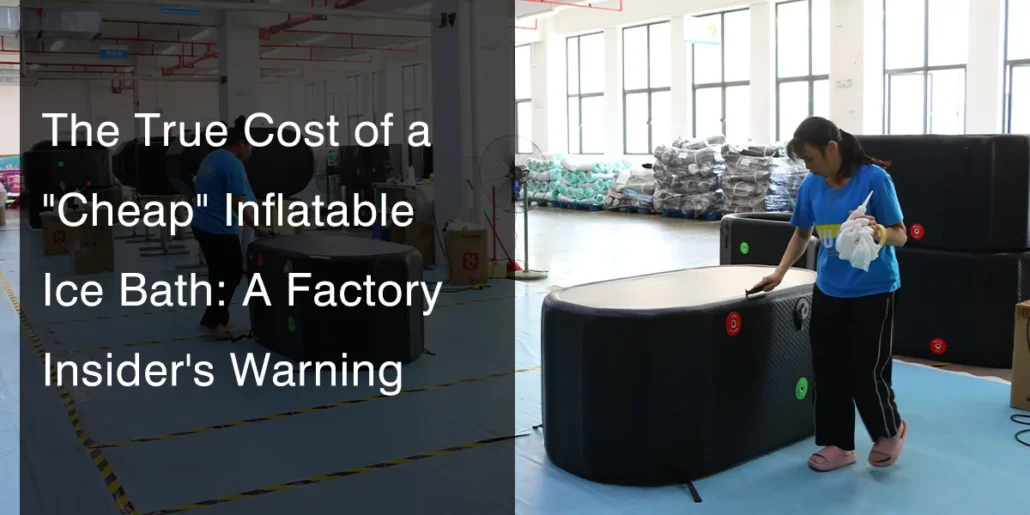
I’m Charlie, a senior industrial designer at Huale, and I’ve spent fifteen years building drop-stitch ice baths — which means I’ve also seen what comes back. The cheapest inflatable ice bath on the market isn’t a bargain; it’s a deferred cost. It reads the same as a commercial tub in a listing, lands at half the price, and fails in 12–18 months — usually right after the buyer has built a customer base on it.
I’m not going to tell you “buy expensive.” I’m going to show you exactly where the cost gets cut, what fails first, and how to run the math on total cost instead of sticker price. Then you decide.
If you’re sourcing for resale, a gym, or a brand, this is the difference between one return-plagued season and a product you can reorder for years.
Where the Price Gets Cut (And What It Costs You)
A cheap inflatable ice bath isn’t cheaper to use — it’s cheaper to build, and every gram of material removed at the factory becomes a failure point in the field. The savings come from four specs, none of which show in a product photo.
Here’s the same tub, built two ways:
| Spec | Cheap Build | Commercial Build | What the Cut Causes |
|---|---|---|---|
| Thread density | 1,200–1,400 | 1,800–2,200 | Walls flex, lose rigidity over time |
| Outer PVC | 0.4–0.5mm | 0.9mm+ | Abrasion, pinholes, UV cracking |
| Seams | Hand-glued | HF welded | Seam separation in 1–2 seasons |
| Valve core | Zinc-plated | Stainless steel | Slow leaks, corrosion, returns |
The cost gap between these two builds is usually 40–60%. The field-performance gap is 200–300%. That’s the whole story of cheap inflatable ice baths in two numbers — you save once, you pay the difference back several times over.
What Fails First — and When
Cheap inflatable ice baths don’t fail randomly; they fail in a predictable order, and the timeline is short enough to hit you inside your first sales season. Knowing the sequence lets you spot a budget build before you commit.
The order I see them come back in:
- Valve leaks (months 1–6): zinc-plated cores loosen and corrode. The buyer thinks it’s punctured; it’s the valve. First wave of returns.
- Seam separation (season 1–2): glued seams give way under the heat-and-cold cycling an ice bath lives in. This one is unrepairable — the tub is done.
- Surface failure (season 2): 0.4mm PVC abrades, pinholes, and UV-cracks. Photodegradation accelerates it for any tub used outdoors.
- Structural sag (season 2+): low thread density loses rigidity, so the tub never feels firm again even at full pressure.
A commercial-grade tub pushes every one of these out by years: stainless valves, PVC at 0.9mm, and HF-welded seams that don’t rely on adhesive. The buyer-side guide to reading these specs is in our inflatable ice bath tub buying guide.
The Real Math: Total Cost, Not Sticker Price
Sticker price compares two tubs once; total cost compares them over the years they’re actually in service — and that’s where the cheap tub loses. For a B2B buyer, the hidden costs aren’t on the invoice: they’re in returns, replacements, freight, and reputation.
What a “cheap” tub actually costs a reseller beyond the unit price:
- Replacement cycles: failing at 12–18 months means buying 2–3x as many units over the same period a commercial tub lasts.
- Return handling: every failed unit is return freight, a refund or replacement, and your staff time.
- Brand damage: the customer blames your label, not the factory — and leaves the review that costs you the next ten sales.
- Re-shipping: you pay freight twice on every unit you replace.
Run it over a typical service window and the commercial tub at $245–295 FOB beats the sub-$100 tub on total cost, often by a wide margin — because the cheap one is never bought just once. The pricing tiers and what each gets you are laid out in the buying guide’s budget section.
Why You Can’t Spot It in the Listing
The reason cheap inflatable ice baths keep selling is that the specs that fail are invisible in a photo — and budget sellers describe their tubs with the same words a commercial factory uses. “Drop-stitch,” “military-grade PVC,” “durable”: all of it appears on a $90 tub and a $250 tub alike.
This is exactly how budget alternatives on marketplaces win the click and lose the customer. They use 1,200–1,400 thread density, 0.4–0.5mm PVC, glued seams, and zinc valves — then write the listing as if it were a commercial build. The text matches; the field performance doesn’t.
The only defense is to demand the four numbers in writing — thread density, PVC thickness, seam method, valve grade — and walk if a supplier won’t give them. We covered the same gap from the cold-plunge angle in our inflatable vs steel frame cold plunge comparison, where budget tubs fail the same way against rigid alternatives.
How to Avoid the Cheap Trap Without Overpaying
Avoiding a cheap tub doesn’t mean buying the most expensive one — it means buying a verified commercial build and refusing to pay for either a pool toy or a marketing markup. The sweet spot is a real factory’s commercial spec at factory-direct price.
Four moves that protect you:
- Get the spec sheet in writing and make it part of your purchase terms, so reorders can’t quietly drop to a cheaper build.
- Sample before bulk at 1 piece — physically check seam quality and valve grade before committing capital.
- Buy from the factory, not a reseller, so you’re not paying a middleman markup on top of the real cost.
- Confirm QC — ask for the 48-hour pressure test and rejection rate (a real factory runs 3–5%).
Which factory can actually prove all of this is its own question — I walk through the 7-point vetting checklist in how to choose an inflatable cold plunge manufacturer. For volume buyers, factory-direct tiers are on our wholesale ice bath tub page.
Avoiding the cheap trap starts with knowing what to look for — see our overview on how to choose an inflatable ice bath tub.
Frequently Asked Questions
Why do cheap inflatable ice baths fail so fast?
They’re built on lower specs that don’t show in a photo: 1,200–1,400 thread density, 0.4–0.5mm PVC, hand-glued seams, and zinc-plated valves. Under the heat-and-cold cycling of an ice bath, glued seams separate and zinc valves corrode, so budget tubs typically fail within 12–18 months of regular use. The cost was cut at the factory, not in your favor.
How long should a quality inflatable ice bath last?
A commercial-grade tub (1,800–2,200 thread density, 0.9mm+ PVC, HF-welded seams, stainless valves) lasts 3–5 years under daily commercial use and 5–7 years in lighter home use. That’s roughly 2–3x the service life of a cheap build, at well under 2–3x the price — which is why total cost favors the commercial tub.
Is a cheap inflatable ice bath ever the right choice?
Rarely for resale. For a one-off personal trial it can be fine, but for any B2B use — gym, studio, brand, resale — the return rate and brand damage outweigh the upfront saving. You’re building a customer base on equipment that fails inside your first season.
How can I tell a commercial tub from a cheap one before buying?
Ask for four numbers in writing: drop-stitch thread density, outer PVC thickness, seam method, and valve core material. A commercial factory provides them without hesitation; a budget seller deflects to adjectives like “premium” or “military-grade.” If you can’t get the numbers, assume it’s the cheap build.
What does a fair factory-direct price actually look like?
For a verified commercial build, roughly $185–225 FOB for an entry 96cm tub and $245–295 for a 110cm commercial unit, before volume discounts. Sub-$100 tubs are almost always the budget spec, and prices far above this range often reflect a reseller markup rather than a better build.
Get a Factory-Direct Quote
Send us your use case, target size, and quantity, and we’ll quote a verified commercial build at factory-direct price — with the spec sheet in writing so you know exactly what you’re buying. Run the four-number test on us first.
We will respond within 24 hours with a factory-direct quote.
MOQ starts from 1 piece.