
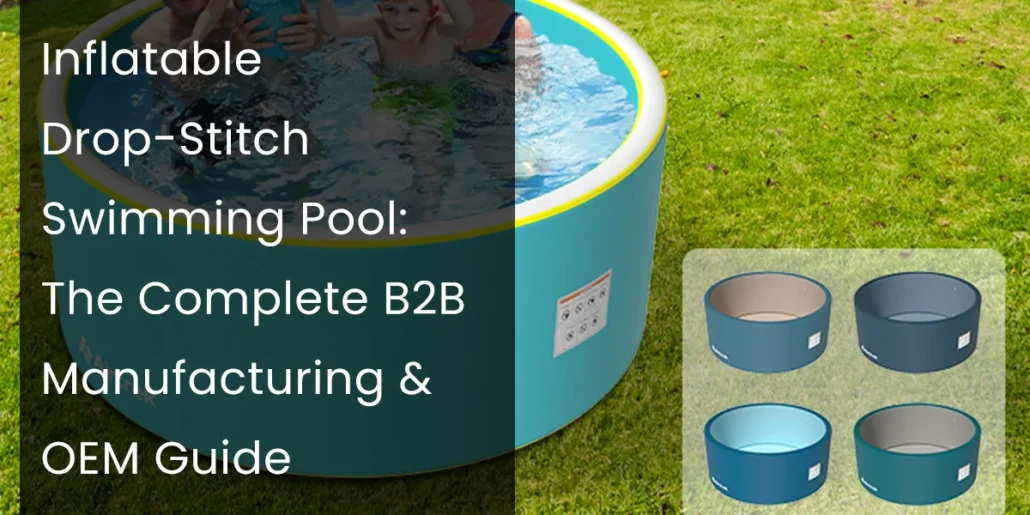
If you spent 2024 watching superyacht-pool TikToks go viral and wondered why your distribution catalog doesn’t have a single inflatable drop-stitch pool in it — you’re not alone. Three years ago this category barely existed at scale. Today it’s the single fastest-growing inflatable water product line we manufacture, with B2B orders from luxury yacht charter companies, beach resorts, hotel chains, event-rental operators, and Amazon brand owners growing 4–6× year-over-year. The structural reason: a permanent in-ground pool costs $35,000–$120,000 and takes 3–6 months to install. A drop-stitch pool delivers 70% of the guest experience at 5% of the cost and inflates in 25 minutes.
I’m Charlie, Senior Industrial Designer at Huale Inflatables. I’ve spent 15 years on the Guangzhou factory floor designing and building drop-stitch products — and the inflatable swimming pool line is currently the highest-margin, fastest-growing category we ship. This guide is everything I’d tell a B2B buyer — distributor, brand owner, resort procurement officer, yacht charter operator, event rental fleet manager, or Amazon seller — before signing the first PO. No “best in the industry” claims. No vague upside. Just the specs, the numbers, the market math, and the engineering decisions that decide whether your pool program survives its second summer.
We’ll cover everything: the 2026 market opportunity that distributors are still underweight on, vetting a factory, OEM vs custom-shape options (the entire point of this category is custom), drop-stitch technology specifics, sizing/shape/stair specs, the head-to-head against traditional frame pools, certifications for EU/US market entry, winterizing protocols to protect your B2B customers, and the 10 in-depth articles we’ve published on every sub-topic — so you can drill down wherever the conversation gets technical.
Why Inflatable Drop-Stitch Pools Are the 2026 Outdoor Leisure Category Distributors Are Missing
Three structural shifts converged in 2024–2025 to turn this category from “niche” to “essential B2B inventory line.” Recognizing all three is what separates the distributors who’ll dominate this category in 2026 from those who’ll be playing catch-up in 2027:
Shift 1: The Yacht Charter Pool Explosion
Luxury yacht and superyacht charters have always offered “sea pools” — inflatable nets dropped over the side. Drop-stitch swimming pools changed that. A self-contained inflatable pool sits on the swim platform, holds its own water, and gives charter guests a controlled pool experience without exposure to jellyfish, currents, or water-quality concerns. The global yacht charter market has grown 8–10% annually for three consecutive years, and pool equipment is now a standard line item in charter fit-outs. Our anti-jellyfish yacht pool design specifically addresses this segment — full breakdown in Inflatable Yacht Pools with Net: The Ultimate Anti-Jellyfish Solution for Charters.
Shift 2: Resort & Hotel Quick-Deploy Pools
Hotel chains and beach resorts are the second wave. The old amenity model — one large permanent pool serving 200 rooms — is being augmented (not replaced) by smaller inflatable pools positioned at beachfront, rooftop, and event spaces. The ROI math is decisive: a $1,400 inflatable pool at a beachfront bar drives roughly $18,000–$32,000 of incremental F&B revenue per season for a mid-tier resort, with a 3-week payback. Full ROI analysis in Inflatable Drop Stitch Pools for Resorts and Hotels: ROI, Durability, and Guest Experience Guide.
Shift 3: Event Rental & Custom-Shape Demand
Wedding venues, corporate event organizers, and pop-up bar operators are the fastest-growing sub-segment by unit volume. A custom-shape pool (heart-shaped for weddings, brand-shaped for product launches, oversized rectangles for film/photo shoots) commands a $400–800/day rental rate, with utilization of 8–15 events per month per pool in active markets. The custom-shape opportunity is documented in Custom Size and Shape Inflatable Drop Stitch Pools: The Ultimate Event Hack.
The B2B-side opportunity sizing — including which buyer segments to prioritize, expected order volumes, and the realistic distribution margin structure — is in Inflatable Drop Stitch Swimming Pools: The Outdoor Leisure Category Distributors Are Missing in 2026. If you’ve been on the fence about adding this line, this article alone has driven dozens of distributors to place their first orders this past year.
📈 Why This Is the Single Most Underweight Category in B2B Outdoor Leisure
Most distributors we talk to still treat inflatable pools as a “summer toy” category — the same shelf space as kids’ pool floats. That positioning misses the entire B2B opportunity. We’ve documented why drop-stitch pools should be in your commercial outdoor leisure lineup, not your seasonal toy lineup, with the order-volume data from 60+ B2B customers who switched their merchandising in 2024–2025.
→ Read the full 2026 B2B opportunity analysisWhat Makes Drop-Stitch Pools Different From Traditional Inflatable Pools
If your buying experience comes from traditional vinyl inflatable pools (Intex, Bestway), drop-stitch is a fundamentally different product category — engineered for sustained pressure, not just child-pool-tier short-term inflation. The difference matters because traditional vinyl pools cannot hold the wall pressure required for adult swimming use without external frames, ropes, or rigid sidewall supports. Drop-stitch holds itself up.
The Engineering Difference
- Traditional inflatable pool: Single-chamber vinyl construction. Wall holds shape via air pressure pushing outward against a rope-reinforced top ring. Inflation pressure typically 2–4 PSI. Walls bulge and lose shape under any sustained side-load.
- Frame-supported pool: Vinyl pool body with external metal or PVC frame providing structural support. Stable but requires 30+ minutes assembly and the frame is the failure point (corrosion, joint failure).
- Drop-stitch pool: Top and bottom skins linked by thousands of internal vertical yarns (the “drop-stitch core”). Inflated to 6–10 PSI, the wall becomes a rigid panel that holds its shape under sustained water pressure with no external frame.
The technology was originally developed for military and aerospace applications (high-pressure inflatable kayaks, paddle boards, military bridges), and migrated to pool manufacturing only in the last 6–8 years as drop-stitch fabric pricing came down. The full evolution and engineering deep-dive is in What is Drop Stitch Technology in Pools? The Evolution of Inflatable Durability.
Why It Matters for B2B Buyers
The construction difference translates to three commercial-grade benefits that traditional inflatable pools can’t match:
- Adult swimming-grade wall stability. A drop-stitch pool holds its shape with a 90kg adult leaning against the sidewall. A traditional inflatable pool deforms immediately.
- 5–7 year operational lifespan under daily commercial use, vs 18–30 months for traditional inflatable pools used in equivalent settings.
- Custom shape capability. Drop-stitch panels can be welded into rectangular, round, oval, heart, octagonal, or any custom geometry. Traditional inflatables are limited to the shapes their molds support.
How to Choose an Inflatable Drop-Stitch Pool Manufacturer in China
Pool sourcing has a specific trap that hurts first-time B2B buyers: the surface area of a pool is much larger than a SUP or air track, which means small defects in the drop-stitch panel compound into visible problems. A 0.5mm thickness variation across a 5m × 3m pool wall is barely noticeable. A 0.5mm variation across a 12m × 4m superyacht pool wall produces visible warping after the first 30-day deployment cycle. Most factories that successfully build air tracks or SUPs can’t scale that quality control to pool-sized panels.
The 7-Point Factory Audit Before You Sample
- Large-panel manufacturing capacity. Ask for the maximum continuous drop-stitch panel size the factory can manufacture in-house. Commercial pools require panels up to 4m × 8m without seams. Factories limited to 2m × 3m panels stitch multiple panels together, creating failure points.
- HF welding equipment sized for pool-scale work. Standard HF welders are designed for SUP-sized seams. Pool sidewalls require larger-format welding equipment. Demand to see the equipment, not just claimed capability.
- 48-hour pressure retention test. Every finished pool on our line is inflated to 8 PSI and filled with water to operational level, held for 48 hours. Pressure drop tolerance: ≤0.4 PSI.
- Inner liner specification. The water-contact layer must be food-grade or REACH-compliant TPU. Cheap pools use PVC inner liners that leach plasticizers into the water — a major issue for any B2B buyer serving children or food-service environments.
- Custom shape engineering capability. Ask if they can build a non-rectangular shape. Most factories outsource custom shapes to third parties (with predictable quality results). In-house custom geometry capability is rare and worth paying for.
- QC rejection rate. Our internal target is 3–5% at final QC. A factory claiming “0% defects” is either lying or not inspecting.
- BSCI / SMETA audit status. Required for any European hotel chain procurement system or premium retail distribution.
For B2B buyers planning to build a custom pool brand from scratch — including the 60-day timeline from spec brief to launched product — see Private Label Inflatable Drop Stitch Pool: How to Launch Your Own Pool Brand in 60 Days.
🚀 Launch Your Own Pool Brand in 60 Days
Most first-time brand owners assume launching a custom pool brand is a 6-month project. It isn’t. From spec brief to first delivered units is realistically 60 days — including custom shape engineering, color and graphic design, branded packaging, and full certification documentation. We’ve mapped the exact week-by-week sequence based on the brand launches we’ve supported in 2024–2025.
→ Read the complete 60-day brand launch playbookOEM, ODM & Custom Shape: Manufacturing Models for Pool Brands
The single most differentiated aspect of this category is custom shape engineering. Unlike SUPs or air tracks where 95% of buyers source standard shapes, roughly 40% of our pool orders involve some level of custom geometry — heart shapes for wedding rentals, brand-shaped pools for product launches, freeform organic shapes for high-end resort installations, and oversized rectangles for film and photography production. Three realistic manufacturing models:
| Model | What You Provide | MOQ | FOB Price (4m × 2m × 65cm rectangular) | Lead Time |
|---|---|---|---|---|
| ODM (Stock Shape + Logo) | Logo + carton print | 10 pcs | $485–$685 | 30–35 days |
| OEM (Custom Color + Standard Shape) | Color scheme, dimensions | 30 pcs | $565–$845 | 35–45 days |
| Full Custom Shape | Shape design, full brand spec | 20 pcs | $745–$1,250 | 45–60 days |
Pricing for a standard 4m × 2m × 65cm rectangular pool + pump + repair kit + carry bag. Larger commercial pools (8m × 4m, 12m × 4m yacht pools) scale roughly proportionally on FOB cost. Custom shapes add 25–55% on top of the equivalent rectangular pool price, depending on geometric complexity.
The Custom Shape Margin Opportunity
Here’s the math most distributors miss: a $645 FOB rectangular pool retails at roughly $1,300 MSRP in B2B sales — a 100% markup that’s standard for the category. A $945 FOB custom-shape heart pool retails at $2,800–$3,500 to event rental operators — a 200–270% markup, because there’s no comparable Amazon-stocked product the buyer can price-shop against. Custom shape is where the real margin lives in this category. The full event-rental custom shape opportunity, including ROI projections for rental fleets, is documented in Custom Size and Shape Inflatable Drop Stitch Pools: The Ultimate Event Hack.
Critical Buying Specs: Size, Shape, Depth & Integrated Features
Pool spec selection is more complex than other inflatable categories because the end-use scenarios vary so dramatically. A 2m × 1.5m × 50cm pool for a beach bar serves a completely different function than a 12m × 4m × 80cm pool for a superyacht. Three spec dimensions decide most buyer satisfaction:
Size & Shape: Match to End-User Scenario
The most common B2B sizing mistake is defaulting to “bigger is better.” Three real-world sizing examples:
- Beach bar / café installations: 2m × 2m or 3m × 2m. Compact enough to fit on small patios, deep enough (50cm) for foot/leg cooling.
- Resort beachfront amenity pools: 4m × 3m or 5m × 3m. Large enough for 4–6 adults, manageable enough for daily inflate/deflate routines.
- Yacht charter pools: 4m × 3m to 6m × 4m depending on swim platform size. Custom rectangular shapes with anti-jellyfish netting are now standard for premium charter operators.
- Event / wedding rentals: Custom shape, typically 3m × 3m equivalent footprint. Aesthetics matter more than size.
The full size-and-shape selection framework — including the procurement-decision flowchart for distributors stocking multiple sizes — is in How to Select the Right Size and Shape for a Custom Drop Stitch Swimming Pool.
Integrated Stairs: The Underrated Premium Feature
Standard inflatable pools require either a separate ladder accessory or end users climbing in over the sidewall (awkward and unsafe). Integrated inflatable stairs solve both problems and command a $80–140 retail price uplift per unit with $25–40 manufacturing cost increase. For B2B buyers targeting the premium hospitality and senior-adult segments, integrated stairs are the single highest-ROI customization feature. Full breakdown in Why Your Next Inflatable Drop Stitch Pool Needs Integrated Stairs.
Wall Height & Water Depth
Wall heights typically range from 50cm (kids/wading) to 80cm (adult-comfortable swimming) to 100cm (semi-permanent installation). For B2B buyers, the 65–75cm range serves the broadest market — comfortable for adult use, manageable for daily setup, and shippable in standard cartons. Walls above 80cm require oversized cartons and shift freight calculations significantly.
Drop-Stitch vs Frame Pool vs Soft-Wall: B2B Format Comparison
Your end customers will cross-shop drop-stitch pools against two alternative formats: traditional frame-supported pools (Intex, Bestway commercial lines) and soft-wall vinyl pools (the classic backyard pool). Your sales team needs to know exactly when each format wins for which buyer segment. Here’s the realistic breakdown:
| Format | Best For | Setup Time | B2B Lifespan | Custom Shape |
|---|---|---|---|---|
| Drop-Stitch | Yacht, resort, event rental, premium DTC | 15–25 min | 5–7 years | Yes (any shape) |
| Frame Pool | Mid-tier backyard, mass-market retail | 30–60 min | 3–5 years | No (frame limits) |
| Soft-Wall Vinyl | Kids’ pools, low-end consumer | 10–15 min | 1–2 years | Limited |
For B2B distributors deciding which format to lead with in 2026, the answer depends entirely on your channel strategy. Premium hospitality, event rental, and DTC-luxury channels overwhelmingly favor drop-stitch. Mass-market retail and big-box channels still default to frame pools. The full distributor-side decision framework — including the channel-by-channel sales argument for each format — is in Drop Stitch Pool vs Frame Pool vs Soft-Wall Pool: Which Should Your Brand Be Selling in 2026?.
⚠️ The Yacht Charter Pool Problem No One Tells You About
Standard inflatable pools placed on yacht swim platforms face two problems traditional pool buyers never encounter: jellyfish swimming under the sidewall (a real issue in Mediterranean and Caribbean waters), and currents that destabilize the bottom seal. We’ve engineered specific yacht-grade designs to address both — and the difference between a “generic inflatable pool” and a “yacht charter pool” is significant for any buyer selling into the charter market.
→ Read the yacht-grade pool engineering breakdownCertifications & Compliance for US, EU & UK Market Entry
Pool compliance is stricter than most inflatable categories because any product holding water for human contact triggers additional regulatory requirements — water-contact material safety, child-drowning prevention warnings, and chemical safety for the PVC and TPU materials in contact with treated pool water.
| Certification | Required For | What It Covers |
|---|---|---|
| CE Marking | EU/EEA imports | Safety conformity (essential) |
| EU GPSR (2024) | All EU imports from Dec 2024 | General product safety regulation |
| EN 71 | EU (kids’ market) | Children’s product safety |
| REACH | EU imports | PVC/TPU water-contact chemical safety |
| UKCA | UK imports (post-Brexit) | UK equivalent of CE |
| ASTM F963 | US (under-14 use) | US safety standard for kids |
| FDA-Equivalent Liner | US food-service installations | Water-contact material certification |
| SGS Test Report | Hotel chains + tier-1 retail | Independent batch-level testing |
| BSCI / SMETA | European retail chains | Ethical sourcing audit |
Two warnings most pool buyers learn the hard way. First, hotel chain procurement systems require batch-level REACH compliance documentation, not a one-time certificate from years prior. Without batch-level documentation, you’re locked out of premium hospitality distribution. Second, the inner liner specification matters more than the outer skin for compliance — buyers obsess over outer-skin certifications and skip the inner-liner spec where the actual water-contact compliance lives.
Logistics, FOB Pricing & Container Optimization
Pool freight math is straightforward but specific to the category. A deflated 4m × 2m × 65cm pool folds down to roughly 65 × 50 × 30 cm in retail packaging — meaning a 40HQ container fits about 320–380 pools. Larger 8m × 4m commercial pools fit about 90–120 per 40HQ container. Custom shapes typically reduce container efficiency by 8–12% due to non-stackable carton geometry.
FOB Guangzhou Pricing & Landed Cost Math
FOB Guangzhou reference ranges (for standard 4m × 2m × 65cm rectangular pool + pump + carry bag kit):
- FOB Guangzhou: $485–$1,250 per kit depending on customization tier
- Sea freight to US East Coast (LCL share): ~$22–35 per pool
- Sea freight to Rotterdam/Hamburg: ~$18–28 per pool
- US import duty: ~4.7% (HTS 9506.99.05)
- EU VAT: 19–25% depending on country (recoverable for VAT-registered importers)
Typical landed cost in the US for a $685 FOB rectangular pool: $760–$830. Markup that 1.8–2.2x for retail and you land at a $1,400–$1,800 MSRP — which matches market pricing for mid-tier premium pool brands. Larger commercial pools and custom-shape pools scale FOB pricing but maintain similar markup ratios.
Seasonal Booking Strategy
European summer is May–August. To hit shelves on time, EU distributors need to place orders December–February the prior year. North American summer is similar. Factories at our scale book peak production windows 8–10 weeks ahead — miss the booking window and you’re paying 15–25% surcharge for express production or accepting late delivery into the season. The pool category is one of the most seasonally concentrated B2B products we manufacture — get the timing right and the unit economics are excellent; get it wrong and you’ll be sitting on inventory in October.
🛡️ Protect Your B2B Customers Through the Off-Season
Roughly 30% of pool warranty claims happen in spring, not summer — caused by improper winterization the prior fall. Most are fully preventable with a structured 5-step protocol that takes the end user under 20 minutes per pool. We’ve documented the exact protocol with diagrams, so you can include it in your customer onboarding materials and significantly reduce your spring warranty cost.
→ Read the complete winterization protocolMaintenance & Long-Term Lifespan: Protecting Your Customers’ Investment
About 42% of pool warranty claims aren’t manufacturing defects — they’re maintenance failures the end user could have prevented with proper guidance. Brands that ship clear maintenance protocols see 30–40% lower warranty cost and significantly higher customer review scores. Three issues account for most preventable failures:
The Three Maintenance Failures That Drive Warranty Cost
- Improper winterization. Pools left inflated and partially filled with water through winter freeze cycles develop sidewall seam failure (water expansion under pressure damages welded seams). Full preventative protocol in Winterizing Your Drop Stitch Pool: An Expert’s Guide to Avoiding Spring Leaks.
- Inadequate water chemistry management. Untreated pool water breeds biofilm in low-flow zones (corners, stair channels), producing odor complaints and inner-liner staining within 4–8 weeks. Hydrogen peroxide or chlorine sanitation is mandatory for commercial use; lower-strength salt-water systems work for residential use.
- UV exposure damage. Pools left exposed to direct sun for weeks without water in them develop UV-degradation in the inner liner. Always store pools dry, folded, and indoors — or covered if left outdoors during off-season.
These three issues alone account for ~70% of all the warranty claims we process in the pool category. Documenting them clearly in your buyer-facing onboarding pays for itself in the first 90 days of distribution. The full hotel-and-resort-specific maintenance framework, written for commercial property managers, is in our Inflatable Drop Stitch Pools for Resorts and Hotels guide.
Frequently Asked Questions
What is the minimum order quantity (MOQ) for OEM inflatable drop-stitch pools?
Our MOQ starts from 1 piece for samples, 10 pieces for first commercial runs with logo customization, 20 pieces for full custom-shape orders, and 30 pieces for full OEM with custom color and dimensions. Volume tier pricing applies above 100 pieces per SKU, with another step at 300+ pieces. Buyers running brand validation often start with a 10–20 piece test batch before committing to full container quantities.
How long does it take to produce a custom inflatable drop-stitch pool order?
Standard lead time is 30–35 days for ODM (stock shape + logo + carton print), 35–45 days for OEM (custom color and standard shape), and 45–60 days for full custom shapes. Add 10–15 days for pre-production sample approval. Peak season for EU summer shipments is December–February — book 10–12 weeks ahead to lock in production slots and avoid express-production surcharges.
What is the FOB Guangzhou price for an inflatable drop-stitch pool?
FOB Guangzhou pricing for a standard 4m × 2m × 65cm rectangular pool + pump + carry bag kit runs $485–$1,250 depending on construction tier and customization. ODM stock builds with logo sit at $485–$685. OEM with custom color runs $565–$845. Full custom shapes (heart, octagonal, brand-shaped) range $745–$1,250. Larger 8m × 4m commercial pools and yacht-grade pools scale roughly proportionally on FOB pricing. Custom shapes add 25–55% on top of the equivalent rectangular pool price.
What certifications do I need to import inflatable pools into the EU and sell to hotel chains?
Mandatory for EU imports: CE marking, EU GPSR (effective December 2024), REACH compliance, and EN 71 (for kids’ market positioning). For UK imports, add UKCA. For hotel chain procurement systems, you additionally need batch-level REACH documentation and SGS test reports, plus FDA-equivalent inner liner certification for any installation involving food-service environments. We supply complete documentation packs with every container including all relevant batch reports.
Can I order a fully custom-shape pool, and how does pricing work?
Yes. We can manufacture any shape — heart, octagonal, freeform organic, brand-logo-shaped, oversized rectangles for film production — using in-house custom drop-stitch panel engineering. Custom shape pricing typically adds 25–55% on top of the equivalent rectangular pool FOB price, depending on geometric complexity, the number of welded seams required, and panel utilization efficiency. MOQ for custom shapes starts at 20 pieces per design. Most successful custom-shape brands we’ve helped launch start with a single signature shape (a heart pool, an organic kidney-shape pool) and add additional shapes after market validation.
Get a Factory-Direct Quote for Your Inflatable Drop-Stitch Pool Order
Whether you’re placing your first 10-piece test batch for a resort installation, building a custom-shape event rental fleet, equipping a yacht charter operation, or scaling to multi-container OEM runs for a premium pool brand, the path is the same: send us your spec brief (pool dimensions, shape, color scheme, integrated features, accessory needs, certification requirements, target volume), and we’ll respond with a detailed quote covering FOB pricing, lead time, certification options, and sample protocol.
We will respond within 24 hours with a factory-direct quote. MOQ starts from 1 piece.
Contact our B2B sales team directly, or browse our full inflatable drop-stitch swimming pool product line to start matching specifications to your distribution plan.


