
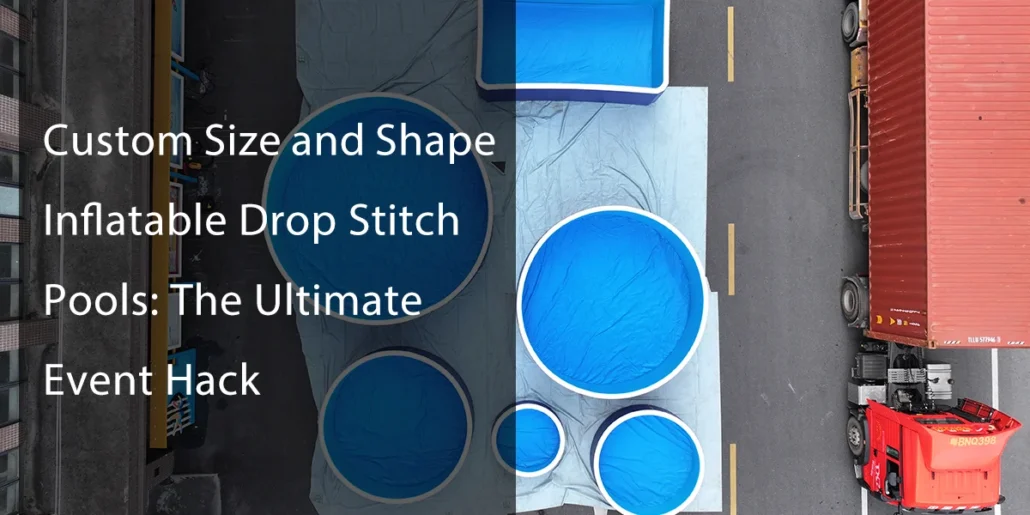
Custom inflatable pools are usually requested because a standard product does not fit the buyer’s space, operating model or brand requirements. For B2B projects, changing the size or shape also affects drainage, fittings, handling, packaging, sample approval and production feasibility.
I’m Charlie from Huale. We manufacture inflatable drop-stitch products for distributors, brands, resorts, hotels, rental operators and project buyers. When a buyer sends us a custom pool inquiry, the first thing we check is not whether the drawing looks attractive. We check where the pool will be used, how it will operate and which details need engineering confirmation before sampling.
Short answer: a custom drop stitch pool project should start with the use case, installation space and operating requirements. Once those are clear, the buyer and factory can define the shape, dimensional direction, drainage, equipment interfaces, branding and sample specification.
This guide focuses on the commercial and technical planning stage before quotation and production. If you are mainly comparing factory capabilities, see our drop stitch pool factory page.
What Makes an Inflatable Drop Stitch Pool a Custom Project?
A custom pool does not necessarily mean developing an unusual shape from zero. Customization can begin with a standard rectangular or round structure and change only the dimensions, fittings, branding or packaging.
It helps to separate projects into three levels:
| Project Level | Typical Changes | Main Review Needed |
|---|---|---|
| Standard Structure + Branding | Colors, logo, labels, manual and packaging | Artwork and private-label approval |
| Modified Size or Specification | Length, width, diameter, wall height, drain or accessory package | Dimensions, structure, fittings and packing |
| Project-Specific Shape | Site-fit geometry, special corners, marine layout or other non-standard configuration | Drawing, engineering feasibility and physical sample |
The deeper the customization, the more important it becomes to control the project with drawings and approved specifications rather than descriptions such as “large pool” or “custom resort pool.”
When Does a Custom Inflatable Pool Make Commercial Sense?
Custom development is most useful when a standard pool creates a clear operational or commercial limitation.
Resorts and Hotels
A resort may need the pool to fit a specific terrace, seasonal activity area or guest zone. The project should account for available floor space, access, drainage, water management and storage rather than choosing dimensions from a catalog alone.
Event and Rental Operators
Rental businesses may need a recognizable shape, brand-specific appearance or dimensions that fit common event venues. Repeated transportation, setup, drainage, repair and storage should be included in the design brief.
Yacht and Marine Projects
Marine projects can require tighter dimensional control because deck or platform space may already be fixed. Buyers should provide measured drawings and identify any installation, handling or connection constraints before the factory confirms feasibility.
Private-Label Pool Brands
A brand may start from an existing round or rectangular platform and customize dimensions, visual design, accessories and packaging instead of developing a completely new structure.
For projects centered specifically on branding and product-line development, see our private label drop stitch pool guide .
Start With the Installation Site Before Choosing the Pool Shape
For project-based custom pools, the available space should be documented before the final pool dimensions are frozen.
A useful site brief should identify:
- Maximum available length and width
- Required access space around the pool
- Doors, columns, walls or fixed equipment
- Water filling location
- Drainage route
- Nearby pump, filtration or chiller equipment where applicable
- Floor or deck conditions
- Storage and transport access
Do not design the pool to consume every available centimeter of a measured area. Installation, maintenance, access and project-specific safety requirements may also need surrounding space.
For commercial installations, the buyer remains responsible for confirming that the site, supporting surface and local operating requirements are suitable for the intended pool installation.
What Drawing Should You Send for a Custom Drop Stitch Pool?
A buyer does not need a finished engineering drawing for the first inquiry. However, a measured sketch is much more useful than a reference photograph alone.
For a rectangular or simple pool, include:
- Overall length
- Overall width
- Target wall height
- Required drain location
- Valve position if location matters
- Any chiller, filter or circulation connection points
- Logo locations
For an irregular or site-fit pool, also mark:
- Corner positions
- Curves or angled sections
- Restricted areas
- Reference dimensions between key points
- Fixed obstacles around the installation
Photographs of the actual site can be supplied together with the sketch. They help the factory understand the environment, but they should not replace measured dimensions.
Rectangular, Round or Project-Specific: Which Custom Pool Shape Fits the Brief?
Pool shape should follow the site and operating requirement rather than being selected only for visual impact.
| Shape Direction | Typical B2B Fit | Project Question |
|---|---|---|
| Rectangular | Resorts, rentals, schools, activity zones and private-label programs | Does the site benefit from a defined length and width? |
| Round | Leisure, soaking, retail and visually centered installations | Does the site have enough diameter and surrounding access? |
| Project-Specific | Marine, events, special installations and constrained spaces | Does the operational requirement justify additional design and sample review? |
For buyers who are still deciding the actual length, width, wall height and shape, use our drop stitch pool size and shape selection guide .
You can also compare our rectangular drop stitch pool and round drop stitch pool ranges before deciding whether a completely custom geometry is necessary.
What Makes a Custom Pool Shape More Difficult to Manufacture?
A custom drawing still needs a manufacturing review before it becomes a production specification.
Important factors can include:
- Number and geometry of corners
- Curved versus straight wall sections
- Drop-stitch panel layout
- Joining and reinforcement areas
- Drain and valve positions
- Equipment connection points
- Access for production and inspection
- How the finished pool will fold and pack
A visually simple concept can become difficult to manufacture if the geometry creates complicated panel transitions or leaves insufficient space for fittings and reinforcement.
For this reason, buyers should separate design intent from approved manufacturing geometry. The first drawing explains what the project needs; the factory review determines how that requirement can be translated into a manufacturable product.
How Should a Custom Inflatable Pool Design Be Verified Before Sampling?
Before a physical sample is produced, both sides should review the latest drawing and specification as one controlled project version.
The design review should confirm:
- Overall pool geometry
- Main dimensions and wall height
- Drain, valve and fitting locations
- Water-circulation connections where required
- Handles or other operating components
- Logo and graphic locations
- Accessory package
- Expected packaging method
For non-standard projects, each significant revision should replace the previous version rather than creating several conflicting drawings in email and messaging threads.
A useful approval record identifies which drawing, specification and artwork version the sample is expected to follow.
Confirm Drainage, Ports and Equipment Connections Before the Pool Drawing Is Frozen
Drainage and external-equipment connections should not be treated as accessories added after the pool body has already been designed.
Before sampling, confirm where applicable:
- Drain quantity and location
- Expected hose or fitting connection
- Water inlet or return locations
- Filter or pump interface requirements
- Chiller connection requirements for wellness applications
- Clearance around external equipment
A statement such as “make it compatible with our pump” is not enough for production. Provide the equipment model, fitting information, hose dimensions or a physical reference where compatibility is commercially important.
Port position should also be reviewed against the finished pool geometry so fittings remain practical to access during use, drainage and maintenance.
Does a Custom Pool Need a Different Drop Stitch Material?
Not automatically.
Material selection should be reviewed together with the pool dimensions, wall height, expected use frequency, environment and approved construction. A custom shape by itself does not determine the correct material specification.
For buyers, the useful questions are:
- What construction is being proposed for this specific pool?
- Which material specification will appear on the approved product sheet?
- Are reinforcement areas required around fittings or other high-stress locations?
- What operating and test specification applies to the final sample?
Do not compare custom pools using one material label alone. The complete construction and manufacturing method need to be reviewed together.
For deeper structural background, see our drop stitch pool technology guide .
Why Is Sample Approval Important for a Custom Pool?
A custom pool sample is not only a visual prototype. It should verify whether the approved design works as a physical product.
Depending on the project, buyers should review:
- Finished dimensions
- Shape and symmetry
- Wall and floor configuration
- Valve and drain positions
- Port and fitting compatibility
- Surface and visual finish
- Logo placement
- Accessories
- Setup and drainage workflow
- Folded and packed configuration
Air-retention pressure, test duration and acceptance criteria should follow the approved product specification and factory test method for that exact model. We do not recommend applying one universal test duration to every custom pool.
If changes are required after the sample review, record them as a new revision before bulk production begins.
How Does OEM Branding Fit Into a Custom Pool Project?
The product structure should normally be confirmed before the final graphics and packaging are frozen.
Private-label customization may include:
- Pool colors
- Logo size and position
- Sidewall graphics
- Model name and labels
- User instructions
- Accessory packaging
- Carton artwork
- Barcode or SKU identification
For project-specific shapes, wait until the approved geometry is available before finalizing large graphics. Changes to corners, seams, valves or fittings can change the usable printing area.
Brand owners developing a broader pool range can use our private label inflatable pool guide for the branding and launch process.
How Does Customization Affect the Pool Quotation?
A custom pool cannot be priced accurately from the words “custom shape” alone.
The quotation can change with:
- Overall dimensions and wall height
- Shape complexity
- Approved construction
- Drainage and fittings
- External-equipment connections
- Graphics and branding
- Accessories
- Packaging
- Sample requirements
- Order quantity
For a useful comparison, make sure each supplier is pricing the same product scope.
For detailed sample-versus-bulk pricing, FOB logic and quotation comparison, use our drop stitch pool price guide .
Should You Start From an Existing Pool or Develop a New Shape?
A completely new geometry is not always necessary.
If the project can work with a conventional rectangular footprint, starting from an existing structure can simplify specification review, sample development and repeat production.
For a physical product reference, review our rectangular custom drop stitch pool .
A new custom shape becomes more relevant when a standard rectangular or round format cannot meet the site’s dimensions, equipment layout, operating workflow or project design requirement.
The decision should therefore be driven by a measurable project constraint rather than customization for its own sake.
What Evidence Should B2B Buyers Request for a Custom Pool Project?
Custom-project claims are easier to evaluate when the supplier can show evidence related to similar work.
Useful evidence can include:
- Real production photographs of drop stitch pools
- Examples of non-standard dimensions or layouts
- Redacted project drawings or specification sheets
- Sample measurement records
- Drain, valve and fitting installation photographs
- Inflation and inspection records
- Branding or artwork approval examples
- Final packing photographs
The strongest evidence is connected to the exact type of project being discussed. A general factory photograph may demonstrate production activity, but it does not confirm that every custom geometry or equipment interface is feasible.
For buyers evaluating production capability rather than project design, review our drop stitch pool manufacturer and OEM factory page.
Custom Inflatable Pool Project Brief Checklist
The first inquiry does not need to contain a complete engineering package, but it should explain enough for the factory to understand the project.
| Project Input | What to Send | Why It Matters |
|---|---|---|
| Application | Resort, hotel, yacht, event, rental, retail or another defined use | Sets the operating context for the design review |
| Site | Available area, photos and any fixed obstacles | Defines the physical design boundary |
| Dimensions | Length, width or diameter and target wall height | Required for initial feasibility review |
| Shape | Standard format or measured sketch of the custom geometry | Allows panel and manufacturing review |
| Connections | Drain, pump, filter, chiller or other equipment information | Prevents fitting conflicts later |
| Commercial Plan | Quantity, branding, packaging, destination and required timing | Connects the engineering brief with the purchasing plan |
A drawing or specification can be refined after the first review. The important point is to identify unknown items instead of allowing both sides to make different assumptions.
Common Mistakes in Custom Drop Stitch Pool Projects
- Starting with an unusual shape before defining the use case: custom geometry should solve a project requirement, not create unnecessary manufacturing complexity.
- Sending only a reference photo: a photograph cannot confirm dimensions, fitting locations or site restrictions.
- Designing to the exact maximum site dimensions: installation and operating access may also require space.
- Adding drains or equipment ports after the sample drawing is approved: these interfaces should be reviewed as part of the main product design.
- Comparing custom-pool quotations without matching specifications: different constructions, fittings, accessories and packaging can produce very different prices.
- Finalizing graphics before the physical geometry is stable: structural revisions may change the available logo or printing area.
- Moving directly from a concept drawing to bulk production: a new size, shape or interface may require physical sample approval.
FAQ: Custom Inflatable Drop Stitch Pools
Can inflatable drop stitch pools be made in custom sizes and shapes?
Yes, custom dimensions and project-specific shapes can be reviewed, but feasibility depends on the complete geometry, wall height, construction, fittings and manufacturing requirements. Buyers should provide dimensions or a measured drawing before the final design is confirmed.
What information should I send for a custom inflatable pool quotation?
Start with the application, installation area, target dimensions, shape, wall height, quantity and destination. Add drainage, external-equipment connections, branding, accessories and packaging requirements where available.
Do I need a CAD drawing before asking for a custom pool quote?
Not necessarily. A measured sketch with key dimensions is often enough for an initial project review. More detailed drawings can be developed or confirmed after the factory evaluates the basic requirements.
Should I order a sample for a custom drop stitch pool?
A physical sample is particularly useful when the project introduces a new size, geometry, fitting layout or private-label specification. It allows the buyer to verify dimensions, shape, components, branding and packing before bulk production.
Is a custom-shape inflatable pool always more expensive than a standard rectangular pool?
Not necessarily based on shape alone. The quotation depends on the full dimensions, wall height, construction, fittings, branding, accessories, packaging and quantity. Compare custom and standard designs using the same project scope.
Conclusion: Define the Project Before You Define the Pool
A successful custom inflatable pool project starts with the operating requirement rather than the shape.
Define where the pool will be installed, how it will be used, which dimensions are constrained, how water will be managed, which equipment needs to connect to it and how the finished product will be stored or transported.
Once those inputs are clear, the buyer and manufacturer can turn the commercial requirement into a controlled drawing, sample and production specification.
For detailed dimension selection, use our pool size and shape selection guide . For pricing, use the drop stitch pool price guide . For OEM production capability, review our drop stitch pool factory page.