
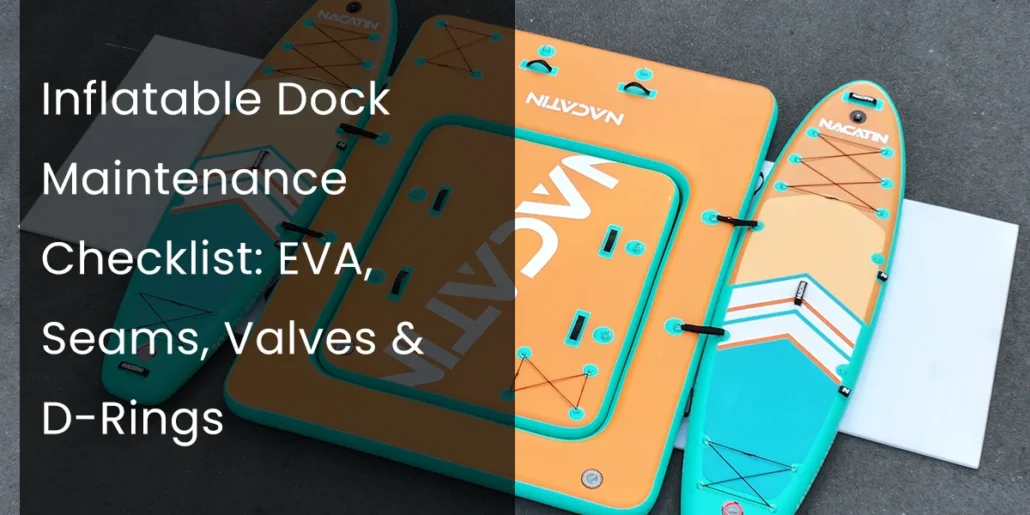
An inflatable dock used by a marina, yacht operator, resort or rental business should not be inspected only when a problem becomes obvious. EVA surfaces, seams, valves, D-rings, handles and connection hardware all experience different types of wear during setup, use, transport and storage.
I’m Charlie from Huale. From the manufacturing side, we recommend treating dock maintenance as a repeatable inspection process rather than a general “wash and store” routine.
Short answer: inspect the dock before deployment, check high-load fittings and connection areas after use, remove dirt and salt residue where applicable, dry the dock before closed storage, and take the unit out of service when pressure loss, seam changes or damaged attachment points need further inspection.
This guide focuses on equipment condition and commercial dock handling. It does not replace the operating instructions for the specific dock model, anchoring engineering, local marine rules or a qualified repair procedure.
If you are still choosing the size, thickness, EVA layout or connection system for a new project, start with our inflatable floating dock buying guide .
Inflatable Dock Maintenance Workflow at a Glance
A commercial maintenance process is easier to manage when the dock moves through the same inspection stages each time it is deployed, recovered or stored.
| Stage | Main Check | Decision |
|---|---|---|
| Before Deployment | Surface, seams, valve, D-rings, handles and connectors | Ready / inspection required |
| During Use | Unexpected pressure change, impact or connector movement | Continue use / remove from service |
| After Recovery | New abrasion, damaged fittings, residue and missing parts | Clean / inspect / maintenance queue |
| Before Storage | Cleanliness, dryness and protection from sharp contact | Store / continue drying |
| Before Return to Service | Previously reported issues and repaired areas | Approved / further inspection |
For commercial fleets, assigning an asset ID to each dock or module makes inspection records easier to follow when several similar platforms are used together.
Before-Deployment Inflatable Dock Inspection Checklist
Before placing the dock in service, inspect the complete platform rather than checking only the inflation pressure.
- PVC surface: look for cuts, abrasion, unusual deformation or areas that have changed since the previous use.
- EVA deck: check for lifting edges, tears, deep abrasion or contamination that may affect normal use.
- Seams and edge areas: inspect for visible separation, distortion or changes that require further review.
- Valve: confirm the cap, valve area and surrounding material appear clean and undamaged.
- D-rings: inspect the metal fitting, base patch and surrounding material.
- Handles: check the webbing and attachment area for tearing or detachment.
- Connection straps and buckles: confirm required parts are present and visibly serviceable.
- Previous repair areas: review them before the dock returns to commercial use.
Inflate the dock according to the specification for the exact model. Do not use one PSI value across different sizes, thicknesses or structures.
If the platform does not maintain its expected shape or shows unexplained pressure loss, move it out of normal service until the cause has been inspected.
How to Inspect the EVA Deck
The EVA deck is one of the most visible wear areas on a commercial inflatable dock because users walk, kneel, carry equipment and move across the surface repeatedly.
Check the EVA for:
- Edges beginning to lift
- Tears or cuts
- Deep abrasion
- Areas that have shifted or changed shape
- Dirt, oil, sand or other contamination
- Damage around handles, fittings or high-traffic areas
Minor cosmetic marks do not automatically mean the dock must be removed from service. The important question is whether the condition affects normal use, cleaning or the integrity of the bonded surface.
Use cleaning methods that are compatible with the EVA, printed graphics, PVC surface and bonding system. Do not assume that a stronger cleaner is suitable for every deck material.
How to Check PVC Surfaces and Seams
The outer PVC surface should be inspected together with the seams and edge zones because commercial docks often experience repeated contact during launching, recovery, connection and transport.
Look for:
- Cuts or puncture marks
- Heavy abrasion
- Unexpected bulging or deformation
- Areas that appear different from the approved product shape
- Visible seam separation
- Changes around corners and edge zones
- Damage near D-rings, handles or connector bases
Do not assume that every surface mark is an air leak. Record the location first and inspect the condition before deciding whether repair work is required.
If a seam area is visibly changing or the dock is losing pressure unexpectedly, remove the platform from commercial use pending further inspection.
Valve Inspection and Pressure-Loss Warning Signs
A valve inspection should focus on the valve itself, its cap, the surrounding material and any change in inflation condition.
Before deployment, confirm:
- The valve area is free from visible sand, dirt and debris
- The cap and external parts are present
- The surrounding PVC is not visibly damaged
- The dock reaches the approved operating condition for the model
During use or after recovery, investigate any repeated or unexplained pressure loss rather than simply adding more air each time.
A softer platform does not automatically prove that the valve is leaking. Temperature change, valve condition, punctures and seam problems can produce different symptoms, so the cause should be checked before repair begins.
Detailed valve removal or replacement is a repair task and should follow the correct procedure for the specific valve system.
How to Inspect D-Rings, Handles and Reinforcement Areas
D-rings and handles transfer load into the dock structure. For commercial users, the fitting itself and the reinforced base area should both be checked.
D-Ring Inspection
- Check the metal D-ring for obvious distortion or damage
- Inspect the base patch and surrounding PVC
- Look for lifting, tearing or unusual movement around the attachment area
- Check high-load anchoring or connection points more closely than decorative fittings
Handle Inspection
- Check handle webbing for cuts or heavy wear
- Inspect the base where the handle attaches to the platform
- Look for movement, peeling or material damage
- Pay additional attention to handles used frequently for launching and recovery
A fitting that is still attached should not automatically be considered serviceable if the surrounding reinforcement area is visibly damaged.
For new projects, D-ring quantity, handle layout and reinforcement requirements should be selected according to the intended use rather than copied from another dock model.
How to Inspect Dock Connectors, Straps and Buckles
Modular inflatable docks rely on the connection system to keep separate platforms aligned during use. The correct inspection depends on whether the system uses D-rings, straps, buckles, webbing or another approved connector.
Check:
- Straps for cuts, fraying or unusual stretching
- Buckles for cracks or visible damage
- Webbing connection points for wear
- D-ring bases used as connection points
- Missing or mismatched connector components
- Whether modules remain aligned as intended after connection
Replace damaged removable connector parts rather than continuing to use a weakened strap or buckle.
If a connection point on the inflatable platform itself is damaged, remove that module from the connected system until the attachment area has been inspected.
Buyers designing a modular system can review our inflatable dock OEM options for size, EVA, D-ring and connection-layout planning.
How Should an Inflatable Dock Be Cleaned After Use?
Cleaning requirements depend on where the dock is used and what has accumulated on the surface.
A practical cleaning sequence is:
- Remove loose sand, mud, leaves and other debris.
- Rinse salt, dirty water residue or surface contamination where appropriate.
- Clean EVA, PVC and fittings using a method compatible with the product materials.
- Pay attention to D-rings, handles, connection areas and EVA grooves where residue can collect.
- Remove cleaner residue where the product instructions require rinsing.
- Allow the dock to dry before closed packing or longer-term storage.
Do not use aggressive chemicals simply because they remove dirt faster. A cleaning product should be compatible with the PVC coating, EVA surface, printed graphics, adhesive system and metal or plastic fittings used on the dock.
Saltwater Use
After saltwater use, remove salt and sand residue from the dock surface and connection components where practical. Metal fittings should also be inspected for signs of corrosion or damage where applicable.
Freshwater Use
Freshwater does not eliminate the need for cleaning. Mud, organic residue, sand and other contamination can still collect around deck grooves, fittings and connection points.
Why Drying Matters Before Packing or Storage
A large inflatable platform can hold moisture in areas that are not obvious from the top surface.
Before packing, check:
- EVA grooves and deck edges
- Areas around D-rings and handles
- Connection straps and webbing
- Underside surfaces
- Carry bags and accessory bags
- Fold areas where water may remain trapped
Allow the platform and removable accessories to dry before closed storage.
Avoid uncontrolled high heat simply to speed up the process. Drying and storage should follow the material and product instructions for the specific dock.
Inflatable Dock Storage Checklist
The correct storage method can vary by dock structure, available space and operating schedule. Some commercial users may keep docks deployed or inflated for a period, while others pack them after use.
Before longer storage, confirm:
- The dock has completed its final inspection
- The surface and fittings are clean
- The dock and accessories are sufficiently dry
- Removable connectors and straps are accounted for
- The valve is protected from impact
- The platform is not packed against sharp objects
- Heavy equipment is not placed on the stored dock in a way that damages fittings or folds
- The storage area avoids unnecessary prolonged heat and direct UV exposure
- Units requiring repair are separated from ready-to-use equipment
If the dock is stored inflated or partly inflated, follow the product-specific instructions and ensure the platform is supported in a way that does not create unnecessary load on edges, handles or fittings.
When Should an Inflatable Dock Be Removed from Service?
Commercial staff do not need to diagnose every technical fault during a routine inspection. They do need clear rules for when a platform should stop being used.
Remove the dock from service pending inspection when you find:
- Repeated or unexplained pressure loss
- Visible puncture, cut or serious surface damage
- Seam separation or another visible structural change
- A damaged valve or valve area
- A D-ring base or reinforcement area showing significant damage
- A handle or attachment point that is tearing or separating
- A damaged connector point that affects a modular system
- EVA lifting or damage that creates an operational issue
- A previous repair area that has changed
Record the asset ID, location of the issue and visible symptoms before repair work changes the original condition.
Puncture repair, valve servicing, seam repair and D-ring reattachment should follow a separate technical repair procedure. They are not part of the normal maintenance checklist.
Create a Commercial Inflatable Dock Maintenance Log
A maintenance log is especially useful for marinas, rental operators and resorts that manage several dock modules or seasonal equipment.
| Field | Example |
|---|---|
| Asset ID | Dock-M03 |
| Date | Record the actual inspection date |
| Area Inspected | EVA / seam / valve / D-ring / connector |
| Issue Found | D-ring base shows visible lifting |
| Action | Removed from connected dock system for inspection |
| Status | Ready / monitor / inspection / repair |
| Return to Service | Record only after the required inspection or repair is completed |
Photos can be linked to the asset record when a visual history is useful. Use consistent photo angles so later inspections can be compared with the same part of the dock.
Inspection Priorities by Commercial Dock Use Case
The same dock components can wear differently depending on how the platform is used.
| Use Case | Priority Inspection Areas | Why |
|---|---|---|
| Yacht & Boat Dock | EVA, contact edges, D-rings and connection points | Repeated contact, boarding and connection activity |
| Marina Platform | D-rings, anchoring points, seams and connectors | Frequent load on connection and securing areas |
| Rental Dock | Handles, EVA, valves and frequently moved fittings | Repeated setup, recovery and staff handling |
| Resort Platform | EVA cleanliness, guest-contact areas and connectors | Frequent guest use and presentation requirements |
| Modular System | Straps, buckles, D-rings and module alignment | Several modules depend on the same connection system |
Huale’s commercial dock planning also distinguishes marina, rental, yacht and resort buyers because their handling and connection requirements are not identical. :chatgpt-content-reference{index=”2″}
For broader use-case planning, see our commercial inflatable dock applications guide .
What This Maintenance Checklist Does Not Replace
This article covers product condition, routine cleaning, handling and maintenance records. It does not replace:
- The instructions supplied with the specific dock model
- Anchoring or mooring engineering for the installation site
- Local marina or waterway regulations
- Weather and operating-condition policies
- Load planning for a commercial installation
- Qualified structural repair procedures
- Professional inspection after a major impact or unusual event
For commercial applications, maintenance decisions should reflect the exact platform design, water environment, usage intensity and connection system rather than a generic schedule copied from another dock.
FAQ: Inflatable Dock Maintenance & Inspection
How often should an inflatable dock be inspected?
There is no single inspection interval for every dock. Commercial operators should check the platform before deployment, after unusual impact or pressure loss, before storage and before returning a stored or repaired dock to service. High-use fleets may add scheduled inspections based on usage and environment.
How should I clean an EVA deck on an inflatable dock?
Remove loose dirt, sand and residue first, then use a cleaning method compatible with the EVA, PVC, printed graphics and bonding system. Avoid assuming that strong chemicals are suitable for every dock surface.
What should I check around inflatable dock D-rings?
Inspect the D-ring itself, its reinforced base patch and the surrounding PVC. Look for distortion, tearing, lifting or unusual movement, especially at anchoring and modular connection points.
Should I repair an inflatable dock as soon as I notice pressure loss?
First remove the dock from service and identify the symptoms. Pressure loss can come from different sources, including a valve, puncture or seam area. Record and inspect the problem before choosing a repair method.
Should inflatable docks be stored inflated or deflated?
Follow the storage method for the specific dock. Commercial platforms may be stored inflated, partly inflated or packed depending on the model and operating schedule. In every case, control moisture, sharp contact, unnecessary heat and load on valves or fittings.
Planning a Commercial Inflatable Dock Project?
If you are sourcing inflatable docks for a marina, yacht program, resort, rental fleet or modular platform system, send us your required size, use case, EVA layout, D-ring and handle requirements, connection method, branding and expected quantity.
For product selection, review our inflatable floating dock buying guide .
For custom layouts and private-label development, see our inflatable dock OEM options guide .
Sample availability, bulk MOQ and production timing depend on the final dock size, structure, EVA layout, connection system, branding and order quantity.
We will respond within 24 hours with a factory-direct quote.