
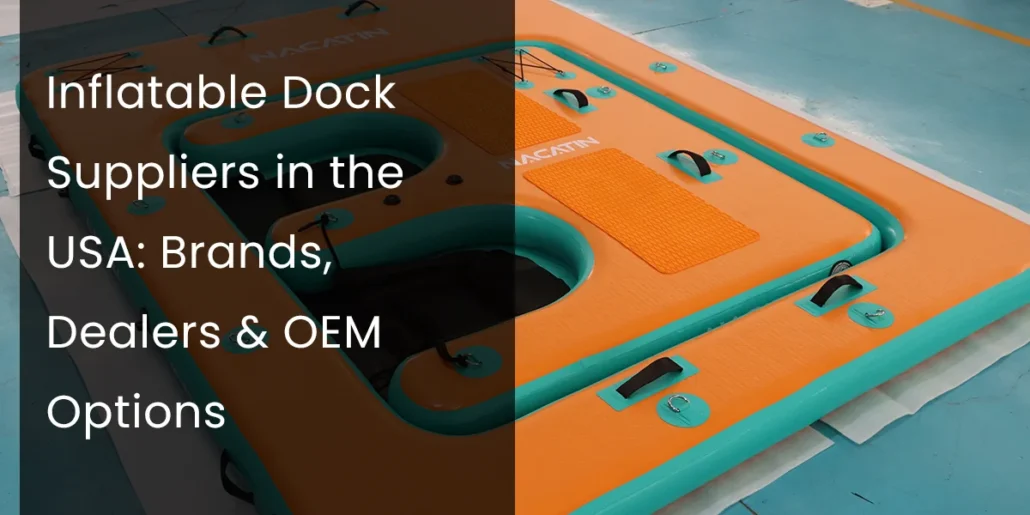
Finding inflatable dock suppliers in the USA involves more than comparing floating platforms by price or size. A marine retailer may need established products with dealer support, while a resort, marina or yacht operator may need a platform suited to a particular waterfront layout. A private-label importer has another requirement: a manufacturer willing to develop and produce docks under its own brand.
I’m Charlie from Huale, a China-based manufacturer of inflatable drop-stitch products. In this guide, we compare four established brands and supply channels serving the US market: BOTE, MISSION Boat Gear, Solstice Watersports and NautiBuoy Marine.
We distinguish branded product supply from contract manufacturing, explain which types of inflatable platforms belong in the comparison, and identify the questions commercial buyers should ask before requesting a quotation.
Short answer: Consider a US brand or authorized dealer if you need an existing product range and a defined local sales channel. Evaluate a specialist yacht-platform supplier for vessel-specific applications. Consider an overseas OEM/ODM factory when your business needs private-label graphics, custom dimensions, modular layouts or a repeatable bulk-production program.
In each case, verify the actual product, commercial-use limits, manufacturer identity and after-sales arrangements. A recreational swim platform should not automatically be treated as permanent marina infrastructure or as a drive-on PWC dock.
What Types of Inflatable Dock Suppliers Serve the US Market?
The term “inflatable dock supplier” can describe a brand, an authorized retailer, a marine equipment distributor or a contract manufacturer. These companies can sell related products while offering very different commercial services.
For a buyer, the first decision is whether to purchase a finished branded product or develop a dock to an approved specification.
| Supply Model | What It Offers | Best-Fit Buyer | What to Verify |
|---|---|---|---|
| US inflatable dock brand | Finished products sold under an established brand. | Retailers, boat owners and operators seeking an existing product range. | Product availability, warranty, operating limits and dealer eligibility. |
| Authorized marine dealer | Access to selected brands and potentially local sales or technical support. | Yacht outfitters, marine equipment retailers and fleet purchasers. | Authorized product lines, trade terms, stock, service and replacement parts. |
| Specialist yacht-platform supplier | Platforms and accessories designed for particular yacht or boating applications. | Yacht operators, marine outfitters and charter businesses. | Vessel compatibility, connection details, load limits and support arrangements. |
| Overseas OEM/ODM factory | Manufacturing to an agreed product specification and branding requirement. | Importers, private-label brands and commercial equipment distributors. | Production location, engineering scope, samples, MOQ, inspection and import terms. |
Does a US Brand Mean the Dock Is Made in the USA?
No. A company can be based in the United States while sourcing products or components internationally. Its headquarters, warehouse or dealer network does not establish the manufacturing country of every model.
If country of origin matters to your purchasing or marketing requirements, request confirmation for the exact dock model and production batch.
Does an Authorized Dealer Offer Private-Label Manufacturing?
Not necessarily. An authorized dealer generally sells products under the brand owner’s commercial arrangements. It should not be assumed to own the factory or have the right to manufacture a competing private-label product.
For a private-label project, confirm that the proposed supplier accepts third-party branding and has the necessary production and specification-control arrangements.
Inflatable Dock Brands and Supply Channels for US Buyers
The following companies offer relevant inflatable products or supply channels in the United States. They are presented as different purchasing options, not as a ranking of manufacturing quality or production capacity.
1. BOTE — Inflatable Hangout Docks and Dealer Programs
BOTE offers Hangout inflatable docks for recreational floating, lounging and water access. Its official product range includes square Dock 7 and Dock 10 models, which can also be used in connected leisure layouts according to the product instructions.
BOTE has a published application process for authorized dealers and authorized rental operators. This provides a documented starting point for businesses interested in its branded product channels.
Potential buyer fit: Watersports retailers, rental businesses and operators seeking finished recreational floating platforms under an established brand.
Questions to confirm:
- Which dock models are available to the applicant’s dealer or rental account?
- What commercial-use permissions and restrictions apply?
- What warranty, replacement-part and product-support arrangements are available?
- Does the selected platform suit the intended water environment and operating conditions?
The availability of a dealer or rental program does not establish third-party OEM manufacturing services or permission to use a recreational dock as permanent marina infrastructure.
2. MISSION Boat Gear — REEF Inflatable Water Mats and Swim Platforms
MISSION Boat Gear offers REEF inflatable water mats and related floating products designed for boating and on-water recreation. The REEF MAT product range uses a layered drop-stitch structure to create a platform that can be inflated, transported and stored.
The company also offers products intended to connect with particular boating environments, including pontoon-related swim platform formats. Its website provides a store locator and a contact route for dealer enquiries.
Potential buyer fit: Boat accessory retailers, pontoon owners and commercial buyers researching portable floating recreation surfaces.
Questions to confirm:
- Is the required product a REEF water mat, a boat-connected swim platform or another format?
- What are the model-specific attachment instructions and weight limits?
- What conditions apply to commercial or repeated rental use?
- Can the supplier support dealer orders, replacements and repeat supply?
A REEF water mat may provide a walkable floating recreation surface, but that does not make it equivalent to a permanent dock, a vessel mooring structure or a drive-on PWC dock.
3. Solstice Watersports — Drop-Stitch Floating Docks and Authorized Dealers
Solstice Watersports offers several inflatable floating dock formats, including Classic Docks, Luxe Traction Docks and mesh-center platforms.
Its Luxe Traction range includes a drop-stitch core, an EVA traction surface and access accessories. The brand also publishes an authorized dealer application form for retail businesses.
Potential buyer fit: US retailers and distributors seeking finished inflatable dock products with different deck and leisure configurations.
Questions to confirm:
- Which dock models are eligible for authorized dealer supply?
- Are the products approved for the buyer’s intended commercial application?
- What are the actual deck materials, dimensions, fittings and model-specific operating limits?
- What are the warranty, replacement and reorder terms?
Solstice is a relevant US-market brand and dealer-channel example. Its US presence should not be used as proof that every dock model is physically manufactured in the United States.
4. NautiBuoy Marine — Yacht Platforms with US Marine Resellers
NautiBuoy Marine supplies modular inflatable yacht-platform systems and associated accessories. Its product information includes platform specifications for different layouts and vessel-related uses.
The brand’s published reseller network includes US businesses such as Nautical Ventures, National Marine Suppliers and Yacht Chandlers USA in the Fort Lauderdale area.
This gives yacht operators and marine professionals a route to investigate specialist products through established US marine supply channels.
Potential buyer fit: Yacht outfitters, charter operators, marine accessory buyers and businesses evaluating vessel-specific floating platform configurations.
Questions to confirm:
- Which platform model and accessories fit the intended vessel?
- How is the platform connected, deployed and recovered?
- Who provides local sales support and replacement components?
- Does the reseller support the proposed commercial application?
US reseller availability does not make NautiBuoy a US manufacturer. The manufacturing location and any third-party OEM arrangements must be verified separately.
Which US Inflatable Dock Supply Channel Fits Your Business?
The most useful comparison is not which brand has the longest feature list. It is which supply model can deliver the product, purchasing terms and support that your business actually needs.
| Business | Relevant Product | Documented US Supply Route | Best Reason to Shortlist | What Is Not Established |
|---|---|---|---|---|
| BOTE | Hangout inflatable floating docks | Authorized dealer and rental-operator applications | Branded recreational dock supply | Third-party OEM availability and universal commercial suitability |
| MISSION Boat Gear | REEF mats and boat-related swim platforms | Product sales, dealer contact and store locator | Portable boating and recreation platforms | Third-party OEM availability and permanent dock use |
| Solstice Watersports | Classic, Luxe Traction and mesh docks | Authorized dealer application | Finished inflatable dock assortment | Third-party OEM availability and US production of every model |
| NautiBuoy Marine | Modular inflatable yacht platforms | Published US marine reseller network | Specialist yacht outfitting and platform layouts | US manufacturing and third-party OEM availability |
Which Suppliers Offer a Documented Business Application Route?
BOTE and Solstice publish authorized dealer applications. BOTE also describes an authorized rental-operator route.
MISSION provides a dealer enquiry contact and local-store information, while NautiBuoy lists specific marine resellers serving US customers.
These channels are meaningful evidence of commercial supply activity. However, they do not confirm approval for a particular buyer, stock availability, volume discounts, commercial-use warranties or permission to sell private-label versions of the products.
What About Actual Manufacturing Location?
None of the supply routes above should be treated as proof that all relevant dock models are made in the United States.
Buyers requiring domestic manufacturing should ask the business to identify the production country and manufacturing entity for the exact model. Do not confuse brand headquarters, warehouse location or a dealer address with a factory address.
Inflatable Swim Platform vs PWC Dock vs Boat Lift
One of the most expensive sourcing mistakes is treating different floating products as interchangeable because they all appear under the word “dock.”
A platform designed for people to stand, sit or swim from is not automatically suitable for supporting a personal watercraft. A permanent marina dock or a boat lift has different structural and installation requirements.
| Product Type | Primary Function | Typical Application | Important Limitation |
|---|---|---|---|
| Inflatable swim platform | Provides a temporary floating surface for boarding, sitting or other approved activities. | Boat leisure, resort swimming areas and seasonal recreation. | Must not be used as a vessel support or mooring system without documented approval. |
| Modular inflatable platform | Connects approved floating modules to form a larger temporary layout. | Yacht extensions, resort activity areas and selected seasonal installations. | Connector loads, anchoring, user limits and site conditions require review. |
| Drive-on PWC dock | Supports a specified personal watercraft using an approved docking arrangement. | PWC storage and certain rental or marina operations. | Requires documented compatibility with the craft, weight and docking method. |
| Inflatable boat lift | Uses a designated lifting or buoyancy system to support a boat. | Boat handling and storage applications. | Requires a separate lifting design and rated operating requirements. |
| Fixed or modular pontoon dock | Forms part of a more permanent waterfront access or vessel docking arrangement. | Commercial marinas, berths, walkways and fixed waterfront facilities. | Engineering, site installation, mooring and permitting requirements differ from portable inflatable platforms. |
Can a Regular Inflatable Dock Hold a Jet Ski?
Do not assume so. A static load figure for people or distributed equipment does not prove that the structure can withstand a PWC driving onto it, concentrated contact pressure or repeated docking impacts.
A PWC docking project requires a product designed and evaluated for the intended craft and docking method. Confirm its rated capacity, hull contact areas, restraint system, water conditions and operating procedure.
Can an Inflatable Platform Replace a Fixed Marina Dock?
Not in every application. A portable floating platform may provide seasonal recreational space or temporary access when the product and installation are appropriate.
It should not automatically replace engineered infrastructure used for vessel berthing, public access or permanent mooring. The suitability of an inflatable installation depends on the actual structure, loads, environmental conditions and local requirements.
For the broader infrastructure comparison, read our inflatable versus fixed dock comparison for marina and resort buyers.
What Should US Marina and Resort Buyers Verify Before Purchasing?
Commercial applications place different demands on inflatable platforms. A yacht-side swimming deck, a resort guest platform and a rental operator’s repeatedly deployed dock may all require different layouts and operating procedures.
Start with the site and the intended activity before comparing products.
| Buyer | Intended Use | Questions to Resolve Before Ordering |
|---|---|---|
| Resort or beach club | Seasonal swimming or guest recreation area. | Approved guest load, water access, supervision, slip conditions, anchoring, storage and local use restrictions. |
| Yacht operator | Temporary swim deck or vessel-side floating platform. | Vessel connection, contact protection, deployment, recovery and manufacturer-approved operating limits. |
| Boat club or marina | Additional recreation or water-access space. | Waterway permissions, navigation clearance, mooring arrangement, inspection and responsibility for users. |
| Rental or watersports operator | Equipment deployed, recovered and handled repeatedly. | Staff handling, setup time, cleaning, repair support, replacement components and storage. |
| Marine equipment distributor | Resale of standard products or a private-label range. | Product category, documentation, packaging, dealer rights, consistency and after-sales responsibilities. |
Six Technical Questions That Matter More Than a Product Photo
- Water environment: Is the dock intended for sheltered freshwater, protected coastal water or another specific operating environment?
- Loads: What is the documented allowable loading for the exact model and intended use?
- Surface: What deck material is supplied, and what wet-use limitations or maintenance requirements apply?
- Connection: What are the intended D-ring, strap, fitting and anchoring arrangements?
- Operation: How will staff deploy, supervise, recover, inspect and store the platform?
- Service: Who supplies compatible repair materials, spare parts and technical guidance?
Why Modular Layouts Require Additional Review
Connecting several platforms changes the way people, waves and current can load the assembly. A D-ring count alone is not evidence that a proposed modular layout is suitable for the site.
Buyers should provide a layout drawing showing platform orientation, access routes, connection locations and the expected operating environment. The supplier must confirm what the proposed components and connection system are designed to support.
For larger or exposed installations, qualified site-specific engineering may be necessary. An inflatable product specification is not a substitute for an anchoring or mooring design.
Commercial Maintenance Should Be Planned Before Purchase
Ask suppliers for inspection procedures covering seams, valves, handles, D-rings, connectors and deck surfaces. Also confirm how damaged equipment is removed from service and who can approve structural repairs.
Our inflatable dock maintenance and inspection checklist covers these operational checks in greater detail.
US Brand or Dealer Supply vs Overseas OEM Manufacturing
Both sourcing models can be suitable for US commercial buyers. The right choice depends on whether the business needs existing branded stock or intends to develop and control its own product range.
Choose a Brand or Authorized Dealer When…
- You intend to resell an established brand rather than launch your own.
- The available models already match your product requirements.
- You need a defined sales channel, local stock or dealer support.
- You can work within the brand’s authorization, pricing and product policies.
- The manufacturer has confirmed the product’s suitability for your intended application.
Consider an Overseas OEM/ODM Manufacturer When…
- You want your own logo, color scheme, deck graphics or retail packaging.
- Your business needs dimensions or a modular layout not covered by existing products.
- You need to specify fitting positions, handles or connection arrangements.
- You plan repeat orders against an approved product specification.
- You have a process for importing, selling, inspecting and supporting your own branded equipment.
Where Huale Fits
We manufacture inflatable drop-stitch floating platforms in Guangzhou, China. We are an overseas OEM/ODM option, not a US-made dock brand or an authorized dealer for the companies listed above.
For suitable projects, we can review custom platform dimensions, surface designs, private-label graphics, fittings, modular layouts, accessories and export packaging. Feasibility and the required production checks depend on the approved product specification.
We do not treat a standard swim platform as an approved PWC drive-on dock or heavy-duty lifting system without a separately verified design and application-specific requirements.
For details of our manufacturing scope, see our inflatable floating dock factory page.
What Does a Private-Label Buyer Need to Manage?
Working directly with an OEM factory also means the importing brand must define its product requirements and commercial responsibilities.
Before approving a new model, confirm:
- Who owns and approves the finished design and artwork.
- Which product specifications the factory is responsible for meeting.
- How sample changes and final approval are documented.
- Which inspections and acceptance criteria apply to the order.
- Who handles US import documentation and market-specific requirements.
- How replacement parts, warranty claims and product complaints are managed.
An overseas factory can be a suitable manufacturing partner without replacing every role performed by a US distributor, marine installer or local service provider.
How to Shortlist an Inflatable Dock Supplier for a US Commercial Project
A supplier comparison should use the same questions for every candidate. This prevents a retail product listing, a dealer quotation and a custom factory proposal from being treated as equivalent offers.
The goal is not to assign an arbitrary supplier score. It is to establish whether the supplier can provide the right product and accept the commercial responsibilities your project requires.
| Qualification Area | Evidence to Request | Decision It Supports |
|---|---|---|
| Product identity | Exact model, construction, intended use and product documentation. | Is this the correct type of floating platform? |
| Supplier identity | Brand owner, authorized dealer, contracting business and actual manufacturer where relevant. | Who is responsible for supply and product conformity? |
| Commercial suitability | Operating instructions, approved usage conditions, load information and application limits. | Can the product be used for the proposed commercial activity? |
| Platform connections | Layout drawings, fitting locations and documented connection requirements. | Is the proposed installation compatible with the product? |
| Purchasing rights | Dealer authorization or private-label manufacturing agreement, as applicable. | Can the business legally buy and resell the product as intended? |
| Supply terms | Confirmed availability, MOQ, sample terms, production schedule and delivery arrangements. | Does the supply model match the purchasing plan? |
| After-sales support | Warranty scope, spare parts, repair procedures and service responsibilities. | How will the product be supported after delivery? |
When Should You Reject a Supplier from the Shortlist?
Reconsider a supplier if it cannot identify the exact product being offered, cannot explain the applicable operating limits, or makes manufacturing-origin claims that it cannot support.
For projects involving custom connections, commercial user loads or vessel docking, do not approve a product solely from marketing photographs or a generic load statement.
If the supplier’s documents do not address the intended activity, request clarification before proceeding.
Prepare a Short Project Brief Before Requesting Quotes
For the first enquiry, send:
- Use case: Yacht-side swim deck, resort platform, rental dock or another defined application.
- Site: Freshwater or saltwater, sheltered or exposed location, and intended operating period.
- Product: Standard model or custom layout, with dimensions where available.
- Commercial arrangement: Finished branded supply, authorized dealership or private-label OEM.
- Quantity: Estimated opening order and potential repeat demand.
- Destination: US state, destination port or delivery location.
Include a drawing for modular layouts or vessel-specific connections. The supplier can then determine which additional engineering and quotation details are needed.
For a detailed factory RFQ, use our inflatable dock quotation guide, which covers EVA surfaces, fittings, packaging and freight-related information.
Do Inflatable Docks Need Permits in the United States?
There is no universal permit exemption for inflatable floating platforms. The answer depends on the waterbody, location, deployment method, duration, anchoring arrangement and intended activity.
A portable product should not be advertised as automatically permit-free simply because it can be deflated and removed.
Federal, State and Local Requirements May Differ
The U.S. Army Corps of Engineers regulates certain work and structures in navigable waters under Section 10 of the Rivers and Harbors Act. Its jurisdiction can include docks, floats and related structures or activities.
Other rules may apply to particular waters and activities, including requirements administered by state agencies, local governments, marina authorities or the operator responsible for the site.
See the U.S. Army Corps of Engineers permitting information for federal regulatory guidance.
Questions to Resolve Before Installation
- Who controls or manages the waterbody and intended installation area?
- Is the platform temporary, seasonal or continuously deployed?
- How will it be secured, and could it affect navigation or access?
- Does the site require an operator agreement, authorization or permit?
- What weather and water conditions are permitted for the selected product?
- Who is responsible for supervision, inspection and removing equipment when conditions change?
For a commercial installation, confirm the applicable requirements with the relevant authorities and qualified local professionals. A manufacturer’s product description cannot replace that site-specific determination.
Commercial Safety and Product Approval
Before opening a platform to guests or rental customers, confirm the product’s approved intended use, occupancy or loading instructions, access arrangements and inspection requirements.
Do not assume that a recreational platform’s marketing capacity establishes suitability for every commercial setting. The responsible operator must assess the installation and its operating procedures.
Important: An inflatable dock is not automatically a personal flotation device, a lifesaving appliance or a substitute for an engineered dock system.
Frequently Asked Questions
Who are the main inflatable dock suppliers serving the USA?
Relevant US-market suppliers and brands include BOTE, MISSION Boat Gear, Solstice Watersports and NautiBuoy Marine’s US reseller network. Their products and commercial arrangements differ. Buyers should compare the exact platform type, dealer availability, operating limits and support terms rather than assuming these companies are equivalent manufacturers.
Are inflatable dock brands based in the USA also manufactured in the USA?
Not necessarily. A company may operate its headquarters, sales and distribution in the United States while sourcing products elsewhere. If US manufacturing is a purchasing requirement, ask for evidence identifying the actual manufacturer and production country of the specific model.
Can US businesses buy inflatable docks wholesale or through dealers?
Yes. BOTE and Solstice publish authorized dealer application programs, and BOTE also offers an authorized rental-operator application route. Other brands may work through marine dealers or direct enquiries. Buyers must confirm the selected product’s eligibility, minimum order terms and commercial-use conditions with each supplier.
Can a standard inflatable floating dock be used for jet ski parking?
Not without confirmation. A platform intended for people to stand or relax on should not be assumed suitable for supporting a personal watercraft. A PWC application needs a product designed and approved for the relevant craft, weight, contact forces and docking method.
When should a US buyer consider a Chinese inflatable dock OEM factory?
An overseas OEM manufacturer may be suitable when a business wants custom dimensions, private-label graphics, different EVA surfaces, approved modular layouts or repeat production under its own brand. Buyers should confirm engineering feasibility, samples, inspection requirements, import responsibilities, MOQ and delivery terms before approving the project.
Discuss a Custom Inflatable Dock Project with Huale
We manufacture inflatable drop-stitch floating platforms for brands, marine equipment distributors, yacht businesses, resorts and other commercial buyers.
If you are developing a custom platform for the US market, share your intended use, target size, layout drawing if available, quantity range, deck-surface requirements, connection arrangement, branding and delivery destination.
We can review the manufacturing scope and identify which product details need to be confirmed before sample approval and quotation.
Contact Huale for a project-specific inflatable dock OEM/ODM quotation.