
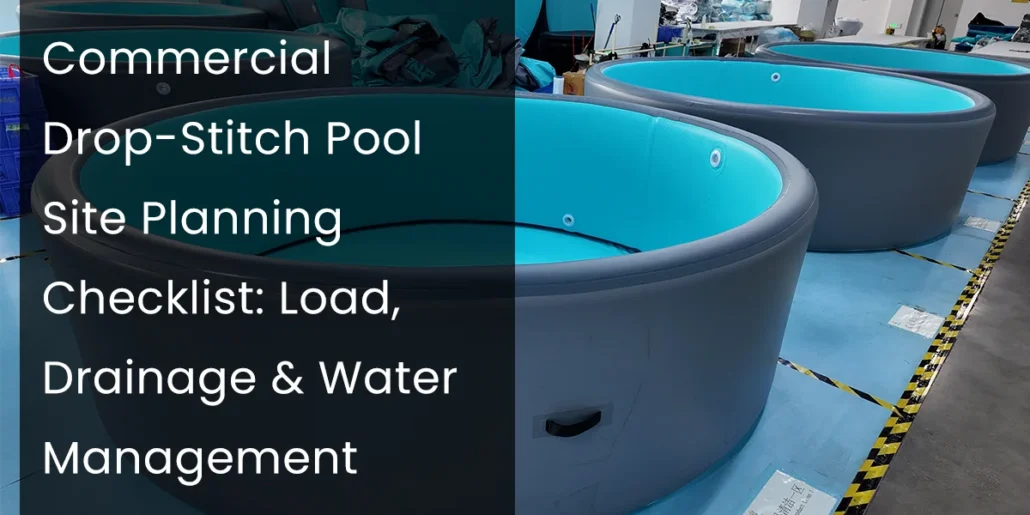
A commercial drop-stitch pool project should not move directly from product delivery to filling with water. Before filling begins, the project team needs to confirm that the site, drainage route, equipment connections, access plan and operating responsibilities are ready for the selected pool.
I’m Charlie from Huale. When we review a custom drop-stitch pool project, we can help buyers define the pool dimensions, expected water volume, drain and filtration interfaces, fittings and product specification. However, the manufacturer cannot approve the structural capacity of a hotel deck, local wastewater discharge, public-pool operating rules or the water-treatment program for the destination site.
Short answer: before filling a commercial drop-stitch pool, confirm the pool footprint and working water depth, assess the filled load, approve the installation surface, decide where drained water will go, verify access and equipment interfaces, assign responsibility for water management, and check the local requirements that apply to the facility.
This checklist is designed for resorts, hotels, commercial leisure projects, temporary installations and other B2B buyers. It is a site-planning framework, not a substitute for structural engineering, local aquatic-facility rules, electrical design or qualified pool-operation procedures.
Commercial Drop-Stitch Pool Site Readiness: Quick Checklist
The following questions should be answered before the pool is filled for commercial use.
| Check | Question to Resolve | Primary Responsibility |
|---|---|---|
| Pool Specification | Are the approved dimensions, wall height and working water depth clear? | Buyer + Manufacturer |
| Filled Load | Can the ground, deck or platform support the filled pool and intended use? | Site Owner / Engineer |
| Surface | Is the installation area level, clean and suitable for the pool footprint? | Site Team |
| Drainage | Where will the water go when the pool is emptied? | Site Team / Local Authority |
| Pool Ports | Do drain, suction, return and equipment connections match the approved system? | Buyer + Manufacturer + Equipment Supplier |
| Access | How will users enter and exit the pool under the planned operating conditions? | Operator / Project Team |
| Water Management | Who will manage filtration, treatment, testing and water replacement? | Pool Operator |
| Local Requirements | Have applicable public-pool, barrier, supervision and operating requirements been checked? | Operator / Local Authority |
If one of these questions is still unresolved, record it as an open project item rather than assuming the product specification solves the site requirement.
1. Confirm the Pool Footprint and Working Water Volume
Site planning should use the actual pool specification rather than only the product name or external wall height.
Confirm:
- Pool shape
- Internal length and width or diameter
- Wall height
- Intended working water depth
- Space required around the pool
- Location of stairs, access equipment or external components
- Pump, filtration or circulation equipment position
- Drainage and hose-routing space
For a rectangular pool, an early water-volume estimate can be calculated from:
Internal length × internal width × average working water depth = approximate water volume in cubic metres.
One cubic metre is approximately 1,000 litres of water. This calculation is useful for initial site planning, but it should not replace the final project specification because corners, internal geometry, actual fill level and pool shape can change the real volume.
If you are still deciding the basic dimensions, use our drop-stitch pool size and shape selection guide before completing the site checklist.
2. Check the Filled Water Load Before Using a Deck, Terrace or Platform
Water volume becomes a structural question as soon as a pool is installed on anything other than an approved ground-level surface.
For early planning, one litre of water is approximately one kilogram. A commercial pool can therefore create a substantial load before the weight of the pool, users, stairs, equipment and surrounding furniture is considered.
The total weight alone is not enough to approve a site. The project team may also need to consider:
- How the load is distributed across the installation area
- Whether the pool is placed on ground, a deck, terrace, rooftop or temporary platform
- Local structural design requirements
- The number of users expected in the pool
- External pumps, filters or equipment
- Dynamic movement during normal use
Manufacturer boundary: Huale can provide product dimensions and project-specific pool information required for planning. We cannot certify whether a building deck, yacht deck, rooftop, terrace or temporary structure is capable of carrying the filled installation.
Where structural capacity is not already documented, the responsible project authority or qualified structural professional should review the installation before filling begins.
3. Is the Installation Surface Suitable for the Pool?
A suitable site needs more than enough floor area.
From the product side, the installation area should be reviewed for:
- A level and stable supporting surface
- Sharp objects, exposed fixings or abrasive contact points
- Enough clearance around the pool for normal access
- Access to valves, drains and external fittings
- Room for hoses, pumps or filtration equipment
- A drainage route that does not create standing water around the installation
- A layout that does not block required site access routes
The manufacturer can identify the pool footprint and component positions, but the site owner remains responsible for approving the ground, deck or building surface for the intended installation.
Do not solve a visibly uneven or structurally uncertain site by simply placing more protective material underneath the pool. The underlying site condition should be resolved first.
4. Decide Where the Water Will Go Before Filling the Pool
A drain fitting and a drainage plan are not the same thing.
The pool manufacturer can help define:
- Drain-port position
- Port construction
- Hose or adapter requirement
- Gravity or pump-assisted drainage interface
- Access to the fitting after installation
The project site must separately confirm:
- The final discharge destination
- Whether the available drain can accept the expected flow
- Whether water may enter a sewer, approved wastewater system or another permitted destination
- Whether discharge could affect landscaping, neighbouring property or public areas
- Whether treated pool water is subject to local discharge requirements
Do not assume that a nearby floor drain or outdoor drain is automatically an approved discharge point.
For the physical pool connection, see our drop-stitch pool drain, filter and port specification guide .
5. Confirm How Users Will Enter and Exit the Pool
Access should be planned around the actual user group and facility rather than selected only from a product photograph.
The project team should confirm:
- Where the main entry and exit point will be located
- Whether access equipment is compatible with the pool wall and site
- Whether surrounding space remains clear for normal movement
- Whether the user group has specific accessibility needs
- Whether additional handholds, steps or facility-side equipment are required
- Whether local rules impose requirements for access, barriers or supervision
An integrated inflatable stair, external ladder or another access method can change the required site footprint and user flow. This should be confirmed before the installation layout is frozen.
A product feature should not be described as satisfying all local access or public-pool requirements without confirmation from the responsible authority or project professional.
6. Define Filtration, Circulation and Equipment Connections Before Installation
Commercial installations often use external equipment, but the pool-side fittings and equipment-side connections should be planned as one system.
Before approving the installation, identify:
- Whether filtration or circulation is required
- Pump or filtration equipment model where already selected
- Suction and return connections
- Hose or pipe dimensions
- Thread, adapter or connector requirements
- Equipment position relative to the pool
- Service access around hoses and fittings
- Any heater, cooling system or other connected equipment
A nominal connector size alone does not prove compatibility. The buyer should provide equipment drawings, manuals or physical connection details where the interface is important.
Huale’s pool port specification guide covers these product-interface questions in more detail.
7. Define Who Is Responsible for Water Quality and Daily Pool Operation
Supplying the pool structure does not make the pool manufacturer the operator of the finished aquatic facility.
For a commercial installation, the operating team may need procedures for:
- Water circulation
- Filtration
- Water treatment
- Water-quality testing
- Cleaning
- Contamination response
- Filling and water replacement
- Equipment inspection
- Operating records
The required procedures and acceptable water conditions depend on the destination, facility type and local requirements.
Huale can confirm product materials, fittings and agreed operating conditions that affect the manufactured pool. We do not set the water-treatment program for a hotel, resort, public facility or commercial aquatic venue.
Before opening the pool to users, the project owner should identify who is responsible for water management and which local rules, facility procedures or qualified operators apply.
8. Check Barriers, Supervision and Public-Access Requirements Locally
Portable construction does not automatically remove the responsibilities that apply to a commercial or publicly accessible pool.
Depending on the destination and type of facility, the operator may need to confirm requirements related to:
- Barriers or controlled access
- Children and vulnerable users
- Operating hours
- User supervision
- Staff responsibilities
- Emergency procedures
- Depth or use signage
- Maximum user limits
- Rescue equipment
- Facility inspections
These requirements cannot be set globally by the pool manufacturer.
A hotel, resort, school, gym, event operator and private buyer may face different obligations even when the physical pool looks similar.
The operator should therefore verify the applicable local requirements before treating a portable pool as ready for public or commercial use.
9. Plan Electrical Equipment Separately from the Pool Structure
Pumps, filters, heaters, chillers and other powered equipment introduce electrical questions that are outside the pool body’s manufacturing specification.
Before operation, the project team should confirm:
- Where electrical equipment will be installed
- How cables and powered equipment are separated from wet user areas
- Whether outdoor-rated equipment is required
- How equipment is protected from water exposure
- Whether local electrical protection requirements apply
- Who is responsible for installation and commissioning
Do not treat an equipment connector supplied with the pool as approval of the complete electrical installation.
Powered systems should be installed and reviewed according to the equipment manufacturer’s instructions and the requirements that apply at the destination site.
Manufacturer vs Operator: Who Should Confirm Each Pool Project Item?
One of the easiest ways to reduce project confusion is to separate product decisions from site and operating approvals.
| Project Item | Manufacturer Can Support | Site / Operator Must Confirm |
|---|---|---|
| Pool Dimensions | Yes — approved product specification | Confirm the site has sufficient space |
| Estimated Water Volume | Can support from approved dimensions and intended fill level | Use it for site and operating planning |
| Deck / Structural Capacity | Provide product data | Engineer or responsible site authority approves |
| Drain-Port Position | Yes — reviewed against pool construction | Confirm access and final discharge route |
| Wastewater Destination | No site approval | Confirm site capacity and local requirements |
| Pump / Filter Interface | Review pool-side fittings against supplied equipment data | Approve complete equipment system |
| Water-Treatment Program | Confirm material-related information where relevant | Operator or qualified specialist defines and manages |
| Electrical Installation | Provide equipment interface information where applicable | Qualified local professional / project team |
| Barriers & Supervision | Not a manufacturer approval | Operator / responsible local authority |
| Public-Pool Permission | Provide requested product documentation | Buyer / operator / local authority |
This separation should also appear in the project file. An unanswered site question should not disappear simply because the physical pool sample has been approved.
10. Create a Pre-Fill Approval Record
For a commercial project, use a short approval record before filling the pool for the first time.
| Pre-Fill Item | Status | Approved By |
|---|---|---|
| Correct pool model and specification installed | Open / Approved | Project Team |
| Site and structural capacity confirmed where required | Open / Approved | Responsible Site Authority |
| Installation surface checked | Open / Approved | Site Team |
| Drainage destination confirmed | Open / Approved | Site Team |
| Pump, filter and connection interfaces checked | Open / Approved | Equipment / Project Team |
| User access arrangement approved | Open / Approved | Pool Operator |
| Water-management responsibility assigned | Open / Approved | Pool Operator |
| Local operating requirements checked | Open / Approved | Buyer / Operator |
The purpose of this record is not to create unnecessary paperwork. It prevents a product approval from being mistaken for complete site approval.
When Should a Commercial Drop-Stitch Pool Not Be Filled?
Delay filling if a major site or product question remains unresolved.
Examples include:
- The structural capacity of a deck, terrace or platform has not been confirmed where required
- The installation surface is unstable, sharply uneven or contains damaging contact points
- The drainage destination is unknown
- The drain or filtration interface does not match the installed equipment
- The pool shows visible structural damage or an unresolved air-retention problem
- User access has not been planned
- Electrical equipment has not been installed appropriately for the site
- No person or team has responsibility for water management
- Required local operating or public-access approvals have not been checked
Stopping at this stage is usually easier than correcting a site problem after a large volume of water has already been added.
What This Site Planning Checklist Does Not Replace
This guide helps commercial buyers connect the manufactured pool specification with the site-planning questions that must be resolved before operation.
It does not replace:
- Structural engineering
- Building or deck-load approval
- Local public-pool or aquatic-facility regulations
- Water-treatment procedures
- Qualified pool-operation training
- Electrical design or installation
- Barrier or fencing requirements
- Lifeguard or supervision requirements
- Emergency planning
- Local drainage or wastewater requirements
Commercial pool requirements differ by country, region, facility type and operating model. Buyers should confirm the rules that apply at the installation location instead of relying on one global checklist.
Once the site requirements are known, Huale can work with the buyer on the physical pool specification, including dimensions, structure, drain and equipment interfaces, accessories and project-specific production details.
For the manufacturing side of the project, visit our drop-stitch pool factory page .
FAQ: Commercial Drop-Stitch Pool Site Planning
Can a commercial drop-stitch pool be installed on a hotel deck or rooftop?
The pool manufacturer can provide dimensions and product information, but the deck or rooftop must be approved for the filled installation by the responsible project authority or qualified structural professional. Water, users, the pool and connected equipment all contribute to the installation load.
How do I estimate how much water a drop-stitch pool will hold?
For an early rectangular-pool estimate, multiply the internal length by the internal width and average working water depth. This gives an approximate volume in cubic metres. Final planning should use the approved pool dimensions, intended fill level and actual pool geometry.
Can Huale decide where pool water should be drained?
Huale can help specify the pool drain port, fitting and connection. The buyer or site operator must confirm the approved discharge destination, site drainage capacity and any local wastewater requirements.
Does a portable drop-stitch pool avoid public-pool regulations?
Not automatically. Requirements depend on the country, location, facility and way the pool is operated. Hotels, resorts, clubs and other commercial facilities should check the rules that apply locally before opening the pool to users.
Does Huale provide the water-treatment program for a commercial pool?
No. Huale can provide information about the manufactured pool, materials and approved equipment interfaces. Filtration operation, water treatment, testing and facility management should be defined by the pool operator according to the applicable local requirements and operating conditions.
Planning a Commercial Drop-Stitch Pool Project?
Before requesting a production quotation, send us the intended pool size, working water depth, installation environment, target use, drain requirements, filtration or equipment connections, branding requirements and expected order quantity.
If the dimensions are still undecided, start with our drop-stitch pool size and shape guide .
If your project already has a pump, filtration unit or drainage system, review our drain, filter and port specification guide before the sample drawing is frozen.
Sample availability, bulk MOQ and production timing depend on the final pool dimensions, structure, fittings, branding, accessories and order quantity.
We will respond within 24 hours with a factory-direct quote.