
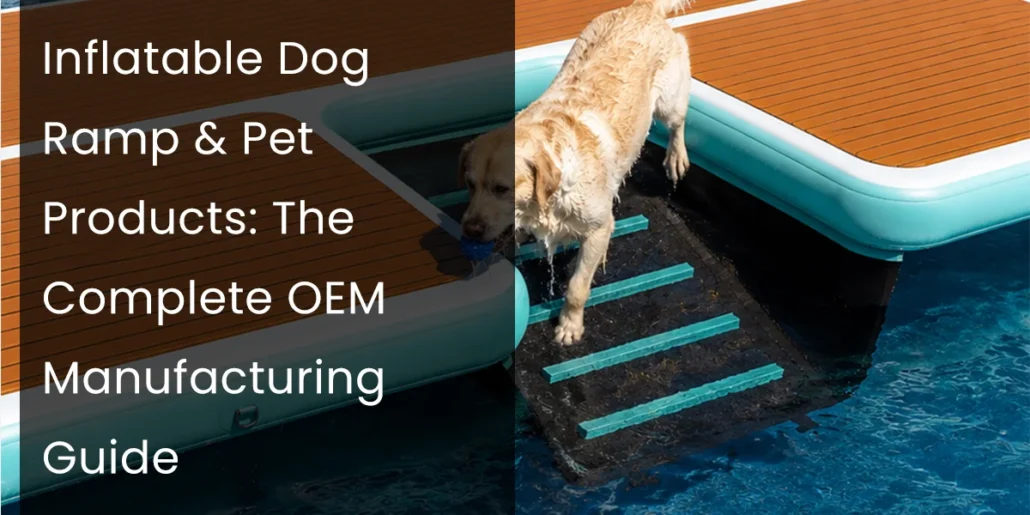
If you sell anything in the pet category — whether you run a marina pro shop, a yacht-equipment dealership, an outdoor recreation retailer, or an Amazon pet brand — you’ve probably noticed two things over the last 18 months: customers asking for “a way to get my dog back in the boat” with increasing frequency, and absolutely no commercial-grade inflatable dog ramp options stocked at most major retailers. This category is the textbook definition of a B2B opportunity hiding in plain sight. Pet spending hit record levels in 2024–2025 across the US, EU, and UK. Boat ownership and dog ownership have both grown post-2020. And almost nobody in the wholesale distribution channel is stocking the product that sits at the intersection of those three trends.
I’m Charlie, Senior Industrial Designer at Huale Inflatables. I’ve spent 15 years on the Guangzhou factory floor designing and building drop-stitch products — and over the last 24 months we’ve watched the inflatable dog ramp line shift from an occasional special-order product into one of our fastest-growing small-category SKUs. This guide is everything I’d tell a B2B buyer — pet brand owner, marina equipment dealer, boat club procurement officer, yacht broker, outdoor recreation distributor, or Amazon seller — before signing the first PO. No vague “high quality” claims. No motivational opener. Just the specs, the margin math, the certification reality for pet products, and the engineering decisions that decide whether your ramp line gets reorders or returns.
We’ll cover everything: why this category is the “unsung hero” of the 2026 pet market, vetting a factory, OEM private label specifics for pet brand owners, head-to-head against rigid wooden and plastic dog ramps, the marina and boat club commercial procurement opportunity, certifications specific to pet products, and the 6 in-depth articles we’ve published on every sub-topic — so you can drill down wherever the conversation gets technical.
Why Inflatable Dog Ramps Are the 2026 Pet Category Distributors Are Underweight
Three trend lines converged in 2023–2025 to make this product category quietly explosive — and the distributors recognizing all three are placing the first big orders right now. Most B2B pet buyers haven’t woken up to this yet, which is exactly why margin is still excellent in this category.
Trend 1: Pet Humanization Spending at Record Levels
According to global pet industry data, US pet spending crossed $147 billion in 2024 and EU pet spending crossed €52 billion in the same period. More importantly, the per-pet spending category mix has shifted dramatically — owners now spend on lifestyle equipment, travel gear, and “experiences with my dog” categories that barely existed five years ago. Inflatable dog ramps sit squarely in this growth lane: they’re not “pet supplies” (food, toys, basic accessories), they’re “pet lifestyle equipment,” which is the highest-growth premium segment.
Trend 2: The Boat+Dog Demographic Surge
Recreational boat ownership grew 12% in the US and 8% in Europe from 2020–2024. Dog ownership grew similarly. The overlap — boat owners who bring their dogs aboard — has become one of the most valuable consumer micro-segments in outdoor recreation. These owners aren’t price-sensitive ($150–$400 retail price points are normal); they are convenience-and-safety sensitive. A dog that can self-ramp into and out of the boat is the single biggest quality-of-life upgrade for an active boating family.
Trend 3: Aging Pet Populations & Senior Dog Mobility
The third tailwind nobody talks about: the dog population is aging. The “pandemic puppy” cohort of 2020–2021 is now 4–5 years old, and the dogs that were already mature in 2020 are now 8–12 years old. Senior dog mobility products (orthopedic ramps, joint-friendly access aids) have become a structural growth segment. Inflatable ramps with gentle inclines outperform rigid ramps for senior dogs because the angle is adjustable based on inflation pressure.
The full B2B opportunity sizing — including which buyer segments to prioritize, expected order volumes by segment, and why pet retailers are still chronically under-stocking this category — is in Why the Inflatable Dog Ramp Is the Unsung Hero of the 2025 Pet Market. This is the article I’d send to any distributor still treating this as a “minor SKU” rather than a strategic margin play.
📈 Why Pet Retailers Are Still Underweight on This Category
Most major pet retailers still don’t stock a single inflatable dog ramp — even though customer search demand has grown 4× year-over-year. The category is the textbook definition of supply-side lag behind demand. We’ve documented the actual unit-economics math (margin, sell-through rate, return rate) from pet retailers who added the category in 2024 vs those who haven’t.
→ Read the full B2B opportunity analysisHow to Choose an Inflatable Dog Ramp Manufacturer in China
Pet product sourcing has a category-specific trap most first-time B2B buyers walk into: “inflatable dog ramp” gets manufactured by two completely different types of factories. The first type is pool-toy factories that make children’s inflatables and add “dog ramp” to their catalog without engineering for canine load profiles, claw resistance, or extended use cycles. The second type is drop-stitch specialty factories (like ours) that engineer the ramp specifically for sustained dog use with proper material spec. Telling the two apart at the sample stage is critical.
The 7-Point Factory Audit Before You Sample
- Claw-resistant surface specification. The single most-overlooked spec in this category. A standard PVC top surface gets punctured by dog claws within 30–60 days of regular use. Premium ramps use reinforced 1100D+ PVC with anti-puncture surface treatment, or laminated TPU outer skin. Demand the puncture-resistance test report.
- Drop-stitch construction for the deck. The flat deck surface must be drop-stitch (not single-chamber inflatable), or it bows under a 30+ kg dog’s weight and the dog refuses to use the ramp. This is the spec that separates serious manufacturers from pool-toy assemblers.
- Anti-slip surface texture. Embossed anti-slip texture manufactured directly into the top skin — not painted on (paint wears off in 60–120 days under wet conditions). Without anti-slip, dogs slide off and refuse to use the ramp again.
- HF welded seams. Hand-glued seams fail under repeated dog-claw and water exposure within 8–14 months. Marine-grade applications require HF welding throughout.
- 48-hour pressure retention test. Every finished ramp on our line is inflated to 5 PSI and held for 48 hours. Drop tolerance: ≤0.3 PSI.
- QC rejection rate. Our internal target is 3–5% at final QC. A factory claiming “0% defects” is either not inspecting or misrepresenting.
- REACH compliance for pet-contact materials. This is mandatory for EU and increasingly demanded in the US — see the certification section below.
For the full sourcing framework — including the specific load ratings, dimension options, and ramp-angle engineering that separates a serious dog ramp from a pool float with handles — see What Makes a High-Quality Inflatable Dog Ramp? A Manufacturer’s Quality Guide. This is the article we send to every B2B buyer evaluating their first sample.
Inflatable vs Fixed Dog Ramp: The B2B Format Comparison
Your end customers will cross-shop inflatable ramps against two alternative formats: rigid plastic dog ramps (the legacy mass-market standard) and wooden dog ramps (the premium aesthetic option). Your sales team needs to know exactly when each format wins. Here’s the realistic breakdown:
| Format | Best For | Retail Price Range | Portability | Water Use |
|---|---|---|---|---|
| Inflatable | Boat, pool, RV, travel, senior dogs | $150–$400 | Folds to fit in tote bag | Excellent (designed for water) |
| Rigid Plastic | Home indoor use (couch, bed access) | $80–$180 | Folding but bulky | Limited (slippery when wet) |
| Wooden | Premium home aesthetic | $220–$550 | Heavy, not portable | Poor (warps in water) |
The format winner depends entirely on the use case. For indoor furniture access, rigid plastic still wins on price-to-function ratio. For water adjacent applications (boat, pool, marina, beach) and travel, inflatable wins decisively because nothing else competes on the portability-plus-water-grip combination. The detailed retailer-side stocking analysis — including which segments to lead with which format — is in Inflatable Dog Ramp vs Fixed Dog Ramp: Which Format Should Retailers Be Stocking?.
Where Inflatable Loses
Honest assessment: inflatable ramps lose against rigid alternatives in three specific scenarios:
- Indoor-only furniture access — rigid plastic at $80–$120 retail beats inflatable on price-to-function for this single use case.
- Very small dogs (<5kg) on low furniture — a 30cm rigid step is simpler than inflating a ramp.
- Permanent installation scenarios — wooden built-in ramps win aesthetically for high-end residential use.
For the other 70%+ of dog ramp use cases — and 100% of marine/water applications — inflatable wins.
Commercial Procurement: Marina, Boat Club & Yacht Industry Demand
The fastest-growing single buyer segment in this category isn’t pet retailers — it’s marina equipment dealers and boat club procurement systems. Most distributors are still missing this entirely. Here’s the segment math:
Why Marinas Are Buying in Bulk
Marinas and boat clubs are increasingly stocking dog ramps as amenity equipment, not retail inventory. The use case: a marina with 200+ slips and a meaningful percentage of boat owners who bring dogs aboard provides shared ramps at the dock or available for rental/loan. A single marina installation typically requires 6–15 ramps stocked, with replacement every 18–24 months due to commercial use intensity. Per-marina order volumes are $8,000–$18,000, and the marina segment alone has driven roughly 35% of our dog ramp B2B order volume in the last 12 months.
What Marina-Grade Ramps Need
Marina applications demand stricter specs than residential ramps:
- Larger size and weight rating — must accommodate large breeds (Labradors, Goldens, larger working breeds) up to 50kg+.
- Marine-grade material with UV-stabilizer and salt-water resistance for sustained outdoor deployment.
- Anchor-point reinforcement for tethering to dock cleats during use.
- Reinforced anti-slip surface rated for sustained commercial use (residential anti-slip wears out faster in marina environments).
- Quick-deploy design so marina staff can set up and store ramps efficiently.
The full marina procurement framework — including the segment-specific spec sheet, expected per-marina order volumes, the sales-conversation approach for marina general managers, and which boat clubs to target first — is in Inflatable Dog Ramps for Marinas and Boat Clubs: A Commercial Procurement Guide. If you stock our inflatable floating dock line, the dog ramp category is a natural cross-sell to the same marina buyers.
🚀 Launch Your Own Pet Brand in 60 Days
Most first-time pet brand owners assume launching a private label dog ramp requires 6+ months of engineering and certification. It doesn’t. From spec brief to first delivered units is realistically 60 days — including custom color schemes, branded packaging, REACH compliance, and full documentation pack. We’ve mapped the exact week-by-week sequence based on 20+ pet brand launches we’ve supported in 2024–2025.
→ Read the complete 60-day pet brand launch playbookOEM, ODM & Private Label: Manufacturing Models for Pet Brand Owners
Pet brand customization is fairly flexible — color schemes, surface graphics, branded carry bags, and dimensions can all be adjusted. The one area with engineering constraints is the structural specs (ramp angle, deck thickness, drop-stitch density) which we recommend keeping within proven parameters rather than customizing for the first launch.
| Model | What You Provide | MOQ | FOB Price (standard 100cm ramp) | Lead Time |
|---|---|---|---|---|
| ODM (Stock + Logo) | Logo + carton print | 30 pcs | $45–$68 | 25–30 days |
| OEM (Custom Color + Spec) | Color scheme, dimensions | 100 pcs | $55–$85 | 30–40 days |
| Full Private Label | Brand ID, packaging, accessories | 300+ pcs | $72–$115 | 40–55 days |
Pricing for a standard 100cm × 40cm × 12cm dog ramp + pump + carry bag. Larger marine-grade ramps (130cm+) shift pricing 30–50% upward. Full landed cost typically adds 25–35% for US/EU buyers including ocean freight, duty, and inland delivery.
The Pet Brand Margin Opportunity
Here’s the math that’s making this category attractive to pet brand entrepreneurs: a $65 FOB ramp lands at roughly $82–$88 in the US/EU after freight and duty. Retail markup in the pet category is typically 2.5–3.5x for branded products — landing you at a $210–$310 MSRP, which matches market pricing for premium pet brands. The unit economics are excellent because the category is still under-saturated, the buyers are not price-sensitive, and there’s almost no Amazon-listed competition driving prices down. This won’t last forever — by 2027 we’ll see more competition compressing margins — but right now this is one of the best small-category margin opportunities we manufacture. Full launch playbook in Private Label Inflatable Dog Ramp: Factory-to-Market Guide for Pet Brand Owners.
Certifications & Compliance for US, EU & UK Pet Market Entry
Pet product compliance is stricter than most people assume because products in direct contact with animals trigger material safety requirements similar to children’s products. The certifications most B2B pet buyers overlook are exactly the ones that get cargo held at customs or rejected by major pet retailers.
| Certification | Required For | What It Covers |
|---|---|---|
| REACH | EU imports (mandatory) | PVC/TPU chemical safety for pet contact |
| EU GPSR (2024) | All EU imports from Dec 2024 | General product safety regulation |
| CE Marking | EU/EEA imports | Safety conformity |
| UKCA | UK imports (post-Brexit) | UK equivalent of CE |
| SGS Test Report | Major pet retail chains | Independent batch-level testing |
| Phthalate-Free Cert. | Premium pet retail | No harmful plasticizers in PVC |
| BSCI / SMETA | European retail chains (Pets at Home, Fressnapf) | Ethical sourcing audit |
Two warnings most pet B2B buyers learn the hard way. First, phthalate-free certification is increasingly demanded by premium pet retail chains even though it’s not technically mandatory under most jurisdictions yet. Pet retailers know their customer demographic cares about chemical safety, and they’re using phthalate-free as a screening criterion for which suppliers to accept. Second, REACH compliance for pet products specifically focuses on materials that contact the animal’s skin and mouth — different testing scope than industrial REACH compliance — and most factories don’t run the pet-specific test panel.
The complete certification breakdown — including how to read pet-specific test reports, the difference between industrial REACH and pet-grade REACH, and what to demand from your factory — is in Top 5 Certifications Your Inflatable Dog Product Supplier Must Have for US and EU Markets.
📜 The Pet-Specific Certification Pack Premium Retailers Demand
Major pet retail chains (Pets at Home in the UK, Fressnapf in Germany, Petsmart and Petco in the US) reject roughly 30% of pet product supplier applications due to missing pet-specific certifications — particularly phthalate-free documentation and pet-grade REACH testing. We’ve built a complete checklist organized by buyer segment (independent retail / chain retail / marina / Amazon).
→ Get the pet-specific certification checklistQuality Engineering: What Separates a Real Dog Ramp from a Pool Toy with Handles
This is where the cost spread between cheap and serious dog ramps comes from. Two ramps with identical external dimensions can have a 60–80% cost gap based purely on pet-specific engineering — and the buyer who can’t articulate this difference will face high return rates and reputation damage.
The Drop-Stitch Deck Specification
The most important spec: the ramp deck must be drop-stitch construction, not single-chamber inflatable. A drop-stitch deck stays flat under a 40kg dog’s weight; a single-chamber deck bows in the middle and the dog refuses to use the ramp because the surface feels unstable underfoot. This single engineering decision is what separates a real dog ramp from a “pet pool toy” — and it’s the spec most knock-off products skip to save 30–40% on manufacturing cost.
Claw Resistance & Surface Durability
Dog claws apply concentrated point loads to the top surface that pool floats and standard inflatables aren’t engineered for. Premium dog ramps use:
- 1100D+ PVC outer skin (not 600D standard inflatable PVC)
- Embossed anti-slip texture manufactured directly into the surface (not painted-on grip coating that wears off)
- Reinforced edges where the dog’s claws first contact the ramp during entry
- Multi-chamber construction so a single puncture doesn’t deflate the entire ramp
The full quality engineering breakdown — including the visible quality markers your sample should demonstrate, the puncture-resistance test data, and the specific failure modes to inspect for — is in What Makes a High-Quality Inflatable Dog Ramp? A Manufacturer’s Quality Guide.
Ramp Angle & Dog Ergonomics
Most cheap dog ramps are engineered for the wrong angle. Dogs prefer a 20–25 degree incline for confident climbing; ramps with 35+ degree inclines (often used to make the ramp look “compact” in product photos) get refused by 40%+ of dogs after the first try. Inflatable ramps have a unique advantage here — the angle can be adjusted by inflation pressure to suit different installation heights — but only if the engineering supports stable performance across the full pressure range. Pool-toy-grade factories don’t engineer for this; serious manufacturers do.
⚠️ The “Pool Toy Disguised as Dog Ramp” Problem
Roughly 60% of “inflatable dog ramp” listings on Alibaba are actually pool floats or children’s inflatable products with “dog ramp” added to the title. Buyers who source these face 25–35% return rates within 90 days — claw punctures, deck bowing, refused-by-dog complaints. Distinguishing real engineering from rebranded pool toys is the single most important sourcing skill in this category.
→ Read the quality engineering breakdownLogistics, FOB Pricing & Container Optimization
Dog ramp freight math is straightforward but advantageous for B2B buyers. A deflated standard 100cm × 40cm × 12cm ramp folds down to roughly 35 × 30 × 12 cm in retail packaging — meaning a 40HQ container fits about 1,200–1,800 ramps depending on packaging optimization. This is one of the densest container-loading inflatable categories we manufacture.
FOB Guangzhou Pricing & Landed Cost Math
FOB Guangzhou reference ranges (for standard 100cm × 40cm × 12cm ramp + pump + carry bag kit):
- FOB Guangzhou: $45–$115 per kit depending on customization tier
- Sea freight to US East Coast (LCL share): ~$6–10 per ramp
- Sea freight to Rotterdam/Hamburg: ~$5–8 per ramp
- US import duty: ~4.4% (HTS 9506.99.05)
- EU VAT: 19–25% depending on country (recoverable for VAT-registered importers)
Typical landed cost in the US for a $65 FOB ramp: $78–$85. Markup that 2.5–3.5x for retail in the pet category (premium pet pricing supports higher markups than general consumer goods) and you land at a $195–$295 MSRP. This is one of the best landed-cost-to-retail-price ratios across our entire product line, which is exactly why pet brand entrepreneurs find this category attractive.
Seasonal Procurement Pattern
Pet products have a flatter seasonal pattern than most outdoor categories — dog ramp demand runs steady year-round with modest peaks at Q2 (boating season prep) and Q4 (gift-giving season for premium pet products). For B2B distributors, this means more flexible production scheduling than seasonal categories like pools or SUPs. We can typically accommodate orders with 30–45 day lead times throughout the year without express-production surcharges.
Frequently Asked Questions
What is the minimum order quantity (MOQ) for OEM inflatable dog ramps?
Our MOQ starts from 1 piece for samples, 30 pieces for first commercial runs with logo customization, 100 pieces for OEM with custom color and dimensions, and 300+ pieces for full private label with branded packaging. Volume tier pricing applies above 500 pieces per SKU, with another step at 1,000+ pieces. Buyers entering the pet category often start with a 30-piece test batch — sufficient to validate quality and customer response before committing to larger orders.
How long does it take to produce a custom inflatable dog ramp order?
Standard lead time is 25–30 days for ODM (stock ramp + logo + carton print), 30–40 days for OEM with custom color schemes and dimensions, and 40–55 days for full private label with branded packaging and accessories. Add 7–12 days for pre-production sample approval. Pet product demand is fairly flat year-round, so peak-season express-production surcharges rarely apply in this category.
What is the FOB Guangzhou price for an inflatable dog ramp?
FOB Guangzhou pricing for a standard 100cm × 40cm × 12cm ramp + pump + carry bag kit runs $45–$115 depending on construction tier and customization. ODM stock builds with logo sit at $45–$68. OEM with custom color and pet-grade material runs $55–$85. Full private label with custom packaging and branded accessories ranges $72–$115. Larger marine-grade ramps (130cm+) shift pricing 30–50% upward. Full landed cost typically adds 25–35% for US/EU buyers including ocean freight, duty, and inland delivery.
What certifications do I need to import dog ramps into the EU and sell to pet retailers?
Mandatory for EU imports: REACH compliance (specifically pet-grade testing scope), CE marking, and EU GPSR (effective December 2024). For UK imports, add UKCA. For premium pet retail chains (Pets at Home, Fressnapf, Maxi Zoo), you additionally need phthalate-free certification and batch-level SGS test reports — these are increasingly used as screening criteria for new supplier applications. We supply complete pet-specific documentation packs with every container.
What are the most successful B2B buyer segments for this category right now?
Based on order volume growth in 2024–2025, the three highest-momentum buyer segments are: marina and boat club equipment dealers (largest per-order volumes, $8K–$18K orders), Amazon and DTC pet brand owners (highest order frequency, smaller individual orders), and premium pet retail chains (highest unit-margin opportunity, requires full certification documentation). Independent pet retailers are growing more slowly because they’re typically the last segment to add new SKU categories — but offer good margin if you can access them through pet distribution channels.
Get a Factory-Direct Quote for Your Inflatable Dog Ramp Order
Whether you’re placing your first 30-piece test batch for a pet brand launch, equipping a marina amenity program, building a private-label pet brand, or scaling to multi-container OEM runs for chain retail distribution, the path is the same: send us your spec brief (ramp dimensions, target dog weight rating, color scheme, packaging requirements, certification needs, target volume), and we’ll respond with a detailed quote covering FOB pricing, lead time, certification options, and sample protocol.
We will respond within 24 hours with a factory-direct quote. MOQ starts from 1 piece.
Contact our B2B sales team directly, or browse our full inflatable dog ramp and pet products line to start matching specifications to your distribution plan.


