
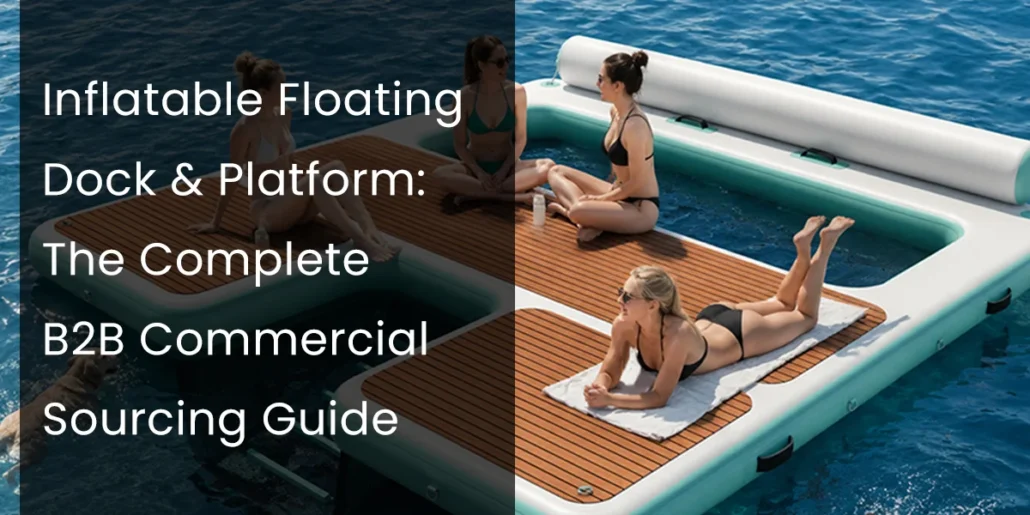
If you’ve spent any time in marina procurement, yacht fit-out, or beachfront resort operations, you already know the structural problem with traditional floating dock infrastructure: a permanent fixed dock costs $25,000–$80,000 per 10-meter section to install, requires marine permits in most jurisdictions, takes 4–8 months from design to deployment, and depreciates against rising sea levels and shifting shorelines. A 10-meter inflatable floating dock delivers 80% of the functional capability at 8% of the capital cost, inflates in 30 minutes, requires zero installation permits in most regions, and packs into a single trailer for relocation. The unit economics are why marinas, yacht charters, resort operators, and event-rental companies have moved this category from “novelty” to “standard procurement line” between 2022 and 2026.
I’m Charlie, Senior Industrial Designer at Huale Inflatables. I’ve spent 15 years on the Guangzhou factory floor designing and building drop-stitch products — and the inflatable floating dock and platform line is currently one of the highest-margin, fastest-growing B2B categories we ship. This guide is everything I’d tell a B2B buyer — marina operator, yacht broker, resort procurement officer, event rental fleet manager, dock dealer, or commercial distributor — before signing the first PO. No vague “high quality” claims. No motivational opener. Just the specs, the load-rating math, the certification requirements, and the engineering decisions that decide whether your dock program survives 3+ years of saltwater commercial use.
We’ll cover everything: vetting a factory, OEM vs ODM cost tiers, load-rating and modular configuration specs, the head-to-head against fixed and wooden docks, certifications for EU/US marine market entry, the modular yacht-dock-and-sea-pool ecosystem opportunity that’s driving 2026 procurement, and the 9 in-depth articles we’ve published on every sub-topic — so you can drill down wherever the conversation gets technical.
Why Inflatable Floating Docks Are the 2026 Marine Infrastructure Category Distributors Are Watching
Three structural shifts converged in 2023–2025 to transform this category from a marine specialty product into a mainstream B2B procurement decision. Distributors who recognize all three are the ones placing orders right now — not the ones still treating inflatable docks as a niche category.
Shift 1: The Yacht & Superyacht Owner-Equipment Boom
According to global superyacht industry data, the active superyacht fleet has grown roughly 4× since 2015, and the >30m yacht category specifically has expanded ~7% annually for five consecutive years. Every one of those vessels needs swim-platform extensions, tender docking, and guest entertainment surfaces — and inflatable docks have become the standard onboard equipment because they store flat when not deployed, deploy in 25 minutes, and don’t take up critical aft-deck storage. Yacht-grade inflatable docks are now a $250K+ annual line item for typical superyacht charter operators.
Shift 2: Marina Modernization Without Permitting Headaches
Permanent marina expansion in most coastal jurisdictions (US East/West Coast, Mediterranean, UK, Australia) now requires multi-year environmental impact studies and permit processes that can cost $200K–$1.2M before a single piling goes in the water. Inflatable floating docks bypass nearly all of this — they’re classified as “removable equipment” in most jurisdictions, not “permanent marine structures.” A marina operator can add 40m of dock capacity in 6 weeks for under $30K, vs 18+ months and $400K+ for fixed dock expansion. The full ROI comparison vs traditional wooden docks is documented in Inflatable vs Wooden Docks: Why Marinas & Resorts Are Switching.
Shift 3: The Modular Yacht-Dock-and-Sea-Pool Ecosystem
This is the trend most distributors are still missing. Yacht owners and luxury resort operators no longer buy “a dock” — they buy a modular system that combines floating dock sections, integrated swimming areas (sea pools), water slides, and guest entertainment platforms into a connected aft-deck or beachfront ecosystem. We’re seeing single B2B orders in the $40K–$120K range for complete modular setups serving one superyacht or one resort beachfront. The modular ecosystem opportunity is documented in Manufacturer’s Guide: Upgrading to Modular Inflatable Yacht Docks & Sea Pools. If you also stock our yacht sea-pool line, you can offer the complete ecosystem rather than competing on individual SKUs.
The full distributor-side opportunity analysis — including which buyer segments to prioritize, expected order volumes by segment, and the realistic margin structure for inflatable dock distribution — is in Discover the Benefits of Inflatable Platforms: A 2026 Manufacturer’s Guide. This is the article I’d send to any distributor still on the fence about adding this line in 2026.
📈 The Modular Yacht-Dock-and-Sea-Pool Opportunity Most Distributors Are Missing
Single SKU dock sales are still healthy. But the real margin in 2026 is in the modular ecosystem — selling yacht owners and resort operators a complete connected system rather than individual docks. We’ve documented the full opportunity, including the realistic average order value ($40K–$120K vs $3K–$8K for single SKU), the buyer-conversation framework, and the SKU lineup distributors should stock to capture this segment.
→ Read the modular ecosystem opportunity analysisHow to Choose an Inflatable Floating Dock Manufacturer in China
Dock sourcing has a hidden trap that hurts first-time B2B buyers: most factories listing “inflatable floating dock” on Alibaba are actually selling repurposed inflatable platforms with no engineering adjustment for sustained saltwater immersion, dynamic load cycling, or the specific buoyancy distribution requirements that marine-grade docks demand. A pool-grade drop-stitch platform works fine in fresh water for occasional use. It fails within 8–14 months under daily saltwater commercial deployment. Vetting any factory before sampling means asking about marine-specific engineering, not just generic inflatable specs.
The 7-Point Factory Audit Before You Sample
- Marine-grade material specification. Standard PVC degrades under sustained saltwater exposure. Marine-grade docks require 1100D+ marine-grade PVC tarpaulin or laminated TPU outer skins with UV-stabilizer additives. Ask for the material spec sheet and salt-spray test data.
- Load-rating documentation. Static load capacity (people standing) and dynamic load capacity (people jumping off) are different specs. Commercial-grade docks must hold 250 kg per square meter static / 180 kg/m² dynamic minimum. Demand the test report.
- D-ring and anchor-point reinforcement. The single most common failure point on cheap inflatable docks. Premium docks use reinforced patches with 4–6 layers of bonded PVC at every D-ring; budget docks use single-layer attachment that tears within 6 months of marina use.
- HF welding for all sidewall seams. Hand-glued seams fail under sustained saltwater and UV exposure within 12 months. Demand HF-welded construction throughout.
- 48-hour pressure retention test. Every finished dock on our line is inflated to 5 PSI and held for 48 hours with simulated wave-cycling pressure variations. Drop tolerance: ≤0.3 PSI.
- QC rejection rate. Our internal target is 3–5% at final QC. A factory claiming “0% defects” is either not inspecting or misrepresenting.
- BSCI / SMETA audit status. Required for any European marina chain or premium retail distribution.
For the full sourcing framework — including the specific dimensions, load ratings, and configuration options for different B2B applications — see How to Choose the Right Inflatable Floating Dock Platform. The buyer-side perspective focused on dock-for-boat applications is in The Ultimate Guide to The Best Inflatable Docks for Boats.
The 5 Commercial Use Cases Driving B2B Dock Demand in 2026
Understanding what your end customers actually do with these docks is what separates distributors who win deals from those who lose to “I’ll just buy from Alibaba.” Five distinct B2B use cases drive most order volume right now, and each has different spec requirements:
1. Yacht Swim Platform Extensions
Connects directly off the yacht’s existing swim platform to extend usable deck space for swimming, sunbathing, water sports launches, and tender docking. Spec requirements: rectangular shape, 4m–8m length, integrated tether attachment points sized for marine cleats, and reinforced edges for hull contact.
2. Marina Expansion & Slip Capacity
Marina operators add inflatable floating dock fingers between existing fixed slips to increase boat capacity without permitting overhead. Spec requirements: longer rectangular sections (8m–12m), higher static load rating (300+ kg/m²), and modular connection systems to link multiple sections.
3. Resort Beachfront & Lake Frontage Amenities
Resorts deploy floating docks off beach or lake frontage as entertainment surfaces — yoga platforms, kid play areas, swim platforms with deep-water access. Spec requirements: large square or freeform shapes (typically 6m × 6m or 8m × 8m), anti-slip surface texture, and integrated stair access.
4. Event Rental & Water Activity Platforms
Wedding venues, corporate event organizers, and water-sports tour operators rent floating platforms for event surfaces, photography backdrops, and group activities. Spec requirements: modular shapes that can reconfigure for different events, branded surface graphics, and quick-deploy capability for crew of 2–3 people.
5. Commercial Diving & Water Sports Base Platforms
Scuba diving operators and water sports schools use floating platforms as gear staging, equipment storage, and student rest stations. Spec requirements: oversized surface area, integrated equipment storage bags, and high freeboard (water-line-to-deck height) to keep gear dry.
The full breakdown of each use case — including the specific dimensional and material specs that B2B buyers in each segment demand — is in Top 5 Commercial Use Cases for Inflatable Floating Dock Platforms (With Real Specs). Read this before your next B2B sales call — knowing the use-case-specific spec sheet is what wins distribution deals.
🚀 Launch Your Own Floating Dock Brand in 60 Days
Most first-time brand owners assume launching a custom dock brand requires 6+ months of engineering. It doesn’t. From spec brief to first delivered units is realistically 60 days — including custom dimensions, load-rating certification, branded surface graphics, marine-grade material spec, and full documentation pack. We’ve mapped the exact week-by-week sequence based on 30+ dock brand launches we’ve supported.
→ Read the complete 60-day brand launch playbookOEM, ODM & Modular Configuration: Manufacturing Models for Dock Brands
Dock customization is more complex than other inflatable categories because modular configurations are now standard, not an upgrade. Most premium B2B buyers want connected systems (dock + sea pool + slide platform) rather than standalone units. Three realistic manufacturing models:
| Model | What You Provide | MOQ | FOB Price (6m × 2m platform) | Lead Time |
|---|---|---|---|---|
| ODM (Stock + Logo) | Logo + carton print | 5 pcs | $685–$985 | 30–35 days |
| OEM (Custom Color + Standard Shape) | Color scheme, dimensions | 20 pcs | $845–$1,285 | 35–45 days |
| Full Modular System | System design, brand spec | 10 systems | $1,650–$3,850/section | 45–60 days |
Pricing for a standard 6m × 2m × 15cm rectangular dock platform + pump + repair kit + carry bag. Larger commercial docks (8m × 3m, 12m × 3m yacht-grade) scale roughly proportionally on FOB cost. Modular systems with connection hardware and integrated accessories carry premium pricing because the engineering complexity is significantly higher.
The Modular System Margin Opportunity
Here’s the math that’s driving 2026 B2B distribution strategy: a single $885 FOB dock retails at roughly $1,800–$2,200 MSRP — a 100–150% markup that’s standard for the category. A $12,000 FOB modular system (3 dock sections + integrated sea pool + slide platform + connection hardware) retails to a superyacht owner at $32,000–$45,000 — a 165–275% markup, because the buyer is purchasing an integrated solution rather than commodity equipment. Distributors who only sell single SKUs are competing on Amazon-equivalent pricing. Distributors who sell modular systems are competing on engineering-equivalent pricing. Full system-launch playbook in Private Label Inflatable Dock Platform: How to Launch Your Own Brand in 60 Days.
Inflatable Floating Dock vs Fixed & Wooden Docks: The B2B Cost Comparison
Your end customers will cross-shop inflatable docks against two alternative formats: traditional wooden floating docks (the legacy standard for residential lake homes and small marinas) and fixed-piling docks (the standard for permanent marina installations). Your sales team needs to know exactly when each format wins. Here’s the realistic breakdown:
| Format | Best For | Capex (10m section) | Install Time | B2B Lifespan |
|---|---|---|---|---|
| Inflatable Floating | Yacht, resort, event, mobile, marina expansion | $1,800–$4,500 | 30–45 min | 5–7 years |
| Wooden Floating | Residential lake, small marina legacy | $3,200–$6,800 | 4–8 hours | 8–12 years (with annual maintenance) |
| Fixed Piling | Permanent commercial marina | $15,000–$45,000+ | Weeks–months (permitting + installation) | 20–30 years |
The capex comparison alone is decisive for many operators — but the real wins for inflatable are deployment speed and permit-free operation. The full B2B distributor-side comparison, including the sales argument for each buyer segment, is in Inflatable Dock vs Fixed Dock: The Business Case for Stocking Inflatables. The marina-and-resort-specific ROI analysis with real operator data is in Inflatable vs Wooden Docks: Why Marinas & Resorts Are Switching.
When Inflatable Loses
Three scenarios where I’d honestly recommend fixed or wooden docks over inflatable:
- Permanent commercial marina with 24/7 daily commercial vessel docking — fixed piling wins on long-term cost per docking event.
- Heavy vessel mooring (>50 ton boats) — inflatable docks aren’t engineered for sustained heavy vessel mooring loads.
- Cold-climate year-round installations — winter ice damage destroys inflatable docks left in place. Inflatable is best for seasonal or removable installations.
For the other 75%+ of B2B applications — yacht use, resort amenities, event rentals, seasonal marina expansion, mobile water sports operations — inflatable wins on total cost of ownership.
⚠️ The Real ROI Math Marinas Use to Justify Switching
Marina operators evaluating a switch from wooden docks to inflatable use a specific 7-factor ROI framework — covering capital cost, installation time, permit overhead, annual maintenance, weather damage exposure, off-season storage cost, and slip-revenue uplift from faster capacity expansion. The full framework with real operator data showing 18-month payback in most cases is the single most-referenced article we have when marina buyers compare formats.
→ Read the marina ROI frameworkMarine-Grade Construction: Materials & Engineering for Saltwater Use
This is where most “inflatable platform” suppliers fail B2B buyers, and where the cost spread between cheap and serious docks comes from. Two docks with identical external dimensions can have a 60–80% cost gap based purely on marine-specific construction — and the buyer who can’t articulate this difference will overpay for budget product or undersell premium product.
Marine-Grade vs Standard-Grade Materials
- Standard inflatable platform: 850D PVC outer skin, no UV stabilizer, no anti-microbial treatment. Designed for occasional fresh-water use. Lifespan in saltwater commercial use: 8–14 months.
- Marine-grade dock: 1100D+ marine-grade PVC tarpaulin with UV-stabilizer and anti-fungal additives, or laminated TPU with reflective barrier. Designed for sustained saltwater immersion. Lifespan in commercial use: 5–7 years.
D-Ring & Anchor-Point Engineering
The D-ring attachment points (where the dock connects to anchors, mooring lines, or other dock sections) are where 60%+ of premature dock failures occur. Marine-grade construction uses 4–6 layers of bonded PVC at each D-ring, with stainless steel attachment hardware embedded between the reinforcement layers. Budget docks use single-layer attachment that tears within 4–8 months under daily commercial mooring loads. Always inspect D-ring construction on samples — this is the visible quality marker that separates serious manufacturers from assemblers.
Buoyancy Distribution & Stability Engineering
An inflatable dock isn’t just a floating platform — it’s a buoyancy distribution system. Marine-grade docks have independently inflated chambers (typically 3–5 chambers per platform section) so that a single puncture doesn’t sink the entire dock. Budget docks use single-chamber construction where any leak deflates the whole unit. For commercial use, multi-chamber construction is non-negotiable — and worth the 15–25% cost premium.
Surface Anti-Slip & Footing
Commercial-grade docks have embossed anti-slip surface texture manufactured directly into the top skin, not painted on. Painted anti-slip wears off in 6–12 months of foot traffic. Embossed texture lasts the full lifespan of the dock. This single spec difference is one of the biggest visible quality markers for B2B buyers evaluating samples.
Certifications & Compliance for US, EU & UK Market Entry
Floating dock compliance is stricter than most inflatable categories because marine-use products trigger additional safety regulations covering load ratings, water-contact materials, and (in some jurisdictions) marine-safety equipment classification.
| Certification | Required For | What It Covers |
|---|---|---|
| CE Marking | EU/EEA imports | Safety conformity (essential) |
| EU GPSR (2024) | All EU imports from Dec 2024 | General product safety regulation |
| REACH | EU imports | PVC/TPU chemical compliance |
| UKCA | UK imports (post-Brexit) | UK equivalent of CE |
| SGS Load Test Report | Marina + commercial tenders | Independent batch-level load testing |
| Salt-Spray Test Cert. | Marine commercial use | Material salt-corrosion resistance |
| BSCI / SMETA | European retail chains + marinas | Ethical sourcing audit |
Two warnings most floating dock buyers learn the hard way. First, marina procurement systems demand SGS load-test reports specific to your shipment batch, not a generic certificate from a sample tested years prior. Without batch-level load testing, you’re locked out of premium marina distribution. Second, the salt-spray test certificate is the single most-overlooked compliance document in this category — most factories don’t run salt-spray testing because they’re not actually manufacturing marine-grade product. Demand this certificate before signing the PO.
The complete certification breakdown — including how to read the test reports, what to demand from your factory, and which certifications matter for which buyer segment — is in Inflatable Dock Supplier Certifications: CE, SGS, BSCI Guide for Importers.
📜 The Marina Procurement Document Pack That Wins Tenders
Marina tenders alone reject roughly 28% of imported floating dock bids due to missing load-test reports, salt-spray certificates, or batch-level documentation. We’ve built a complete checklist of every document your supplier must hand over before shipment — organized by buyer segment (marina / yacht / resort / event rental).
→ Get the segment-by-segment certification checklistLogistics, FOB Pricing & Container Optimization
Floating dock freight math is straightforward but specific to the category. A deflated 6m × 2m × 15cm dock platform folds down to roughly 90 × 60 × 35 cm in retail packaging — meaning a 40HQ container fits about 80–110 standard dock platforms. Larger 10m × 3m commercial sections fit about 35–50 per 40HQ. Modular systems with connection hardware reduce container efficiency by 15–20% due to accessory packaging.
FOB Guangzhou Pricing & Landed Cost Math
FOB Guangzhou reference ranges (for standard 6m × 2m × 15cm rectangular dock + pump + repair kit + carry bag):
- FOB Guangzhou: $685–$1,285 per kit for single units, $1,650–$3,850/section for modular system components
- Sea freight to US East Coast (LCL share): ~$85–145 per dock
- Sea freight to Rotterdam/Hamburg: ~$65–115 per dock
- US import duty: ~4.7% (HTS 9506.99.05)
- EU VAT: 19–25% depending on country (recoverable for VAT-registered importers)
Typical landed cost in the US for a $985 FOB dock: $1,150–$1,250. Markup that 1.8–2.5x for retail and you land at a $2,100–$3,100 MSRP — which matches market pricing for mid-to-premium tier dock brands. Larger commercial docks and modular systems scale FOB pricing but typically maintain similar or higher markup ratios because there’s less commodity competition.
Seasonal Booking & Production Strategy
The floating dock category has two distinct B2B booking peaks. European summer market requires orders placed November–February for May delivery. North American marina market requires orders placed February–April for May–June delivery. Yacht-grade orders flow year-round driven by superyacht delivery schedules and charter season prep. Miss the seasonal booking window and you’re paying 15–25% express-production surcharges or accepting late-season delivery.
Frequently Asked Questions
What is the minimum order quantity (MOQ) for OEM inflatable floating docks?
Our MOQ starts from 1 piece for samples, 5 pieces for first commercial runs with logo customization, 20 pieces for full OEM with custom color and dimensions, and 10 systems for full modular configurations. Volume tier pricing applies above 100 pieces per SKU, with another step at 300+ pieces. Buyers entering the marine market often start with a 5–10 piece test batch to validate quality and market response before committing to full container quantities.
How long does it take to produce a custom inflatable floating dock order?
Standard lead time is 30–35 days for ODM (stock platform + logo + carton print), 35–45 days for OEM with custom color schemes and dimensions, and 45–60 days for full modular systems with connection hardware and integrated accessories. Add 12–18 days for pre-production sample approval. Peak production windows (November–February for European summer; February–April for US marina season) should be booked 10–14 weeks ahead.
What is the FOB Guangzhou price for an inflatable floating dock platform?
FOB Guangzhou pricing for a standard 6m × 2m × 15cm rectangular dock platform + pump + repair kit + carry bag runs $685–$1,285 depending on construction tier and customization. ODM stock builds with logo sit at $685–$985. OEM with custom color runs $845–$1,285. Larger 10m × 3m commercial sections range $1,650–$2,850. Modular system components (designed to connect with sea pools, slides, and other platforms) run $1,650–$3,850 per section depending on connection hardware complexity. Full landed cost typically adds 25–35% for US/EU buyers.
What certifications do I need to import inflatable docks into the EU and sell to marinas?
Mandatory for EU imports: CE marking, EU GPSR (effective December 2024), and REACH compliance. For UK imports, add UKCA. For marina procurement systems and commercial tenders, you additionally need batch-level SGS load-test reports and salt-spray test certificates — most factories skip these because they’re not manufacturing true marine-grade product. We supply complete marine-specific documentation packs with every container.
Can I order a fully modular dock system (dock + sea pool + slide), and how does pricing work?
Yes. The modular yacht-and-resort ecosystem is the fastest-growing segment of this category in 2026. We engineer complete modular systems with connection hardware that links dock sections to inflatable sea pools, water slides, swim platforms, and entertainment surfaces into one connected setup. MOQ for modular systems starts at 10 complete systems, and per-section pricing typically adds 15–25% over equivalent standalone dock sections due to the engineering complexity of integrated connection hardware. Most successful brands we’ve helped launch start with a single signature 3-piece modular setup and expand the system after market validation.
Get a Factory-Direct Quote for Your Inflatable Floating Dock Order
Whether you’re placing your first 5-piece test batch for a marina trial, building a custom yacht-grade dock fleet, equipping a resort beachfront expansion, or scaling to multi-container OEM runs for a premium marine brand, the path is the same: send us your spec brief (dock dimensions, load rating, color scheme, modular configuration needs, certification requirements, target volume), and we’ll respond with a detailed quote covering FOB pricing, lead time, certification options, and sample protocol.
We will respond within 24 hours with a factory-direct quote. MOQ starts from 1 piece.
Contact our B2B sales team directly, or browse our full inflatable floating dock and platform product line to start matching specifications to your distribution plan.


