
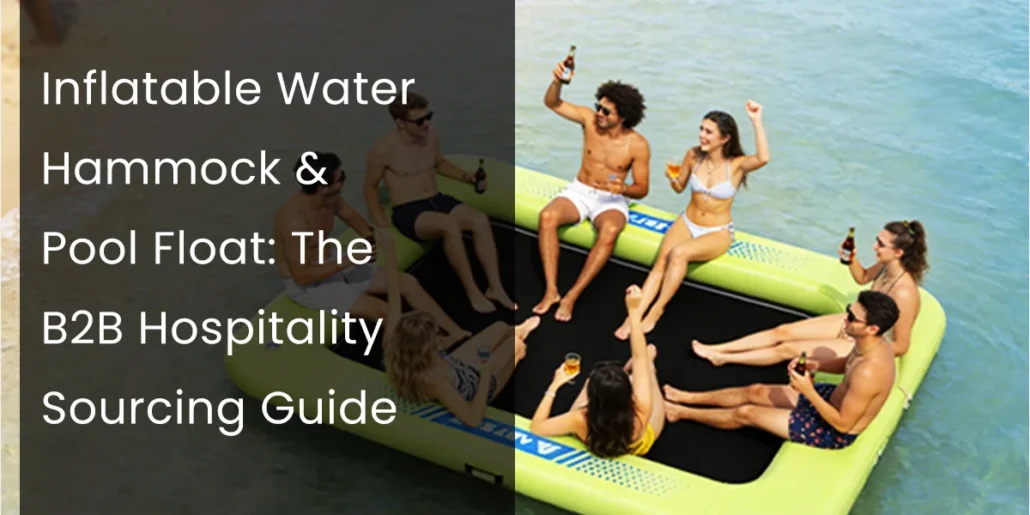
If you’ve spent any time on TikTok or Instagram Reels in the last 18 months, you’ve seen them — circular mesh “floating dock” hammocks deployed off the swim platforms of charter yachts in Mallorca, hexagonal water hammock pods at Maldives resort pools, the viral $4M Bahamas overwater bungalow where guests lounge on rope-mesh platforms suspended just above the lagoon. This is the single fastest-growing inflatable hospitality category we manufacture in 2026, and almost every major resort group, yacht charter operator, and premium hotel chain we work with has either placed orders or is actively quoting in the last six months. The B2B opportunity isn’t a niche — it’s the new standard amenity for high-end water-adjacent properties.
I’m Charlie, Senior Industrial Designer at Huale Inflatables. I’ve spent 15 years on the Guangzhou factory floor designing and building drop-stitch inflatable products. Over the last 24 months, I’ve personally signed off on water hammock and mesh dock production runs shipping to resorts in 18+ countries — from the Maldives and the Greek islands to luxury yacht charters in the Caribbean. This guide consolidates what we’ve learned from those orders. No “best in industry” claims. No motivational opener. Just the engineering decisions, the procurement realities, and the search-trend data that explain why this category is going to absorb billions of dollars of hospitality CapEx between now and 2028.
We’ll cover everything: why the mesh dock trend is structurally bigger than a viral TikTok moment, vetting a factory for hospitality-grade product, OEM private label for pool float brands, the resort and hotel commercial procurement opportunity, the yacht and floating island ecosystem play, certifications for premium hospitality B2B markets, and the 8 in-depth articles we’ve published on every sub-topic — so you can drill down wherever the conversation gets technical.
Why Inflatable Water Hammocks & Mesh Docks Are the Viral B2B Category of 2026
Three structural forces converged between 2023 and 2025 to transform water hammocks from a pool-float novelty into the single most-discussed amenity category in luxury hospitality procurement. Distributors and brand owners who recognize all three are placing orders right now — not the ones who still treat water hammocks as “summer seasonal SKUs” alongside generic pool floats.
Force 1: The Social Media Aesthetic Engine
The mesh floating dock specifically has become one of the most photographed pieces of hospitality equipment on the planet. Hospitality industry research consistently shows that 60–70% of luxury hotel bookings are now influenced by social-media imagery — and resorts that install Instagram-friendly amenities see direct booking conversion lifts of 15–30%. A mesh floating dock or hexagonal hammock pod is essentially a CapEx investment that pays back through marketing reach, not just through guest experience. The detailed analysis of why mesh dock specifically went viral and which resort categories are buying first is in Inflatable Water Hammocks: Why Floating Mesh Docks Are The Viral Hit of 2026.
Force 2: The Post-Pandemic Hospitality CapEx Recovery
Resort and hotel groups deferred major amenity investments through 2020–2022. By 2024, that pent-up CapEx began flowing aggressively into “differentiation amenities” — features that distinguish one beachfront property from another in a market where the base product (rooms, pools, restaurants) has become commoditized. Water hammocks and mesh docks sit in the sweet spot: $2,000–$8,000 per installation, 18–36 month payback through bookings premium, and instant social-media-shareable visibility. The hospitality CapEx framework with realistic ROI projections for hotel operators is in Inflatable Water Hammock for Hotels: ROI, Durability and Guest Experience Guide.
Force 3: The Yacht Floating Island Ecosystem
The third force is the yacht-side opportunity. Superyacht and charter yacht owners increasingly buy connected modular “floating island” systems — combining water hammocks, mesh docks, slides, and entertainment platforms into one connected aft-deck setup. Per-yacht orders run $25K–$80K for complete floating island ecosystems. The full opportunity sizing and ecosystem composition is documented in Beyond the Boat: Creating a “Private Floating Island” Ecosystem for Yachts & Resorts. If you also stock our inflatable floating dock line and yacht sea-pool line, the water hammock category completes a high-value cross-sell triangle for any distributor serving the marine luxury segment.
For the resort-specific transformation story — including which resort chains are adopting fastest and how guest-experience metrics shift after installation — see How Inflatable Water Hammocks Are Transforming Resort Pool Experiences in 2026.
📈 The Mesh Dock Standard: Why This Specific Format Is Going Viral
Standard water hammocks have existed for 10+ years. The mesh floating dock format — where guests can sit submerged with cool water around them — is what tipped the category into viral territory in 2024–2025. The engineering, the design specs, and the reason this specific format outperforms traditional hammocks in both photo appeal and guest comfort is documented in the article we send to every resort procurement officer evaluating this category.
→ Read the 2026 mesh dock standard breakdownHow to Choose an Inflatable Water Hammock Manufacturer in China
Water hammock sourcing has a hidden trap that hurts first-time hospitality B2B buyers: roughly 70% of “water hammock” listings on Alibaba are repurposed pool-float manufacturers without engineering for hospitality-grade load profiles, sustained UV exposure, or chlorinated/salt water resistance over multi-year deployment. A pool-float-grade product holds up for 60–90 days of casual residential use. A hospitality-grade water hammock needs to survive 18–36 months of daily commercial deployment in resort pool environments. Telling the two apart at sample stage is critical.
The 7-Point Factory Audit Before You Sample
- Hospitality-grade material specification. Standard pool-float PVC degrades under sustained UV and chlorine exposure within 12–18 months. Hospitality-grade water hammocks require 1100D+ PVC tarpaulin with UV-stabilizer additives, or laminated TPU outer skin. Demand the UV-resistance test data and chlorine-immersion test reports.
- Mesh quality and attachment integrity for mesh dock products. The mesh material itself is the failure point on cheap units — it must be reinforced PVC-coated polyester with UV stabilizers, and the mesh-to-frame attachment must use HF-welded reinforcement, not glued straps.
- Anti-puncture surface treatment for water hammock decks. Pool environments include sunscreen residue, sand grit, and occasional debris that compromise standard inflatable surfaces. Hospitality-grade products use reinforced top surfaces specifically engineered for these conditions.
- HF welded seams throughout. Hand-glued seams fail under sustained UV and water exposure within 14–18 months. Demand HF welding throughout the construction.
- 48-hour pressure retention test. Every finished product on our line is inflated to 4–6 PSI (varies by product type) and held for 48 hours. Drop tolerance: ≤0.3 PSI.
- QC rejection rate. Our internal target is 3–5% at final QC. A factory claiming “0% defects” is either not inspecting or misrepresenting.
- BSCI / SMETA audit status. Required for any premium hotel chain procurement system.
For the full vetting framework — including the specific load ratings, dimensions, and configuration options for different hospitality applications — see Water Hammock Manufacturer Checklist: What Every B2B Buyer Should Verify Before Ordering. This is the single most-downloaded article on our site from hotel procurement officers, because the spec questions in it map directly to the questions premium hospitality buyers need answered before committing.
The Four Hospitality Application Scenarios Driving B2B Demand
Understanding what your end customers actually do with these products is what separates distributors who win deals from those who lose to “I’ll source generic floats from Alibaba.” Four distinct hospitality use cases drive most B2B order volume in 2026, and each has different spec requirements and procurement cycles:
1. Resort Pool Lounge Amenity
Resorts deploy water hammocks as in-pool guest amenities — typically 6–15 units per resort installation, replaced every 18–24 months due to commercial use intensity. Per-resort orders run $8,000–$22,000, and this segment alone has driven roughly 40% of our water hammock B2B order volume in the last 12 months.
2. Beachfront & Lagoon Floating Lounge Zones
Beachfront resorts and lagoon-property hotels deploy hammocks and mesh docks as offshore floating lounge zones. Spec requirements: larger sizes, marine-grade UV stabilization, anchor-point reinforcement for tethering to seafloor anchors. The hotel-specific commercial framework with ROI projections is in Inflatable Water Hammock for Hotels: ROI, Durability and Guest Experience Guide.
3. Yacht & Charter Boat Floating Island Ecosystems
Charter yacht operators and superyacht owners buy connected systems — water hammocks combined with mesh docks, swim platforms, and slide platforms into floating island setups. Per-yacht orders run $25K–$80K for complete ecosystems. Spec requirements: marine-grade materials, modular connection systems, quick-deploy designs that yacht crew can handle without dedicated installation teams.
4. Event Rental & Private Villa Installations
Private villa rentals, wedding venues, and short-term luxury rental operators have become the fastest-growing buyer sub-segment. These operators rent properties at $3,000–$15,000/night and use water hammocks as differentiation amenities. Per-property orders run $4,000–$12,000 and replacement cycles are shorter (12–18 months) due to high-turnover guest use.
For the resort-transformation story specifically — including which resort categories are adopting fastest, the guest-experience metrics that shift after installation, and the procurement-officer-side decision framework — see How Inflatable Water Hammocks Are Transforming Resort Pool Experiences in 2026.
Color, Design Trends & Customization Driving 2026 Hospitality Orders
Unlike most inflatable B2B categories where the spec sheet drives the order, water hammocks and pool floats are aesthetic-driven products. Color schemes, surface graphics, and shape design directly determine whether a property’s hammock setup goes viral on social media or fades into the background. Three design trends are driving most premium B2B orders right now:
Trend 1: Earth Tones & Natural Aesthetics
The “Instagram blue and white pool float” aesthetic peaked in 2022. By 2024–2025, premium resort buyers shifted toward earth tones — sand, terracotta, sage green, dusty rose — that photograph as part of a curated property aesthetic rather than standing out as commercial product. Hammocks in these palettes command 25–35% premium pricing because they signal “designed for this property” rather than “ordered from a catalog.”
Trend 2: Hexagonal & Organic Shapes Replacing Rectangles
Rectangular hammocks still dominate budget tier sales, but premium hospitality has shifted toward hexagonal, oval, and organic freeform shapes. Hexagonal mesh dock platforms in particular have become a signature 2026 design — they photograph beautifully from drone angles, link into modular floating island layouts, and command roughly 40% premium pricing over equivalent rectangular units.
Trend 3: Modular Connection Systems
The 2026 standard is “connectable” products — multiple hammocks or mesh docks that link into larger floating zones rather than standalone units floating independently. Resorts buying 8–12 connectable hexagonal pods can create dramatic floating zones; buyers ordering 8 separate rectangular hammocks get a generic-looking pool. The full design trends breakdown for B2B buyers — including the specific colors, shapes, and styles selling best by region and segment — is in Trending Inflatable Pool Floats for 2026: Colors, Styles and Designs Selling Best for Brands.
🚀 Launch Your Own Pool Float & Hammock Brand
Most first-time brand owners assume launching a premium pool float brand requires a fashion-design background. It doesn’t. What it requires is the right manufacturer who understands the difference between commodity pool floats and hospitality-grade product. We’ve documented the full OEM design and launch process for new pool float brands — from concept brief to delivered units in 50–60 days, including color palette selection, shape engineering, and packaging.
→ Read the complete OEM design guide for pool float brandsOEM, ODM & Private Label: Manufacturing Models for Pool Float Brands
Pool float and water hammock customization is highly flexible — color schemes, surface graphics, custom shapes (hexagonal, organic freeform, branded silhouettes), and modular connection systems can all be engineered into the order. Three realistic manufacturing models:
| Model | What You Provide | MOQ | FOB Price (standard mesh hammock) | Lead Time |
|---|---|---|---|---|
| ODM (Stock + Logo) | Logo + carton print | 20 pcs | $85–$135 | 25–30 days |
| OEM (Custom Color + Shape) | Color, shape, graphics | 50 pcs | $115–$185 | 30–40 days |
| Full Modular System | System design, brand spec | 30 systems | $285–$485/unit | 40–55 days |
Pricing for a standard 2m × 1.2m water hammock or equivalent-sized mesh dock unit + pump + carry bag. Larger commercial units (3m+ hexagonal dock pods, 4m+ floating island components) shift pricing 50–120% upward. Full landed cost typically adds 25–35% for US/EU buyers including ocean freight, duty, and inland delivery.
The Hospitality Margin Opportunity
Here’s the math that’s making this category attractive to hospitality-focused brand owners: a $135 FOB mesh hammock lands at roughly $165–$185 in the US/EU after freight and duty. Retail markup for hospitality-grade products is typically 2.5–3.5x — landing at $440–$650 MSRP, which matches market pricing for premium pool float brands sold through hotel procurement channels. Direct-to-resort sales bypass the retail markup entirely — you sell at $350–$500 per unit directly to procurement officers buying in 8–15 unit batches, which is a much more attractive distribution model than competing on Amazon listings.
Certifications & Compliance for Premium Hospitality B2B Markets
Hospitality water hammock compliance is stricter than mass-market pool float compliance because premium hotel chains and resort groups have procurement-officer-level due diligence that mass retail doesn’t enforce. The certifications most B2B pool float buyers overlook are exactly the ones that get supplier applications rejected by tier-1 hospitality buyers.
| Certification | Required For | What It Covers |
|---|---|---|
| CE Marking | EU/EEA imports | Safety conformity (essential) |
| EU GPSR (2024) | All EU imports from Dec 2024 | General product safety regulation |
| REACH | EU imports | PVC/TPU chemical safety |
| UKCA | UK imports (post-Brexit) | UK equivalent of CE |
| UV-Stability Test | Hospitality commercial use | Sustained outdoor UV resistance |
| SGS Test Report | Tier-1 hotel chains | Independent batch-level testing |
| BSCI / SMETA | Marriott, Hilton, Accor procurement | Ethical sourcing audit |
Two warnings most hospitality B2B buyers learn the hard way. First, major hotel chain procurement systems (Marriott Sourcing, Hilton Supply Management, Accor’s PASS platform) require active SMETA audits, not BSCI alone — and the SMETA pillar requirements have tightened in 2024. Without active SMETA, you’re locked out of the largest hospitality procurement channels. Second, the UV-stability test certificate is the single most-overlooked compliance document in this category — most “pool float” factories don’t run UV testing because they’re not actually engineering for sustained commercial deployment. Demand this certificate before signing the PO.
📜 The Hospitality Procurement Document Pack That Wins Tier-1 Hotel Tenders
Tier-1 hotel chains (Marriott, Hilton, Accor, IHG) reject roughly 35% of supplier applications due to missing certifications — particularly active SMETA audits and UV-stability test reports for outdoor amenity products. The full manufacturer checklist organized by buyer segment is what we hand to every distributor pursuing tier-1 hospitality channels.
→ Get the segment-by-segment manufacturer checklistQuality Engineering: What Separates Hospitality-Grade from Pool-Float-Grade
This is where the cost spread between cheap and serious water hammocks comes from. Two products with identical external dimensions can have a 60–80% cost gap based purely on hospitality-specific engineering — and the buyer who can’t articulate this difference will face high return rates from hospitality clients and reputation damage in the procurement community.
The UV Stability Specification
The most important spec for outdoor hospitality deployment: UV-stabilizer additives in the PVC formulation. Standard pool-float PVC fades 30–40% in color saturation within 4–6 months of sustained outdoor UV exposure. UV-stabilized PVC retains 85%+ color saturation through 18–24 months of equivalent exposure. This single material decision is what allows hospitality customers to keep their pool float fleet looking new for the full depreciation cycle, rather than replacing fading products every 6 months.
Chlorine & Salt-Water Resistance
Resort pool environments are chlorinated; beach and lagoon environments are saltwater. Standard pool-float PVC degrades under both — chlorine attacks the plasticizer chemistry, saltwater attacks the seam adhesives. Hospitality-grade construction uses chlorine-resistant PVC formulations + HF welded seams (not glued) to withstand both environments. Demand the chlorine immersion test report and the salt-spray test report.
Multi-Chamber Construction for Safety
Single-chamber inflatable hammocks deflate completely from a single puncture — which is acceptable for residential use but creates safety liability in hospitality settings. Premium hospitality-grade hammocks use 3–5 independently inflated chambers so that a single puncture doesn’t sink the unit with a guest on it. This is increasingly demanded by hotel-chain risk management teams as a procurement requirement.
Anchor-Point Reinforcement
Outdoor hospitality deployment requires tethering to anchors (pool edges, dock cleats, seafloor anchors for beach installations). Premium products use 4–6 layers of bonded PVC at every anchor point, with stainless steel attachment hardware embedded between the reinforcement layers. Budget products use single-layer attachment that tears within 4–8 months of commercial use.
⚠️ The “Pool Float Disguised as Hospitality Equipment” Problem
Roughly 70% of “commercial water hammock” listings on Alibaba are repurposed residential pool floats with “commercial grade” added to the title. Hospitality buyers sourcing these face 30–40% replacement rates within 12 months — UV fading, seam delamination, single-chamber safety concerns. The mesh dock format specifically has stricter engineering requirements than traditional hammocks, and the 2026 commercial standard is documented in detail.
→ Read the 2026 commercial mesh dock standardLogistics, FOB Pricing & Container Optimization
Water hammock and pool float freight math is straightforward but advantageous for B2B buyers. A deflated standard 2m × 1.2m water hammock folds down to roughly 45 × 35 × 18 cm in retail packaging — meaning a 40HQ container fits about 600–850 hammocks depending on packaging optimization. Larger hexagonal mesh dock pods (3m+ diameter) fit 180–280 units per 40HQ. Modular systems with connection hardware reduce container efficiency by 12–18% due to accessory packaging.
FOB Guangzhou Pricing & Landed Cost Math
FOB Guangzhou reference ranges (for standard 2m × 1.2m water hammock + pump + carry bag kit):
- FOB Guangzhou: $85–$185 per unit for hammocks, $285–$485 per unit for hexagonal mesh dock pods, $400–$650/unit for modular system components
- Sea freight to US East Coast (LCL share): ~$8–18 per hammock, $30–55 per mesh dock pod
- Sea freight to Rotterdam/Hamburg: ~$6–14 per hammock, $25–45 per mesh dock pod
- US import duty: ~4.7% (HTS 9506.99.05)
- EU VAT: 19–25% depending on country (recoverable for VAT-registered importers)
Typical landed cost in the US for a $135 FOB water hammock: $155–$175. Markup that 2.5–3.5x for hospitality-grade products sold to procurement officers lands at $400–$600 MSRP — matching premium pool float brand pricing. For B2B distributors selling direct to hospitality procurement (bypassing retail markup), $350–$500 per unit on 8–15 unit orders represents the realistic per-unit price point.
Hospitality Procurement Seasonal Pattern
Hospitality orders have two distinct procurement peaks. Northern hemisphere resort fit-outs place orders October–February for spring/summer deployment. Caribbean/Southern hemisphere place orders March–August for their winter/autumn high season. Yacht fit-outs flow year-round driven by charter season schedules and superyacht delivery cycles. Premium hospitality buyers typically book production 10–14 weeks ahead to avoid express-production surcharges.
Frequently Asked Questions
What is the minimum order quantity (MOQ) for OEM water hammocks and mesh docks?
Our MOQ starts from 1 piece for samples, 20 pieces for first commercial runs with logo customization, 50 pieces for OEM with custom color and shape, and 30 systems for full modular floating island configurations. Volume tier pricing applies above 200 pieces per SKU, with another step at 500+ pieces. Hospitality buyers running pilot installations often start with a 15–25 piece test batch — sufficient to equip 1–2 resort properties or one charter yacht fit-out before scaling to multi-property deployment.
How long does it take to produce a custom water hammock order?
Standard lead time is 25–30 days for ODM (stock product + logo + carton print), 30–40 days for OEM with custom color schemes and shapes, and 40–55 days for full modular floating island systems. Add 10–15 days for pre-production sample approval. Peak hospitality procurement windows (October–February for Northern Hemisphere resorts, March–August for Southern Hemisphere) should be booked 10–14 weeks ahead.
What is the FOB Guangzhou price for a water hammock or mesh dock?
FOB Guangzhou pricing for a standard 2m × 1.2m water hammock + pump + carry bag kit runs $85–$185 depending on construction tier and customization. ODM stock builds with logo sit at $85–$135. OEM with custom color and hospitality-grade UV stabilization runs $115–$185. Hexagonal mesh dock pods (3m+ diameter) range $285–$485. Modular floating island system components run $400–$650 per unit depending on connection hardware complexity. Full landed cost typically adds 25–35% for US/EU buyers.
What certifications do I need to sell water hammocks to premium hotel chains?
Mandatory for EU imports: CE marking, EU GPSR (effective December 2024), and REACH compliance. For UK imports, add UKCA. For tier-1 hotel chain procurement (Marriott, Hilton, Accor, IHG), you additionally need active SMETA audit (not just BSCI), batch-level SGS test reports, and UV-stability test certification — these are increasingly used as screening criteria for new supplier applications. We supply complete hospitality-specific documentation packs with every container.
Is the mesh floating dock trend going to last beyond 2026, or is it a viral fad?
Based on hospitality CapEx commitments we’re seeing from major resort groups for 2027–2028 delivery, this category is structural rather than fad-driven. Three reasons: (1) mesh docks solve a real guest-experience problem (cool-water lounging without swimming) that traditional pool floats don’t address; (2) the unit economics work for property owners regardless of social media exposure — 18–36 month payback through booking premium; (3) the modular floating island ecosystem creates a moat for resorts that invest early. Categories with this combination of guest demand, unit economics, and competitive differentiation don’t typically reverse. The deeper analysis of why this specific trend has structural staying power is in Why Floating Mesh Docks Are The Viral Hit of 2026.
Get a Factory-Direct Quote for Your Water Hammock Order
Whether you’re equipping a single resort installation, building a yacht-grade floating island ecosystem, launching a private-label pool float brand, or scaling to multi-container OEM runs for hospitality distribution, the path is the same: send us your spec brief (product type, dimensions, color scheme, modular configuration needs, certification requirements, target volume), and we’ll respond with a detailed quote covering FOB pricing, lead time, certification options, and sample protocol.
We will respond within 24 hours with a factory-direct quote. MOQ starts from 1 piece.
Contact our B2B sales team directly, or browse our full inflatable water hammock and pool float product line to start matching specifications to your distribution plan.