
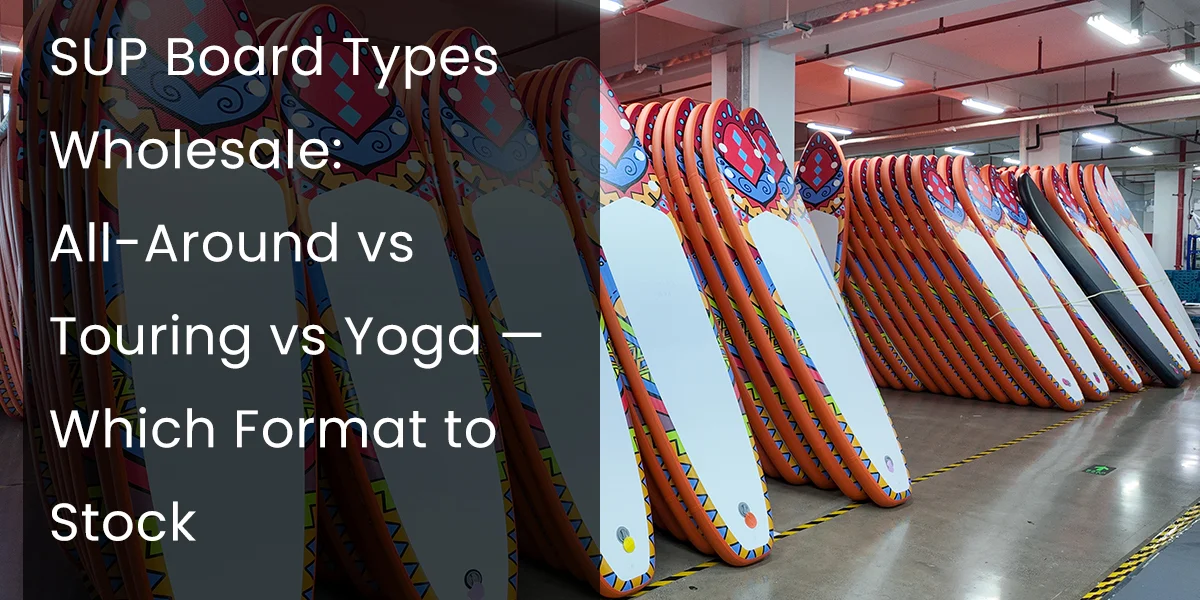
For a distributor or paddle board brand, choosing SUP models is not the same as choosing one board for personal use. The real question is how many different board types your range needs, which model should carry most of the inventory, and which specialist models deserve smaller but strategically important positions.
I’m Charlie from Huale. We manufacture inflatable SUP boards for distributors, private-label brands, rental businesses and e-commerce sellers. When we help buyers plan a wholesale SUP range, we normally start with customer type, paddling environment, price ladder, board overlap, packed size and reorder strategy before discussing graphics or logo placement.
Short answer: for most wholesale ranges, an All-Around SUP works as the core volume model, Touring boards provide a clear performance step-up, Yoga boards serve a wider stability-focused niche, and Race boards should normally be treated as specialist performance SKUs rather than mass-volume inventory.
This article focuses on which SUP board types to stock and how they should work together in one commercial range. If your main question is factory capability, materials or OEM production, visit our inflatable paddle board factory page.
Which SUP Board Types Should a Wholesale Buyer Stock?
Short answer: do not give every SUP category equal inventory weight. Build the range around a broad-use core model, then use Touring, Yoga and Race boards to create clear steps for different buyer needs.
| SUP Type | Best-Fit Customer | Stocking Role | Main Buying Reason |
|---|---|---|---|
| All-Around SUP | Beginners, families, casual paddlers, rental users | Core inventory | Broad usability and easier customer matching |
| Touring SUP | Intermediate paddlers, longer-distance users, premium buyers | Step-up model | Better tracking and distance efficiency |
| Yoga SUP | Yoga studios, fitness buyers, stability-focused users | Niche / lifestyle model | Wide usable deck and stability-focused layout |
| Race SUP | Experienced paddlers, clubs, performance-focused buyers | Specialist SKU | Speed-oriented outline and lower drag |
The right mix depends on your market. A family-oriented retailer should not copy the assortment of a performance SUP shop, and a rental operator should not build the same range as a race-focused distributor.
Why Should All-Around SUP Boards Usually Form the Core of a Wholesale Range?
Short answer: All-Around boards cover the widest group of users, so they usually give distributors the simplest starting point for inventory planning.
When a new wholesale customer asks us which SUP model should come first, we normally ask who their largest customer group will be. If the answer is beginners, families, recreational paddlers or general outdoor retailers, an All-Around board is usually easier to position than a specialist design.
What Makes an All-Around Board Easier to Stock?
- Broader rider fit: suitable for a wider mix of beginner and recreational users.
- Balanced outline: provides stability without becoming as wide or specialized as a dedicated Yoga board.
- Simple sales message: retailers can explain the product without requiring customers to understand technical SUP categories.
- Shared-use potential: useful for families, holiday buyers and some rental applications.
- Multiple price positions: material structure, paddle package, pump, bag and branding can create entry and premium versions.
The main risk is over-expanding the All-Around range. If three boards have nearly the same length, width, shape and target user, the dealer may create internal SKU competition without giving the customer a clear reason to choose one model over another.
For category-level products, see our All-Around SUP board range.
When Should a Distributor Add Touring SUP Boards?
Short answer: add Touring boards when your customers are ready to pay for better tracking, longer-distance paddling and a more performance-oriented shape than a general All-Around board.
From a stocking perspective, Touring boards work best when they create a clear reason to trade up. If the Touring model looks and paddles almost the same as your All-Around SKU, the buyer may only see a price difference.
| Buyer Check | All-Around | Touring |
|---|---|---|
| Primary user | Beginner / recreational | Intermediate / distance-oriented |
| Shape direction | Balanced, forgiving outline | Longer, more directional outline |
| Sales message | Versatility | Tracking and distance efficiency |
| Range role | Core SKU | Premium step-up |
A Touring board should solve a different customer problem rather than simply add another graphic to the same shape.
For model direction, review our Touring SUP board range.
Does Every Wholesale SUP Range Need a Yoga Board?
Short answer: no. A Yoga SUP makes sense when the buyer has a clear fitness, wellness, resort or lifestyle audience. It should not be added simply to make the catalog look larger.
When we review Yoga SUP projects, the discussion changes from straight-line paddling performance to usable deck space, stability, deck-pad layout, handle position and accessory interference.
What Wholesale Buyers Should Check on a Yoga SUP
- Width and outline: enough stability for stationary movement and balance work.
- Usable EVA area: deck layout should support kneeling, sitting and standing positions.
- Handle placement: a center handle should not create unnecessary interference during floor-based movements.
- D-ring layout: confirm attachment points without overcrowding the working deck.
- Accessory strategy: decide whether the SKU is sold as a pure Yoga board or a broader lifestyle SUP.
A Yoga SKU can create useful differentiation for wellness retailers, resorts and fitness-oriented brands, but a dealer should estimate real demand before allocating too much inventory to a specialist category.
For a deeper product-selection discussion, see our SUP Yoga board selection guide.
When Is a Race SUP Worth Adding to Wholesale Inventory?
Short answer: a Race SUP is worth stocking when the dealer already serves experienced paddlers, race clubs or customers who understand the trade-off between speed and stability.
Race boards are not simply narrower versions of All-Around boards. The outline, waterline, stiffness target and rider expectations are different. That makes them valuable for a specialist range, but less suitable as a high-volume beginner SKU.
What Makes Race Inventory Different?
- Narrower customer group: the buyer usually knows what performance characteristics they want.
- Greater specification sensitivity: width, length, stiffness and fin setup have more influence on customer expectations.
- Higher demonstration requirement: dealers may need clearer product education or test opportunities.
- Lower tolerance for vague positioning: experienced paddlers notice when a board is marketed as “race” but designed like a general recreational model.
For wholesalers, the main decision is not whether a race board looks impressive in the catalog. It is whether enough customers in the target market understand and want that performance category.
For technical race-board positioning, use our SUP race board wholesale guide.
How Should Dealers Build a SUP Range Without Too Many Similar SKUs?
Short answer: every board in the range should have a clear customer, use case and price role. If two models solve the same problem, one of them may become unnecessary inventory.
In factory discussions, we often see buyers start with colors and graphics before they decide how each model fits the assortment. We prefer to define the commercial role first.
| Range Role | Recommended Board Type | Customer Question It Answers |
|---|---|---|
| Core | All-Around | “I want one board that works for general paddling.” |
| Step-Up | Touring | “I want to paddle farther and track better.” |
| Lifestyle Niche | Yoga | “I need more stable deck space for fitness or wellness use.” |
| Performance Specialist | Race | “I prioritize speed and performance over beginner stability.” |
This structure also makes retailer training easier. Sales staff can match the customer to a board category instead of explaining several nearly identical products.
Should Every SUP Model Use the Same Material Construction?
Short answer: not necessarily. The construction should match the board’s price position, weight target, stiffness requirement and expected user.
A wholesale range may include standard drop-stitch construction on one model and lighter or higher-spec material systems on another. What matters is that the buyer understands why the material changes and how that difference supports the SKU positioning.
Construction Points to Confirm
- Drop-stitch type: standard knitted or woven structures may be discussed depending on the project.
- PVC construction: confirm whether the board uses the agreed laminated or fusion structure.
- Rail construction: rail design affects air retention, finish and manufacturing consistency.
- Deck pad: EVA layout should match the target activity.
- Fin system: removable or other configurations should match retail and replacement-part needs.
- Valve and pressure specification: final working pressure must follow the confirmed board construction.
Do not describe every model as woven drop stitch if only selected models use it. The approved specification should identify the actual structure for each SKU.
For a technical comparison, see our woven vs knitted drop stitch SUP guide.
What Should Buyers Customize Across a Wholesale SUP Range?
Short answer: keep the brand system consistent while allowing each SUP type to communicate a different purpose.
When a buyer orders four board categories, making every model completely different can create unnecessary artwork, material and packaging complexity. A better OEM plan is often to share brand language across the range while changing the shape, color coding and features that help the customer understand each category.
| OEM Element | Keep Consistent | Change by SUP Type |
|---|---|---|
| Brand logo | Logo style and core placement rules | Scale or secondary graphic treatment |
| Color system | Overall brand palette | Category-specific color accents |
| Deck layout | Visual brand language | EVA coverage and attachment layout |
| Accessories | Bag and manual branding | Paddle, fin or package tier where needed |
| Carton | Brand template | Model name, SKU, dimensions and barcode |
For private-label development, buyers should approve the artwork, specification and accessory list for each SKU before bulk production.
Should Wholesale Buyers Sample Every SUP Type Before Bulk Production?
Short answer: sample the models that introduce a new shape, material structure, accessory package or artwork system before committing to volume.
A sample can start from 1 piece. Bulk MOQ depends on the confirmed board structure, artwork, color, accessory package, packing and order quantity.
What to Check During Sample Approval
- Board dimensions and inflated shape
- Deck-pad position and finish
- Fin-box alignment
- Handle, D-ring and accessory positions
- Logo color, scale and orientation
- Valve installation and air retention
- Paddle, pump, leash, fin, bag and repair-kit package
- Carton, barcode and model identification
If multiple SUP types share the same branding system, sample approval should still record each model separately. A Touring board should not be approved only because the All-Around artwork looked correct.
What QC Matters Most When Stocking Multiple SUP Models?
Short answer: the more SKUs a distributor carries, the more important specification control becomes. QC should confirm that each model matches its approved structure, dimensions, artwork and accessory package.
Factory QC Points for Wholesale SUP Orders
- Drop-stitch and PVC material check
- Inflated dimensions and outline check
- Rail and seam inspection
- Valve sealing inspection
- Deck-pad bonding and alignment
- Fin-box position and fit
- D-ring and handle inspection
- Pressure-retention testing according to the approved production process
- Logo and graphic inspection
- Accessory and carton verification
For distributors, a repeat-order problem is not only a product defect. It can also be receiving a different shade, paddle package, fin type or carton layout from the previous batch. That is why the approved specification should remain the reference for repeat production.
For a deeper QC discussion, see our SUP quality control and return-rate guide.
How Do Packing and Freight Affect SUP Stocking Decisions?
Short answer: do not evaluate an assortment only by FOB unit price. Different board sizes and accessory packages can change carton dimensions, CBM, warehouse space and final landed cost.
For each SKU, buyers should request:
- Packed carton dimensions
- Gross weight
- Carry-bag specification
- Accessory list
- Units per shipping plan
- FOB Guangzhou quotation basis
For US and EU importers, landed cost should be evaluated as the factory price plus freight, insurance, destination charges, duty or tax, brokerage and inland delivery. A fixed landed cost cannot be quoted accurately without the destination, quantity, carton data and shipping method.
A slower-moving specialist Race or Yoga SKU can become expensive if the dealer ignores warehouse space and reorder timing. Inventory planning should therefore consider sell-through speed as well as product margin.
For logistics planning, see our inflatable paddle board shipping and container planning guide.
Common Mistakes When Building a Wholesale SUP Board Range
Stocking Too Many Similar All-Around Boards
If the customer cannot understand why two boards are different, the dealer may be dividing sales across duplicate inventory instead of creating a stronger range.
Adding Race Boards Without a Performance Customer Base
Race models can strengthen a specialist range, but they should follow real market demand rather than catalog appearance.
Treating Yoga SUP as Only a Graphic Variation
A real Yoga-focused board should consider deck space, stability, handle position and attachment layout. Changing only the print does not create a clear category.
Choosing Materials Before Defining the Price Position
Construction decisions should support the intended buyer and selling price. A dealer should know whether the SKU is entry, core, premium or specialist before finalizing materials.
Ignoring Carton Data Until the Order Is Finished
Carton volume affects freight and warehouse planning. Ask for packing information before approving the final bulk quotation.
What Should You Send a SUP Factory Before Planning a Wholesale Range?
Short answer: tell the factory how you intend to sell the range, not only which board photos you like.
| Information to Provide | Why the Factory Needs It |
|---|---|
| Target country | Helps define seasonality, customer use and packing requirements. |
| Sales channel | Dealer, distributor, rental, marketplace and retail channels need different assortments. |
| Target buyer | Beginner, family, touring, fitness or performance users require different board types. |
| Target price positions | Helps align material, accessory and packaging decisions. |
| Expected order quantity | Supports MOQ, production and SKU planning. |
| Branding requirement | Defines artwork, bag, carton, labels and sample requirements. |
For the full product range, visit our inflatable SUP board wholesale range. For factory and OEM capability, use our paddle board factory page.
FAQ: Wholesale SUP Board Stocking
Which SUP board type should a new distributor stock first?
For many general retail markets, an All-Around SUP is the safest core category because it serves beginners, families and recreational paddlers. Touring, Yoga and Race boards should be added when the dealer can identify clear customer demand for those categories.
What is the difference between All-Around and Touring SUP boards for wholesale buyers?
All-Around boards focus on broad recreational use and easier customer matching. Touring boards are more directional and are better positioned for customers who want longer-distance paddling and improved tracking. The two categories should have clearly different roles in the range.
Should a wholesale SUP range include Yoga and Race boards?
Only when the target market supports them. Yoga boards fit fitness, wellness and stability-focused customers, while Race boards serve experienced paddlers and performance buyers. They normally work better as specialist SKUs than as the main inventory base.
Can one factory produce All-Around, Touring, Yoga and Race SUP boards under one private label?
Yes. An OEM range can share brand graphics, bag design and packaging while using different board shapes, deck layouts, material specifications and accessory packages. Each model should still have its own approved production specification.
What should I send for a wholesale SUP board quote?
Send your target country, sales channel, required board types, target customer, quantity by SKU, branding needs, preferred accessories, packing requirements and destination. If you already have reference models or drawings, include them with the RFQ.
Plan a SUP Range That Gives Every SKU a Clear Role
Send us your target market, sales channel, expected order quantity and the board categories you want to stock. We can help review the range structure, OEM specifications, sample plan, accessories, packing and repeat-order requirements before bulk production.
For direct project discussion, use our SUP wholesale quote contact page.
We will respond within 24 hours with a factory-direct quote.
MOQ starts from 1 piece.


