
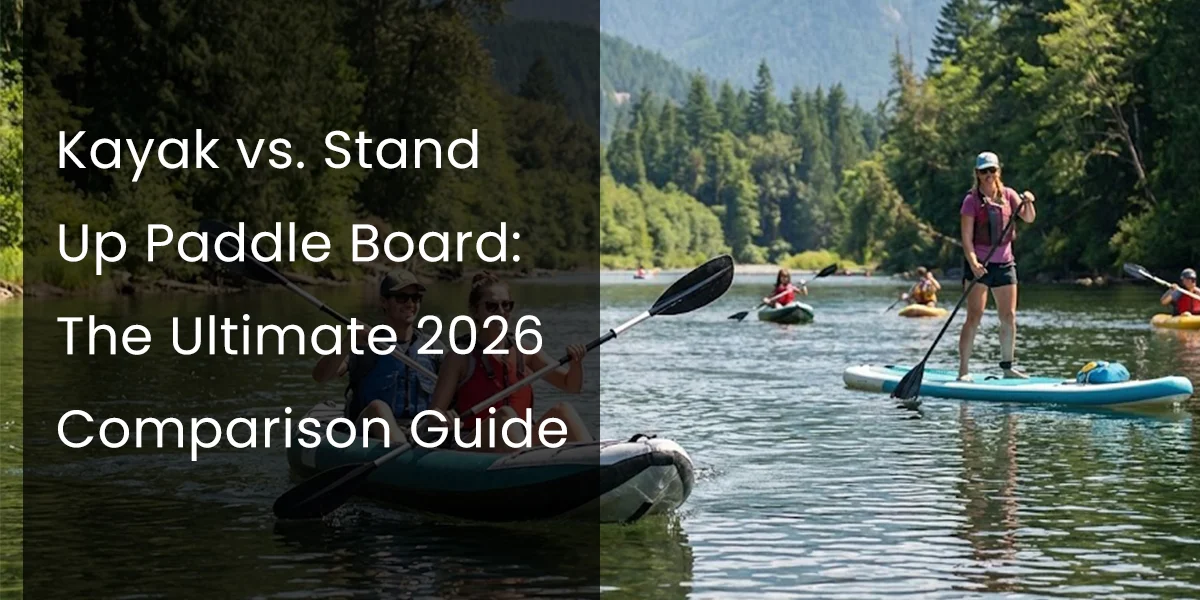
Should you choose a kayak or a stand-up paddle board? The answer depends on where you paddle, whether you prefer sitting or standing, how much equipment you carry and how you plan to transport and store the craft.
I’m Charlie from Huale. We manufacture inflatable SUP boards and drop-stitch kayaks for water-sports brands, distributors and commercial buyers. These products share some materials and manufacturing processes, but their hull designs, seating arrangements and intended uses can be very different.
Short answer: a kayak is often the better starting point for seated paddling, longer trips and carrying equipment. A stand-up paddle board (SUP) is often better for people who want an open platform, the option to change positions and general recreation on suitable water. Neither is automatically safer, faster or more stable in every situation.
An inflatable SUP with an optional kayak seat can offer another way to paddle, but adding a seat does not turn its board-shaped hull into a dedicated kayak.
This guide compares the practical differences, including inflatable and rigid designs, and explains what matters when selecting products for personal use, retail ranges or commercial rental operations.
Kayak vs Paddle Board: What Are the Main Differences?
A kayak is generally designed around seated paddling, usually with a double-bladed paddle. A stand-up paddle board is an open platform normally paddled while standing or kneeling, using a single-bladed paddle.
Those basic differences affect stability, paddling technique, wind exposure, gear storage and user comfort.
| Consideration | Kayak | Stand-Up Paddle Board |
|---|---|---|
| Paddling Position | Primarily seated, with foot support depending on the design | Standing, kneeling or sitting on an open deck |
| Paddle | Usually double-bladed | Usually single-bladed |
| Balance | Seated position generally lowers the paddler’s center of gravity | Standing requires additional balance and foot-position control |
| Wind Exposure | A seated paddler often presents a lower profile | A standing paddler typically presents more area to the wind |
| Gear Storage | May include cockpit, tank well, deck rigging or enclosed compartments | Usually relies on deck space, bungees and approved attachment points |
| Movement on Deck | Usually organized around a seated paddling station | More freedom to change position on suitable designs |
| Transport and Storage | Depends heavily on inflatable, folding or rigid construction | Inflatable versions can be deflated and packed into a bag |
The category label alone does not determine performance. A wide recreational kayak behaves differently from a narrow touring kayak, just as an all-round SUP differs from a racing or touring board.
A fair comparison should therefore identify the actual craft type before deciding which one is better.
How Do Hull Shape and Paddling Position Affect Stability?
A kayak and a SUP respond differently because the hull shape and paddler’s center of gravity are different.
A seated kayaker normally keeps body weight lower than a standing SUP paddler. This can make balance easier to manage, especially for someone who is uncomfortable standing on a moving platform.
However, this does not mean every kayak is more stable than every paddle board.
Kayak Hull Design
Kayak stability depends on beam, hull cross-section, length, seating position and load distribution. A broad recreational kayak is designed for different priorities from a narrow performance kayak.
Inflatable kayaks may use air chambers, drop-stitch floors or more extensively drop-stitch structures depending on the model. Those design differences affect inflated shape, seating arrangements, rigidity and handling.
SUP Board Outline
For paddle boards, width, outline, thickness, stiffness and rider load work together. A broad all-round SUP can provide a forgiving platform on calm water, while a narrower touring or racing shape places more demands on balance.
Maximum width is not enough to predict stability. Two boards with the same advertised width can have different nose, tail and standing-area shapes.
Why Operating Pressure Matters
An inflatable craft must be used within its model-specific pressure requirements. Insufficient inflation can change hull shape and stiffness, while overinflation can exceed the product’s design limits.
A buyer comparing inflatable products should therefore check the complete specification rather than assume a higher PSI rating always means better performance.
Selection rule: compare the intended paddling position, actual hull geometry and approved load range before using the word “stable” in a product comparison.
Which Is Better in Wind, Waves and Different Water Conditions?
Water conditions can change the answer more than the product category itself.
A seated kayaker normally presents less body area to the wind than someone standing on a SUP. That is a meaningful difference, but it does not make every kayak suitable for strong wind or rough water.
Calm Lakes and Sheltered Water
Both recreational kayaks and suitable all-round SUPs can work well in calm, protected environments. The paddler’s comfort, skills, balance and preferred activity are often more useful deciding factors.
Wind and Open Water
A standing SUP paddler can experience greater wind resistance. Kneeling may lower the paddler’s profile, but it does not eliminate wind, current or return-route risks.
A kayak may offer a more comfortable seated paddling position in some exposed conditions, but hull design, buoyancy, recovery capability and user experience still determine whether the trip is appropriate.
Rivers and Moving Water
Neither ordinary recreational SUPs nor ordinary recreational kayaks should automatically be treated as whitewater equipment.
Moving-water environments may require specialized craft, suitable personal equipment, knowledge of hazards and practiced rescue skills.
Cold-Water Environments
A kayak can offer different levels of shelter depending on whether it is sit-inside, sit-on-top or inflatable. A SUP generally leaves the paddler more exposed.
Neither craft removes the risk of cold-water immersion. Appropriate clothing, flotation equipment, weather judgment and recovery planning remain important.
The RNLI’s paddleboarding safety advice emphasizes wind direction, buoyancy aids, a means of calling for help and water-appropriate leash selection.
Practical rule: choose the craft for the expected environment, and change or cancel the activity when conditions exceed the users’ skills or operating plan.
Is a Kayak or Paddle Board Easier for Beginners?
For someone who prefers sitting, a stable recreational kayak can feel easier at the start because the user does not need to learn standing balance.
A stable all-round SUP can also be approachable for beginners on protected water, especially when they begin kneeling and practice standing gradually.
The better first experience depends on the individual, not on a universal rule that one category is always easier.
Learning to Paddle a Kayak
A beginner normally needs to become familiar with the seating position, paddle orientation, forward and turning strokes, launching and landing, and recovery procedures appropriate to the craft.
Some kayaks also require learning how to manage a cockpit, spray deck or other equipment. A wide sit-on-top recreational kayak has a different learning process from a narrow sit-inside touring kayak.
Learning to Paddle a SUP
A beginner usually starts by checking the fin, inflation and equipment, then practices kneeling, standing, basic strokes and remounting after a fall.
Standing balance is an additional skill, but users do not need to stand immediately to begin learning how the board responds.
Which Should a School or Rental Operator Offer?
A commercial operator should consider how quickly staff can explain the equipment, whether customers can use it comfortably and how participants will be assisted if they fall or capsize.
A short supervised trial is more useful than deciding from a product photograph.
The American Canoe Association’s paddling safety resources distinguish kayak and SUP training modules, reflecting the different techniques and preparation each activity requires.
Inflatable SUP vs Inflatable Kayak vs Hard-Shell Kayak: Which Is Easier to Transport?
A common comparison mistake is to describe an inflatable SUP as portable, then compare it only with a rigid kayak that requires substantial storage space.
That is not a fair basis for choosing between inflatable product categories.
An inflatable kayak can also be deflated and packed for transport. The final difference depends on the model, its construction, the included accessories and the finished package.
| Factor | Inflatable SUP | Inflatable Kayak | Rigid Kayak |
|---|---|---|---|
| Packing | Can be deflated and folded or rolled | Can be deflated and packed according to the design | Retains its full hull dimensions |
| Assembly | Inflation, fin and accessory setup | Inflation, seats, foot supports and other fittings as specified | Usually no hull inflation, but outfitting and transport preparation remain |
| Storage | May use a bag and compact storage space when dry and packed | May use a bag, with packed size depending on the kayak and fittings | Requires space for the complete hull |
| Handling | Affected by board weight and accessory kit | Affected by hull weight, seats, floor and accessories | Depends on full-size hull weight and handling arrangements |
| Freight Planning | Use final carton dimensions and gross weight | Use final carton dimensions and gross weight | Plan around the rigid hull and protective packaging |
For personal buyers, the main question is where the product will be stored and how often it will be transported.
For e-commerce sellers and distributors, the more useful comparison is the complete packed SKU, including paddle, pump, seat, fin, bag, repair items and retail carton.
A lighter bare product does not automatically produce lower freight cost if the complete carton has a different volume or the delivery method charges by dimensional weight.
Which Is Better for Fishing, Touring and Carrying Gear?
Kayaks and paddle boards can both support recreational fishing and day trips, but their equipment layouts create different advantages and limitations.
Fishing From a SUP
Standing can provide an elevated viewing position, and a wide fishing-oriented board can offer an open deck for moving and organizing equipment.
However, the paddler must manage balance while casting or reaching for gear. Rod holders, storage boxes and other accessories should only be fitted to compatible attachment points.
Fishing From a Kayak
A fishing-oriented kayak can provide a seated working position, foot support and storage arrangements designed around paddling and fishing.
Some fishing kayaks also support standing, but that capability must be evaluated for the specific design. It should not be assumed for every recreational kayak.
Touring and Longer Trips
For touring, compare the actual hull, directional control, paddling efficiency, seating comfort, cargo arrangement and recovery procedure.
A touring SUP can carry secured gear, but deck bungees are not the same as an enclosed kayak storage compartment. Equipment may be more exposed to water, and additional cargo can change trim and stability.
A touring kayak may be designed for more organized cargo storage and sustained seated paddling, although the suitability still depends on the individual boat and trip.
Buying decision: list what the user needs to carry, how the gear will be secured and the actual expected paddling conditions before comparing products.
Can a Paddle Board With a Kayak Seat Replace a Kayak?
A SUP with a compatible kayak seat can provide a seated paddling option, but it does not automatically become equivalent to a dedicated kayak.
This distinction matters for consumers buying a multi-use product and for brands marketing a SUP-kayak conversion package.
What a Seat Conversion Can Change
- Provides a supported seated paddling position when fitted correctly
- May allow use of a compatible double-bladed or convertible paddle
- Allows some users to alternate between standing and seated use
- May broaden the intended recreational use of an approved SUP model
What a Seat Conversion Does Not Change
- The underlying SUP hull geometry
- The board’s overall beam, length and rocker
- The original fin and underwater profile
- The absence of a kayak cockpit or enclosed storage
- The board’s approved load and operating-pressure limits
- The suitability of the product for demanding water conditions
What Should Be Checked Before Calling a SUP “Kayak-Ready”?
We recommend checking whether the exact board has approved seat attachment points, a suitable back-support arrangement and enough usable deck area for the intended sitting position.
Also review foot support, paddle compatibility, seat stability, installed hardware and the effect of the seated user’s position on the board.
D-rings alone do not confirm that a board is designed for a kayak conversion kit. Their location, reinforcement and intended function should be checked against the actual product specification.
For buyers considering a recreational SUP with a conversion option, compare the complete kit rather than adding a generic seat to the quotation without sample approval.
The correct product description is a SUP with a seated-paddling option, unless the manufacturer’s approved design and documentation support a more specific designation.
Kayak or SUP: Which Should You Choose for Your Activity?
A better selection starts with the user’s main activity rather than a universal product ranking.
Use the following table as a starting point. The actual model, water conditions and paddler’s experience still need to be considered.
| Main Activity | Product Direction to Consider | Main Reason |
|---|---|---|
| Relaxed seated paddling | Recreational kayak | Seating and paddling station designed for that position |
| Casual standing recreation | Stable all-round SUP | Open platform and standing-paddling experience |
| SUP yoga and deck-based fitness | Yoga-oriented SUP | Uninterrupted padded deck and suitable platform geometry |
| Seated touring with additional gear | Suitable touring kayak | Seated paddling, directional performance and cargo arrangements |
| Standing sightseeing and light touring | All-round or touring SUP | Standing visibility and open deck, where conditions allow |
| Seated fishing | Fishing-oriented kayak | Seated equipment layout and dedicated storage options |
| Occasional standing and seated use | Compatible SUP with an approved kayak-seat option | Allows different positions while retaining SUP hull characteristics |
For users who are uncertain, a supervised trial with comparable products on suitable water can reveal more than a general product review.
For distributors and rental businesses, this comparison also helps identify which activity should be represented in the product range.
What Should Rental Operators and Retailers Stock: Kayaks, SUPs or Both?
For a commercial buyer, the right answer is based on customer demand and the operating environment rather than a general statement that one craft is more profitable.
A resort serving first-time water-sports visitors may need a different mix from a kayak tour operator or a specialist SUP retailer.
Rental Operators
Review the customers, activities, water environment and staff responsibilities before selecting a fleet.
Useful questions include:
- Do customers mainly request seated trips, standing paddling or both?
- Are activities guided, supervised or independently rented?
- How much time is needed for setup, cleaning and inspection?
- Can staff transport and handle each craft safely?
- How will customers be instructed and supported?
- Which paddles, fins, seats and repair parts need to be kept in stock?
- How much storage space is available during and after the season?
Outdoor Retailers and Distributors
A retailer can use kayak and SUP categories to serve different purchase reasons rather than assuming they are interchangeable products.
An all-round SUP may serve general recreational customers, while an inflatable kayak may better match buyers specifically looking for seated paddling and kayak-style equipment organization.
For a new retail assortment, one clear product specification per customer group is often easier to explain than multiple models with overlapping claims.
How Should Fleet Economics Be Compared?
Calculate the operating economics using the buyer’s actual prices, expected utilization, equipment life, staff requirements and maintenance records.
Useful metrics include:
- Capital cost per ready-to-use craft
- Revenue per available rental hour
- Actual utilization by craft type
- Labor time for setup and inspection
- Repair and replacement cost
- Storage and transport cost
- Seasonal downtime
There is no reliable universal claim that a SUP will generate a higher return than a kayak for every operator.
If your business is specifically choosing between single and tandem kayak models, see our single vs tandem inflatable kayak rental guide. That is a separate fleet-sizing decision.
How Should Buyers Compare Inflatable Kayak and SUP Samples?
When comparing two inflatable product categories, the sample evaluation should check both shared manufacturing requirements and the features specific to each craft.
A visually similar PVC or drop-stitch material does not mean the finished kayak and SUP have identical construction or performance requirements.
Shared Inflatable Product Checks
- Finished dimensions against the approved drawing
- Material and construction specification
- Rail, seam and joint workmanship
- Valve location and installation
- Approved operating pressure
- Air-retention inspection under the agreed procedure
- Handles, fittings and reinforcement areas
- Accessory completeness
- Instructions, labels and packaging
Kayak-Specific Checks
- Seating position and seat attachment method
- Foot support and paddling ergonomics
- Floor and sidewall geometry
- Drainage or self-bailing features where applicable
- Tracking components and fin compatibility
- Specified load capacity and load distribution
SUP-Specific Checks
- Outline, standing area and inflated flatness
- Deck-pad position and finish
- Fin-box position and fin retention
- Handles, bungees and deck fittings
- Rigidity under the approved operating conditions
- Board weight and folded package where relevant
Commercial Approval
For a B2B order, we recommend linking the approved sample to one written specification, accessory list and artwork revision.
A later change to construction, fittings or accessories should be reviewed before bulk production rather than treated as an informal adjustment.
For category details, see our inflatable SUP board range and inflatable kayak manufacturing page.
Common Mistakes When Comparing Kayaks and Paddle Boards
Many product comparisons produce misleading results because they compare different types of equipment or use claims that are not supported by the specific models.
- Comparing an inflatable SUP only with a rigid kayak: this overlooks inflatable kayak options and exaggerates the difference in portability.
- Assuming every kayak is more stable: seating position helps, but hull design, width and load still matter.
- Assuming every SUP is suitable for kayaking: an approved seat system and appropriate equipment are needed for a seated conversion.
- Calling a SUP with a seat a full kayak replacement: adding a seat does not change the underlying hull.
- Choosing by maximum width alone: shape, construction and load distribution also affect handling.
- Assuming a touring SUP is automatically suitable for strong wind: the water environment and the user’s ability remain limiting factors.
- Claiming one sport is always better for the body: comfort and physical demands differ with technique, fitness and individual needs.
- Comparing bare-product weight only: check the complete package, including accessories and transport bag.
- Ignoring recovery and safety procedures: a product that feels stable in a showroom still requires appropriate on-water preparation.
- Using generic marketing claims for a commercial order: verify the exact sample, included equipment and documented product specification.
The most useful comparison is between real products intended for similar users and conditions, with clear limitations stated for each design.
FAQ: Kayak vs Stand Up Paddle Board
Is kayaking easier than stand-up paddle boarding?
For someone who prefers sitting, a stable recreational kayak can feel easier initially because it removes the need to learn standing balance. A stable all-round SUP can also be suitable for beginners on calm water, particularly when they start kneeling. The actual experience depends on the craft, user and conditions.
Is a kayak more stable than a paddle board?
Not always. A seated paddler normally has a lower center of gravity, but stability also depends on hull width, geometry, load distribution and intended use. A broad recreational SUP and a narrow performance kayak should not be compared using category labels alone.
Is an inflatable kayak or inflatable SUP easier to transport?
Both can be deflated and packed. Compare the actual packed dimensions, complete kit weight, number of accessories and setup procedure for the selected models. A rigid kayak has different storage requirements because its hull does not fold or deflate.
Can I turn a stand-up paddle board into a kayak?
Some SUPs can accept a compatible kayak seat and paddle conversion system. However, the board retains its SUP hull shape and original design limits. Check attachment-point compatibility, seat position, foot support, paddle equipment and approved use before purchasing a conversion kit.
Should a rental business offer both kayaks and SUPs?
Offering both can be useful when customer demand includes seated paddling and standing activities. The correct mix depends on location, customer groups, water conditions, supervision, storage, maintenance and actual utilization. Test the proposed craft types before committing to a large fleet.
Planning a Kayak or SUP Product Range?
If you are buying for a brand, distributor, resort or rental operation, start with your target customer, water environment, intended activities and equipment requirements.
Send us your preferred kayak and SUP categories, expected quantity, branding needs, accessory package and destination market. We can review the available product specifications and sampling requirements before bulk production.
Review our inflatable SUP categories or inflatable kayak OEM options for the next step.
One-piece availability refers to sampling and should be confirmed for the selected product. Bulk MOQ, pricing and lead time depend on the final configuration and current production schedule.
We will respond within 24 hours with a factory-direct quote.
MOQ starts from 1 piece.