
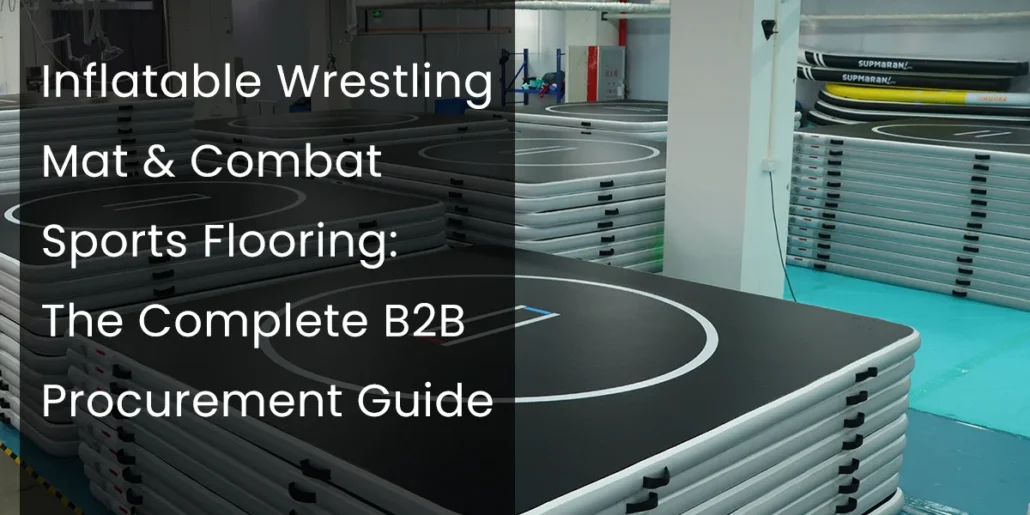
Choosing an inflatable wrestling mat for a gym, school, martial arts academy or resale program is not mainly a question of finding the largest or thickest model. Before you request a sample, you need to define the sport, usable floor area, surface requirement, thickness, connection layout, markings and how the mat will be installed and stored.
I’m Charlie, and I’ve spent 15 years working with inflatable drop stitch products at Huale. On wrestling mat projects, many sourcing problems begin before production: the buyer sends only a target size, while important details such as surface feel, usable training area, connection positions and artwork remain undefined.
This guide is designed to prevent that. I’ll show you how we recommend B2B buyers compare wrestling, BJJ, MMA and judo applications, prepare a technical specification, review an inflatable mat sample and document the final details before bulk production.
The goal is not to choose a mat from a catalogue as quickly as possible. The goal is to create a specification that your team, your supplier and your sample approval process can all follow.
What Should B2B Buyers Decide Before Choosing an Inflatable Wrestling Mat?
Start with the training environment, not the supplier’s model number. Two mats with similar dimensions can require different surfaces, layouts or connection systems when one is intended for wrestling and the other for BJJ, school PE or mixed-use gym training.
Before requesting a sample, I recommend documenting these six decisions.
1. Primary Sport or Training Program
Confirm whether the mat is mainly intended for wrestling, BJJ, grappling, MMA, judo or mixed training. The sport affects which surface characteristics, markings and floor layout should receive the most attention during sampling.
2. Available Floor Area
Measure the actual room or training area before specifying the mat. Do not rely only on a nominal product size. Buyers should distinguish between the overall mat dimensions and the usable area available for training.
3. Standalone or Connected Layout
A compact gym may use one inflatable mat, while a larger academy or school may need several sections to form one training floor. If multiple mats will be connected, connection position and alignment should be included in the sample review.
4. Surface Requirement
Surface selection should reflect the intended movement, footwear or barefoot use, ground training and cleaning routine. A surface that looks suitable in photos may feel different during actual grappling or wrestling practice.
5. Installation and Storage Routine
Ask how often the mat will be inflated, moved, deflated or stored. A permanent academy floor and a school gym that changes activities every day have different operating requirements.
6. Markings and Branding
Confirm training circles, boundary lines, zones, club logos, sponsor graphics and brand colors before artwork approval. These details should be documented before the sample becomes the production reference.
Buyer takeaway: A useful RFQ should describe the application, floor area and required layout before asking the supplier to recommend a model.
Wrestling vs BJJ vs MMA vs Judo: What Should Buyers Compare?
The sport name does not automatically determine one fixed inflatable mat specification. Instead, use the intended training activity to decide which technical details need to be tested during sample approval.
Wrestling Programs
- Training area: Confirm the total usable space and the number of athletes expected to train on the floor.
- Markings: Define any circles, boundaries or training zones required by the buyer.
- Surface: Review traction during the intended wrestling movements and footwear conditions.
- Layout: Confirm whether one mat or several connected sections will be used.
BJJ and Grappling Programs
- Ground movement: Surface feel becomes especially important during repeated rolling and positional training.
- Usable area: Check whether the mat provides enough clear space for drilling and rolling.
- Connections: Larger academy floors may require several sections to align into one training surface.
- Storage: Shared facilities should consider how often the floor needs to be removed or stored.
MMA and Mixed Training
- Training mix: Define how much of the program involves stand-up work, takedowns and ground training.
- Firmness: Review the selected thickness and inflation setup during the intended training activity.
- Floor shape: Check the available gym, training-zone or cage-floor dimensions before sampling.
- Graphics: Gym logos, sponsor graphics and training zones should be included in the artwork approval process.
Judo Programs
- Surface: Review texture and movement characteristics for the intended dojo or training environment.
- Training use: Tell the supplier how the mat will be used during throwing and groundwork practice.
- Floor layout: Confirm whether the project requires a single portable mat or a larger connected training area.
- Buyer requirements: Any school, event or organization-specific specification should be verified for the individual project before ordering.
Do not assume that one generic inflatable mat specification automatically fits every combat sport. For an OEM project, the final surface, dimensions, thickness, layout and markings should be confirmed against the intended use before production.
When Should You Evaluate the Wrestling Mat Manufacturer?
Product selection and supplier qualification are related, but they are not the same decision. Once you know the sport, floor size, layout and sample requirements, the next step is to check whether the supplier can manufacture and control that specification consistently.
For factory evaluation, focus on the production process, OEM development workflow, material handling, seam and valve inspection, air-retention checks, artwork control and how the approved sample is transferred into production.
We cover those supplier-side questions separately on our inflatable wrestling mat manufacturer page. Use that page when your purchasing team moves from product selection into factory qualification.
If your main concern is MOQ, model mix, private-label packaging or bulk-order preparation, go instead to our wholesale inflatable wrestling mats page.
Inflatable vs Foam Wrestling Mats: Which Format Fits Your Facility?
Inflatable and foam wrestling mats solve different operating problems. For B2B buyers, the better choice depends on how the floor will be used, how often it needs to move and whether the facility has dedicated storage and training space.
An inflatable mat should not automatically be positioned as a replacement for every traditional foam system. Permanent combat sports rooms and multi-purpose facilities often have very different purchasing priorities.
| Buyer Situation | Inflatable Mat | Foam / Permanent Mat |
|---|---|---|
| Multi-Purpose Gym | Useful when the floor needs to be cleared for PE, fitness or other activities. | Works well when the mat can remain installed for long periods. |
| Dedicated Combat Sports Room | Suitable when portability or flexible floor layouts are still required. | Often considered when the room is permanently assigned to wrestling, BJJ or martial arts. |
| Temporary Event | Can support projects where transport, temporary installation and storage matter. | Requires a transport and installation plan for rolls, tiles or larger foam sections. |
| Storage-Limited Facility | Deflation can reduce the space required when the mat is not in use. | Storage requirements depend on the selected roll, tile or permanent flooring system. |
| Custom Layout | Custom dimensions, graphics and connection layouts can be reviewed during OEM development. | Customization depends on the foam flooring construction and supplier. |
Inflatable mats usually deserve closer consideration when portability, storage, temporary installation or a custom modular layout is important.
Foam systems may remain the more practical choice when a facility has a permanent dedicated combat sports room and does not need to regularly remove or transport the floor.
For a deeper comparison of floor construction and purchasing factors, see our inflatable wrestling mat vs traditional foam mat guide.
Key Specifications to Confirm Before Ordering an Inflatable Wrestling Mat Sample
A useful sample starts with a clear specification. If the RFQ only says “custom wrestling mat with logo,” too many technical decisions remain open for the supplier to interpret.
Before sample development, I recommend confirming the following items in writing.
| Specification | What to Confirm | Why It Matters |
|---|---|---|
| Sport / Application | Wrestling, BJJ, MMA, judo, school PE or mixed training. | Defines the environment in which the sample should be evaluated. |
| Dimensions | Overall dimensions and usable training area. | Ensures the mat fits the actual floor plan. |
| Thickness | Target thickness and intended firmness direction. | Thickness should be reviewed together with construction and training use. |
| Surface | Texture, grip, finish and cleaning requirements. | Surface characteristics affect standing movement and ground training. |
| Connection Layout | Standalone construction or connection points for multiple mats. | Important when several sections form one larger floor. |
| Markings | Training lines, circles, zones, logos and graphics. | Artwork needs to be approved before production. |
| Valve Position | Valve location and access after installation. | Affects inflation, deflation and operating convenience. |
| Accessories | Pump, carry bag, repair items, instructions and other required accessories. | The sample package should reflect the intended final product program. |
| Packaging | Carton, labels, barcode and private-label requirements. | Important for distributors, brands and e-commerce programs. |
| Documentation | Buyer-required factory, material or product documents. | Requirements can vary by product, buyer and destination market. |
Buyer takeaway: Do not treat a catalogue specification as the final production specification. The approved sample should reflect the actual size, surface, graphics, accessories and packaging required for the project.
How Should B2B Buyers Approve an Inflatable Wrestling Mat Sample?
A sample should not be approved only because the color and logo look correct. The purpose of sampling is to check whether the agreed specification works in the intended training environment and whether the supplier has enough detail to reproduce the approved version during production.
1. Measure the Finished Dimensions
Check the overall dimensions and usable training area against the approved specification. If the mat must fit a specific gym room, school floor or connected layout, test it in that space whenever possible.
2. Evaluate the Surface During Real Training
Do not judge the surface only by touching the material. Test standing movement, footwork, grappling and ground movement according to the intended sport. Also review how easily the surface can be cleaned after use.
3. Review Firmness and Inflation Setup
Check how the mat feels under the intended users and training activity. Record the inflation setup used during sample approval so the buyer and supplier are referring to the same operating condition.
4. Check Connections and Floor Alignment
If several inflatable mats will form one larger floor, assemble the sections during sample review. Check connection positions, alignment and any gaps that affect the final usable training area.
5. Review Air Retention
Follow the inspection method agreed with the supplier and record any pressure or air-retention concerns before approval. The applicable test procedure should be confirmed for the selected mat construction rather than assumed from another model.
6. Approve Logos and Training Markings
Check logo size, location, colors, circles, boundaries and training graphics against the final artwork. Small artwork errors are much easier to correct during sampling than after bulk production has started.
7. Check Accessories
Review the pump, carry bag, repair items, instructions and any other accessories that will be included with the final product. For branded programs, the accessory set should also match the intended retail or institutional package.
8. Review Packaging
For private-label or resale projects, check carton information, labels, barcode position, instructions and any required brand presentation before approving the final production specification.
Most important: Once the sample is approved, document the approved construction, dimensions, surface, artwork, accessories and packaging. This becomes the reference that both buyer and supplier can use during bulk production.
What Should Be Confirmed Before Bulk Wrestling Mat Production?
Sample approval is not the end of the buying process. Before the supplier starts bulk production, purchasing teams should make sure the final order is based on a documented and approved specification.
Is the Final Product Specification Complete?
Dimensions, thickness, surface, connection layout, markings and construction details should be recorded in one final specification rather than spread across different email conversations.
Has the Sample Been Tested in the Intended Environment?
A gym, school, martial arts academy and temporary event can use the same inflatable mat very differently. Whenever possible, evaluate the sample under the conditions the buyer expects after delivery.
Is the Final Artwork Approved?
Confirm logo position, colors, training markings and other graphics using the final artwork file. If anything changes after sample approval, the change should be documented before production begins.
Are Accessories and Packaging Confirmed?
The final order should clearly state which pump, carry bag, repair items, labels, instructions and packaging components are included.
Are Quality-Control Requirements Clear?
Buyer and supplier should agree on which dimensions, workmanship details, air-retention checks, graphics and packing points will be reviewed during production and final inspection.
Have Required Documents Been Confirmed?
If your organization, distributor or destination market requires specific factory, material or product documentation, confirm which documents apply to the selected mat model before the order enters production.
For deeper information on manufacturing process and factory quality control, see our inflatable wrestling mat manufacturer page.
What Is the Next Step After Choosing Your Wrestling Mat Specification?
Once you know the required sport, dimensions, surface, layout and sample criteria, the next page you need depends on where you are in the purchasing process.
Evaluate Factory and OEM Capability
If you are comparing suppliers, manufacturing processes, OEM development and quality-control capability, review our Inflatable Wrestling Mat Manufacturer page.
Plan MOQ and a Wholesale Order
If you already understand the required product and need to plan models, quantities, private-label packaging or bulk-order details, continue to our Wholesale Inflatable Wrestling Mats page.
Compare a Compact Wrestling Mat Model
For a smaller gym, BJJ room or modular training-floor project, you can also review our 10×10 Inflatable Wrestling Mat product page.
The important point is to separate these decisions. First choose the product specification. Then qualify the supplier. After that, confirm the commercial terms for the actual order.
Inflatable Wrestling Mat Buying and Sample Approval FAQs
What information should I prepare before requesting an inflatable wrestling mat sample?
Prepare the intended sport, available floor area, target dimensions, preferred thickness, surface requirement, standalone or connected layout, training markings, branding and expected use environment. These details help the supplier prepare a sample that reflects the actual project.
Should wrestling, BJJ, MMA and judo use the same inflatable mat specification?
Not automatically. Surface feel, usable training area, firmness, connection layout and markings should be reviewed according to the intended sport and training environment. A specification developed for one use case should not be assumed to fit every combat sports program.
How do I choose the right inflatable wrestling mat size?
Start with the actual available floor space, intended number of users and training activity. Then decide whether one mat is sufficient or whether several connected sections are required. The nominal product size should not be chosen before the facility layout is confirmed.
What should I check before approving an inflatable wrestling mat sample?
Check dimensions, usable training area, surface, firmness, connection alignment, air retention, logos, training markings, accessories and packaging. Evaluate the mat during the intended type of training whenever possible.
Where should I check wrestling mat MOQ, wholesale pricing and bulk-order requirements?
MOQ, product mix, private-label packaging and bulk-order requirements depend on the selected model and order configuration. Review these commercial details on our wholesale inflatable wrestling mats page rather than using a general buying guide as a fixed quotation reference.


