
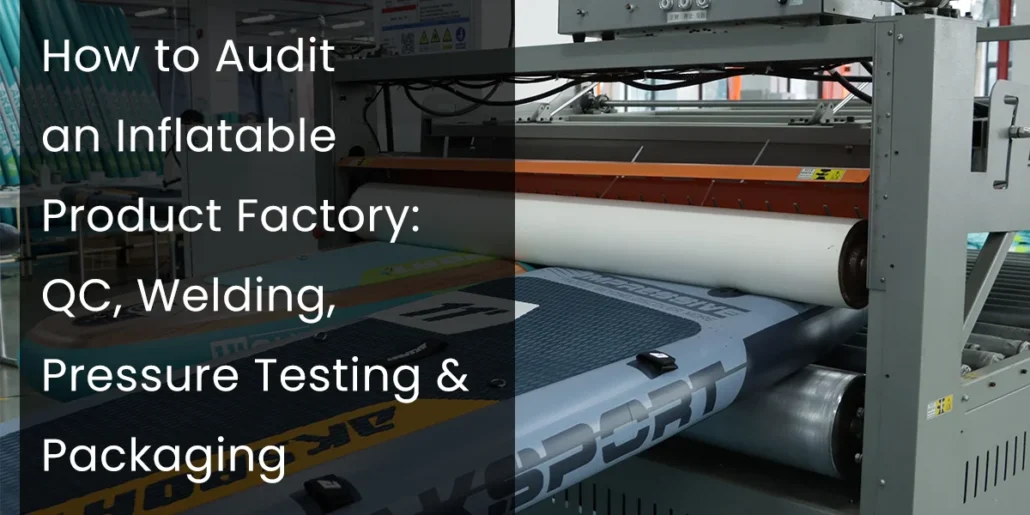
A factory may show you welding machines, rows of finished inflatable products and a wall of certificates. But none of these alone proves that your approved product specification will be followed during bulk production.
I’m Charlie from Huale, a Guangzhou-based manufacturer of inflatable drop-stitch products. For brands, importers and procurement teams, a useful factory audit should connect what a supplier claims with the actual processes, inspection records and production decisions behind an order.
To audit an inflatable product factory, verify the manufacturing site, approved specifications, material controls, welding or bonding methods, pressure-test records, corrective actions and final packaging checks. Each finding should be supported by evidence relevant to the product you intend to purchase.
This guide gives buyers a practical method for evaluating factories producing inflatable SUP boards, kayaks, floating docks, air tracks, cold plunge tubs, drop-stitch pools and wrestling mats. It is a supplier qualification guide, not a substitute for an independent certification or product-specific safety assessment.

What Should an Inflatable Product Factory Audit Verify?
A factory audit should answer a practical purchasing question: can this supplier consistently manufacture and release products that match your approved requirements?
Start by defining the product category, intended use, target market, order stage and audit criteria. Then select a representative product or production order to follow through the factory.
Seven Evidence Checks for Supplier Approval
- Factory identity: Confirm the legal manufacturer, production site and any outsourced processes.
- Specification control: Check the approved sample, drawings, materials, components and document revisions.
- Material traceability: Verify how incoming materials are identified, inspected and linked to production.
- Process control: Review the applicable cutting, welding, bonding and assembly procedures.
- Product testing: Check the test method, acceptance criteria, actual results and handling of failures.
- Corrective actions: Examine how defects are contained, investigated and resolved.
- Shipment release: Confirm final inspection, packaging, accessories, labels and order approval.
The ISO 19011:2026 auditing guidelines provide a recognized framework for evidence-based management-system audits. However, using an audit checklist does not mean a factory has been independently certified.
Buyer takeaway: A factory tour shows what is present. An audit checks whether the documented controls are being followed for a real order.
Factory Claims vs Evidence: What Should Buyers Request?
A useful supplier audit does not stop at a positive answer. Each important factory claim should lead to a specific record, observation or demonstration that can be evaluated.
| Factory Claim | Evidence to Request | Buyer Decision |
|---|---|---|
| We manufacture in-house. | Production-site details, actual process walkthrough and subcontractor information. | Who performs each production step? |
| We use approved materials. | Material specifications, receiving records and relevant batch identification. | Can the material be traced to the order? |
| We use HF welding. | Applicable joint drawings, equipment details, process instructions and inspection records. | Which joints actually use this process? |
| Every product is pressure-tested. | Test procedure, product identification, conditions, results and failure records. | Was the required test performed and passed? |
| Bulk orders match samples. | Approved sample reference, drawing revision, component list and production records. | Were any changes made without approval? |
| Our factory is certified. | Applicable certificate, issuing body, company, site, scope and validity. | Does the document cover the claimed activity? |
| Orders are checked before shipment. | Final inspection, packing list, labels, accessories and release authorization. | Who approved this specific order for shipment? |
Why a Certificate Alone Is Not Enough
A quality-management certificate, social audit report, material test report and product test report provide different types of evidence.
For example, an ISO 9001 certificate concerns a defined quality management system. It does not automatically prove that a specific inflatable dock, kayak or air track passed every applicable product test.
Check the issuing body, named company, manufacturing location, validity, document scope and whether the evidence relates to the product being purchased.
For a detailed explanation of document types and their limitations, see our inflatable product compliance documentation guide.
How to Audit Sample-to-Bulk Production Consistency
One of the most important supplier checks is whether the factory can reproduce the approved sample without introducing uncontrolled changes.
A buyer may approve a sample with specific material, dimensions, graphics, valves and packaging. Bulk production must follow the agreed version, not an earlier drawing or a later substitution that has not been approved.
Check the Approved Sample Against Production Documents
Ask the factory to identify the documents controlling the order:
- Approved product drawing and specification revision.
- Material and component list.
- Logo, graphics and color references.
- Valve, fitting and accessory requirements.
- Packaging artwork and pack-out specification.
- Approved changes and their effective dates.
Use a Two-Way Traceability Check
Forward check: Start with the approved sample and trace its specifications through the work order, production instructions and final inspection.
Reverse check: Select a finished unit or recent production record and trace it back to the relevant material, drawing and approved sample revision.
If the factory cannot explain a difference, the buyer should request clarification before approving the affected product.
What If a Material or Component Changes?
Not every change is unacceptable. The concern is whether the change affects an approved requirement and whether the right person authorized it.
For example, a revised valve model may require updated fitting dimensions, installation instructions or product checks. A different PVC construction may require more extensive review.
Buyer takeaway: The approved sample is useful only when production documents and change controls keep the bulk order aligned with it.
For the product-development stage, see our prototype and sample testing process.
How to Audit Welding, Bonding and Seam Quality
Seam construction is an important part of inflatable product reliability, but different products and joint locations may use different manufacturing methods.
High-frequency welding, heat-based lamination and adhesive bonding are not interchangeable terms. An audit should identify which method is used on each relevant part of the product and how its quality is controlled.
What to Check for High-Frequency Welding
Where HF welding is used, ask to review the applicable joint specification, material compatibility, equipment setup, approved process conditions and inspection method.
During the factory visit, check whether:
- The joint being inspected actually uses HF welding.
- Operators work from a current process instruction.
- Equipment and tooling match the required joint design.
- Process settings are controlled and changes are authorized.
- The finished joint is inspected against defined acceptance criteria.
- Nonconforming welds are identified and handled correctly.
What About Heat Lamination and Adhesive Bonding?
Heat lamination is often associated with the preparation of layered materials, while adhesive bonding may be used for selected joints, reinforcement areas or accessories.
The correct process depends on the material system and product design. Do not reject a factory merely because it uses adhesive bonding, or approve one merely because it owns HF welding equipment.
For bonded components, review relevant surface preparation, adhesive handling, application, curing and inspection controls where applicable.
How Can Buyers Verify Seam Quality?
Ask how the factory evaluates seam workmanship, alignment, bonding quality and relevant performance requirements.
If joint-strength testing is part of the approved plan, review the sample identification, method, actual results and acceptance criteria.
Red flag: A factory claims every seam is welded but cannot identify which joints are welded, bonded or reinforced on the specific model.
How to Verify Pressure and Air-Retention Test Records
A pressure test is useful only when the test method, conditions, acceptance criteria and actual results are known.
For inflatable products, the approved working pressure and test procedure depend on the construction and intended use. There is no single PSI value or holding period that should automatically be applied to every product category.
What Should a Pressure Test Record Contain?
| Record Field | What the Buyer Should Check |
|---|---|
| Product Identification | Model, sample or batch reference and specification revision. |
| Test Method | The approved procedure and the characteristic being checked. |
| Pressure & Duration | Required conditions for the particular product and test. |
| Environment | Relevant temperature or other conditions affecting interpretation. |
| Actual Results | Recorded measurements, observations and any identified leakage. |
| Acceptance Criteria | The approved pass/fail requirements for the test. |
| Disposition | Pass, hold, rework, retest or rejection decision. |
| Authorization | Test date and responsible inspector or approving role. |
Why Pressure Readings Need Context
A difference between starting and ending pressure does not automatically establish the size of an air leak. Temperature changes, measurement conditions and the specified test method can influence the recorded pressure.
Ask the factory how its procedure accounts for these factors and how it distinguishes an acceptable result from a product requiring investigation.
What Happens When a Product Fails?
An effective audit should follow at least one documented failure or rework example, where records are available.
Check whether the affected product was identified, separated from accepted stock, investigated, repaired where permitted, retested and given a final disposition.
Buyer takeaway: A photograph of inflated products is not the same as a traceable pressure-test record. Confirm the agreed test requirements and actual outcomes for the selected model.
Product-Specific QC Checks Across Seven Inflatable Categories
The audit method can remain consistent across different inflatable products, but the inspection priorities should reflect the structure, components and intended application of each category.
For example, a SUP board has different hardware and handling requirements from a cold plunge tub or a large modular floating platform.
| Product | Main QC Evidence to Review | Buyer Risk to Investigate |
|---|---|---|
| Inflatable SUP Boards | DWF construction, rail joints, shape, valves, fins, deck pads and pressure records. | Changes in structure, shape or fittings between sample and bulk units. |
| Inflatable Kayaks | Floor, sidewalls, chambers, seams, valves, seats, fins and fittings. | Uncontrolled changes to hull construction or functional components. |
| Floating Docks | Platform construction, EVA bonding, D-rings, handles and modular connectors. | Unsupported load claims or unverified connection arrangements. |
| Drop-Stitch Pools | Wall geometry, joints, valves, drains, fittings and product-specific leakage checks. | Mismatch between approved installation and finished pool configuration. |
| Air Tracks | Dimensions, seams, valves, surface markings, handles and specified inflation performance. | Inconsistent surface, geometry or model-specific operating instructions. |
| Ice Bath Tubs | Tub structure, drainage, inlet/outlet fittings, covers and packaging. | Incorrect fittings or unclear responsibility for external chiller compatibility. |
| Wrestling Mats | Mat dimensions, surface, connection layout, markings, valves and accessories. | Differences in approved training layout or repeated-use requirements. |
This matrix is a buyer’s starting point, not a universal product standard. The exact acceptance criteria must come from the approved specification, intended use and relevant requirements.
Why One Factory Certificate Does Not Replace Product Testing
A factory-level quality management certificate and a product-specific test report answer different questions.
A management-system audit can evaluate how procedures are controlled. Product-specific checks evaluate whether the relevant sample or production output meets the agreed requirements.
A supplier should be able to distinguish these records and explain which evidence applies to the buyer’s intended order.
How to Audit Packaging, Defect Handling and Shipment Release
Factory inspection does not end when an inflatable product passes its functional checks. The final order must also match the approved accessories, labels, packaging and quantity.
Check Packaging Against the Approved Specification
Select a packed unit and compare its contents with the approved pack-out list.
- Correct model, size, color and revision.
- Approved carry bag, pump, repair kit and other accessories.
- Correct product labels, warnings and instructions.
- Private-label graphics, barcodes and retail packaging.
- Carton dimensions, packing quantities and shipping marks.
- Identification of products requiring hold or reinspection.
What Happens to Nonconforming Products?
Ask the factory to show how it records and manages products that fail material inspection, production checks or final testing.
A useful record should identify the issue, affected quantity, disposition, responsible person and any follow-up inspection.
For repeated problems, review the corrective action rather than accepting a general statement that workers have been instructed to be more careful.
How Should Audit Findings Be Classified?
| Finding Level | Example | Buyer Action |
|---|---|---|
| Critical Approval Issue | Undisclosed critical outsourcing, uncontrolled substitutions or no credible shipment-release control. | Hold the affected approval until the issue is resolved and verified. |
| Major Finding | Missing traceability, incomplete testing evidence or repeated unresolved defects. | Require corrective action and verify closure before the relevant milestone. |
| Minor Finding | An isolated documentation issue without evidence of wider loss of control. | Record the correction and verify at the agreed follow-up. |
These examples are a practical buyer framework, not universal defect classifications. Severity and release decisions should be defined according to the product, risk and quality agreement.
Buyer takeaway: A product should not be approved for shipment merely because it looks finished. Confirm that the required inspections, packing checks and release decisions are complete.
Factory Visit Checklist: Remote vs On-Site Audits
Buyers do not always need to begin with a physical factory visit. A remote review can help evaluate supplier information and identify unresolved risks before committing to travel or third-party inspection.
However, remote evidence has limits. Product complexity, order value, process risk and previous quality performance should determine whether an on-site audit is needed.
What Can a Remote Factory Audit Check?
- Legal company and manufacturing-site information.
- Controlled product specifications and sample revisions.
- Selected material and production records.
- Live demonstrations of relevant production processes.
- Available quality documents and test results.
- Packaging examples and final inspection records.
Ask to view relevant production activity and records connected to an identifiable model or order. Prepared marketing videos alone provide limited verification.
What Is Better Checked On-Site?
- Whether the stated manufacturing operations are actually performed at the site.
- Material identification and storage conditions.
- Current documents used by production staff.
- Equipment condition and process control.
- Physical separation of accepted and nonconforming products.
- Independent selection of production and inspection records.
- Actual packaging and shipment-release procedures.
Factory Audit Decision: Approve, Conditional Approval or Hold
After the audit, prepare a short report identifying the audit scope, evidence reviewed, findings, required actions, responsible parties and approval decision.
- Approve: Evidence supports the required supplier capabilities and no unresolved issue blocks the intended order.
- Conditional approval: Correctable findings have agreed actions and verification requirements. The buyer must define which activities may proceed.
- Hold: Important manufacturing, traceability, quality or release requirements remain unverified.
Do not allow a high checklist score to cancel a critical unresolved issue. Supplier qualification should depend on both the overall assessment and the risks that could prevent a safe, conforming order.
Prepare Your Audit Request
Before contacting a factory, define:
- Product category and intended market.
- Existing model or custom development project.
- Relevant drawings and material requirements.
- Required testing and inspection evidence.
- Estimated order quantity and approval milestone.
- Preferred remote, on-site or third-party audit arrangement.
A useful audit creates a documented purchasing decision, not just a collection of factory photographs.
Frequently Asked Questions About Inflatable Factory Audits
What should I check during an inflatable product factory audit?
Verify the manufacturing site, approved specifications, material traceability, welding or bonding controls, pressure-test records, defect handling and final packaging approval. Review evidence connected to an actual product or production order.
How can I verify a factory’s high-frequency welding capability?
Confirm which product joints use HF welding, inspect the applicable process instructions and review equipment, operator and inspection records. Owning an HF welding machine does not prove that every product seam uses that process.
What evidence should I request for an inflatable pressure test?
Request the approved procedure, product identification, test conditions, required pressure and duration, recorded results, acceptance criteria and disposition of failures. The correct test requirements depend on the specific product.
Can a remote factory audit replace an on-site visit?
A remote audit can verify selected documents and support a live production review, but it may not provide the same independent access to equipment, material storage and production records. The appropriate method depends on supplier and product risk.
Does ISO 9001 certification guarantee inflatable product quality?
No. ISO 9001 certification concerns a defined quality management system. Buyers must still confirm that the certificate applies to the relevant company and scope, and that the ordered product meets its approved specification and applicable requirements.
Review Your Inflatable OEM Supplier Requirements with Huale
We manufacture inflatable drop-stitch products for brands, importers and commercial buyers. If you are evaluating a supplier for a new project, share your product category, technical specification, estimated order quantity, destination market and required quality evidence.
We can discuss the manufacturing scope, sample requirements and available product-specific documentation before confirming the proposed production and inspection arrangements.
Visit our inflatable paddle board manufacturing page for an example of our product-specific factory information.
Contact Huale to discuss your OEM project and request a specification-based quotation.