
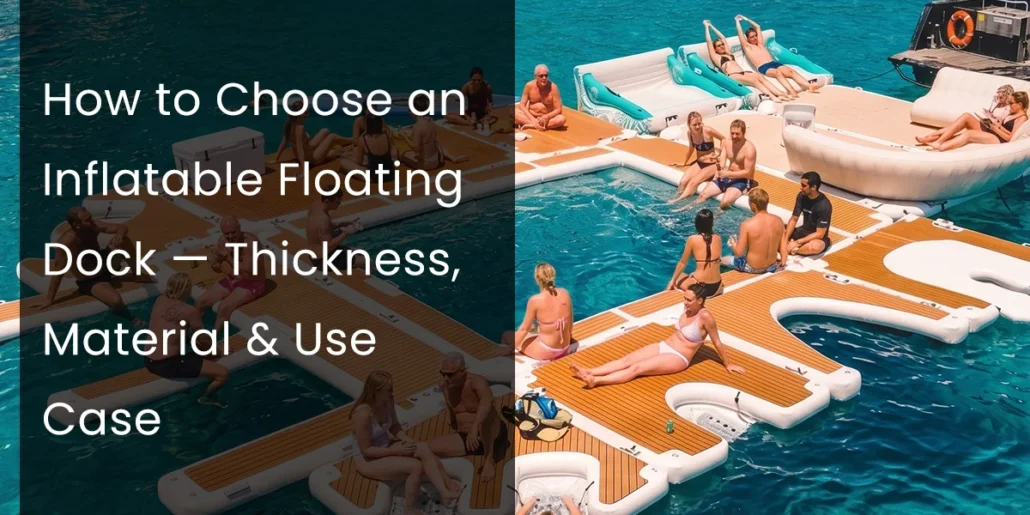
Most buyers pick an inflatable dock by photo and price, then find out at the dock that it flexes, sits low or peels at the seams within a season. By then the container has landed and the reviews are coming in. The fix is choosing on three things the photo never shows: thickness, material and the actual use case.
I’m Charlie, a senior designer on our factory floor in Guangzhou. We have built drop-stitch docks, platforms and boards here for 15 years, for distributors, rental fleets and private-label brands. This guide walks you through how we’d spec a dock for your order — the same questions we ask every buyer before we quote.
Start With the Use Case, Not the Price
The cheapest dock that fails is the most expensive one you can buy. Before thickness or material, pin down how the dock gets used — that decides everything after it.
We sort almost every order into one of these jobs:
- Swimming and lounging off a boat — a yacht swim platform that extends deck space.
- Docking a personal watercraft — a drive-on jet ski dock, single or double.
- Commercial work on the water — a thick heavy-duty work platform for hull cleaning or marina jobs.
- Events, walkways and changing layouts — a modular floating platform you reconfigure.
- A safe, enclosed pool off a yacht — an inflatable yacht pool with a net floor.
- General lake, marina and resale use — a versatile floating swim platform for wholesale.
Once the job is clear, the right thickness and material almost pick themselves. Here’s how.
Thickness: The Spec Buyers Underrate Most
Thickness is where cheap docks cut corners, because thinner panels use less material and ship lighter. But thickness is what makes a dock feel like a deck instead of a pool toy. Here is how we match it to the job.
| Thickness | Feel | Best for |
|---|---|---|
| 6–10 cm | Flexes, sits low, wobbles | Toys and pads — not a work dock |
| 15 cm (6 in) | Firm, walk-on | Swim platforms, leisure docks, rental |
| 20 cm (8 in) | Stiff, stable at the edge | Mixed loads, jet ski docks, busy platforms |
| 30 cm (12 in) | Rigid, deck-like | Heavy-duty work, crew plus equipment |
The drop-stitch core inside is what holds that thickness rigid under pressure — thousands of threads linking the top and bottom panels. If you want the construction background, this overview of drop-stitch construction is a useful primer.
For most leisure and resale orders we recommend 15 cm. Step up to 20–30 cm only when the load or the commercial use case demands it — paying for 30 cm on a backyard lake dock is wasted cost.
Load Capacity: Ignore “Holds X People,” Use the Math
“Holds 8 people” tells you nothing — eight children and eight adults with gear are different orders. We spec load by buoyancy, not by headcount, and you should buy that way too.
The rough rule we use on the floor:
- A dock displaces water equal to its volume. Each square meter of a 15 cm panel supports roughly 120–150 kg before it sits too low to stay dry.
- So a 3 × 2 m, 15 cm dock (6 m²) carries about 700–900 kg of live load with usable freeboard.
- Thicker panels add buoyancy: a 20 cm version of that same dock carries noticeably more before the deck wets out.
When you send us a use case, we work backward from the heaviest realistic load — crew plus tools, or a full party — and size thickness and footprint to keep the deck dry under it. Ask any supplier for the load per square meter, not a people count.
Material and Build: What Decides How Long It Lasts
Two docks can look identical and last very differently. The difference is the skin material and how the seams are joined.
PVC vs TPU, in one line
For most docks, UV-treated PVC drop-stitch carries the same load as TPU at 20–35% lower cost, because the core does the structural work. Pay up for TPU only when you need lighter weight, sub-zero flexibility or chemical resistance. We break this down fully in our inflatable dock factory range notes.
HF welding vs hand-glued seams
This is the single biggest predictor of lifespan. High-frequency (HF) welded seams fuse the panels into one piece. Hand-glued seams rely on adhesive that ages and peels — they are cheaper and they are why bargain docks leak at the edges within a season. Always confirm the seams are welded.
How we prove it before shipping
- Working pressure 7–10 PSI on dock panels.
- 48-hour pressure retention test — any panel losing more than 10% is rejected.
- QC rejection rate of 3–5%, caught before the container.
- CE and REACH compliant for EU resale.
Size, Accessories and Customization
Once thickness and material are set, the rest is fitting the dock to the buyer and the container.
- Size: common footprints run from 2×2 m (7×7 ft) up to 6×3 m (20×10 ft), with custom sizes on request. Bigger is not always better — oversized docks are harder to handle and ship.
- Surface: anti-slip EVA in teak-pattern or grey. Teak reads premium; grey reads utilitarian and commercial.
- Accessories: high-pressure pump, carry bag, repair kit and D-rings as standard; optional ladder, backrest, anchor and connectors.
- OEM/ODM: printed logo, custom colors, branded packaging and private-label certificates. Your branding is independent of which material you choose.
If you sell across markets, label dimensions in both metric and imperial on your listing — a US buyer thinks in feet, an EU buyer in meters, and the dual spec cuts pre-sale questions.
Pricing: MOQ, FOB Guangzhou and Landed Cost
Pricing below is indicative for a 3×2 m, 15 cm PVC dock. Thickness, material, size and accessories move the number, but the tiers give you a planning range.
| Order size | FOB Guangzhou (per unit) | Typical buyer |
|---|---|---|
| 1 pc (sample) | $260–340 | Testing quality before a run |
| 10–49 pcs | $220–290 | Rental fleets, small distributors |
| 50+ pcs | $190–250 | Wholesale, private label |
MOQ starts at 1 piece for a sample. For a US or EU importer, add roughly 25–40% over FOB for freight, insurance and duty — lower at full-container volume, higher for small LCL shipments. Duty rates vary by country; importers can check current classifications through the US Harmonized Tariff Schedule before ordering. Tell us your destination port and quantity and we’ll estimate landed cost with the quote.
Choosing an Inflatable Dock: FAQ
What thickness inflatable dock do I actually need?
15 cm (6 in) suits most swim and leisure docks. Step to 20 cm for mixed loads and jet ski docks, and 30 cm for heavy-duty commercial work. Below 15 cm you are buying a pad, not a dock.
How much weight can an inflatable floating dock hold?
Spec it by buoyancy, not headcount. A 15 cm panel supports roughly 120–150 kg per square meter with dry freeboard, so a 3×2 m dock carries about 700–900 kg of live load. Thicker panels carry more.
Is PVC or TPU better for an inflatable dock?
For most orders, UV-treated PVC drop-stitch carries the same load as TPU at lower cost. Choose TPU only for weight-sensitive, sub-zero or chemical-contact builds. The drop-stitch core, not the skin, sets the load capacity.
How do I know the seams won’t fail?
Confirm the seams are HF-welded, not hand-glued, and ask for the pressure-retention test result. We hold every panel at working pressure for 48 hours and reject any that loses more than 10%.
What is the MOQ, and can I order one to test?
You can order a single sample before committing to a production run. Production MOQ and tier pricing depend on size, thickness and spec — send us the details and we’ll lay it out.
Get a Spec Recommendation and Factory Quote
Tell us how the dock will be used, your target market and rough quantity, and we’ll recommend the thickness and material with the test data and pricing behind it. If you already know the application, jump straight to the matching product page above, or start from our full inflatable dock range.
We will respond within 24 hours with a factory-direct quote.
MOQ starts from 1 piece.


