
I’m Charlie, a senior industrial designer at Huale, and here’s a mistake I see commercial buyers make constantly: they spend 80% of their budget vetting the chiller and barely think about the tub it’s paired with. A thin, poorly insulated tub forces even an expensive chiller to run almost continuously — driving up your electricity bill and wearing the compressor out years early.
I’ve inspected gyms where a $3,000 chiller failed inside a year because it was fighting a single-layer tub that leaked cold as fast as the chiller could make it. The chiller wasn’t faulty. It was overworked by the vessel beside it.
This isn’t a claim that inflatable beats every rigid tub on raw insulation — a foam-walled steel tub holds cold longer. The real comparison that decides your running cost is a properly insulated tub versus a thin budget one. Here’s the engineering case, and what it costs you to get it wrong.
The “Duty Cycle”: How Hard Your Chiller Has to Work
What decides your energy bill isn’t whether the water is cold — it’s how many minutes per hour the chiller has to run to keep it cold, and that’s set by your tub’s insulation. This run-time ratio is called the duty cycle, and it’s the number commercial operators should care about most.
- High duty cycle (costly): a thin single-layer tub bleeds cold into the room, so the chiller runs much of every hour just to hold target temperature.
- Low duty cycle (efficient): a tub with substantial insulated walls slows that heat transfer, so the chiller cools, cycles off, and rests.
The financial impact follows basic thermal-resistance (R-value) principles: more insulation means less mechanical load. A well-insulated drop-stitch tub meaningfully reduces the chiller’s active running time versus a thin-walled tub — and over a year, that run-time gap is a real line on your facility’s overhead.
The “Sweat” Test: Condensation Is Wasted Energy
If a tub’s outer wall is wet to the touch on a warm day, that condensation is a direct signal the tub is leaking cold — and that lost cold is energy your chiller paid for. Run your hand along a cheap tub’s exterior; if it’s damp, the cold is passing straight through the wall to the outside air and hitting the dew point.
For a commercial operator that surface sweat is three problems at once:
- Liability: water pooling around the tub is a slip hazard for members.
- Damage: constant moisture rots wood flooring and breeds mold under mats.
- Inefficiency: every drop of condensation is cold energy you bought and lost.
A tub with a proper insulated double-wall stays dry and closer to room temperature on the outside, which tells you the cold is staying where you want it — in the water. You can see our insulated builds on the inflatable ice bath tub range.
How Inflatable Insulation Actually Works (and Its Honest Limits)
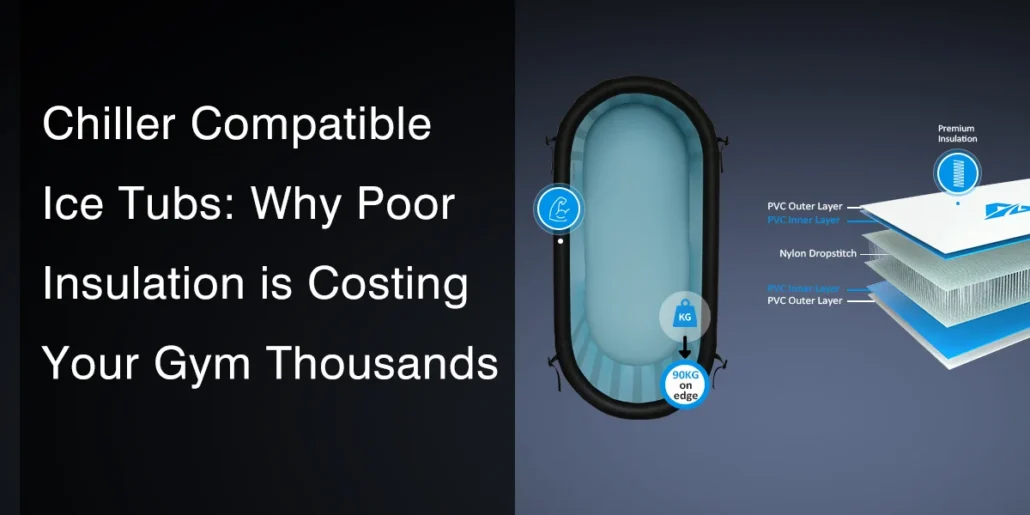
A drop-stitch tub insulates through the air held between its double walls — useful, but not magic, and not a claim that air outperforms a foam-insulated rigid tub. Still air is a fair insulator because it doesn’t conduct heat well, which is the same principle behind double-pane windows. That’s why a double-wall inflatable tub holds temperature far better than a single-layer one.
Where to be honest with your buyers: a foam-walled steel or acrylic tub will hold cold longer than an inflatable in raw thermal terms. Inflatable’s advantage isn’t “best insulation” — it’s good-enough insulation combined with low cost, light freight, portability, and easy branding. For most commercial and DTC operations, good-enough insulation at a fraction of the cost is the better business decision.
For an optional insulated-wall upgrade, we add a reflective/foam layer inside the drop-stitch wall that narrows the gap with rigid tubs while keeping the inflatable cost and freight advantages. We laid out the inflatable-vs-rigid trade-off in full in the inflatable vs steel frame cold plunge comparison.
Protecting Your Chiller: Insulation Extends Compressor Life
A chiller’s compressor has a finite number of running hours in it — so the harder your tub makes it work, the sooner it dies. Pair a high-end chiller with a thin, uninsulated tub and you make that compressor run a marathon every day: the fans wear, the refrigerant circuit is stressed, and the unit runs hot.
An insulated tub lets the chiller cycle off and rest between pulls, which is the single biggest factor in how long it lasts before service. Put plainly, buying a well-insulated tub is insurance on the more expensive chiller next to it.
This is also why insulation belongs in your total-cost math, not just your comfort math — the savings show up in both the electricity bill and the replacement cycle. The full cost-of-cheap breakdown is in the true cost of a cheap inflatable ice bath.
Insulation is one factor in the wider buying decision — for how it sits alongside size, specs, temperature and budget, see our overview on how to choose an inflatable ice bath tub.
Frequently Asked Questions
Does tub insulation really affect my chiller’s electricity cost?
Yes. Insulation sets the chiller’s duty cycle — how many minutes per hour it runs to hold temperature. A thin single-layer tub bleeds cold into the room, forcing near-continuous running; an insulated double-wall tub slows that heat transfer so the chiller cycles off and rests. Over a year of commercial operation, that run-time difference is a meaningful line on your energy bill.
Do inflatable tubs insulate better than steel or acrylic ones?
Not in raw thermal terms — a foam-walled rigid tub holds cold longer. An inflatable’s double-wall air gap gives good, sufficient insulation for most commercial use, and its real advantage is combining that with much lower cost, lighter freight, portability, and easy branding. The honest comparison is a well-insulated tub versus a thin budget tub, not inflatable versus rigid.
What does it mean if my cold plunge tub “sweats” on the outside?
Exterior condensation means cold is passing through the tub wall to the outside air and hitting the dew point. It signals poor insulation, and it creates a slip hazard, flooring and mold damage, and wasted energy. A properly insulated tub stays dry and near room temperature on the outside.
Will a better tub really extend my chiller’s lifespan?
It extends the working life by reducing run hours. A chiller paired with an uninsulated tub runs almost continuously, stressing the compressor and fans and running hot. An insulated tub lets it cycle off and rest, which is the biggest practical factor in how long it lasts before needing service.
Is the insulated-wall upgrade worth it for a commercial buyer?
For daily-use commercial operations, usually yes — the upgrade narrows the heat-loss gap, lowers the chiller’s duty cycle, and pays back through reduced electricity and slower chiller wear. For low-use home tubs the payback is slower, so it’s optional. Tell us your daily plunge volume and we’ll advise whether it’s worth it for your case.
Get a Factory-Direct Quote
Tell us your facility’s daily plunge volume, tub size, ambient conditions, and whether you want the insulated-wall upgrade, plus your destination port. We’ll recommend a tub-and-chiller pairing that keeps your duty cycle — and your energy bill — down.
We will respond within 24 hours with a factory-direct quote.
MOQ starts from 1 piece.