
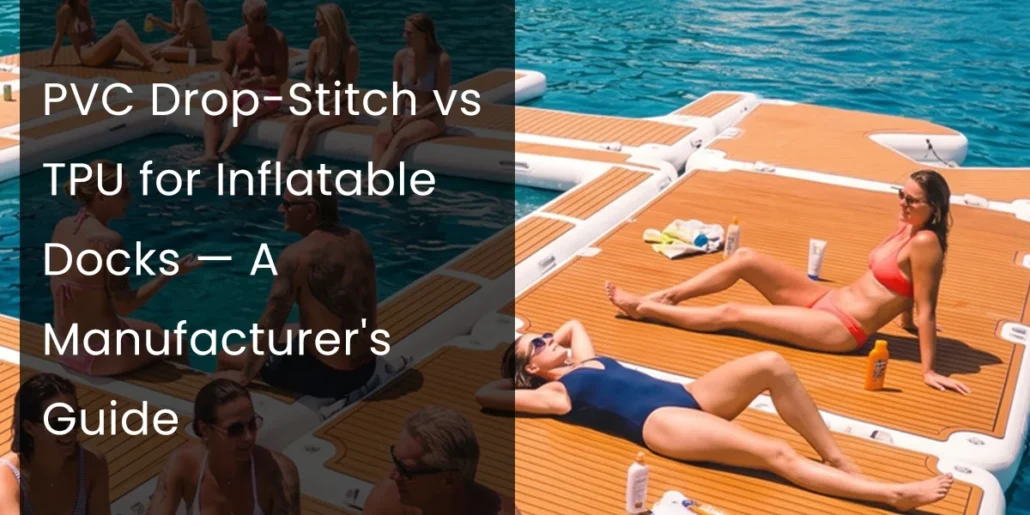
If you resell inflatable docks, you have heard the pitch. A competitor calls their dock “TPU, premium grade” and yours “just PVC,” then prices it 30% higher. Your customer asks you to explain the difference, and the honest answer is harder to find than it should be.
I’m Charlie, a senior designer on our factory floor. For 15 years we have built drop-stitch docks, SUP boards and platforms here in Guangzhou, in both materials, on the same machines. This guide gives you the real differences, the test numbers and the FOB pricing, so you can quote your own buyers without guessing.
Drop-Stitch Is the Strength. PVC and TPU Are Just the Skin
This is the part most sales pitches skip. The stiffness of a dock does not come from the outer coating — it comes from the drop-stitch core: thousands of threads connecting the top and bottom panels so the deck holds its shape under pressure.
PVC or TPU is the outer skin bonded to that core. The skin changes weight, UV behaviour, chemical resistance and price. It does not, on its own, make a dock “strong” or “weak.” A well-built PVC drop-stitch dock and a TPU one start from the same structural backbone.
So the real question is not “PVC or TPU.” It is which skin matches the job and the budget. That is what the rest of this guide answers.
PVC vs TPU: The Differences That Actually Matter
Both skins are bonded over a base fabric (we use a 1000D woven base), and both can be heat-welded. Where they split is weight, cold flexibility, chemical resistance and cost. Here is how they compare on a like-for-like dock panel.
| Property | PVC drop-stitch | TPU drop-stitch |
|---|---|---|
| Panel weight | Baseline | 15–25% lighter |
| Abrasion resistance | High | High to very high |
| UV resistance | Treated, holds for years | Slightly better |
| Cold-crack flexibility | Good to about −15°C | Stays flexible below −30°C |
| Oil, fuel & chemical contact | Moderate | Strong |
| HF weldability | Excellent | Excellent |
| Coating material cost | Baseline | ~1.5–2× higher |
| Typical service life (commercial) | 5–8 years | 6–10 years |
If you want the chemistry behind these numbers, the material backgrounds for PVC and thermoplastic polyurethane (TPU) are worth a quick read.
Where PVC Drop-Stitch Wins (Most Dock Orders)
For the docks most buyers actually sell — swim platforms, jet ski docks, work platforms, lake and marina decks — high-grade PVC drop-stitch carries the same loads and inflates to the same pressure as TPU, because the drop-stitch core is doing the structural work.
What you get for the lower price:
- Working pressure 7–10 PSI on dock panels, the same target we set for TPU builds.
- HF-welded seams across the whole panel — not hand glue (more on that below).
- 5–8 years of commercial service with normal care.
- 20–35% lower FOB than the TPU version of the same dock.
For a heavy-duty work platform or a wholesale run of swim platforms, that price gap is margin you keep or pass on to win the order. PVC is the right call unless a specific condition below forces TPU.
When TPU Is Worth the Premium
I will not tell you TPU is hype. There are jobs where it earns the extra cost, and I quote it without hesitation for them.
- Weight-sensitive builds. On a superyacht where crew handle the unit by hand, or a product that ships and stows often, 15–25% less weight matters. This is common on a superyacht sea pool program.
- Extreme cold. For cold-climate or winter use, TPU stays flexible below −30°C where PVC starts to stiffen.
- Fuel and chemical contact. If the deck will sit in oily marina water or contact solvents, TPU holds up better.
- Premium positioning. Some brands want a TPU spec sheet to match their price point. That is a marketing reason, and it is a valid one.
Outside those cases, the extra spend buys you little a buyer will notice on the water.
How We Build and Test Both
The material only performs if the seams and QC behind it are right. Here is what happens on our floor, and it is the same for PVC and TPU.
HF welding, not hand glue
We join panels with high-frequency (HF) welding, which fuses the two layers into one piece. Hand-glued seams rely on adhesive that ages, peels and fails first — they are cheaper to make and the reason many low-cost docks leak at the edges within a season. Every structural seam we ship is welded.
48-hour pressure retention test
Each panel is inflated to working pressure and held for 48 hours. We reject any unit that loses more than 10% of its pressure in that window. Our overall QC rejection rate runs 3–5% — those units never reach a container.
Compliance
Both materials are supplied to CE and REACH requirements for the EU market. If you import to Europe, the REACH framework is worth understanding before you place an order.
Pricing: MOQ, FOB Guangzhou and Landed Cost
Prices below are indicative for a standard 3×2 m, 20 cm dock panel. Your exact quote depends on size, thickness, accessories and branding — but the PVC-to-TPU gap stays in this range.
| Order size | PVC drop-stitch (FOB) | TPU drop-stitch (FOB) |
|---|---|---|
| Sample — 1 pc | $280–360 | $360–470 |
| 10–49 pcs | $240–310 | $310–410 |
| 50+ pcs | $210–270 | $270–360 |
MOQ starts at 1 piece for a sample, with production tiers above. For a US or EU importer, add roughly 25–40% over FOB for sea freight, insurance and duty to your port — lower at container volume, higher for small LCL shipments. We quote FOB Guangzhou and can estimate your landed cost once we know the destination and quantity.
PVC vs TPU Inflatable Docks: FAQ
Is a TPU dock stronger than a PVC dock?
Not by itself. The load strength comes from the drop-stitch core, which is the same in both. TPU’s advantages are lower weight, cold flexibility and chemical resistance — not raw load capacity on a standard dock.
Will a PVC drop-stitch dock last in saltwater and sun?
Yes. Our PVC is UV- and saltwater-treated and runs 5–8 years in commercial use. The faster failure you see in cheap docks is usually hand-glued seams, not the PVC itself.
When should I pay extra for TPU?
Choose TPU when weight matters (superyacht or frequently moved units), when the dock faces extreme cold below −15°C, or when it contacts fuel and chemicals. For most lake, marina and leisure docks, PVC is the better value.
Can you weld and brand both materials?
Yes. Both are HF-welded on the same lines, and both accept printed logos, custom colors and OEM/ODM packaging. Your branding does not change which material you should pick.
What is the MOQ, and can I test one first?
You can order a single sample in either material to check quality before a production run. Production MOQ and tier pricing depend on size and spec — tell us your order and we will lay it out.
Get a Material Spec and Factory Quote
Send us your dock size, where it will be used and your target market, and we will recommend PVC or TPU with the test data and pricing to back it up. You can also start from our full inflatable dock range if you are still choosing a model.
We will respond within 24 hours with a factory-direct quote.
MOQ starts from 1 piece.


