
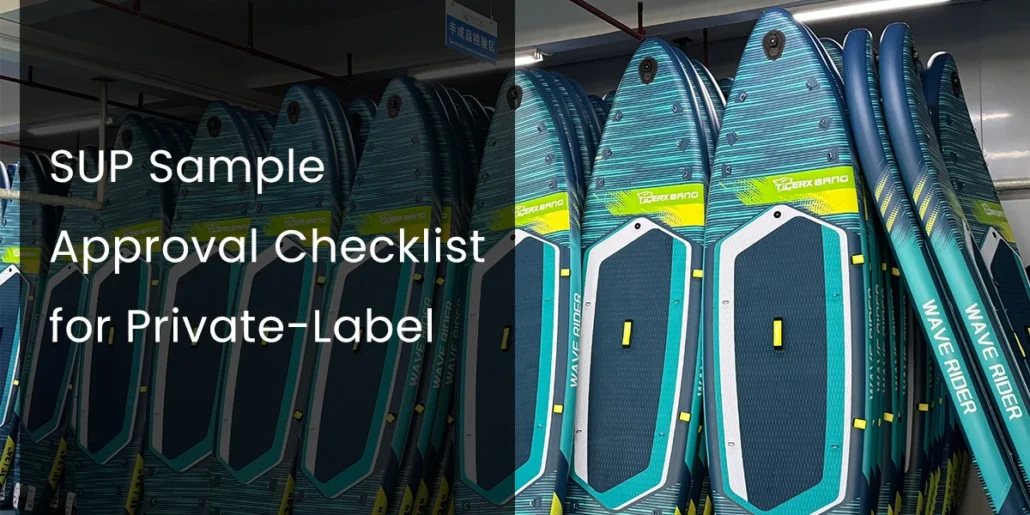
A private-label SUP sample is not only a product you inspect and then say “looks good.” It should become the approved production reference for your bulk order.
I’m Charlie from Huale. When we work with paddle board brands, distributors and e-commerce sellers, sample approval is the stage where product specifications, graphics, fittings, accessories and packaging need to stop being vague and become documented requirements.
Short answer: before approving an inflatable paddle board sample, confirm the board structure, dimensions, visual finish, logo placement, EVA deck, valve, fin system, handles and D-rings, accessory package and retail packaging. Any change requested after approval should be recorded before bulk production starts.
This checklist is designed for private-label buyers who need a repeatable way to review a SUP sample and turn it into a clear production standard rather than relying only on photos or general comments.
What Should a SUP Sample Approval Actually Confirm?
The purpose of sample approval is to answer one practical question: if the bulk production matches this approved sample and written specification, will the buyer accept the order?
That means the sample should confirm more than appearance. A useful approval record should connect the physical board with measurable specifications, artwork files, accessory requirements and packaging instructions.
For private-label projects, we recommend treating the approved sample as one part of a larger reference package that may include:
- Approved product specification sheet
- Final artwork and logo files
- Approved color references
- Board dimensions and component positions
- Accessory list
- Packaging and carton requirements
- Approved sample photos
- Revision number or approval date
The physical sample and the written specification should agree with each other. If they do not, clarify which version controls production before the purchase order moves forward.
10-Point SUP Sample Approval Checklist
The table below can be used as a first-pass inspection before a private-label SUP sample is signed off.
| Checkpoint | What to Verify | Approval Evidence |
|---|---|---|
| 1. Board dimensions | Length, width, thickness and overall outline against the approved specification. | Measurement record + sample photos |
| 2. Construction | Drop-stitch type, PVC construction and rail structure specified for the project. | Specification sheet |
| 3. Shape & visual finish | Board symmetry, surface appearance, rail finish and visible workmanship. | Inflated sample inspection |
| 4. Graphics & logo | Artwork version, logo size, orientation, position and print appearance. | Approved artwork + photos |
| 5. EVA deck pad | Shape, color, pattern, alignment and bonding appearance. | Sample photos + specification |
| 6. Valve | Correct valve type, installation, cap condition and air retention during the agreed test. | Inflation inspection record |
| 7. Fin system | Fin box type, fin fit, installation direction and included fin configuration. | Physical fit check |
| 8. Handles & D-rings | Quantity, position, alignment and attachment appearance against the approved layout. | Layout drawing + sample photos |
| 9. Accessories | Paddle, pump, leash, backpack, repair kit and other agreed items. | Approved packing list |
| 10. Packaging | Bag, carton artwork, labels, barcode information, manuals and packing arrangement. | Packaging sample or approved artwork |
Do not mark a checkpoint as approved simply because it “looks close.” Where the item affects bulk consistency, connect the approval to a drawing, specification, artwork file or written acceptance requirement.
Check the Board Structure Before Approving Appearance
Artwork often receives most of the attention during a private-label sample review, but the board structure should be confirmed first.
A buyer should verify that the sample matches the specification agreed for the project, including the selected drop-stitch structure, PVC construction, board thickness and rail design.
Dimensions and outline
Measure the finished inflated board and compare it with the approved specification. Length, width and thickness affect stability, packing volume and how the finished model fits into your product range.
The acceptance tolerance should be agreed with the supplier for the specific construction rather than assumed from another model.
Rail and surface inspection
Inspect the rails around the full perimeter rather than checking only the most visible sections. Look for abnormal wrinkles, lifting, uneven finishing or other visible differences that should be clarified before approval.
If you need more background on construction options before approving the sample, our SUP construction comparison explains how different structures affect product positioning and sourcing decisions.
Approve Artwork, Color and Branding as Production Data
For a private-label board, “logo approved” is not specific enough. The final approval should identify exactly which artwork file and placement the factory must reproduce.
Check the artwork version
- Final logo file and revision
- Top, bottom and rail graphics
- Logo orientation
- Print position
- Requested colors
- Model name and specification markings
If the sample uses a color reference, save that reference with the project file. Screen colors, printed artwork and PVC materials can appear different under different lighting, so buyers should avoid approving color only from a phone photo.
Check branding beyond the board
Private-label branding may also appear on the backpack, paddle, pump, carton, product label or manual. These items should be approved individually instead of assuming that approval of the deck logo covers the full package.
Buyers still developing their brand specification can reference our private-label paddle board guide before freezing the sample artwork.
Inspect the Valve, Fin, Handles and D-Rings
Small components can create large after-sales problems when their specification or placement changes between the sample and bulk production.
Valve
Confirm that the sample uses the agreed valve and that it is installed cleanly. Inflate the sample according to the model specification and check for obvious leakage around the valve area during the agreed inspection period.
Fin system
Fit and remove the fin yourself. Check whether the correct fin and fin box have been supplied, whether the fit is secure and whether installation is practical for the intended customer.
Handles and D-rings
Compare the quantity and placement with the approved layout. This is particularly important for boards with extra cargo areas, kayak-seat attachment points, shoulder straps or rental-specific configurations.
Take clear reference photos after approval. They give both the buyer and production team a faster visual reference when checking the first bulk units.
Check the EVA Deck Pad Before You Approve the Sample
The EVA deck pad is one of the most visible parts of an inflatable SUP, and alignment problems are easy for end customers to notice.
Check the pad from both close range and several steps away. A section may appear acceptable when viewed individually but still look off-center when you see the entire board.
Review:
- EVA shape and coverage
- Centerline alignment
- Color and surface pattern
- Kick pad position if included
- Edges and corners
- Visible bonding condition
If a custom EVA pattern or logo is part of the project, keep the approved drawing together with the sample record. Do not rely on the finished sample alone to communicate exact production placement.
Inflate and Test the SUP Sample Before Sign-Off
A sample should be evaluated as an inflatable product, not only as a printed object.
Inflate the board according to the pressure guidance specified for that model. Do not apply a universal PSI copied from another SUP because allowable pressure can depend on the board structure and specification.
During the agreed sample test, buyers should check:
- Valve operation
- Visible air leakage
- Board shape when fully inflated
- Abnormal twisting or deformation
- Rail and seam appearance
- Pressure retention under the agreed test conditions
The test duration, operating pressure, environment and acceptance method should be documented for the project. If your purchasing specification requires a defined pressure-retention test, confirm the exact procedure with the factory before treating it as a bulk QC standard.
For buyers concerned about deformation and consistency, see our guide to SUP quality control and return-rate reduction .
Do Not Approve the Board and Forget the Accessories
For an e-commerce seller or distributor, the customer receives a complete package rather than a bare inflatable board. A correct board with the wrong accessory or packaging configuration can still create returns and customer complaints.
Accessory approval
Lay out the full package before approving the sample:
- Paddle
- Pump
- Leash
- Fin or fins
- Backpack
- Repair kit
- Manual
- Any project-specific accessories
Record the model, color and branding requirements for each component where they matter.
Packaging approval
Check the retail carton, shipping marks, barcode, labels and printed information against the approved files. If the buyer sells through a marketplace or retail chain, packaging requirements should be confirmed before bulk cartons are printed.
Packaging also affects carton dimensions and freight planning. Buyers preparing larger orders can reference our inflatable paddle board shipping and container planning guide .
How Should a Private-Label Buyer Sign Off a SUP Sample?
The strongest sample approval process is not a WhatsApp message saying “OK.” It is a traceable record showing exactly what was approved.
Step 1: List every requested change
After the first sample inspection, combine all revisions into one document rather than sending separate comments across multiple messages.
Step 2: Confirm what requires a revised physical sample
A small packaging text correction may be possible to approve by updated artwork, while a structural, dimensional or component change may require another physical sample. Decide this according to the risk of the change.
Step 3: Freeze the approved specification
Once the sample is accepted, record the approved artwork, component configuration, accessories, packaging and any agreed acceptance requirements.
Step 4: Keep an approved reference sample
Where practical, both buyer and supplier should retain a reference sample or a detailed approval record. This gives the production and QC teams something concrete to compare against during bulk production.
Step 5: Control later revisions
If a component, material, graphic or packaging item needs to change after approval, record the new revision before production continues. Silent substitutions create disputes because the buyer and factory may be comparing the finished order against different references.
What Can Be Approved by Photo and What Needs a Physical SUP Sample?
Not every correction requires another international sample shipment, but not every change should be approved remotely either.
| Change Type | Remote Approval May Be Suitable | Physical Sample Should Be Considered |
|---|---|---|
| Minor artwork text | Often possible with final artwork and production proof. | Usually not necessary unless print execution is uncertain. |
| Logo position | Possible when placement can be measured and photographed clearly. | Consider when placement strongly affects the overall appearance. |
| Color change | Digital approval can confirm artwork intent. | Consider a physical reference when color accuracy is commercially important. |
| Board dimensions or shape | Drawing approval is useful but does not verify the finished product. | Recommended when the change affects performance, packing or positioning. |
| Construction or component change | Documents can confirm the intended specification. | Consider physical verification when the change affects function or quality. |
The decision should be based on the commercial risk of the change rather than the cost of sending another sample alone.
Common SUP Sample Approval Mistakes That Cause Bulk-Order Disputes
Most sample disputes are not caused by one dramatic defect. They usually start with a requirement that was never defined clearly before production.
- Approving only from photos: photos cannot confirm dimensions, fin fit, pressure behavior or the physical feel of materials.
- Approving the board but not the package: accessories, labels and cartons are still part of the delivered SKU.
- Using vague comments: terms such as “make it slightly darker” or “move the logo a little” should be converted into an approved file or measurable instruction.
- Changing specifications after approval without revision control: the factory and buyer may then use different versions as the production reference.
- Assuming one sample standard applies to every model: dimensions, construction, components and pressure requirements can differ across a SUP range.
- Skipping pre-production confirmation: if changes were made after the physical sample, confirm the final revision before the full order proceeds.
For a larger private-label project, the goal is not to inspect more randomly. The goal is to make the approved standard clear enough that production and QC teams can repeatedly check the same requirements.
From Approved SUP Sample to Bulk Production
Once the sample is approved, the next step is to transfer that approval into production documents rather than treating the sample stage as finished and forgotten.
For an OEM or private-label order, the production team should have access to the current product specification, approved artwork, component requirements, accessory list and packaging instructions.
The approved sample can then act as a visual and physical reference during production and final inspection.
Buyers who want to understand how the sample moves into manufacturing can review our inflatable paddle board factory and OEM production process . For assortment and bulk-order planning, see our wholesale paddle board program .
The key principle is simple: bulk production should reproduce an agreed standard, not reinterpret the buyer’s original idea.
FAQ: SUP Sample Approval for Private-Label Buyers
Should I approve a physical SUP sample before bulk production?
For a new private-label specification, a physical sample is usually the safer reference because it allows the buyer to check dimensions, construction, components, graphics, accessories and packaging together. Whether another physical sample is needed after revisions depends on the type and risk of the change.
What should I check first on an inflatable paddle board sample?
Start with the agreed product specification: dimensions, construction and overall configuration. After that, check graphics, EVA, valve, fin system, handles, D-rings, accessories and packaging.
Can I approve a private-label SUP sample from photos and video?
Some minor artwork or packaging changes may be suitable for remote approval, but photos cannot fully verify dimensions, physical components, inflation behavior or material feel. Structural or functional changes may justify another physical sample.
What is a golden sample in SUP manufacturing?
A golden sample is an approved product reference used together with written specifications and artwork during production and inspection. The exact approval record should identify which sample or revision is considered the reference.
What happens if I change the SUP specification after sample approval?
Record the change as a new revision and confirm how it will be verified before bulk production continues. Do not rely on scattered messages because the buyer, production team and QC team need to work from the same current specification.


