
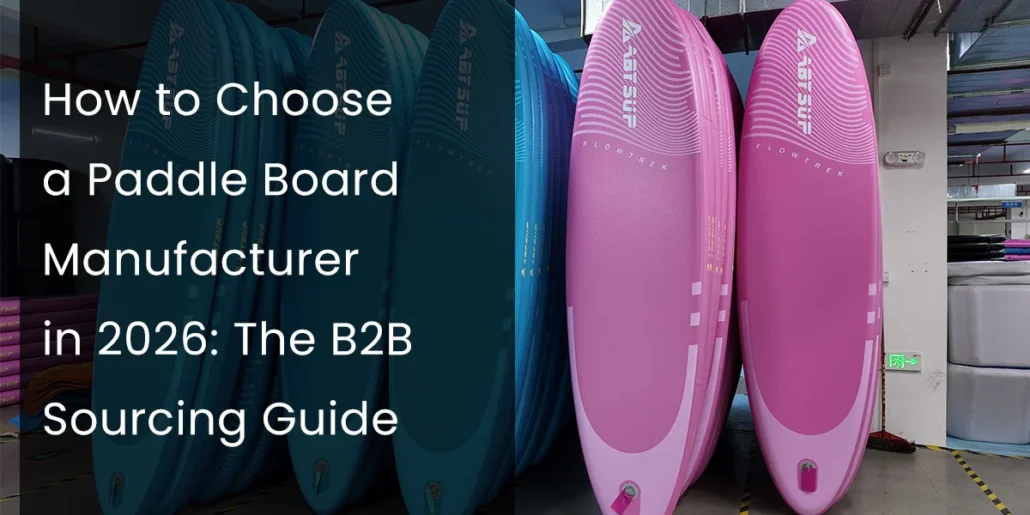
Every year, hundreds of new paddle board brands launch on Amazon, Shopify, and retail shelves. Most of them use the same manufacturing pool — a few dozen factories concentrated in China, Vietnam, and Thailand. The difference between the brands that thrive and the ones that quietly disappear often comes down to one decision made in year one: which paddle board manufacturer they chose to partner with.
This guide is not a list of “Top 10 manufacturers.” If you want a brand ranking, see our regional guides for the US market, Europe, and Oceania. This guide is the decision framework itself — the criteria that separate a real factory from a trading company, the compliance paperwork that actually matters at customs, the MOQ thresholds that indicate a manufacturer is serious about B2B partnerships, and the red flags that should end a conversation immediately. It is written for paddle board buyers who have not sourced from Asia before, and for experienced buyers who want a second opinion on their current manufacturing partner.
Everything below is structured around one principle: sourcing paddle boards is not primarily about price. It is about supply chain reliability, regulatory compliance, and defect resolution when things go wrong. Price differences of 5-15% between manufacturers mean very little. The difference between a manufacturer that ships on time with full compliance documentation and one that ships late with expired certificates can cost you an entire selling season.
What Types of Paddle Board Manufacturers Exist?
Before evaluating specific manufacturers, you need to know what you are actually choosing between. The term “paddle board manufacturer” is used loosely in the industry, and a significant share of companies calling themselves manufacturers do not actually manufacture anything. Four distinct business models exist, each serving different buyer needs.
1. Direct Factories (Contract Manufacturers)
Direct factories own the production facility, employ the workers, and maintain the quality system. They produce paddle boards under your brand name — your logo, your packaging, your specifications — and ship containers directly to your warehouse or freight forwarder. They do not sell under their own name in consumer markets, which means no channel conflict with your retail distribution.
For B2B buyers — retailers, rental operators, distributors, and brand owners — direct factories are the only viable sourcing option. Pricing is 10-20% lower than buying through trading companies (no middleman markup), quality is more consistent (same production line for every unit in your order), and communication is direct with the people who actually build your product.
Examples of direct paddle board factories: Huale Inflatable (Guangzhou, China), several mid-size factories in Fujian and Zhejiang provinces, and a smaller number in Vietnam. Direct factories typically accept MOQ from 50-200 pcs depending on customization level.
2. Direct-to-Consumer Brands
D2C brands like NRS, iRocker, BOTE, and Red Paddle are often described as “paddle board manufacturers” because they design and sell paddle boards. In reality, almost none of them manufacture in-house; they contract production to factories in Asia under NDA, then sell the finished boards through their own websites and authorized retailers.
D2C brands are not sourcing options for B2B buyers. They will not produce boards under your brand name, and they will not sell you wholesale inventory at rates that make retail margin possible. In a B2B sourcing context, they are competitors in your retail market — not suppliers. Ignoring this distinction is the single most common mistake first-time B2B paddle board buyers make.
3. Trading Companies
Trading companies are sales organizations that take orders from international buyers and farm the production out to one of several factories they have relationships with. They add 10-15% to the unit price and do not control the production line.
The problem with trading companies is not their existence — many serve a legitimate purpose for buyers who need broad product sourcing across multiple categories. The problem is that many trading companies market themselves as “manufacturers” on platforms like Alibaba and Global Sources. If you ask “Is this your factory?” and the answer is anything other than a direct “Yes, here is the address, you can visit,” you are talking to a trading company.
For paddle board sourcing specifically, trading companies introduce variability (the same order can be produced at different facilities depending on capacity) and weaken your leverage on quality issues (the trading company has to negotiate with the factory on your behalf, slowing everything down).
4. Drop-Ship Brands and Resellers
At the bottom of the ecosystem are drop-ship brands — companies that source finished paddle boards from Alibaba, apply their logo as a sticker or pad print, and resell them without any manufacturing involvement. These operations are common in the budget segment on Amazon.
Drop-ship brands are not manufacturers in any meaningful sense, and they are especially risky to source from. There is no compliance paperwork that holds up under customs scrutiny, no ability to customize, no QC process, and no accountability when boards fail. If a potential supplier cannot produce ISO certificates, test reports, and a factory address you can verify, you are almost certainly looking at a drop-ship operation.
The 7 Criteria for Choosing a Paddle Board Manufacturer
Professional paddle board buyers use a consistent evaluation framework when vetting potential manufacturing partners. The seven criteria below are listed in the order they should filter a candidate — if a manufacturer fails one of the first three, the remaining four stop mattering.
Criterion 1 — Verified Factory Existence
The first and most important filter is whether the “manufacturer” actually operates a factory. This sounds obvious but catches most first-time B2B buyers. Before any other evaluation:
- Request the factory physical address, including street, district, and city. A serious manufacturer will have this on their about page or provide it within one email.
- Verify the address on Google Maps or Baidu Maps. Look for aerial imagery showing an industrial facility, not an office building, residential address, or coworking space.
- Cross-reference the address with business registration records. In China, the National Enterprise Credit Information Publicity System (gsxt.gov.cn) lists registered manufacturing businesses. A legitimate factory will appear in these records with a “manufacturing” scope, not “wholesale trading.”
- Request a live video call with the production floor visible, during local business hours. If the supplier hesitates, resists, or only offers pre-recorded videos, end the conversation.
Huale Inflatable’s manufacturing facility is located at Building 1-3, No. 28 Zhenzhong North Road, Jianggao Town, Baiyun District, Guangzhou, Guangdong, China. This address is verifiable on maps, in Chinese business records, and through physical visits arranged during Canton Fair season. Transparency at this level is table stakes for serious B2B manufacturing, not a premium feature.
Criterion 2 — Current and Verifiable Compliance Certifications
Paddle boards are regulated products in every major Western market. A manufacturer that cannot produce current, independently verifiable certificates for your target markets will create customs problems that cost more than the unit price savings of choosing them.
Required certificates by market:
- United States: CPSC (Consumer Product Safety Commission) compliance is required for consumer paddle boards. ASTM F963-17 applies to any board that could be used by children under 12. Boards for rental operations may also require additional liability documentation.
- European Union: CE marking to EN ISO 25649-1:2017 is mandatory. REACH Regulation compliance covers chemical safety; RoHS covers restricted substances. EU customs will reject shipments without all three.
- United Kingdom: UKCA marking (post-Brexit) generally replaces CE, though CE is still accepted in some transitional categories through mid-2025. Confirm current requirements with your freight forwarder.
- Australia: AS/NZS standards align with ISO; most CE-compliant boards meet Australian import requirements.
- Canada: Generally accepts US CPSC and CE documentation.
When evaluating a manufacturer, ask specifically: “Send me the current certificate and the underlying test report PDF.” Any factory that can only send a certificate but not the test report is using recycled documentation from earlier product runs — and those certificates may no longer be valid if the product formulation has changed.
The full compliance package that should accompany a serious wholesale paddle board shipment includes: CE Declaration of Conformity, CPSC Children’s Product Certificate (for US-bound cargo), REACH material declarations, RoHS compliance statement, ISO 9001:2015 Quality Management System certificate, and amfori BSCI or SMETA social audit (increasingly required by major Western retailers).
Criterion 3 — Construction Type and Material Specification
The physical construction of a paddle board is the single largest determinant of its lifespan, warranty claim rate, and suitability for different use cases. A manufacturer that cannot clearly specify the construction of their boards — or attempts to obscure it with marketing language — is either hiding cost-cutting decisions or does not understand their own product.
Three construction tiers exist:
- Single-layer drop-stitch with glued rails: The cheapest option, suitable only for casual consumer use. Rail seams typically fail within 1-2 seasons of rental use. Avoid for any commercial deployment.
- Dual-layer drop-stitch with heat-welded rails: The industry standard for retail and rental boards. Rails are mechanically bonded into a single piece — no glue joint to fail. Roughly 15-20% higher unit cost than single-layer, but dramatically lower warranty claim rates.
- Fusion / woven drop-stitch: The premium tier. Uses advanced drop-stitch fabric with cross-stitched fibers, reducing weight 15-20% while increasing rigidity. 30-40% cost premium over dual-layer but worth it for performance-focused brands or high-UV markets.
For most B2B applications, dual-layer with heat-welded rails is the right balance. A manufacturer should be able to show you the rail seam under cross-section, explain the welding temperature and dwell time, and produce pull-strength test reports for the rail bond. If they cannot, they likely do not control the welding process themselves.
Criterion 4 — MOQ Flexibility and Order Size Handling
Minimum order quantity is where many B2B sourcing relationships break down. The MOQ a manufacturer quotes reflects two things: the economics of setting up a production run for your order, and how much they value you as a long-term customer vs. a one-time buyer.
Realistic MOQ benchmarks in 2026:
- Logo-only private label (your logo on an existing board design): 50-100 pcs from serious direct factories; 200-300 pcs from trading companies marking up through factory minimums.
- Logo + custom graphics (full-wrap print): 100-200 pcs typical.
- Custom dimensions, shape, or internal structure (full ODM): 200-500 pcs minimum; 500+ pcs at scale-competitive pricing.
- Completely new design with tooling: 500-1,000+ pcs depending on tooling investment.
Questions worth asking at the MOQ stage: “Can I start at a lower quantity for a first-season test order, with commitment to scale in year two?” “What does your pricing look like at 50, 100, 250, and 500 pcs?” “Do you offer mixed-type orders — 25 beginner boards, 25 yoga boards, etc. — to hit MOQ across categories?”
A manufacturer that refuses any flexibility on first-order volume, but claims to want long-term partnerships, is signaling that they are not actually looking for partnerships. They are looking for one-shot revenue.
Criterion 5 — Lead Time and Production Predictability
Paddle boards are seasonal products in most Western markets. Missing the start of the summer selling season by two weeks can destroy a year’s margin. Lead time discipline is therefore as important as product quality.
Realistic production and shipping timelines:
- Sample production: 7-10 business days after specification confirmation.
- Bulk production (50-500 pcs): 25-35 business days after deposit.
- Larger orders (500+ pcs): 35-50 business days, depending on production capacity.
- Ocean freight: 18-22 days to US West Coast, 30-35 days to US East Coast, 25-30 days to EU continental ports, 28-32 days to UK, 20-25 days to Australia.
- Customs clearance at destination: 3-7 days typically.
A manufacturer quoting “10-day bulk production” is either inventorying finished boards with a logo applied on top (quality you cannot verify), or lying. Production takes the time it takes. The question is whether the manufacturer hits their quoted timeline consistently — ask for a recent client reference and check directly.
For seasonal planning: place Northern Hemisphere orders by late January or early February for May-August delivery. Southern Hemisphere buyers should reverse the calendar by six months. Building in a 2-3 week buffer for unexpected delays is standard industry practice.
Criterion 6 — OEM / ODM / Private Label Capability
The three terms are often used interchangeably but mean different things. Knowing the difference will help you evaluate which manufacturing capability you actually need — and prevent you from paying for services you don’t.
- Private Label: The factory’s existing board design gets your logo, your colors, and your packaging. Fastest and cheapest path to market. Typical timeline: 30-45 days from order to shipment. Minimum customization effort; works well for first-season testing or buyers who need inventory quickly.
- OEM (Original Equipment Manufacturer): You provide the design file or specification; the factory engineers and produces to your requirements. Your board is functionally different from anything else on the market. Typical timeline: 45-60 days, plus any sample iteration cycles. Suitable for brands with strong product design capability.
- ODM (Original Design Manufacturer): The factory designs the board to your functional brief (e.g., “a fishing SUP with integrated cooler support and four rod holders”) using their in-house R&D. Your brand owns the final design. Typical timeline: 60-90 days for new designs including tooling. Suitable for buyers who want unique products but don’t have in-house design capability.
Most first-time B2B paddle board buyers should start with Private Label in year one (proven board shape, lower risk, faster to market), then consider OEM/ODM in year two once product-market fit is confirmed. Jumping straight to ODM in year one is usually a mistake — you pay for tooling and design work before you know whether your brand concept resonates with buyers.
Criterion 7 — Warranty and Defect Handling Policy
Defects happen even at well-run factories. What separates a professional manufacturing partner from a risky one is how they handle defect resolution when it happens — and whether they document their warranty process clearly before your first order.
Industry defect rate benchmarks: below 1% for dual-layer boards from verified factories; 2-3% for single-layer construction; 5-8% for budget boards from trading companies. These numbers compound — a 3% defect rate on a 500-piece order means 15 defective boards you need to handle.
Ask specifically before placing any order: “If I receive 15 boards with rail delamination on a 500-piece order, what happens?” The acceptable answers:
- “We replace the defective units in your next container at no charge” — most common for ongoing relationships.
- “We credit the defective value against your next order invoice” — second most common.
- “We issue a partial refund to the wire transfer account you paid from” — less common but possible for relationships ending.
Unacceptable answers: vague reassurances (“We never have defects”), blame-shifting (“Shipping damaged them”), or conditional promises (“If photos satisfy our team…”). A manufacturer that cannot write down their warranty process cannot reliably deliver it.
Serious factories also offer pre-shipment QC inspection reports for orders of 100+ pcs, and welcome third-party QC inspectors (SGS, Bureau Veritas, Intertek) on-site during production at no charge from their side. A factory that resists third-party QC is hiding something.
Red Flags to Avoid in Paddle Board Sourcing
The seven criteria above identify what a good manufacturer looks like. The list below identifies what a bad manufacturer sounds like. If you encounter any of these patterns, end the conversation — the potential upside is never worth the risk.
Suspiciously Low Pricing
If a quote comes in at 25% or more below other quotes you’ve received for similar specifications, the manufacturer is cutting corners somewhere. Common corner-cuts: single-layer construction marketed as “dual-layer,” expired compliance certificates recycled from older batches, substitution of Taiwanese drop-stitch fabric with lower-grade Chinese alternatives mid-production. The savings disappear the first time you handle warranty claims.
No Physical Factory Address
“Guangzhou, China” is not an address. “Our factory is in the industrial zone” is not an address. A serious manufacturer will provide a street-level address you can verify on maps. Any evasion here is disqualifying.
Hesitation or Refusal on Video Factory Tours
Every serious manufacturer has done dozens of video tours for prospective B2B clients. It takes 15 minutes of a salesperson’s time. If a supplier claims they can’t do it “due to confidentiality” or “because the factory is too busy,” they are signaling they do not want you to see the facility — either because it doesn’t exist or because it’s not what they claimed.
Certificates Without Underlying Test Reports
A CE certificate without the 40-60 page test report that generated it is either expired or belongs to a different product. Always ask for both. Factories that have nothing to hide will send both within one business day.
Pressure to Accept Terms Quickly
“This pricing expires in 48 hours.” “The production slot is almost full.” “Deposit today or we can’t guarantee your timeline.” These are sales tactics, not sourcing signals. Good manufacturers have enough demand that they don’t need to pressure first-time buyers. A rushed decision on a $30,000 container is never a good decision.
No References from Your Region
Ask for two B2B client references in your target market (US, EU, UK, or AU). A manufacturer with 100+ active clients should produce two references within 24 hours. If they claim confidentiality prevents any references, that’s sometimes valid for large brands — but they should offer an intermediate option like a sanitized testimonial or a trade reference from a freight forwarder.
Payment Terms That Don’t Match Industry Norms
Standard B2B paddle board terms: 30% T/T deposit on order confirmation, 70% T/T balance before shipment. Letter of Credit (LC at sight) accepted above $30,000. A supplier demanding 50%+ deposit, full payment before production, or PayPal/Western Union (which provide no fraud protection for commercial transactions) is creating conditions that protect them entirely and expose you entirely.
Regional Sourcing Considerations
Paddle board manufacturing is concentrated geographically, and the region you source from affects lead times, compliance, and communication in ways worth considering. The three regions below account for the overwhelming majority of global inflatable SUP production.
Manufacturing in China
China remains the dominant paddle board manufacturing region, producing an estimated 75-80% of inflatable paddle boards sold globally. Guangdong Province (especially Guangzhou and Dongguan), Fujian Province, and Zhejiang Province account for most of this production.
Advantages: Largest and most mature supply chain for drop-stitch fabric and PVC composites; lowest unit costs at scale; strongest OEM/ODM capability; well-established export logistics through Guangzhou, Ningbo, and Shanghai ports.
Considerations: Time zone difference with Western buyers requires scheduling around overlapping business hours; Chinese New Year (January-February) shuts production for 2-3 weeks annually, requiring seasonal planning; tariff structures for US-bound cargo have shifted repeatedly since 2018 and require current consultation with a customs broker.
For most B2B buyers, a Chinese direct factory offers the best combination of price, capability, and compliance infrastructure.
Manufacturing in Southeast Asia (Vietnam, Thailand)
Vietnam and Thailand have grown their paddle board manufacturing capacity significantly since 2018, partly in response to US tariff policies on Chinese imports. These regions now account for an estimated 10-15% of global SUP production.
Advantages: Lower tariff rates for US-bound cargo (varies by product category); emerging manufacturing capability with some experienced staff from Chinese factories; shorter geographic distance to Australia.
Considerations: Smaller supply chain ecosystem — most raw materials (drop-stitch fabric, PVC coatings) are still imported from China, which can add 5-10% to input costs; limited number of factories with 200+ pc MOQ capability; QC infrastructure less mature than Chinese counterparts.
Southeast Asian manufacturing makes sense for US buyers specifically seeking tariff diversification, but most buyers will find Chinese manufacturers more capable at similar or better total landed cost.
Manufacturing in the Americas and Europe
Some inflatable paddle board assembly happens in the US, Canada, and Europe — typically importing drop-stitch shells from Asia and completing final assembly, branding, and packaging domestically. True “made in USA” or “made in Europe” inflatable SUPs are rare; most brands claiming this positioning are doing final assembly only.
Advantages: Faster shipping to Western buyers; easier communication without time zone or language barriers; some marketing value from “locally made” positioning.
Considerations: Unit costs are 2-3x Asian manufacturing; MOQ flexibility is generally poor; scale beyond small boutique volumes is impractical; compliance testing still happens through the same labs that certify Asian production.
For most B2B paddle board buyers, domestic manufacturing is not a cost-competitive sourcing option. It can make sense for premium brands whose retail positioning justifies the pricing, or for niche applications like whitewater-specific construction where small batch production is acceptable.
For buyers focused on specific regional markets, see our supplementary guides: Top Paddle Board Manufacturers in the US Market, Custom Paddle Board Manufacturers in Europe, and Paddle Board Manufacturers in Oceania.
Frequently Asked Questions About Paddle Board Manufacturers
What is the difference between a paddle board manufacturer and a paddle board brand?
A paddle board manufacturer produces physical paddle boards in a factory. A paddle board brand sells paddle boards under its name — the boards are typically made by a manufacturer under contract. Some companies (like Huale) are pure manufacturers. Some companies (like iRocker, BOTE, NRS) are pure brands. A small number operate both functions, designing and manufacturing in-house. For B2B sourcing purposes, only manufacturers are relevant; brands are retail competitors, not suppliers.
How much should a quality inflatable paddle board cost from a manufacturer?
Factory pricing for wholesale paddle boards in 2026 ranges approximately: $80-120 per unit for single-layer budget construction at 500+ pcs MOQ; $130-180 per unit for dual-layer drop-stitch with heat-welded rails at 200+ pcs; $200-280 per unit for fusion/woven drop-stitch at 200+ pcs; plus $40-80 per unit for complete accessory kits (paddle, pump, leash, bag, fin). Any quote significantly below these ranges is either for lower construction than specified or from a trading company using outdated pricing to win initial orders.
Can I trust paddle board manufacturers on Alibaba?
Alibaba hosts both legitimate factories and trading companies marketing themselves as manufacturers. The platform’s “Gold Supplier” and “Verified Supplier” badges indicate payment history, not manufacturing verification. Trust should be built independently: verify factory address, request ISO certificates with expiration dates, conduct video factory tours, ask for B2B client references in your region, and consider commissioning a third-party factory audit (SGS or Bureau Veritas, approximately $400-800 USD) before large first orders. Alibaba is a useful discovery platform, not a vetting platform.
Do paddle board manufacturers offer samples before bulk orders?
Yes, and you should always order a production sample before committing to bulk volume. Sample fees typically range $150-300 per board for stock designs, $300-600 for custom designs requiring setup. Reputable manufacturers credit the sample fee against your first bulk invoice, so the net cost of sampling is often zero. Samples arrive 7-10 business days after specification approval. Inspect samples for construction quality, inflation rigidity (15 PSI test), rail weld integrity, EVA grip adhesion, and accessory completeness. Only approve bulk production after a physical sample passes your inspection.
What happens if my paddle board shipment is damaged during ocean freight?
Ocean freight damage is separate from manufacturing defects and typically the buyer’s responsibility under FOB (Free on Board) terms, which are the standard for international paddle board wholesale. Before shipment, the manufacturer’s responsibility is limited to proper packaging and container loading. Once the container is sealed and bills of lading are issued, damage claims go through marine cargo insurance, which B2B buyers should purchase separately (typically 0.3-0.5% of cargo value). CIF (Cost, Insurance, Freight) terms include basic cargo insurance but often at minimum coverage levels. For orders above $20,000, purchasing additional all-risk marine insurance is standard practice.
How do I calculate the real landed cost of paddle boards from a manufacturer?
Landed cost is the total cost to get one paddle board to your warehouse, including: (1) unit price from the factory; (2) accessories and packaging; (3) ocean freight per unit (typically $15-25 per board in a 40ft container to US West Coast); (4) import duties and tariffs (HS code 9506.29, varies by country and current trade policy); (5) customs clearance fees ($200-500 flat per shipment); (6) domestic drayage and warehouse receiving (varies by destination); (7) marine insurance premium. For a typical 300-piece order of dual-layer paddle boards to US West Coast, landed cost runs approximately 30-40% above the factory unit price. Calculate this upfront, not after the container arrives.
Can paddle board manufacturers produce kayaks, surfboards, and other water sports equipment?
Many direct factories — including Huale — produce multiple inflatable product categories on related production lines. Common combinations: paddle boards + kayaks (similar drop-stitch construction); paddle boards + inflatable docks (same PVC welding process); paddle boards + ice bath tubs (same drop-stitch capability, different shape molds). For B2B buyers looking to expand across multiple water sports categories, sourcing from a single factory reduces logistics complexity — one container, one set of compliance documents, one shipping invoice. Most manufacturers will offer cross-category MOQ flexibility to win the combined order.
How do I evaluate a paddle board manufacturer’s financial stability?
Financial stability matters because a factory that goes bankrupt mid-production creates immediate supply chain disruption. For Chinese manufacturers, check the National Enterprise Credit Information Publicity System (gsxt.gov.cn) for registered capital, legal representative consistency, and any recent legal disputes. Request the manufacturer’s client tenure — how long have they been serving their largest B2B clients? Five-plus-year client relationships are a strong signal of stability. For orders above $50,000, consider requesting a Dun & Bradstreet business credit report ($100-200 USD) or arranging payment through Letter of Credit (LC) rather than T/T, which provides bank-mediated protection if either party fails to perform.
Starting Your Paddle Board Sourcing Project
The decision framework above applies to sourcing from any paddle board manufacturer in any region. Use it systematically — filter candidates through criteria 1-3 before considering criteria 4-7, and end any conversation that triggers red flags 1-7.
For B2B buyers ready to request quotes from a verified direct factory:
Huale Inflatable operates a 25,765 m² manufacturing facility in Guangzhou with full US, EU, UK, and AU compliance certifications. MOQ starts at 50 pcs for logo customization and 200 pcs for full ODM. Sample lead time is 7-10 days; bulk production runs 25-35 days. We serve over 200 active B2B clients across North America, Europe, and Australia.
If you are starting a first wholesale order, explore our wholesale paddle boards program for current pricing tiers. If you are looking for OEM design and tooling capability, see our custom paddle board manufacturing service. For a virtual tour of our production facility, see our paddle board factory.
For deeper regional context on available manufacturers, see our supplementary guides on the US paddle board market, European manufacturers, and Oceania suppliers.