
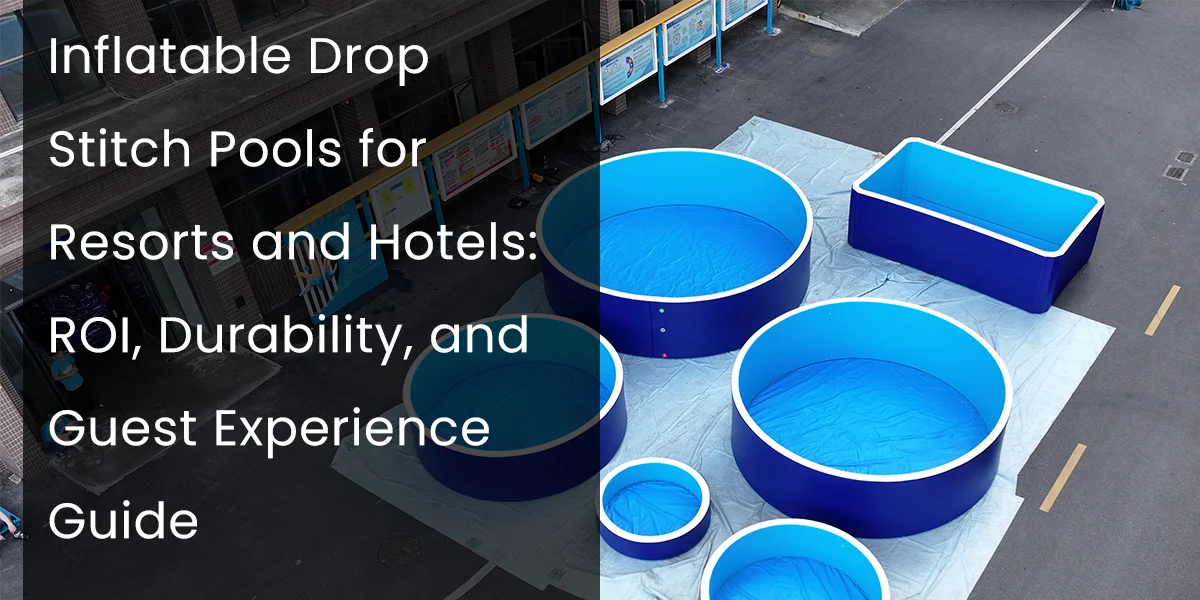
The hospitality procurement call I receive most often goes like this: a resort facility manager has seen inflatable pools at a competitor property — or on a competitor’s Instagram — and wants to add them to their pool deck, villa terrace, or glamping site. Then they pause and ask the question that’s been holding them back: “Are these going to look cheap in guest photographs? Will they deflate on a busy afternoon with four guests in the water? What happens when a guest punctures one and expects us to replace it by dinner?” These are the right questions. And the answer to all of them depends entirely on which construction specification you source.
I’m Charlie, Senior Industrial Designer at Huale Inflatables, a Guangzhou factory producing drop-stitch inflatable products for commercial operators and OEM brand owners across North America, Europe, Australia, and Southeast Asia. We supply inflatable pools to resort amenity procurement programs, boutique hotel groups, villa management companies, and glamping operators. The specification requirements for commercial hospitality use are meaningfully different from consumer product specs — and getting the distinction right before ordering is the difference between an asset that guests photograph and share, and a liability that generates noise complaints at the front desk.
This guide covers the commercial ROI case for drop-stitch pools in hospitality settings, the specific material and construction specifications that determine whether a pool handles daily multi-guest use, what the guest photography and social media case actually looks like in practice, and the certifications and maintenance protocols that satisfy duty-of-care requirements for commercial operators. The numbers below are from our production records and from feedback from hospitality clients who’ve been operating these pools for multiple seasons.
The Commercial Case: ROI Compared to Permanent Pool Installation
The ROI conversation for hospitality buyers starts with a comparison most of them haven’t fully costed out: what does adding a permanent pool to a villa terrace, pool deck extension, or glamping site actually cost, versus what a drop-stitch pool system costs — and how long before each option pays back through guest satisfaction metrics and incremental booking revenue?
Capital Cost Comparison
| Option | Capital Cost (6m² water surface) | Installation Time | Planning / Permits | Maintenance Cost / Year |
|---|---|---|---|---|
| Permanent in-ground pool | USD $35,000–$120,000+ | 6–16 weeks | Required in most jurisdictions | $3,000–$8,000 (chemicals, pump, servicing) |
| Permanent above-ground pool | USD $8,000–$22,000 | 2–5 days | Often required | $1,500–$4,000 |
| Drop-stitch inflatable pool (250cm × 150cm × 65cm) | USD $188–$240 FOB / $210–$275 landed | Under 10 minutes | None in most markets | Minimal (water, occasional repair) |
| Drop-stitch system (5 units, branded fleet) | USD $940–$1,200 FOB for 5 × 250cm units | Under 1 hour total | None in most markets | Minimal — repair kit included |
The capital cost comparison is not close. A 5-unit fleet of commercial-grade drop-stitch pools covering a villa cluster or glamping site costs less than 3% of the entry cost of a single permanent in-ground pool installation — and can be deployed the day the order arrives. No construction crews, no planning applications, no six-week window where the property is partially offline.
The Revenue Justification
The question hospitality operators ask next is whether the pools justify themselves through incremental revenue. The honest answer is: it depends on how you position them. A drop-stitch pool deployed on a villa terrace as a standard amenity, mentioned in booking copy and photographed professionally, can support a room rate premium of USD $40–$80 per night in comparable resort markets — based on pricing data from our clients in the Maldives, Bali, Spain, and Greece. At 60% occupancy on a 120-night summer season, a single villa with a pool addition generates approximately USD $2,900–$5,800 in incremental seasonal revenue per unit. Against a pool cost of USD $210–$275 landed, that’s a payback period measured in days, not months.
Deployment Flexibility
The operational advantage that permanent installation can’t match is reconfigurability. A drop-stitch pool fleet can be redistributed across a property based on seasonal demand — concentrated on pool-facing villas in peak summer, moved to indoor spa or wellness areas in winter, or withdrawn entirely for high-occupancy event seasons where the terrace space is needed for other purposes. A permanent pool can’t be moved. A drop-stitch fleet can be repositioned in under an hour per unit by two staff members, with no tools and no facility management involvement.
Commercial Durability: What Daily Multi-Guest Use Actually Requires From the Specification
Consumer-grade inflatable pools — the products in the USD $80–$120 retail price range on Amazon — are not built for commercial hospitality use. They’re built to survive one family for one summer. The failure modes that generate noise at the front desk — slow pressure loss mid-session, wall bowing under multiple occupants, UV discolouration after a single season outdoors — are consequences of specification decisions made to hit a consumer price point, not to survive 300–400 guest contact hours over a summer season.
Material Specification for Commercial Grade
The specifications that distinguish a commercial-grade drop-stitch pool from a consumer product are measurable and verifiable. At our factory, our hospitality-supply pool specification uses:
- 0.9mm double-wall woven PVC top and outer sheets — consumer products commonly use 0.6–0.7mm. Thicker material resists scuffing from pool toys, jewellery contact, and repeated entry/exit cycles that degrade thinner surfaces within a single commercial season.
- 6,500 internal polyester threads per square metre minimum — this is the thread density that provides wall rigidity under multi-occupant load. Consumer products at lower price points typically use 4,500–5,500 threads/m² — adequate for a single adult but marginally stable with two or three guests applying lateral wall pressure simultaneously.
- UV-stabilised PVC rated to Class 5 under ISO 4892-2 accelerated testing — equivalent to approximately 3–4 years of summer seasonal outdoor exposure without significant colour change or surface embrittlement. Non-UV-stabilised PVC yellows visibly within a single outdoor season — unacceptable for a guest-facing product that is photographed continuously.
- HF (high-frequency) welded seams throughout — not adhesive-bonded. HF welding bonds seams at a molecular level; the joint is as strong as the base material. Adhesive-bonded seams fatigue under the sustained hydrostatic load of a filled commercial pool — typically showing delamination between 6–12 months of commercial operation. We test all seams at 1.5× rated operating pressure for 4 hours minimum on production batch samples before any unit ships.
- Anti-slip ribbed PVC base sheet — pools used on tiled pool decks, polished stone villa terraces, and timber decking must not migrate under guest movement. Our ribbed base sheet specification prevents lateral shift on all common hospitality surface types.
The 48-Hour Pressure Retention Test
For commercial hospitality supply, we run a 48-hour static pressure retention test on all production batch samples, holding wall chambers at rated operating pressure (0.20 bar / 2.9 PSI) at ambient 20–25°C. Acceptable pressure loss: under 2.5% at the 48-hour mark — a tighter threshold than our consumer product standard because a pool losing pressure during a guest session is not a review complaint, it’s a front desk escalation. Production batch QC first-pass acceptance runs at 95–96% for our pool range. Units that don’t pass are reworked or scrapped — they don’t ship as replacement units in a future order.
Load Capacity and Multi-Occupant Use
Our 250cm × 150cm × 65cm commercial pool is rated for a maximum static load of 200kg per square metre at rated operating pressure. For a standard 2-adult occupancy scenario (combined 140–160kg), the surface load is well within rated capacity and the wall panels remain flat and vertical. For 3-adult occupancy in a larger configuration, we recommend the 300cm round format at 65cm wall height, which provides a larger water surface area that distributes load more evenly and accommodates group photography without the pool appearing cramped in frame.
Guest Photography, Social Media, and Why Visual Performance Is a Commercial Specification
The hospitality procurement question that doesn’t appear in most product spec sheets is: does this pool look good in a guest’s iPhone photograph taken in afternoon light at 4:30pm? It sounds like a marketing consideration, not a procurement one. It isn’t. The guest photography generated by a pool amenity is directly linked to organic reach, booking enquiry rate, and the ADR (average daily rate) premium the property can sustain. A pool that looks cheap, bows at the walls, or has visible colour degradation after one season generates photographs the guest doesn’t share — and those non-shared photographs represent the absence of organic marketing that a well-specified pool generates at scale.
What Makes a Drop-Stitch Pool Photograph Well
The visual characteristics that determine how well an inflatable pool photographs in a hospitality setting come down to three factors, all of which are specification-dependent:
- Wall verticality: A drop-stitch pool at 65cm wall height with correct inflation pressure produces walls that are genuinely vertical and flat in the photograph — not bowing outward at mid-height, which is the immediate visual signal that communicates “cheap inflatable” to a viewer. This is the structural difference between drop-stitch and soft-wall construction in practice.
- Colour consistency: UV-stabilised PVC in our standard colour options — sky blue, dark navy, grey, and sand beige — holds its colour through a full summer season without the yellowing and surface haziness that non-UV-stabilised vinyl develops after 200+ hours of direct sun exposure. A pool that was deep navy blue at the start of summer should still be deep navy blue at the end of it.
- Water clarity presentation: The pool wall colour determines how the water appears in photographs. Dark navy and grey walls create a darker water appearance that reads as “private plunge pool” in photography — the visual reference is a luxury spa or premium villa, not a children’s paddling pool. Sky blue creates a lighter, more Mediterranean resort aesthetic. Colour selection is a brand positioning decision for the property, not just a procurement preference.
Social Media Performance by Pool Configuration
Based on feedback from our hospitality clients who track social media metrics, the configuration that generates the highest number of unprompted guest shares is the 300cm round pool at 65cm wall height in dark navy — placed on a wooden villa deck with a visible ocean or garden backdrop. The round format photographs symmetrically from above (a natural drone shot composition) and reads clearly as a premium amenity rather than a functional pool. Rectangular formats perform better in photography contexts where the pool is surrounded by furniture and the straight edge lines align with the terrace geometry.
The Branded Pool Option for Premium Properties
For resort groups and hotel brands with a strong visual identity, we produce pools with a woven logo label heat-bonded to the exterior wall face and, for larger volume orders, can integrate brand colour schemes into the PVC specification at 200+ units. A pool carrying a resort’s logo — visible in every guest photograph and every social media post — compounds the organic marketing value of the amenity across the season. This is the option our clients in the Maldives and luxury Bali villa market have used most consistently, and it’s available from our commercial drop-stitch pool manufacturing program from 50 units minimum.
Maintenance Protocol, Repair Policy, and Duty of Care for Commercial Hospitality Use
The operational concern that gets raised in almost every hospitality procurement conversation — more than cost, more than aesthetics — is liability. A resort operator deploying a pool product for guest use has a duty of care obligation that a consumer buyer doesn’t. Understanding what that means for maintenance protocol, repair policy, and product certification is not optional — it’s what separates a professional commercial deployment from an improvised consumer product placed in a guest-facing context.
Daily Maintenance Protocol
The daily maintenance requirements for a commercial drop-stitch pool are minimal compared to a permanent pool installation, but they are non-negotiable for commercial operation:
- Morning pressure check: Inflate wall chambers to rated operating pressure (0.20 bar / 2.9 PSI) before the first guest session of the day. Temperature variation between overnight ambient conditions and peak afternoon use causes pressure variation of 5–10% — top up to rated pressure each morning takes under 60 seconds per pool with the included electric pump.
- Guest-facing cleaning: Wipe the pool wall exterior and rim with a diluted quaternary ammonium compound solution (standard hospitality surface disinfectant) after each guest session and between guest turnover. The embossed PVC surface is fully wipe-clean and non-porous — no absorption of guest contact residue.
- Water management: Change pool water at the frequency your property’s water treatment protocols require. There is no integrated filtration system in a drop-stitch pool — water chemistry management is the operator’s responsibility. For high-turnover villa use (multiple guest parties per week), daily water change is the simplest protocol. For lower-turnover glamping or resort deck deployment, a small portable filtration pump and light chlorination is adequate.
- End-of-season storage: Deflate fully, clean with pH-neutral cleaner, dry completely before rolling (rolling a damp pool accelerates surface degradation), store loosely rolled in carry bag away from direct UV. Our UV-stabilised PVC holds seasonal condition well in proper storage — do not fold tightly under heavy equipment.
Repair Protocol and What It Costs in Practice
Puncture from sharp object contact is the most common damage mode in commercial hospitality use — typically from guest jewellery (rings and bangles catching the pool rim on entry/exit), glass items brought to the pool edge, or pool toys with sharp attachment points. A puncture is not a product failure — it is a wear event. Our commercial supply kits include a repair kit: two 0.9mm PVC patches matched to the pool wall material, contact cement, and surface prep wipe. Repair procedure: deflate completely, clean the area with the prep wipe, apply patch with even pressure, cure for 24 hours minimum before re-inflation. Time required: under 10 minutes. The pool is available for the next session with no visible repair trace and full pressure retention restored. We advise all commercial clients to maintain a stock of 4–6 additional patch kits per pool for a full commercial season — total cost under USD $15 per pool.
Certification for Commercial Duty of Care
For hospitality operators operating in EU jurisdictions — including Spain, Greece, Italy, France, Portugal, and Scandinavia — inflatable pools used by guests require CE certification covering EN 71-1 (mechanical safety), EN 71-2 (flammability), and EN 71-3 (chemical migration) for products that could foreseeably be used by children. Our commercial pool range holds full CE certification from third-party testing by SGS, verifiable by report reference number on the SGS portal. REACH SVHC compliance documentation covering all PVC materials is available to all commercial buyers — required for EU market placement and expected by any hotel group’s procurement compliance process. For resort operators in Southeast Asia and the Middle East — where certification requirements are less formalised but insurance underwriters increasingly ask for documentation — we provide SGS test reports and our ISO 9001:2015 factory certification on request.
Insurance and Liability Considerations
We’re a manufacturer, not an insurance consultant — but we can tell you what our hospitality clients ask their insurers, and what documentation typically satisfies those underwriters. In our experience, a commercial operator deploying a CE-certified inflatable pool with documented daily maintenance protocols, a signed waiver process for guests (consistent with their existing pool amenity policy), and a manufacturer warranty covering material defects satisfies the duty of care standard in most EU jurisdictions. Non-CE-certified products from unknown suppliers are the scenario that creates genuine insurance exposure — not CE-certified products from a documented factory with traceable test reports. If your property’s insurer has specific documentation requirements, contact us before ordering and we’ll confirm what we can provide before you commit to production.
Commercial Pricing, Fleet Configuration, and Lead Times for Hospitality Procurement
Hospitality procurement decisions move on different timescales and at different order volumes from consumer retail purchases. A resort group fitting out a new villa cluster needs a specific quantity by a specific date — often tied to a property opening or seasonal relaunch. A glamping operator needs a configuration that maximises the visual impact per hectare at a budget their accountant has approved. Here are the numbers that allow you to plan.
Commercial FOB Pricing by Configuration
| Pool Configuration | 1–10 units (FOB GZ) | 11–49 units (FOB GZ) | 50+ units (FOB GZ) | Lead Time |
|---|---|---|---|---|
| 200cm × 150cm × 50cm | $148–$185 / unit | $138–$170 / unit | $128–$165 / unit | 20–28 days |
| 250cm × 150cm × 65cm | $215–$265 / unit | $200–$248 / unit | $188–$240 / unit | 20–28 days |
| 300cm round × 65cm | $272–$340 / unit | $255–$318 / unit | $245–$310 / unit | 22–30 days |
| 400cm × 250cm × 65cm | $420–$520 / unit | $392–$490 / unit | $380–$480 / unit | 24–32 days |
All prices are FOB Guangzhou, inclusive of electric pump kit matched to your market voltage (110V ETL for US/Caribbean properties; 240V CE for EU, Maldives, Southeast Asia on European-standard grids), repair kit, carry bag, and bilingual care instructions. Landed cost for EU resort operators at LCL freight (10–50 units): approximately €8–$14 per unit to Rotterdam or Genova. For Southeast Asian resort operators, freight to Singapore, Bangkok, and Bali typically runs USD $12–$22 per unit on LCL at 10–50 unit volumes. For time-sensitive property openings, air freight is available — budget approximately USD $25–$45 per unit air freight from Guangzhou for the 250cm × 150cm configuration.
Sample Program for Hospitality Procurement
Most hospitality procurement decisions require a physical sample evaluation — to confirm colour accuracy, surface quality, and wall rigidity before committing to a fleet order. Our standard sample turnaround for the commercial pool range is 5–7 business days from brief confirmation and payment for standard colour configurations. Sample units ship at 1–3 unit minimum with the full commercial kit included. Sample cost is credited in full toward the first production order above 10 units. For properties that want to evaluate the pool in an active guest-use context before ordering a full fleet, we recommend ordering 2–3 units on the sample program — sufficient for a side-by-side colour comparison and a week of operational testing under real guest conditions.
Branded Fleet Options for Hotel Groups
For resort groups and hotel brands ordering 50+ units across a property or portfolio, we produce woven logo labels heat-bonded to the pool wall exterior, matching carry bag sublimation print, and — for orders above 200 units — custom PMS wall colour to your brand’s specific colour reference. Lead time for custom colour orders adds 7–10 days for material sourcing before production begins. For a resort group fitting out 5–10 villas on a phased schedule, we support multiple partial shipments against a single framework order — discuss the schedule with us before placing, and we’ll confirm whether production sequencing supports your installation timeline.
Frequently Asked Questions
How many guests can safely use a commercial drop-stitch pool at once?
For our standard 250cm × 150cm × 65cm configuration, we recommend a maximum of 2 adults simultaneously for the most comfortable and stable experience — the pool accommodates this load comfortably within rated capacity. For 3-adult group use, the 300cm round format provides better distribution and allows three adults to use the pool without the water volume feeling restrictive. For the 400cm × 250cm × 65cm format, up to 4 adults is within the load specification at rated operating pressure. For resort operators setting formal pool policies, we recommend including these occupancy guidelines in your guest information materials to align expectations with the product’s actual capacity. We’re direct about this because a pool used within its load rating lasts significantly longer than one consistently overloaded beyond rated occupancy.
Will the pool maintain pressure during a full afternoon session with guests, or will it need topping up?
A correctly inflated pool — at 0.20 bar (2.9 PSI) in the morning — will maintain adequate operating pressure through a standard afternoon session of 4–6 hours under normal ambient temperature conditions. Temperature increase during peak afternoon hours (typically 10–15°C above morning ambient) causes air pressure to rise slightly — roughly 3–6% pressure increase per 10°C of ambient temperature rise — which is within the safe operating range and actually increases wall rigidity slightly during the warmest part of the day. If a pool is losing more than 5% pressure over a 4-hour session, this indicates either a valve seat issue (resolved by tightening the valve core with the included tool) or a minor seam pinhole (resolved by our patch repair kit in under 10 minutes). Both failure modes are rare — our production batch 48-hour pressure retention testing catches them before shipment.
What is the expected operational lifespan of a commercial drop-stitch pool with daily resort use?
With correct daily maintenance — morning pressure check, post-session surface wipe, proper end-of-season storage — our 0.9mm UV-stabilised commercial-grade pools are designed for a minimum of 3–4 full summer seasons of commercial guest use before structural or cosmetic degradation becomes visible. This is based on our UV stability testing to ISO 4892-2 Class 5 accelerated weathering standards, which simulates the UV exposure of 3–4 years of Mediterranean or Southeast Asian summer season use. The most common end-of-life indicator is surface colour fading on the exterior wall face — the structural integrity of the air chamber typically outlasts the cosmetic life of the PVC surface with correct UV care. At a landed cost of USD $210–$275 per unit and a 3–4 year lifespan, the annual capital cost per pool for a commercial operator is under USD $90 per unit per year.
Can the pool be left filled and inflated outdoors overnight, or does it need to be deflated and stored after each session?
The pool can be left inflated overnight for multi-day deployments — deflating and re-inflating daily is unnecessary and adds operational burden without a clear benefit. Do not leave the pool filled with water and fully inflated in direct sunlight for extended periods without monitoring — peak afternoon sun can raise air pressure above rated operating pressure in the wall chambers if the pool is exposed to intense direct radiation for several consecutive hours. Our standard operational recommendation for resort deployment: fill and inflate for the guest day, drain or partially drain the water at the end of the guest session, leave inflated overnight, and top up water and pressure for the next morning’s session. Leaving the pool fully inflated and partially filled overnight in ambient shade is standard operating practice for all our hospitality clients and creates no structural risk to the pool.
What documentation do you provide to support a hotel group’s procurement compliance process?
For hospitality procurement compliance, we provide the following documentation to qualified commercial buyers upon order confirmation or under NDA: full CE test reports covering EN 71-1, EN 71-2, and EN 71-3 (SGS, verifiable by reference number on the SGS portal), REACH SVHC chemical compliance documentation for all PVC materials, ISO 9001:2015 factory quality management certificate, BSCI social compliance audit summary (2023, no critical findings), and a manufacturer warranty letter in the format most hotel procurement offices require. For large-group or chain procurement processes that include a factory audit requirement, our facility in Guangzhou is open to inspection by appointment — please notify us at least 3 weeks in advance for scheduling. If your insurer or property legal team has specific documentation requirements beyond this list, contact us with the requirement in writing and we’ll confirm what we can provide before the order is placed.
Request a Commercial Pool Quote for Your Property — Response Within 24 Hours
If you’re planning a pool deployment for a resort, villa cluster, boutique hotel, or glamping site and want factory-direct pricing, a sample unit, or a fleet configuration proposal, send us your property details and requirements.
Include the number of units required, preferred dimensions, your property location (for freight cost calculation), and your target deployment date. We will respond within 24 hours with a commercial quote, a recommended configuration for your specific property type, sample availability, and a freight estimate to your nearest port.
For branded fleet orders — with your resort logo and colour scheme on the pool and carry bag — include your brand guidelines or logo file and we’ll confirm the customisation options and minimum order threshold at your target volume.
MOQ starts from 1 piece. Commercial fleet pricing from 10 units. We will respond within 24 hours with a factory-direct quote.


