
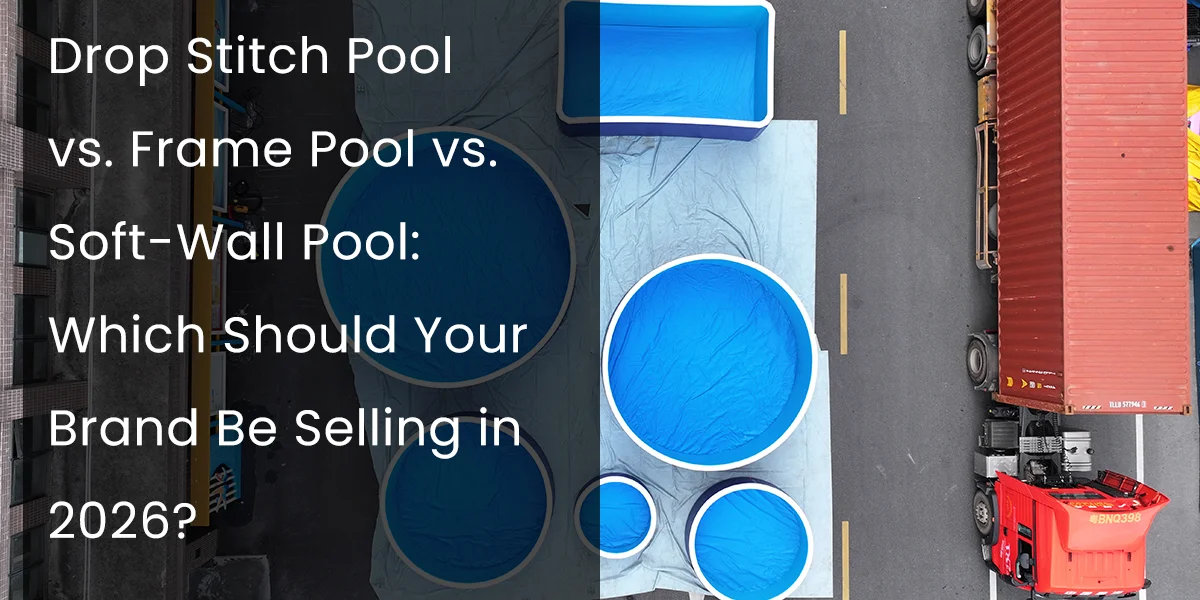
When a garden category distributor or Amazon FBA seller contacts us about adding a pool SKU, the first question is almost always about the product itself — which type, which size, which construction. And the conversation almost always starts in the wrong place. Most buyers arrive with a price comparison between the three main pool formats on the market — drop stitch, steel frame, and soft-wall ring — and assume the decision is about which is cheapest to source. It’s not. It’s about which format your margin model can survive, which your customers will actually keep, and which your brand can differentiate around.
I’m Charlie, Senior Industrial Designer at Huale Inflatables, a Guangzhou factory producing drop-stitch inflatable products for outdoor leisure brands, Amazon private label sellers, and garden product distributors. We produce drop-stitch pools as our core category — but I’ve spent enough time studying what sells, what returns, and what builds long-term brand equity to give you an honest comparison across all three pool formats. The data below comes from our factory records, from freight quotes we process for buyers weekly, and from conversations with clients who’ve been through this decision before you.
This is not a promotional piece for drop-stitch. It’s the comparison I’d give you if you were sitting across from me in a factory meeting, trying to make a sourcing decision that your margins will live with for the next 12–24 months.
The Three Pool Formats: What You’re Actually Comparing
Before the numbers, a quick baseline on what each format is and how it’s built — because the construction method is what determines every downstream variable: return rate, shipping cost, margin ceiling, and customisation potential.
Soft-Wall Ring Pool
The original mass-market inflatable pool. A single-layer PVC ring inflates at the top of the pool wall to hold the panels upright. Hydrostatic pressure from the water pushes the unsupported wall panels outward between the ring and the base — producing visible bowing at mid-wall height when filled. At 50–60cm water depth, the structural compromise is visible and the experience does not match product photography. Return rates on soft-wall pools in the US Amazon category consistently run 12–18%, driven by “looks nothing like the picture” and “wall keeps deflating” reviews.
Steel Frame Pool
A rigid steel or aluminium tube frame holds the pool wall and liner in position. Structurally more reliable than soft-wall at depth, and the liner maintains shape because it’s mechanically supported rather than pressure-supported. The problem for brand owners is logistics: a 300cm × 200cm steel frame pool packs to approximately 0.38 CBM and 22–30kg — nearly four times the shipping volume of a drop-stitch pool of equivalent water capacity. Frame pools also require assembly, which is the second most common negative review category after structural failure in the pool segment.
Drop-Stitch Inflatable Pool
Drop-stitch construction uses thousands of internal polyester threads — at our factory, a minimum of 6,500 threads per square metre — connecting the inner and outer PVC wall sheets. When inflated to 0.15–0.25 bar (2.2–3.6 PSI), those threads prevent the wall faces from separating, holding the panels rigid and vertical regardless of the hydrostatic pressure of the water inside. The result is a pool wall that is genuinely flat and vertical at full water depth — not approximately vertical. Return rates on correctly specified drop-stitch pools from our OEM brand clients run below 4% in the same Amazon channels where soft-wall pools generate 12–18% returns.
Shipping and Logistics: The Business Case in Numbers
If you’re making a product selection decision purely on landed cost per unit, logistics is the section that matters most. The shipping economics across the three pool formats are not marginal differences — they’re structural, and they compound across every order you place and every DTC shipment you fulfil.
Factory-to-Port Packed Volume Comparison
| Product Format | Size Example | Packed Volume | Unit Weight | Units / 20ft Container |
|---|---|---|---|---|
| Soft-wall ring pool | 300cm diameter | ~0.073 CBM | 4–6kg | ~370–400 units |
| Drop-stitch pool (50cm wall) | 200cm × 150cm | ~0.105 CBM | 9–12kg | ~250–280 units |
| Drop-stitch pool (65cm wall) | 250cm × 150cm | ~0.154 CBM | 14–18kg | ~170–190 units |
| Steel frame pool | 300cm × 200cm | ~0.38 CBM | 22–30kg | ~70–85 units |
The soft-wall ring pool ships most efficiently of the three — but that efficiency advantage disappears when you account for the cost of returns, customer service, and listing rating degradation. A drop-stitch pool ships at roughly 1.4× the CBM of a soft-wall ring pool at equivalent footprint, while generating 3–4× fewer returns in practice. The steel frame pool ships at 5× the CBM of a soft-wall ring pool — with return rates driven by assembly complaints, not structural failure.
Last-Mile Delivery and Amazon FBA
A 200cm × 150cm × 50cm drop-stitch pool packs to approximately 70 × 50 × 30cm at 10–13kg gross weight. On US domestic courier networks (UPS, FedEx, USPS), this falls within standard parcel rates without dimensional weight surcharges. Steel frame pools at equivalent water capacity almost always trigger dimensional weight pricing on US domestic routes, adding USD $15–$35 per DTC shipment compared to a drop-stitch equivalent. For Amazon FBA sellers specifically, drop-stitch pools in standard retail carton sizes are eligible for standard storage rate classifications at most configurations up to the 250cm × 150cm × 65cm size — the steel frame format is almost never FBA-eligible without exceeding large-item classification thresholds.
Return Rates, Margin Structure, and Why the Format Decision Defines Your Brand Trajectory
The most important commercial difference between the three pool formats is not the FOB price — it’s what happens after the product reaches the customer. Return rates, review velocity, and the rate at which your listing’s star average erodes over time are all downstream consequences of the product format decision made at the sourcing stage.
Return Rate Comparison and What Drives It
| Format | Typical Amazon Return Rate | Primary Return Reason | Structural Root Cause |
|---|---|---|---|
| Soft-wall ring pool | 12–18% | “Walls sag / looks nothing like the photo” | Single-layer wall with no hydrostatic resistance |
| Steel frame pool | 8–14% | “Difficult to assemble / parts missing” | Complex assembly with multiple tolerance-dependent components |
| Drop-stitch pool | Below 4% | Puncture from sharp object (wear item) | Drop-stitch wall holds shape; no assembly required |
At 200 units sold per month, moving from a 15% soft-wall return rate to a 4% drop-stitch return rate saves approximately 22 units of refund and return processing cost per month. At a USD $220 retail price point, that’s roughly USD $4,840 per month in avoided returns — before accounting for FBA return processing fees, customer service time, and the listing rating degradation that accumulates from structural complaint reviews.
Margin Structure by Format
| Format | FOB Factory (equiv. size) | Est. Landed Cost (US) | Typical US Retail Range | Gross Margin (before FBA) |
|---|---|---|---|---|
| Soft-wall ring pool | $12–$22 / unit | $18–$32 / unit | $35–$70 | 38–48% (erodes fast with returns) |
| Steel frame pool | $28–$55 / unit | $48–$90 / unit | $80–$160 | 40–50% (freight cost erodes fast at volume) |
| Drop-stitch pool (50cm) | $128–$165 / unit | $140–$185 / unit | $220–$320 | 44–54% (holds under low returns) |
The soft-wall pool looks most attractive on paper because the FOB price is lowest. It is the worst business decision of the three because the nominal margin is consumed by returns before the listing establishes any review velocity. A drop-stitch pool at 2–3× the retail price of a soft-wall pool, with return rates below 4%, sustains its margin position through the review accumulation phase and beyond.
The Customisation and Brand Differentiation Gap
Soft-wall ring pools offer minimal customisation — a logo sticker and a custom-print retail box are the practical ceiling at most factory MOQs. Steel frame pools offer similar constraints: the frame components are standardised and the liner is a commodity piece. Drop-stitch pool manufacturing offers a meaningfully different customisation range: wall colour from a library of six standard PVCs (with custom PMS matching at 200+ units), woven logo labels heat-bonded to the wall exterior, full-colour sublimation print on carry bags and retail cartons, and a branded instruction booklet in your target market language. For a brand owner trying to build a defensible position in the outdoor leisure category, that customisation depth is what converts a product into a brand.
Where Each Format Belongs — The Honest Decision Framework
The data above makes a strong case for drop-stitch in most B2B scenarios. But the honest answer is that all three formats have a place — and understanding where each belongs helps you make the right sourcing decision for your specific channel, price point, and brand ambition.
When Soft-Wall Ring Pools Still Make Sense
- Your retail price floor is below USD $45 — the only pool that can be manufactured, shipped, and sold with any margin at that price point is a soft-wall ring pool. Drop-stitch construction economics don’t work below approximately USD $80 retail.
- You’re supplying a one-season promotional or event context — corporate gifts, summer campaign giveaways, short-duration hospitality — where the product is not expected to last multiple seasons and price is the primary constraint.
- Your buyer explicitly needs the smallest possible packed size — for last-minute retail endcap placement or a gift pack format where the pool is a secondary item in a larger kit.
When Steel Frame Pools Make Sense
- Your customer base is permanent installation buyers — a pool that stays assembled in the same garden location for a full season, never moved. Assembly inconvenience is only a one-time event for this buyer.
- Your target water depth requirement is above 70cm — drop-stitch wall construction is currently produced to a maximum practical wall height of approximately 65–70cm. Steel frames can accommodate liner depths of 80–100cm.
- You’re supplying institutional or commercial buyers (leisure centres, resort facilities) who have staff capable of assembly and maintenance and who prioritise water depth over portability.
When Drop-Stitch Pools Are the Right Call
- E-commerce and Amazon FBA channels — the logistics economics, return rate, and review score maintenance advantages compound significantly at e-commerce scale. This is the format built for online retail.
- You want to build a private label brand with meaningful product differentiation — customisation depth, certification documentation, and branded packaging are all more accessible in drop-stitch than in the other two formats.
- Your buyer values portability and seasonal storage — a family that stores their pool in a garden shed between seasons will return a steel frame pool; they will keep a drop-stitch pool that deflates into a carry bag.
- You’re selling into the UK, German, French, or Australian market — markets where premium garden leisure spending is strong and where buyers will pay a meaningful price premium for a product that looks and performs as described.
- Your target retail price is USD $150 and above — the price tier where drop-stitch pool quality justification works and where the brand investment in OEM customisation pays back within the first production run.
The Hybrid Approach
Several of our distributor clients run both soft-wall and drop-stitch pools across different retail channels — a low-price soft-wall pool for supermarket and discount retail accounts where price is the dominant purchase driver, and a branded drop-stitch pool for their e-commerce, garden centre, and direct-to-consumer channels where margin and brand equity matter. This isn’t hedging; it’s matching product construction to channel economics. The mistake is defaulting to only soft-wall because it’s familiar, rather than evaluating which format the channel actually wants.
OEM Private Label Potential: What Drop-Stitch Pools Offer That Frame and Soft-Wall Don’t
The private label question comes up in every product selection conversation with brand owners. Which format supports real OEM customisation at an early-stage brand’s MOQ levels — not just a logo sticker, but branded colour, surface marking, retail packaging, and certification documentation? The answer is unambiguously drop-stitch, and the gap between drop-stitch and the other two formats on this dimension is meaningful.
Customisation Comparison Across Formats
| Customisation Option | Soft-Wall Ring Pool | Steel Frame Pool | Drop-Stitch Pool |
|---|---|---|---|
| Wall / body colour | ⚪ Limited — vinyl colour choices from stock | ⚪ Liner colour only — frame is fixed | ✅ 6 standard PVC colours; PMS match at 200+ units |
| Logo on product surface | ⚠️ Adhesive sticker or transfer only | ⚠️ Label on liner; not durable | ✅ Woven label heat-bonded to PVC wall |
| Branded carry bag | ⚠️ Adhesive label on generic bag | ❌ No carry bag — frame ships in box | ✅ Full sublimation print from 50 units |
| Retail outer carton | ✅ Custom print available | ✅ Custom print available | ✅ Custom print from 50 units |
| Instruction booklet | ⚠️ Generic insert with brand label | ⚠️ Assembly guide; minimal brand scope | ✅ Bilingual, brand-named from 50 units |
| CE / ASTM certification | ✅ Available (EN 71) | ⚠️ Varies by supplier | ✅ CE EN 71, ASTM F963, REACH SVHC |
| OEM minimum order | Often 200–500 units | Often 200–500 units | From 50 units at Huale |
The carry bag is worth pausing on. A steel frame pool ships in a carton — there is no carry bag, because the pool is never practically transported deflated. A soft-wall ring pool carry bag is typically a thin polyester bag with a label applied. A drop-stitch pool carry bag is a branded 600D polyester product with sublimation print front panel that functions as a secondary brand touchpoint every time the product is carried, stored, or photographed by the end consumer. It’s the element that generates the most social media photography of any pool format — and for a DTC brand owner building organic reach, that matters.
Certification Support for Brand Owners
Our drop-stitch pool OEM manufacturing includes the following certification documentation for qualified importers: CE test reports covering EN 71-1, EN 71-2, EN 71-3 (third-party tested by SGS, verifiable by reference number), ASTM F963 from Intertek (CPSC-accepted laboratory), REACH SVHC screening, ISO 9001:2015, and a BSCI social compliance audit (2023, no critical findings). Neither soft-wall nor steel frame pool suppliers typically maintain this full certification stack — it’s a meaningful differentiator for brand owners supplying major EU retailers or running Amazon compliance-reviewed listings.
Frequently Asked Questions
Can I mix formats in the same private label product range — for example, a soft-wall entry product and a drop-stitch premium product?
Yes, and several of our distributor clients do exactly this. A soft-wall pool at a USD $39–$55 retail price point as an entry SKU, and a branded drop-stitch pool at USD $220–$320 as a premium SKU, targets two different buyer segments within the same outdoor leisure category. The only complexity is managing two separate factory relationships and two certification suites — soft-wall and drop-stitch use different PVC material specifications and have different applicable EU standards. If you want to consolidate sourcing, we can produce the retail carton and branded carry bag for both product types while supplying only the drop-stitch pool itself from our production. The soft-wall ring pool component is a commodity product you can source separately at low MOQ from any general inflatable supplier.
Why do soft-wall ring pool return rates run so high, and is there any version of the product that avoids the sagging wall problem?
The sagging wall problem is inherent to single-layer ring-supported construction and cannot be eliminated through material or manufacturing improvements within that format. Hydrostatic pressure on pool walls increases linearly with depth — at 50cm depth, the outward force on an unsupported wall panel is substantial. A single inflated ring at the top of the wall provides structural support only at the ring height; the mid-wall point is cantilevered between the ring and the base with no intermediate support. Thicker PVC film reduces the bowing marginally but doesn’t eliminate it — the physics of the construction method set the ceiling for performance, not the material quality. The only pool format that solves the problem structurally is drop-stitch, where the thread network provides support distributed across the entire wall face rather than at a single point.
What is the minimum order for a custom-branded drop-stitch pool from your factory?
Our absolute minimum for any order, including sample evaluation, is 1 piece. For full OEM private label — sublimation-printed carry bag, woven wall label, branded retail carton, and bilingual instruction booklet — the practical minimum is 50 units. Below 50 units, the per-unit setup cost for branded printing makes OEM uneconomical. For brand owners not yet ready for a 50-unit commitment, we offer white-label pools from our ready-stock inventory from a minimum of 20 units, shipping within 3–5 business days, with your brand label applied to the carry bag before dispatch. Sample cost for 1–5 units is credited in full toward the first production order above 50 units — your financial exposure at the sample stage is limited to express courier shipping cost if you decide not to proceed.
Are there any pool categories where a steel frame pool is genuinely the better product choice over drop-stitch?
Yes — for permanent or semi-permanent installation where the pool stays assembled in the same location for a full season, a steel frame pool eliminates the need for an electric pump and the quarterly re-inflation check that drop-stitch pools require when temperatures change significantly between early morning and peak afternoon. At installation depth requirements above 70cm — which some commercial pool operators require — steel frame pools currently offer more options than drop-stitch construction supports. And for buyers supplying to hospitality or resort facilities with maintenance staff on-site, the assembly inconvenience that makes steel frame pools a poor e-commerce product is irrelevant. The format decision depends on who is actually using the pool and in what context — it’s never absolute across every channel.
What certifications do I need for a drop-stitch pool sold on Amazon US and EU, and can you supply them?
For Amazon EU: CE certification covering EN 71-1 (mechanical safety), EN 71-2 (flammability), and EN 71-3 (chemical migration) is required, alongside a Declaration of Conformity and REACH SVHC compliance documentation for all PVC materials. For Amazon US: ASTM F963 compliance documentation from a CPSC-accepted laboratory is required for products marketed for use by or near children, and you as the US importer of record must produce a General Certificate of Conformity based on that test documentation. We hold full third-party test reports from SGS (CE) and Intertek (ASTM F963) for our drop-stitch pool range — both verifiable by reference number on the respective lab portal. Full documentation is available to qualified importers upon order confirmation or under a signed NDA. If your retail buyer or marketplace account requires documentation beyond these standards, tell us before ordering and we’ll confirm coverage before you commit to production.
Request a Factory-Direct Pool Quote — Response Within 24 Hours
If you’ve decided drop-stitch is the right format for your brand and want to discuss which configuration fits your channel and margin model, send us your target dimensions, wall height, required volume, destination market, and target retail price point.
We will respond within 24 hours with FOB pricing for your configuration, available colour options, lead time, and sample availability. If you’re evaluating the product before committing to production, we can have a sample shipping within 5–7 business days from brief confirmation — full kit included, credited toward your first order above 50 units.
MOQ starts from 1 piece. OEM private label from 50 units. We will respond within 24 hours with a factory-direct quote.


