
Table of Contents

Inflatable Wrestling Mats for Event and Competition Use: A Commercial Procurement Guide for Organizers and Rental Operators

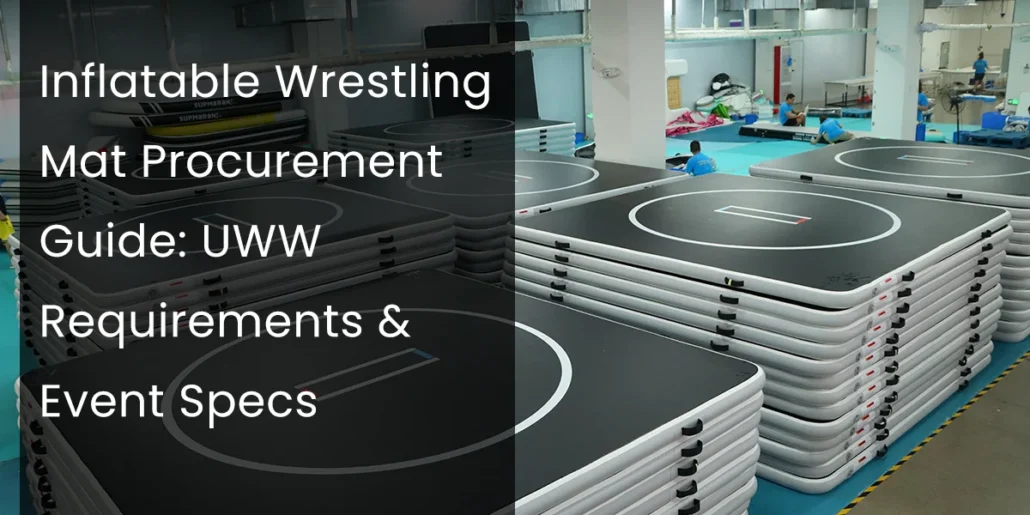
Stacks of inflatable wrestling mats in a storage area, indicating commercial use for events and competitions.

Event organizers who’ve used permanent tatami or foam puzzle mat systems for competition know the logistics problem intimately: a 10m × 10m competition floor arrives in a freight truck, requires four people and 90 minutes to install, needs a specialist to ensure the surface is level and the boundary markings are correctly positioned, and then has to be broken down, loaded, and transported back to storage — all within the turnaround window between the final bout and venue clear-out. When the venue charges per hour and the next event is booked for the following morning, that logistics window becomes a real operational constraint.

I’m Charlie, Senior Industrial Designer at Huale Inflatables, a Guangzhou factory producing drop-stitch inflatable products for combat sports equipment distributors, event rental operators, and competition organizers across North America, Europe, and Australia. We supply inflatable competition mats to regional wrestling federations, MMA promotion companies, university athletics departments, and sports facility operators running multi-event programs. The performance requirements for event and competition use are more specific than for club training — and the consequences of getting the spec wrong are more visible, more immediate, and more commercially damaging.

This guide covers what competition organizers and commercial rental operators actually need to know before sourcing an inflatable mat system: federation compliance considerations, deployment logistics, size configuration options, sponsor print capabilities, camera performance, and the real cost comparison against permanent floor systems. The numbers are from our factory production records and from feedback from event operator clients — not from a catalogue.

Federation Compliance: What Competition Standards Actually Require From an Inflatable Mat Surface

The first question any competition organizer asks about inflatable mats is whether they meet federation standards. The honest answer requires distinguishing between what federation regulations specify, what they leave to event organizer discretion, and where inflatable drop-stitch construction fits within that framework. Most organizers discover the answer is more permissive than they expected.

United World Wrestling (UWW) Surface Standards

United World Wrestling competition regulations specify surface requirements for sanctioned freestyle, Greco-Roman, and grappling competitions. The core surface parameters relevant to mat selection are: a minimum mat diameter of 9 metres for the competition circle with a 1.5-metre protection zone, a total surface area of minimum 12 metres × 12 metres, a surface colour scheme of red and yellow for the competition circle and protection zone respectively, and a surface material that provides adequate friction and shock absorption for competitive wrestling. UWW regulations specify mat thickness requirements based on shock absorption performance metrics rather than prescribing a specific material or construction method — which means drop-stitch inflatable mats that meet the shock absorption and surface friction performance criteria are not categorically excluded from UWW-sanctioned events at regional and national level. Organizers planning to use inflatable mats for UWW-sanctioned competitions should confirm with their national federation whether inflatable surface systems have been pre-approved for the specific event classification before ordering.

MMA and Grappling Event Surface Standards

MMA competition surface standards vary significantly by sanctioning body and jurisdiction. Most state and national athletic commissions in the US specify canvas or vinyl surface material over foam padding for cage and ring-based MMA — which is a different product category from open-mat grappling surfaces. For submission grappling, BJJ competitions, and wrestling events outside UWW sanction (including IBJJF, ADCC, and most regional promotions), surface specifications are set at the event level by the organizer. In practice, this means the event organizer’s primary surface obligations are to the athletes’ safety and to the broadcast production requirements — not to a prescriptive material standard. Drop-stitch inflatable mats at competition specification are used in regional and international grappling events without issue, and the broadcast performance considerations covered later in this article are typically more operationally relevant than federation compliance for this event category.

University and Collegiate Athletics

NCAA wrestling surface specifications for dual meets and tournament competition specify a minimum 10-foot (3.05m) diameter wrestling circle within a minimum 28-foot (8.5m) square mat, with specific colour and marking requirements. NCAA regulations address surface performance through general safety standards rather than by prescribing construction material — inflatable drop-stitch mats configured to the correct dimensions and colour markings are used in collegiate practice and smaller tournament events. For NCAA championship competition, consult current NCAA wrestling rules and your athletic director’s interpretation of surface compliance requirements before specifying an inflatable system. For intramural, club sport, and invitational competition — which represents the majority of university event volume — inflatable mats at competition specification are fully appropriate and widely used.

The Practical Compliance Position

For the majority of competition organizers reading this — regional wrestling tournaments, MMA grappling events, submission wrestling competitions, university invitational meets, and corporate or charity sports events — the relevant compliance question is not “is this federation-approved?” but “does this surface perform safely and look professional for athletes, officials, and broadcast?” A drop-stitch mat at 0.18–0.22 bar (2.6–3.2 PSI) with correct colour and boundary marking print meets that standard. For events requiring explicit federation sanction, verify with the national body before committing to production.

Size Configuration and Modular Layout: Building a Competition Surface From Inflatable Components

Competition mat sizing for wrestling and grappling events requires more precise configuration than training mat setups. The surface dimensions, colour zones, and boundary markings are functionally significant — athletes use the boundary lines to orient themselves during bouts, referees use the zones to make scoring decisions, and broadcast cameras use the colour contrast between competition circle and protection zone to frame shots correctly. Getting these dimensions right before production is not optional.

Standard Competition Configurations We Produce

Our competition-specification inflatable mats are available in the following standard configurations, each designed to meet the most common event surface requirements without custom tooling:

ConfigurationTotal Surface AreaCompetition CircleBest For
Standard Single (8m × 8m)64 m²7m diameterSubmission grappling, BJJ, regional wrestling tournaments, university invitational
UWW Compliant (12m × 12m)144 m²9m diameterUWW-standard events, national federation competitions, broadcast events with wide-angle coverage
Multi-Mat Event Layout (3 × 8m × 8m)192 m²3 × 7m circlesTournament format with simultaneous bouts, elimination events, multi-sport championships
Custom (up to 14m × 14m)Up to 196 m²Custom to specBroadcast events, invitational promotions with specific production requirements, federation championship events

Each configuration above is produced as a system of individual mat panels — typically 4m × 2m or 6m × 2m per panel at 20cm thickness — that are deployed side-by-side to form the total competition surface. Panel joints are not structurally connected; they abut flush under inflation pressure. The surface artwork — competition circle, protection zone boundary, colour fields — is printed across the full system to align precisely when panels are deployed in the correct configuration. We provide a panel layout diagram with every multi-panel order, with each panel numbered and orientation-marked to ensure correct deployment sequence.

Thickness for Competition Use

20cm drop-stitch is the correct thickness for all competition and event applications. The additional air volume compared to 10cm provides better impact absorption on throw landings, creates a more stable surface under the lateral movement of competitive wrestling (which is more forceful than club training), and produces better camera performance — a thicker inflated mat sits more squarely on the floor and creates cleaner edge lines in wide-angle broadcast shots. Operating pressure for competition surfaces: 0.18–0.22 bar (2.6–3.2 PSI) — at the lower end of the drop-stitch operating range to optimise impact absorption while maintaining surface firmness for standing bouts and takedown entries.

Custom Sizing for Specific Venue Constraints

Venues that don’t accommodate standard configurations — sports halls with columns, temporary venues with irregular floor plans, outdoor events on grass or artificial turf — often need a custom panel layout. We accommodate custom total surface dimensions up to 14m × 14m with no tooling fee for panel sizes within our standard mold range (widths of 1m, 1.5m, 2m; lengths from 2m to 10m in 1m increments). Custom panel sizes outside these dimensions require a tooling fee of USD $400–$900. For most venue constraint scenarios, reconfiguring the standard panel sizes to fit the available floor area is the faster and more cost-effective approach. Send us your venue floor plan and required surface dimensions — we can propose a panel layout that meets your competition specifications within one business day.

Deployment Logistics: Setup Time, Staffing, Transport, and What Actually Happens at Load-In

The operational advantage of inflatable competition mats over permanent floor systems is not primarily about cost — it’s about time and flexibility. For event organizers working within venue access windows, multi-event schedules, and transport budgets, the deployment logistics are often more decisive than the product price. These are the realistic numbers from event operators who use our systems.

Setup Time: From Cases to Competition-Ready

Setup time for an inflatable competition mat system depends on the surface area being deployed and the number of electric pumps being operated simultaneously. Based on operational data from event clients using our systems:

ConfigurationNumber of PanelsSetup Time (2 pumps, 2 staff)Breakdown Time
8m × 8m single mat6–8 panels18–25 minutes12–18 minutes
12m × 12m UWW format14–18 panels35–45 minutes22–30 minutes
Triple 8m × 8m tournament layout18–24 panels45–60 minutes (4 pumps, 4 staff)30–40 minutes

These timelines assume staff who have set up the system at least once before — the first deployment typically runs 20–30% longer. We include a numbered panel layout diagram and a QR-linked video setup guide with every commercial system order. For rental operators, we recommend scheduling a practice setup at your warehouse before the first event deployment. A rehearsed two-person team can consistently hit the lower end of the time ranges above by the third event.

Staffing Requirements

An 8m × 8m single mat system can be set up by two people with no specialist training and no tools beyond the electric pumps included in the kit. The heavier panels (6m × 2m × 20cm, approximately 28–32kg each) should ideally be positioned by two people — not because they can’t be moved by one person, but because rolling them into position on a venue floor is faster and reduces the risk of surface drag damage with two staff. For the 12m × 12m format, two staff on setup is workable; three is more comfortable for the panel positioning phase. No venue equipment — no dollies, no pallet jacks, no specialist floor tools — is required.

Transport and Vehicle Requirements

Packed volume is where the logistics advantage of inflatable systems over permanent mats becomes financially concrete. An 8m × 8m inflatable competition mat system packs to approximately 8–10 carrying cases, total volume under 1.2 CBM, total weight 180–220kg. That fits in a standard luton van or large SUV with a trailer. The permanent tatami equivalent for an 8m × 8m competition surface would typically fill a 7.5-tonne freight vehicle and require loading equipment. For event operators who rent venue transport or use event freight services, the cost difference per event is USD $400–$800 in transport cost alone on a regional event circuit. For operators with their own vehicles, the inflatable system eliminates the need for a dedicated freight vehicle for mat transport entirely.

Pressure Check Protocol at Events

Competition mat panels should be pressure-checked 30 minutes before the first bout of each session. Temperature changes between venue load-in (often cooler) and competition start (warm-up activity raises ambient temperature by 3–5°C) cause minor pressure variation — typically 3–6% — that should be normalised before competition. We include a digital pressure gauge calibrated to 0.01 bar accuracy with all competition system orders. Each panel takes under 60 seconds to check and top up if needed. Assign one staff member to the pressure check protocol as part of the pre-competition setup sequence — it takes less than 10 minutes for a full 12m × 12m system and eliminates the risk of a panel losing firmness during a bout due to ambient temperature drop.

Sponsor Print, Camera Performance, and Broadcast Considerations for Event Organizers

For event organizers running ticketed competitions, broadcast-distributed events, or sponsorship-supported promotions, the mat surface is not just a functional training floor — it’s a broadcast asset. The surface appears in every bout photograph, every video clip shared on social media, and every broadcast frame captured during competition. How it looks on camera, what sponsor content it carries, and how consistently it reproduces brand colours under venue lighting are commercial questions, not just aesthetic ones.

Surface Print Options for Sponsor and Event Branding

We produce competition mat surface print in four configurations, each with different commercial applications:

  • Competition layout only: Standard colour fields (red competition circle, yellow protection zone, or custom colour scheme to event specification), boundary lines, and centre marker. No sponsor or event branding on the mat surface. Appropriate for federation-sanctioned events where surface branding regulations are restrictive, or for rental operators supplying unbranded systems to multiple event clients.
  • Competition layout plus title sponsor panel: A dedicated sponsor logo or event title print panel integrated into the competition circle or protection zone. Most commonly placed at the top and bottom of the mat (12 o’clock and 6 o’clock positions) for optimal camera-angle visibility. Standard placement is a 1.5m × 0.8m print panel per position, up to four colour print.
  • Full perimeter branding strip: A branded apron print running around the full outer perimeter of the mat, outside the protection zone. Visible in wide-angle shots and during walkout footage. Effective for multi-sponsor layouts where individual logos can be placed along the perimeter at intervals. Most commonly used by regional MMA and grappling promotions with 4–8 event sponsors.
  • Fully custom surface design: Event-specific artwork covering the full mat surface — custom colour scheme, custom geometry, sponsor logos integrated into the surface design, event title and date print. This is the option used by broadcast promotions and major invitational events where the mat is a primary visual element of the production. Requires a full surface artwork file from the event’s design team and adds 10–14 days to production lead time.

Camera Performance: What Looks Good on Broadcast

Surface colour and print quality on an inflatable mat under competition venue lighting behaves differently from the same colours on a flat print sample. High-contrast colour combinations — the standard red/yellow UWW scheme, or blue/red, blue/yellow, and red/grey combinations used in grappling events — reproduce well under both LED arena lighting and natural light because the embossed PVC surface texture diffuses light without creating hot spots. We print competition surfaces using UV-resistant inks rated for minimum 3 years without colour degradation under indoor venue lighting conditions, which means a mat ordered for a current season maintains colour accuracy through multiple reuse seasons without reprinting.

The surface element that affects broadcast most significantly is not colour but boundary line clarity. Lines that are too narrow (under 8cm) or that use insufficient colour contrast with the adjacent zone colour become ambiguous in compressed broadcast video streams, particularly on mobile viewing where the full court perspective is a small image. Our standard competition layout uses 10cm boundary lines with a minimum colour contrast ratio of 3:1 between line colour and adjacent surface colour — sufficient for clear visibility in both 4K broadcast and compressed streaming formats.

Sponsor Logo Sizing and Placement for Broadcast Visibility

Sponsor logos on a competition mat surface need to be sized for camera visibility from the primary broadcast angle — typically a camera elevated 3–5 metres above the mat surface and positioned 8–12 metres from the competition circle edge for a typical arena or sports hall broadcast setup. At that distance and angle, a logo printed at 120cm × 60cm minimum is clearly legible in a tight-angle broadcast shot of the competition circle. Logos below 80cm × 40cm appear in the background of wide shots but are not legible as individual brand identities. We advise all event organizers briefing sponsor print to confirm their primary broadcast camera position before finalising logo size and placement — we can provide a camera-position simulation diagram showing projected logo visibility at specified camera distances and elevations before artwork is approved.

Print Durability Across Multiple Events

For rental operators and event series organizers who will use the same mat system across multiple events, print durability is a real commercial concern. Our competition surface print uses a heat-transfer process bonding the ink layer to the PVC surface at a molecular level — not a vinyl overlay or adhesive-applied graphic layer that can peel at fold lines or edges. We test print adhesion by folding the printed surface at the print boundary and applying a 2kg load for 48 hours — no delamination or crack propagation at the ink boundary is the acceptance criterion. In practice, this means a competition mat system with proper care — correct storage (loosely rolled, not tightly folded), transport in the supplied carry cases, and cleaning with pH-neutral surface cleaner between events — will maintain print quality for 50–80 event deployments before reprinting is required.

Cost Comparison: Inflatable Competition Mats vs. Permanent Tatami for Event Operators and Rental Companies

The procurement decision between an inflatable competition mat system and a permanent tatami or foam tile system is not purely a capital cost comparison — it’s a total cost of ownership calculation that includes transport, storage, installation, reuse lifespan, and operational flexibility. For event organizers and rental companies running multiple events per year, the numbers look meaningfully different from the sticker price comparison.

Capital Cost Comparison for an 8m × 8m Competition Surface

Cost CategoryPermanent Tatami SystemInflatable Drop-Stitch System
Surface purchase cost (64m²)USD $6,000–$14,000USD $2,800–$4,200 FOB GZ
Competition colour print and boundary markingsIncluded (standard tatami colour) or $800–$2,000 for custom print overlayIncluded in production — full competition layout print at no additional charge for standard colour scheme
Sponsor logo placement on surfaceRequires separate vinyl overlay production — $300–$800 per event applicationIntegrated into surface print at production stage — $12–$22 per unit add-on, permanent across all event uses
Transport cost per event (regional, 200km radius)$600–$1,400 (7.5T freight vehicle required)$80–$220 (large van or SUV with trailer)
Installation cost per event$200–$600 (specialist installer or 4-person crew × 2 hours)$0 (2-person crew × 25–40 minutes, no specialist required)
Storage per month (warehouse)12–18 m² dedicated floor space requiredUnder 2 m² shelf space (8–10 carry cases)
Expected event lifespan8–15 years (surface wear and foam compression reduce performance from year 5+)80–120 event deployments with correct care (typically 4–8 years at 15–20 events per year)

For an event rental company running 20 events per year at 200km average transport radius, the transport cost differential alone between a permanent tatami system and an inflatable system runs at approximately USD $10,400–$23,600 per year. Over a 5-year period, the total operational cost advantage of the inflatable system — transport, installation, storage — exceeds the capital cost of the inflatable system several times over. The capital cost comparison is the starting point of the procurement analysis, not the end of it.

FOB Pricing for Competition Mat Systems

Our competition-specification inflatable mat systems are priced at the following FOB Guangzhou tiers for full event system orders:

System ConfigurationFOB Price (1 system)FOB Price (3+ systems)Lead Time
8m × 8m (standard competition layout print)$2,800–$4,200$2,400–$3,60020–28 days
12m × 12m UWW format (full colour zones)$6,800–$9,400$5,800–$8,20025–35 days
Triple 8m × 8m tournament layout (3 systems)$7,200–$10,800 combinedVolume pricing applies25–35 days
Sponsor print add-on (per logo panel)$280–$420 per panel position$220–$360 per panel at 3+ systemsConcurrent with mat production

All prices are FOB Guangzhou, inclusive of all panels, electric pump kit (voltage matched to your market — 110V ETL for US, 240V CE for EU/UK), panel layout diagram, carry cases, digital pressure gauge, repair kit, and setup guide. Landed cost for US importers at air freight (for time-sensitive first orders): approximately USD $380–$620 per system for the 8m × 8m configuration. Ocean freight at LCL rates is significantly lower — approximately USD $80–$150 per system — but adds 3–5 weeks transit time. Rental operators purchasing inventory ahead of a planned event season should plan for ocean freight; operators with an imminent event need to budget for air.

Frequently Asked Questions

Can an inflatable wrestling mat be used for sanctioned competition events, or only for training?

Inflatable drop-stitch mats are used in sanctioned competition across a range of combat sports disciplines. The compliance position varies by federation and event classification. United World Wrestling regulations specify performance criteria for competition surfaces — including shock absorption and surface friction thresholds — rather than prescribing a specific material or construction method. Inflatable systems configured to the correct dimensions and colour scheme that meet the performance criteria are not categorically excluded from UWW-sanctioned events. For submission grappling, BJJ, and most regional MMA event formats, surface specifications are determined at the event level — inflatable mats at competition specification are widely used without issue. For events where explicit federation sanction at championship level is required, verify with the relevant national federation before committing to an inflatable system for that specific event classification. We can provide technical documentation on surface performance specs to support a federation approval application if needed.

How do the competition mat panels stay in position during a bout without being anchored to the floor?

Individual panels stay in position through a combination of base sheet friction and the weight of inflated air volume. Each panel’s high-grip ribbed PVC base sheet provides adequate friction on hardwood sports floors, synthetic sports surfaces, and rubber underlays under the lateral forces of competitive wrestling — which are lower than what many organizers expect, because the primary motion in wrestling is body-to-body rather than foot-to-floor lateral sliding. For events held on polished concrete, smooth vinyl, or outdoor grass and artificial turf, we recommend a non-slip rubber underlay mat beneath each panel — available through any sports flooring supplier at low cost — and we include D-ring anchor points at 8 positions per panel as standard on all event system orders. On grass or outdoor turf, ground stakes through the D-rings prevent panel migration in wind above Beaufort 3. We include a ground stake kit with all outdoor event system orders.

What is the minimum order for a branded competition mat system with our event logo on the surface?

There is no minimum system quantity for event-branded surface print — a single 8m × 8m competition system with your event logo and sponsor panels is producible as a one-system order. Surface print artwork must be provided as vector files (AI or EPS format; 300dpi minimum PDF acceptable for sponsor logos). Standard competition layout print — colour zones, boundary lines, centre marker — is included in all system pricing. Sponsor logo placement adds USD $280–$420 per logo panel position at single system pricing, reducing to USD $220–$360 at 3+ system orders. Full custom surface design — where the event production team provides the complete surface artwork — requires a 10–14 day additional lead time for artwork review, proofing, and print setup, and adds approximately 15–25% to the base panel production cost. Send us your event date and artwork status and we’ll confirm whether the timeline works for a custom surface or whether the standard layout with logo panels is the right approach for your event schedule.

How many times can an inflatable competition mat system be reused before it needs replacing?

With correct care — transport in the supplied carry cases, storage loosely rolled at room temperature, cleaning with pH-neutral surface cleaner, and inflation/deflation at the rated PSI range — our competition mat systems are designed for 80–120 full event deployment cycles. At 15–20 events per year for a regional event operator, that represents 4–8 years of operational life before performance degradation is noticeable. The components that show wear first are the surface print (colour saturation reduces visibly around deployment 60–80 without reprinting) and the Boston valves (rated for 3,000 inflation cycles — approximately 10+ years at event deployment frequency). Puncture repair from sharp object contact on venue floors — the most common accidental damage mode — is straightforward using the repair kit supplied with every system: three 0.9mm PVC patches and contact cement. A puncture repair takes under 5 minutes and restores full pressure retention.

Can we rent an inflatable competition mat system rather than purchasing outright for a single event?

We’re a manufacturer, not a rental operator — we don’t offer direct rental from our factory. However, we supply a number of sports equipment rental companies across the US, EU, and Australia who stock our inflatable competition mat systems for event hire. If you’re running a one-off event rather than building a recurring event program, contacting a regional sports equipment rental operator is likely the most cost-effective path. For event organizers running 4 or more events per year, the purchase economics typically outperform rental within the first 12–18 months of operation — the transport and logistics savings on owned inflatable systems compound quickly against rental costs at that event frequency. We’re happy to run a break-even analysis for your specific event program based on your event frequency, venue distances, and current transport costs. Send us the parameters and we’ll have the numbers back to you within 24 hours alongside a system quote.

Request a Competition Mat System Quote — Response Within 24 Hours

Whether you’re planning a single event, building a rental fleet, or sourcing a permanent competition surface for an athletics program, the next step is a factory-direct specification conversation.

Send us your required surface dimensions, event format, print requirements (competition layout only, sponsor logos, or full custom), target market destination, and event date. We will respond within 24 hours with a system quote, a recommended panel configuration for your surface area requirements, print timeline confirmation, and shipping options — including air freight if your event date requires an accelerated delivery schedule.

You can also review our full range of custom inflatable wrestling and competition mat manufacturing options before reaching out.

MOQ starts from 1 piece. Competition systems available from single-unit orders. We will respond within 24 hours with a factory-direct quote.

huale sales manager

About the Author

I'm Charlie, a manufacturing expert with over 10 years of experience in OEM, ODM, and private label inflatable drop-stitch products.
I share unparalleled insights into factory design, strict quality control, and B2B market trends to help your brand scale.

Get Factory Direct Quote

Get instant access to our full price list and customization options.
MOQ starts from 1 piece.
huale sales manager charlie
Hi there, I'm Charlie, me and my team would be happy to meet you and learn all about your business and requirements.

Talk To Our Expert

Your information will be kept strictly confidential.
We will contact you within 1 hour. Please pay attention to the email with the info@huale-inflatable.com