
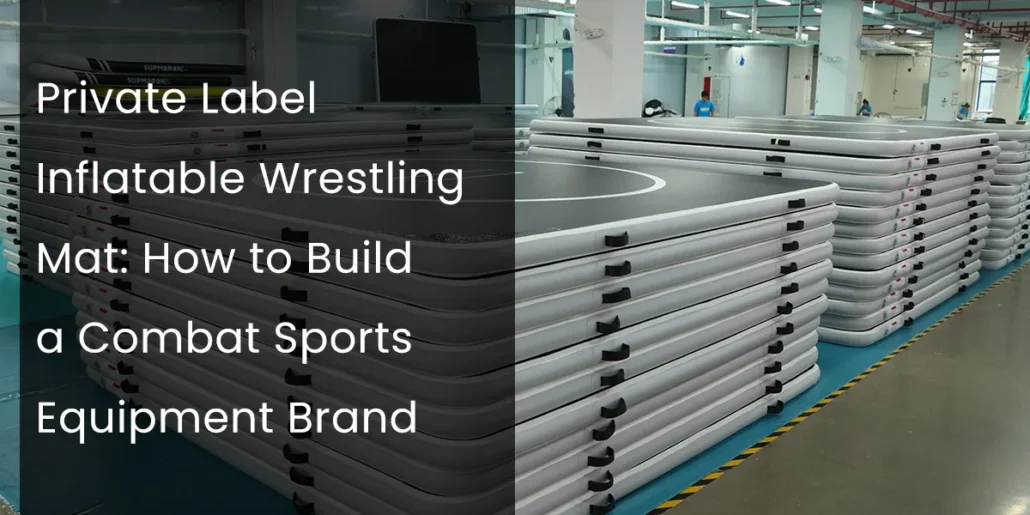
The combat sports equipment market has a branding problem that works in your favour if you’re entering it correctly. Walk into most MMA gyms or BJJ academies and look at the training surfaces — you’ll find a mix of generic puzzle foam tiles, unbranded tatami panels, and, increasingly, inflatable mats with no logo that a coach ordered directly from a catalogue. The facility might have strong branding on the walls and apparel, but the floor — the surface athletes train on for hours every session — is anonymous. That’s a gap in the market, and it’s the gap that well-positioned private label combat sports brands are starting to fill.
I’m Charlie, Senior Industrial Designer at Huale Inflatables, a Guangzhou-based drop-stitch inflatable manufacturing factory supplying OEM and private label brands across North America, Europe, and Australia. We’ve guided brand launches across multiple inflatable product categories, and combat sports equipment is one of the fastest-growing among them. The buyers who do this well — generating strong repeat business from gym accounts and consistent Amazon reviews — follow a specific process. This article breaks that process down, with the actual numbers you need to make a sourcing decision.
If you’re an Amazon FBA seller, a Shopify brand owner, or a combat sports equipment distributor looking to add private label mats to your range, this is the brief I’d give you before we started production — the spec decisions, customisation options, MOQ tiers, and lead times that determine whether your launch goes smoothly or creates problems you’re still solving six months later.
Why Combat Sports Is a Strong Category for Private Label Inflatable Mat Brands Right Now
Private label success in any product category depends on two conditions: a market where buyers have real reasons to prefer a branded product over a generic one, and a manufacturing base where differentiation is achievable at commercially viable MOQ levels. Combat sports inflatables currently satisfy both. Understanding why helps you position your brand accurately — and price it correctly from the start.
The Combat Sports Equipment Market in 2026
MMA, BJJ, wrestling, and grappling sport participation have grown consistently across major markets since 2018. Global MMA participation data shows significant year-on-year growth in gym membership across North America, the UK, Germany, Brazil, and Australia — markets where e-commerce and Amazon are the primary discovery channels for training equipment. That membership base is the end consumer for any combat sports equipment brand, and it includes a meaningful segment that actively prefers branded training surfaces over anonymous commodity products. Affiliates of established BJJ academies, wrestling clubs with competition programs, and MMA teams with sponsor relationships all have reason to care about what brand of mat is on their floor.
Why Generic Mats Leave Margin on the Table
The pricing gap between a generic unbranded inflatable grappling mat and a CE-certified, OEM-branded equivalent with a competition layout print and a custom carry bag is approximately 60–90% at retail in the US and EU markets. The underlying factory cost difference is far smaller. A branded 6m × 1.5m × 20cm drop-stitch mat with a two-colour logo print costs approximately USD $8–$12 more to produce per unit than the unbranded equivalent. At retail, that same product can command a price premium of USD $60–$100 per unit if the brand is positioned correctly and the certification documentation supports the price point. That margin structure is what makes private label in this category worth the additional production complexity.
The Sourcing Gap That Creates Opportunity
Most combat sports brands attempting private label mat products encounter the same barrier: factories that offer either high customisation at high MOQ (500+ units, beyond early-stage brand budgets), or low MOQ at near-zero customisation (sticker label only, no surface print, no color options). The sweet spot — full OEM branding with surface print, custom colors, and branded accessories at 50–200 unit MOQ — is a narrower supplier pool. That gap is exactly what our production setup is built to serve, and it’s the reason brands that find the right factory at this tier tend to stay with them for multiple production runs.
Step 1: Product Selection — Choosing the Right Spec for Your Target Market
Before any branding conversation starts, the product specification has to be right for the training environment your brand is targeting. A private label mat that performs poorly in the gym it’s sold into generates reviews that no amount of branding recovers from. Get the spec right first, then build the brand around it.
Thickness: 10cm or 20cm
10cm drop-stitch mats are appropriate for light training use — beginner BJJ, stretching, conditioning, and general movement work. They’re lighter, pack more compactly, and ship at lower cost per unit, which makes them attractive for an Amazon launch at a lower price point. 20cm drop-stitch mats are the correct specification for throw and takedown training, ground grappling, and breakfall practice at any serious level. At 0.18–0.22 bar (2.6–3.2 PSI), the 20cm configuration provides surface compliance that genuinely absorbs throw landings while remaining firm enough for guard passing and standing clinch work. If your target market is MMA gyms, wrestling academies, or competitive BJJ programs, 20cm is the only specification you should be building a brand around.
Standard Sizes and Custom Sizing
Our standard production sizes — available with no tooling fee — cover the following configurations most relevant to combat sports:
- 4m × 1.5m × 20cm — individual training station, compact storage, suitable for home gym and small academy accounts
- 6m × 1.5m × 20cm — standard club mat, covers one grappling pair with landing margin, the most common commercial gym purchase
- 8m × 2m × 20cm — competition simulation mat, full throw range including back-step entries, used by competition prep programs
- 4m × 2m × 20cm — wide format for ground grappling circuits, two athletes working simultaneously with lateral margin
Custom sizes outside these dimensions require a one-time tooling fee of USD $400–$900 depending on configuration and add approximately 10–14 days to the sample lead time. For a first private label launch, starting with a standard size eliminates that cost and timeline risk — differentiation through surface print, color, and brand identity is more commercially significant than a proprietary mat dimension for an early-stage brand.
Surface Material Selection
Two surface options are appropriate for combat sports private label:
- Embossed diamond PVC (0.9mm top sheet): The standard specification for grappling mats. Provides grip for bare feet and grappling shorts, wipes clean with standard gym disinfectant, and resists scuffing from training wear and repeated contact. This is the correct surface for any product marketed to commercial gym use. It photographs well with overhead lighting and holds logo print colour accurately.
- Smooth PVC (0.9mm top sheet): Avoid for grappling applications. The friction profile is insufficient for lateral ground movement and the surface reflects inconsistently in product photography. We don’t recommend smooth PVC for any combat sports product positioned above the entry-level price tier.
Suede-top bonded surface — available on our gymnastics air track range — is not recommended for wrestling mat applications. The fibre surface retains sweat, requires more intensive cleaning protocols than embossed PVC, and degrades faster under the abrasion patterns of repeated grappling contact.
Step 2: The Brand Brief — What to Prepare Before You Contact the Factory
The distance between a first sample that matches your vision and a first sample that requires revision rounds almost always traces back to the quality of the brief the factory receives. A complete brief produces a tight first sample. An incomplete brief produces rounds of back-and-forth that add weeks to a launch timeline that’s already tight. Here’s exactly what to prepare before you contact us — or any serious OEM factory.
Logo File Requirements
For surface print on the mat, we need your logo as a vector file in AI or EPS format. Minimum 300dpi PNG is acceptable for carry bag and accessory printing. JPEG files are not accepted for surface screen printing — edge definition breaks down at the print scale we work with on mat surfaces, and the result looks amateurish on a product that’s supposed to justify a premium price point. If your logo currently exists only as a website PNG, a graphic designer can vectorise it in under an hour. This is not optional. Standard surface logo print covers up to two colours at base OEM pricing; up to four colours is available at an additional cost of approximately USD $3.50–$6.00 per unit depending on print coverage area.
Surface Artwork Options: Three Tiers
We offer three distinct levels of surface artwork for private label wrestling mats, at different price points:
- Tier 1 — Logo placement only: Your brand logo printed in one or two colours on the centre panel or end panel of the mat. Clean, professional, cost-efficient. Recommended for first production runs where you’re validating demand before investing in more complex artwork. Additional cost: USD $4.50–$8.00 per unit.
- Tier 2 — Logo plus colour accent panels: Logo print combined with colour edge banding or quarter-panel colour inserts on the top sheet, matching your brand’s primary and secondary colour palette. Creates a more distinctive visual identity than logo-only print at moderate additional cost. Additional cost: USD $9.00–$14.00 per unit.
- Tier 3 — Full competition layout print: Centre circle, boundary lines, scoring zone markings, and brand logo — a complete competition-specification surface design. This is the option that generates the strongest product photography and the highest retail price justification. Clubs running competition preparation programs actively seek this specification. Additional cost: USD $12–$18 per unit above the base mat price.
Color Configuration for the Mat Body
Standard PVC top sheet colours in our ready production library: red, blue, grey, black, green, yellow, and dark navy. Most combat sports competition conventions use red/blue, red/yellow, or blue/grey combinations — our standard library covers all of these without custom material sourcing. Custom PMS colour matching on the PVC sheet is available for orders of 200 units or above, with a 7–10 day material sourcing lead time before production begins. For orders below 200 units, selecting from the standard colour library and differentiating via surface artwork is the faster and more cost-effective approach.
Branded Accessories: Carry Bag, Pump Bag, and Instruction Booklet
A branded carry bag is the element that creates the strongest unboxing and in-gym brand impression — and it’s the piece most budget factories skip. At our factory, we produce branded carry bags in-house using 600D polyester with a PVC backing, with full-colour sublimation printing on the front panel from your supplied artwork file. The carry bag can match your mat’s colour scheme and include your logo, social handles, and any other brand elements. Pump bags receive the same treatment. Branded bag production requires a minimum of 50 units and adds 5–7 days concurrent with mat production — not added to the timeline if briefed at the same time as the mat order. Instruction booklets are produced bilingually in English plus one additional language (German, French, Spanish, Portuguese, or Japanese) and are included at no charge for orders above 100 units.
Step 3: Sampling — How to Evaluate a Factory Sample Correctly for a Combat Sports Mat
Sampling a private label wrestling mat correctly requires more structured evaluation than sampling most consumer products. The performance characteristics that matter — PSI stability under training loads, seam integrity under lateral stress, surface grip under sweat and body weight — aren’t visible from an inspection photo. You need to put the product through a realistic evaluation before approving production. Here’s the process.
Our 7-Day Sample Standard
For standard OEM wrestling mats — size within our production mold range, colour from our standard PVC library, logo print in one or two colours — our sample turnaround is 5–7 business days from brief approval and sample payment. Brief approval means we have your confirmed spec sheet, logo in vector format, and written colour reference. A brief that arrives incomplete — missing the logo file, or with an unconfirmed colour reference — starts the clock only when those elements are received. For custom PMS colour, sample lead time extends to 14–18 business days. For full competition layout artwork in four colours, allow 10–12 business days.
What Your Sample Kit Includes
Every OEM sample ships complete with production-equivalent components:
- Wrestling mat in your specified size, surface type, and colour — with logo print if included in the brief
- High-flow electric pump matched to your market voltage (110V ETL for US; 240V CE for EU/UK)
- Double-action hand pump rated to 0.35 bar (5.1 PSI) as a backup inflation option
- Valve replacement kit — two Boston valve cores and a valve seat tool
- Repair kit — three 0.9mm PVC patches matched to the mat material, contact cement, and surface prep wipe
- Carry bag (branded if artwork was provided; unbranded if not)
- Draft instruction booklet for language and content approval
Sample pricing reflects actual small-batch production cost — it’s not a discounted preview unit. The full sample cost is credited against your first production order above 50 units. Your financial exposure at the sample stage is limited to express courier shipping cost if you choose not to proceed.
The Correct Evaluation Sequence
Run this in order. First: the 48-hour pressure retention test. Inflate to 0.22 bar using the included electric pump, seal the Boston valve, and leave the mat undisturbed for 48 hours at ambient indoor temperature (20–25°C). Measure pressure at 24 hours and again at 48 hours. Acceptable loss: under 3% at the 48-hour mark. A mat that fails this test will lose pressure during a training session — no amount of surface print quality or branding compensates for that failure mode. This test must be run before you evaluate anything else.
Second: seam integrity under load. Inflate to operating pressure and run your hand along every perimeter seam. An HF-welded seam at correct bond quality feels smooth, continuous, and shows no flex or softness at the weld line under inflation pressure. Any visible gap, ridge, or soft spot at a seam boundary is a production defect — flag it before approving production. Hand-glued seams feel slightly raised at the bond line and flex more visibly under load; if you can identify that characteristic on the sample, reject it and request a factory explanation of their seam construction method.
Third: surface performance under training conditions. Have an athlete of your target weight range use the mat for at least one full training session at rated PSI before you approve. Observe surface grip during standing grappling, lateral foot movement, and ground movement. Note whether the mat migrates on your floor surface — if it does, contact us before approving; it may indicate an issue with the base sheet specification for your specific floor type.
Step 4: Production Pricing, Lead Times, and a Realistic 60-Day Launch Timeline
A private label combat sports mat brand can go from initial brief to a container on the water in 60 days. That timeline requires decisions to be made promptly and briefs to arrive complete — it’s not a production constraint, it’s a decision-velocity constraint. The table below shows where each week goes.
FOB Pricing by SKU and Volume Tier
| SKU | 50–199 units | 200–499 units | 500+ units |
|---|---|---|---|
| 4m × 1.5m × 20cm (embossed PVC) | $88–$118 / unit | $74–$98 / unit | $62–$84 / unit |
| 6m × 1.5m × 20cm (embossed PVC) | $118–$155 / unit | $98–$132 / unit | $84–$112 / unit |
| 8m × 2m × 20cm (embossed PVC) | $178–$225 / unit | $148–$192 / unit | $124–$165 / unit |
| Logo print add-on (1–2 colours) | +$4.50–$8.00 / unit | +$3.50–$6.50 / unit | +$2.80–$5.00 / unit |
| Competition layout print (4 colours) | +$12–$18 / unit | +$9–$14 / unit | +$7–$11 / unit |
All prices are FOB Guangzhou, inclusive of electric pump (voltage matched to your market), hand pump, repair kit, valve replacement kit, and branded carry bag for orders above 50 units with artwork provided. Landed cost for US West Coast importers at LCL freight (50–200 units): approximately USD $6–$10 per unit. EU Rotterdam: approximately €4–$7 per unit. HTS classification for inflatable gymnastics and sports mats falls under 9506.91 — verify the current applicable tariff rate with your customs broker before finalising your landed cost model, as rates are subject to periodic revision.
The 60-Day Private Label Launch Timeline
| Days | Milestone | Who Drives It |
|---|---|---|
| Day 1–3 | Submit spec brief, vector logo file, colour reference, surface artwork tier selection; pay sample invoice | Brand owner |
| Day 4–11 | Sample production (5–7 business days for standard OEM; 10–12 for competition layout print) | Factory |
| Day 12–17 | Express courier transit to brand owner (3–5 days depending on destination) | Courier |
| Day 18–22 | 48-hour pressure test + training session evaluation + written sample approval submitted | Brand owner |
| Day 23 | 30–50% production deposit paid; production order confirmed and scheduled | Both |
| Day 24–46 | Production run (18–25 days for 50–199 units at standard OEM spec) | Factory |
| Day 47–50 | Optional third-party pre-shipment inspection (1–2 days); balance payment; freight booking confirmed | Brand owner + factory |
| Day 51–57 | Cargo pickup, container stuffing, vessel booking, bill of lading issued | Freight forwarder |
| Day 58–60 | Container on the water; documents released; Amazon FBA shipment created or 3PL notified | Brand owner + forwarder |
Each revision round requiring a new physical sample adds 10–14 days to this schedule. The most effective way to stay on a 60-day timeline is to arrive with a complete brief on Day 1. The factory’s production lead time is the most predictable variable in the whole process — the variables that slip timelines are almost always on the buyer’s side: delayed artwork approval, unconfirmed colour selection, or a brief that changes between the first and second sample round.
Certifications Included With OEM Production
All OEM wrestling mat production at our factory ships with the following documentation available to qualified buyers:
- CE certification: EN 12503 (sports mats for adult use), EN 71-1/2/3 (for products marketed to athletes under 14)
- ASTM F963 third-party test report from Intertek (CPSC-accepted laboratory) for US market supply
- REACH SVHC compliance documentation for all PVC materials — retested within the past 12 months
- ISO 9001:2015 factory quality management certification
- BSCI social compliance audit (2023, no critical findings)
Full third-party test reports are released to buyers with a confirmed production order or under NDA. Declaration of Conformity templates in EU-compliant format are provided with every OEM order — editable for your brand name and EU representative details if required.
Positioning Your Brand: Pricing Strategy and the Right Sales Channel for Combat Sports Mats
A private label wrestling mat brand that’s correctly manufactured but incorrectly positioned will still underperform. The combat sports equipment buyer — whether it’s a gym operator, a competition athlete, or a parent buying for a home training setup — makes purchase decisions on a combination of brand credibility, product specification, and price relativity to known benchmarks. Getting all three right is what separates brands that build repeat accounts from brands that launch, get traction for one season, and stagnate.
Price Positioning by Channel
Retail price ranges vary meaningfully by channel and buyer type. For reference, based on our OEM brand clients’ actual market data:
| SKU | Amazon US Retail Range | Direct-to-Gym B2B Range | Shopify DTC Range |
|---|---|---|---|
| 4m × 1.5m × 20cm (logo print) | $195–$280 | $165–$240 | $210–$295 |
| 6m × 1.5m × 20cm (competition layout) | $320–$450 | $275–$390 | $350–$480 |
| 8m × 2m × 20cm (competition layout) | $520–$720 | $440–$640 | $580–$780 |
At 50-unit FOB pricing with landed cost, the gross margin on a branded 6m × 1.5m × 20cm mat with competition layout print — sold at mid-range Amazon US pricing of USD $385 — runs at approximately 55–62% before Amazon fees. After FBA fulfilment fees (approximately USD $18–$24 per unit at this size and weight), the operating margin is 48–55%. That’s a strong margin for a hard goods category on Amazon, and it compares favourably with the margin structure on foam puzzle mat products that occupy the same search space at lower price points.
The Direct-to-Gym Channel: Why It Compounds
The highest-value distribution channel for a combat sports mat brand is not Amazon — it’s direct supply to gyms and academies. A gym that commits to your brand for their training surface becomes a recurring account: they reorder when mats wear out, they buy additional mats when they expand, and they recommend your brand to other academy owners in their network. A single gym account that buys 10–20 mats annually generates more lifetime value than dozens of one-time Amazon transactions. Building this channel requires a minimum viable product quality (which the spec and certification framework above delivers), a professional brand identity on the mat and carry bag (which the OEM customisation options above enable), and a gym-facing pricing tier that gives facility operators a genuine margin incentive to recommend your product to their network.
Amazon FBA as a Brand Validation Tool
For brand owners without an existing gym account network, Amazon FBA is the fastest path to building the review base that makes direct-to-gym sales conversations credible. A listing with 40+ reviews at 4.5 stars and full certification documentation on a branded, competition-specification mat is a significantly easier sell to a gym owner than a cold outreach with no market validation. Amazon Brand Registry allows private label sellers to protect their listing content and access enhanced brand tools — enrol before your first shipment arrives in FBA, not after. The process requires a registered trademark in your target market; if you haven’t started trademark registration yet, begin it in parallel with your production order, not after launch.
Frequently Asked Questions
What is the real minimum order quantity for a private label inflatable wrestling mat with my logo on it?
Our minimum for any order, including plain sample evaluation units, is 1 piece. For full OEM production with logo print on the mat surface, branded carry bag, and printed instruction booklet, the practical minimum is 50 units — below that, the per-unit setup cost for screen print and branded bag production is not economically viable. For brand owners not yet ready for a 50-unit production commitment, we offer a white-label option: standard colour mats with your brand label applied to the carry bag via adhesive-backed label or hangtag, minimum 20 units from ready-stock inventory, shipped within 3–5 business days. This is the most common starting point for Amazon FBA sellers validating a new combat sports mat SKU before investing in a full branded run.
Can I get my gym’s logo and competition circle printed on the mat surface, or is that only for large orders?
Yes — and the minimum for surface print is 50 units, not the large volumes many brands assume. We apply logo print in up to two colours as part of standard OEM pricing from 50 units. Full competition layout print — centre circle, boundary markings, scoring zones, and logo — is available from 50 units at an additional cost of USD $12–$18 per unit above the base mat price. Custom four-colour artwork requires your supplied vector file and a 7–10 day additional lead time in the production schedule. For gyms or academies ordering fewer than 50 units, we can apply your logo to the carry bag via sublimation print from a minimum of 20 units — the mat surface remains unprinted at sub-50-unit volumes, but the branded carry bag still creates a strong gym-floor brand impression.
What documentation do I need for selling branded inflatable wrestling mats on Amazon US and EU?
For Amazon US: you need an ASTM F963 test report from a CPSC-accepted third-party laboratory (we provide one from Intertek), and you’ll need to produce a General Certificate of Conformity as the importer of record — your customs broker or a product compliance consultant can prepare this from the test documentation we supply. Enrol in CPSC’s GCC program before your first shipment. For Amazon EU: you need CE marking with full test documentation (we provide CE covering EN 12503 and EN 71 standards), a Declaration of Conformity in EU format (we provide a template editable for your brand), and REACH SVHC compliance documentation for the PVC materials. If you’re selling in a category that triggers Amazon’s compliance document request — which is increasingly common in sporting goods — having all documentation available before you launch avoids listing suppression events during your review period.
How do I handle warranty and returns for my branded inflatable wrestling mats?
Our manufacturing warranty covers defects in materials and construction — seam failures, valve defects, material delamination — for 12 months from production date. If a defect is confirmed as manufacturing-origin on inspection, we replace affected units in your next order at no charge or issue a credit note. We provide a standard warranty policy document formatted for customer-facing use — you present it under your brand name. For Amazon FBA sellers, include the repair kit (three PVC patches and contact cement) in every retail carton. At an added cost of USD $0.80–$1.20 per unit, it converts a meaningful percentage of puncture-related returns — which are a normal wear item, not a manufacturing defect — into resolved customer service cases. The repair kit instruction is included in our standard bilingual booklet, so you don’t need to produce additional documentation.
Can I order multiple SKUs — different sizes and configurations — and combine them toward the volume pricing tier?
Yes. Multiple SKUs within the same production order combine toward the volume pricing tier. A mixed order of 30 units of a 4m × 1.5m × 20cm mat and 25 units of a 6m × 1.5m × 20cm mat counts as a 55-unit order for pricing purposes — qualifying for the 50–199 unit tier on both SKUs. We require a minimum of 20 units per variant within a mixed order to run each SKU efficiently through our production scheduling. For brand owners launching with multiple sizes — a compact home gym SKU and a full-size gym floor SKU simultaneously — this combined tier approach is the most cost-effective way to manage a multi-SKU first production run without over-committing inventory volume on either size before you have sales data.
Start Your Private Label Wrestling Mat Brand — Factory Response Within 24 Hours
If you have a target market, a size in mind, and a brand identity ready to apply to a combat sports training surface, the next step is a factory-direct quote with your specific OEM configuration.
Send us your target SKU dimensions, surface artwork tier, order volume, destination market, and required delivery window. We will respond within 24 hours with FOB pricing for your configuration, sample lead time, production timeline, and confirmation of which certifications in our current suite cover your target sales channel.
You don’t need a fully completed brand identity before first contact. Many of the brands we’ve launched started with a target gym account, a price point in mind, and a product spec — the branding elements came together during the sampling process. We can help you think through the spec and customisation decisions if you arrive without a complete brief.
MOQ starts from 1 piece. Full OEM private label from 50 units. We will respond within 24 hours with a factory-direct quote.


