
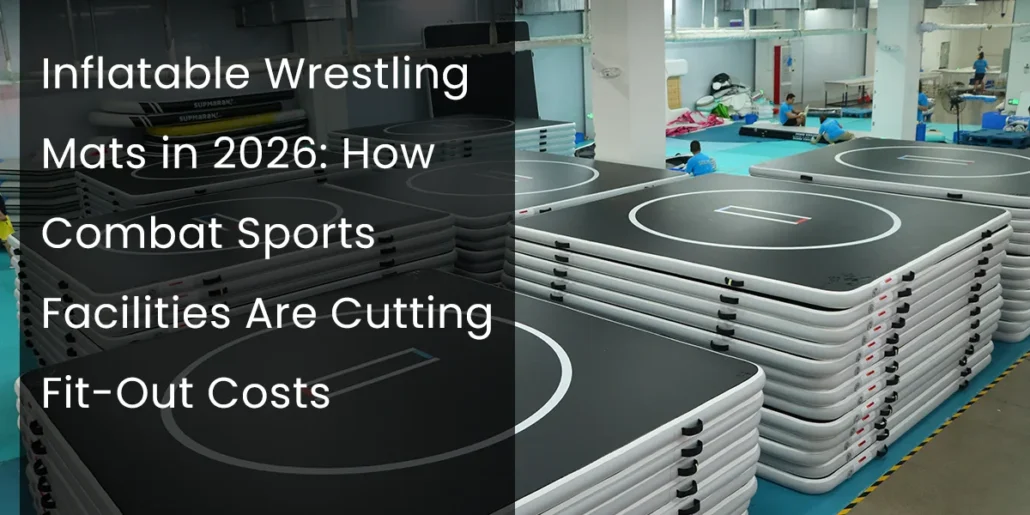
In 2019, a 400-square-metre MMA gym in the EU needed six weeks and a specialist contractor to install a permanent tatami floor. In 2025, a comparable facility in the same market kitted out a second training room in an afternoon using inflatable grappling mats, added a third room three months later when membership grew, and transported their full training surface to a regional competition venue in two SUVs. The fit-out cost was less than 30% of the permanent installation. That’s not a niche case — it’s the direction the market is moving, and it’s moving faster than most equipment distributors and facility operators have accounted for.
I’m Charlie, Senior Industrial Designer at Huale Inflatables, a Guangzhou factory producing drop-stitch inflatable products for combat sports equipment distributors, MMA gym operators, and martial arts school supply chains across North America, Europe, and Australia. We’ve been producing inflatable grappling and wrestling mats since 2015. The specification requirements, the objections from facility operators, and the performance data have all sharpened significantly over that period.
This article covers why inflatable wrestling mats are gaining real traction in commercial combat sports facilities in 2026 — not trend speculation, but specific reasons grounded in construction data, facility economics, and the practical realities of running a training space where the floor is both your most critical piece of equipment and your largest recurring maintenance cost.
Why Combat Sports Facility Demand Is Shifting in 2026
Global MMA gym membership has grown consistently since 2018, with particularly strong expansion in North America, the UK, Germany, Australia, and Brazil. The growth isn’t only in dedicated MMA academies — it’s in hybrid facilities where BJJ, wrestling, muay thai, and fitness programming share the same floor space on rotating schedules. That operational model creates a problem that permanent tatami and foam puzzle mat installations aren’t built to solve: the floor needs to change function multiple times per day, and fixed installations can’t do that.
The Multi-Use Facility Problem
A typical hybrid combat sports and fitness facility in 2026 runs striking classes on a sprung floor or matted area in the morning, BJJ and wrestling sessions in the afternoon, and strength and conditioning programming in the evening. The ideal surface for each of these activities is different — grappling needs high-density cushioning and friction, striking needs a firmer surface, and conditioning needs maximum clear floor space. Permanent mat installations lock the facility into one configuration. Inflatable grappling mats can be deployed for the afternoon session and stored in under ten minutes before the evening class, returning the full floor to the facility operator.
Membership Growth Creating Overflow Demand
Beyond multi-use scheduling, membership growth is driving demand for training surface expansion in facilities that don’t have the floor area or budget for a second permanent mat room. An inflatable mat system covering 30–40 square metres can be deployed in an existing corridor, car park, or outdoor space for summer training camps and seminar events, then stored compactly in a gear room when not in use. For a facility running 12–16 classes per week at capacity, this kind of flexible overflow capacity has direct revenue implications — it’s the difference between turning members away and opening a second session.
The Shift in Distributor Product Mix
Equipment distributors supplying combat sports facilities have started noticing the shift in what facility operators are asking about at trade shows and in procurement conversations. The question is no longer “can an inflatable mat handle real training?” — that objection has largely been answered through field experience. The question is now “which specification is right for our facility’s specific use case, and what does a full program kit cost?” That’s a different conversation, and it’s one that requires a factory partner who can supply consistent commercial-grade product rather than a consumer-grade mat with a commercial price tag.
Why Drop-Stitch Construction Works for Combat Sports — and Where the Limits Are
The performance case for inflatable wrestling mats in combat sports hinges entirely on drop-stitch construction. A single-layer PVC inflatable mat is not a viable grappling surface — it’s too soft, too unstable under lateral load, and too prone to surface movement when two athletes are working at ground level. Drop-stitch is a different product category, and it’s worth explaining why at a technical level, because this is where distributor sales conversations either land or stall.
Drop-Stitch Construction Explained
Drop-stitch construction connects the top and bottom PVC sheets with thousands of internal polyester threads — at our factory, a minimum of 6,500 threads per square metre. When the mat is inflated to operating pressure, those threads hold the two surfaces parallel under load, preventing the sidewall bulge and surface instability that characterises single-layer inflatables. At 0.18–0.22 bar (2.6–3.2 PSI), the surface is firm enough to support standing grappling, hip escapes, and double-leg entries without the foot sinking or slipping, while remaining compliant enough to absorb breakfall impact from throw landings on a 90kg practitioner.
Material Specification for Combat Sports Use
- Top sheet: 0.9mm embossed diamond PVC — provides grip for bare feet and grappling shorts without retaining sweat in the surface texture (suede-top is not recommended for combat sports; it holds moisture and is harder to disinfect between sessions)
- Base sheet: 0.9mm high-grip ribbed PVC — prevents mat migration on sprung wood, vinyl, and rubber gym flooring under the lateral forces of wrestling and takedown training
- Thread density: 6,500 threads/m² minimum — this is the figure to ask your supplier for, not a general claim about “commercial grade”
- Seam construction: HF (high-frequency) welded throughout — not hand-glued. HF welding bonds seams at a molecular level; hand-glued seams degrade under the repeated lateral stress of grappling use faster than any other construction variable
- Valve type: Boston valve, dual-action — rapid inflation and complete deflation, compatible with high-flow electric pumps for fast deployment between sessions
Recommended Operating PSI for Combat Sports Applications
PSI selection matters more in combat sports than in gymnastics because the forces applied to the surface are more variable and less predictable. A gymnast’s landing is a controlled, repeated movement. A wrestling throw landing is not. Our general recommendations by training type:
| Training Type | Recommended PSI | Bar Equivalent | Rationale |
|---|---|---|---|
| BJJ / submission wrestling groundwork | 2.6–3.2 PSI | 0.18–0.22 bar | Lower pressure increases surface compliance for hip pressure and ground movement |
| Wrestling / judo throw and breakfall | 2.6–3.6 PSI | 0.18–0.25 bar | Mid-range balances impact absorption on landings with stability for standing entries |
| MMA striking and clinch work | 3.2–4.4 PSI | 0.22–0.30 bar | Firmer surface needed for lateral foot movement; lower compliance acceptable as falls are less frequent |
| Taekwondo / kick training | 3.6–4.4 PSI | 0.25–0.30 bar | Firm surface required for precise footwork and kicking platform stability |
Where the Performance Limits Are
Drop-stitch inflatable mats are not a direct substitute for permanent competition tatami in every scenario. For high-amplitude slamming techniques — specifically overhead throws where a resisting opponent is slammed from standing height with maximum force — the impact profile can exceed what standard commercial drop-stitch construction is designed for at rated PSI. We’re transparent about this: for schools running competition-simulation sparring at the heaviest weight classes, a dedicated permanent tatami area alongside inflatable mats for supplementary training space is the appropriate mixed approach. Inflatable mats are training tools with a clear performance envelope — understanding that envelope is what allows you to sell them accurately to facility operators without generating returns or complaints.
Facility Economics: What Inflatable Mats Actually Cost Versus Permanent Installation
The performance conversation matters, but in most distributor-to-facility-operator sales conversations, the economics close the deal. Here’s what the numbers look like when you put inflatable mat investment alongside permanent tatami or foam puzzle mat installation at a realistic commercial scale.
Permanent Tatami Installation: The True Cost
A permanent judo or wrestling tatami installation for a 10m × 10m training area (100 square metres) typically costs USD $8,000–$18,000 for the tatami system itself, plus floor preparation, adhesive, edge banding, and specialist installation labour. In most markets, installation requires a contractor familiar with sports flooring systems — not a general tradesperson. Lead time from order to completed floor: typically 4–8 weeks including order, delivery, and installation scheduling. The floor is fixed in place. Moving it requires professional removal, which typically destroys a significant portion of the tatami tiles in the process. For a facility that needs to reconfigure training space seasonally or accommodate growth, permanent tatami is an infrastructure decision with a multi-year lock-in.
Inflatable Mat System: The Cost at Commercial Scale
A comparable inflatable mat coverage of 100 square metres — achieved with a combination of 6m × 1.5m and 4m × 1.5m drop-stitch mats — costs approximately the following at our FOB Guangzhou pricing for commercial orders:
| SKU | Qty for 100m² | FOB Price / Unit (50+ units) | Total FOB Cost |
|---|---|---|---|
| 6m × 1.5m × 20cm drop-stitch | 11 units | $118–$155 / unit | $1,300–$1,705 |
| 4m × 1.5m × 20cm drop-stitch | 5 units | $88–$118 / unit | $440–$590 |
| Total system (16 mats, ~99m²) | 16 units | — | $1,740–$2,295 FOB GZ |
Add landed cost for US importers — approximately USD $6–$10 per unit on LCL freight to West Coast at this volume — and the total landed cost for a 100m² inflatable mat system comes to approximately USD $1,836–$2,455. Against a permanent tatami installation cost of USD $8,000–$18,000 for the same coverage, the capital cost difference is not marginal. It’s a different order of magnitude. Installation cost is zero — facility staff can inflate a full system in under 20 minutes using electric pumps. Reconfiguration cost is also zero.
Storage and Logistics for Facility Operators
A 16-mat inflatable system covering 99 square metres, when deflated and packed, occupies approximately 4–5 standard equipment storage shelves at 0.065 CBM per mat. Total packed volume: under 1.1 CBM for the full system. A permanent tatami equivalent occupies a dedicated room or corridor stacking area — typically 6–8 square metres of floor space minimum — and is rarely moved once installed. For facility operators paying commercial rent per square metre, the difference in storage footprint has a direct monthly cost implication that we encourage distributors to quantify for their clients during the sales conversation.
Distributor Margin Structure
For equipment distributors building a combat sports mat product line, inflatable drop-stitch mats offer margin structure that permanent tatami systems typically don’t. At a wholesale price of USD $118–$155 FOB per 6m × 1.5m × 20cm unit, landed at approximately USD $124–$165, a retail price of USD $280–$350 per unit for a CE and ASTM-certified commercial-grade product represents a gross margin of 50–55% — competitive with premium combat sports equipment categories and well above the margin on puzzle foam mat products at equivalent coverage.
OEM Branding and Customisation Options for Combat Sports Equipment Distributors
Combat sports is a brand-driven market. MMA gyms affiliated with major teams, BJJ academies running competition programs, and national wrestling federations all have strong visual identities that extend to their equipment. The expectation among serious facilities is that their training surface reflects their brand — not a generic product from a catalogue. Our custom inflatable wrestling mat manufacturing service is built around this requirement.
Surface Print and Logo Application
We apply logo and artwork to the top sheet surface via screen printing or heat transfer, in up to four colours. Standard placement options: centre panel print (best for photography and brand visibility from above), edge strip print along the long axis (visible to athletes approaching from outside the mat), or full-surface competition layout print including centre circle, boundary lines, and scoring zone markings. Competition layout printing adds approximately USD $12–$18 per unit at standard order volumes — it’s the most requested custom option from clubs preparing mats for competitive use or video content production.
Color Configuration
Standard top sheet PVC colors available from our ready library: red, blue, grey, black, green, and yellow. These cover the majority of combat sports competition color standards — most wrestling and judo competition surfaces use red/blue or red/yellow combinations. Custom PMS color matching on the PVC sheet is available for orders above 200 units, with a 7–10 day material lead time before production begins. For distributor orders below 200 units supplying multiple gym clients, selecting from the standard color library and differentiating through surface print is the more cost-effective approach.
Mat Border and Edge Configuration
Standard mats ship with a closed-seam edge profile — the perimeter is fully HF-welded and airtight. For facilities requiring a raised edge profile (to prevent ankle injury from mat edge contact during takedowns), we produce a separate inflatable border strip system that sits flush against the mat perimeter and inflates independently. Border strips are available in 1m sections in matching or contrasting colors, and they can be connected to form a continuous perimeter around any mat configuration. Add approximately USD $6–$9 per linear metre of border strip to the system cost.
OEM Pricing and MOQ by Customisation Tier
| Customisation Level | Minimum Order | Additional Lead Time | Added Cost / Unit |
|---|---|---|---|
| White-label (no print, standard color) | 20 units | 0 days (ready stock available) | None |
| Branded label + hangtag only | 20 units | 2–3 days | $1.50–$3.00 |
| Logo surface print (1–2 colours) | 50 units | 5–7 days additional | $4.50–$8.00 |
| Full competition layout print (4 colours) | 50 units | 7–10 days additional | $12–$18 |
| Custom PMS color + logo print | 200 units | 14–18 days additional | $16–$26 |
All OEM orders include branded carry bag printing, a bilingual instruction booklet (English + your choice of German, French, Spanish, Portuguese, or Japanese), and a valve replacement kit. For distributors supplying multiple gym brands from the same production run, we support mixed branding across a single batch order — minimum 50 units per brand variant within the order, combined toward the volume pricing tier.
QC Standards for Commercial Wrestling Mats: What to Require From Any Supplier You Consider
The combat sports market has higher tolerance for product failure than it should. Facility operators who’ve used cheap puzzle mats or single-layer inflatables have low baseline expectations — which means substandard products can circulate in the market longer than they would in a consumer retail channel with active review systems. If you’re a distributor building a commercial-grade product offering, the QC standards below are what separate a product that generates repeat business from one that generates complaints after the first heavy training session.
Material Incoming Inspection
Every PVC material batch entering our production line is inspected against four parameters before it’s approved for use: sheet thickness (0.9mm ±0.05mm tolerance), tensile strength (minimum 3,500N/5cm for the warp direction), tear resistance (minimum 500N), and thread density count on the drop-stitch fabric (6,500 threads/m² minimum verified by physical count on a sampled section). Material batches that don’t pass incoming inspection are quarantined and returned to the material supplier — they don’t enter production regardless of schedule pressure.
Seam Pressure Testing
HF-welded seams on production-batch units are tested at 1.5× rated operating pressure for a minimum of 4 hours on a random sample basis — not on every unit, but on a statistically meaningful sample from each production batch. Any seam failure in the sample triggers a full-batch seam inspection. The seam pull-force specification for our combat sports mats is minimum 80N per linear centimetre of weld — slightly higher than our gymnastics mat specification because the lateral forces in grappling training produce higher seam stress patterns than vertical landing forces in gymnastics.
48-Hour Pressure Retention Test
For product development samples and for the first production run of any new OEM configuration, we run a 48-hour static pressure retention test at rated operating pressure. Inflate to 0.22 bar, seal, hold at ambient temperature (20–25°C), measure at 24 hours and 48 hours. Acceptable pressure loss: under 3% at the 48-hour mark. This test is run on every new SKU configuration — not assumed to carry over from a previously tested specification. For ongoing production, we run a 6-hour retention test on production batch samples, which is sufficient to catch valve defects and major seam failures without adding the full 48-hour window to the production schedule.
First-Pass QC Acceptance Rate
Our production QC first-pass acceptance rate on commercial wrestling mat batches runs at 96–97%. The 3–4% that don’t clear first inspection go through one of two paths: rework and re-test if the issue is a minor seam imperfection or valve seat alignment problem; scrapping if the issue is a material defect or major structural failure. You are not invoiced for units that don’t pass QC — the quantity shipped is the quantity confirmed at production completion. We provide a batch QC summary report with every commercial order above 20 units, documenting rejection reasons and rework outcomes for any flagged units.
Third-Party Pre-Shipment Inspection
We support third-party pre-shipment inspection by SGS, Intertek, or Bureau Veritas on any order. Our factory is open to inspectors by appointment during production and at the loading stage. For distributors placing first orders with our factory, or for buyers supplying major retail accounts that conduct their own supplier audits, a pre-shipment inspection provides independent verification of batch QC before goods leave the factory. Inspection cost — typically USD $280–$420 per visit — sits with the buyer, but it’s consistently the most cost-effective insurance step on a first production run above 50 units with any new manufacturing relationship.
Frequently Asked Questions
Can inflatable wrestling mats handle the impact of judo and wrestling throws from standing height?
Yes — within a defined performance envelope. A controlled judo throw from a 90kg practitioner landing in a standard breakfall position generates a peak impact load that our 20cm drop-stitch mats at 0.18–0.22 bar (2.6–3.2 PSI) absorb without seam stress or surface deformation. Our mats are load-tested to a maximum static load of 200kg per square metre at rated operating pressure, providing a meaningful safety margin above normal training loads. The scenario where performance limits become relevant is repeated maximal-effort overhead slamming techniques — specifically from resisting partners thrown from the highest position in the clinch with full force. For schools where that training is a regular element of their program, we recommend supplementing inflatable mats with a permanent tatami area for the highest-impact drilling, and using inflatables for the broader training floor. We’re direct about this because a buyer who understands the product’s performance envelope sells it accurately and generates better client outcomes than one who oversells it.
How long does it take to inflate a commercial inflatable wrestling mat system before a training session?
Using a high-flow electric pump rated above 300 litres per minute — which we include with all commercial kit orders matched to your market voltage — a single 6m × 1.5m × 20cm mat inflates to operating pressure in approximately 3.5–4.5 minutes. A full 16-mat system covering 99 square metres can be inflated by two staff members using two pumps in under 35–40 minutes. In practice, most facilities that run back-to-back grappling and non-grappling sessions leave the mats inflated throughout the training day and deflate them only for storage or transport, which reduces the daily setup overhead to a pressure check rather than a full inflation cycle. Re-inflating to rated PSI from the previous session’s residual pressure takes under 60 seconds per mat in normal conditions.
What is the minimum order for a custom-branded inflatable wrestling mat for a gym or distributor?
Our absolute minimum for any order, including samples, is 1 piece. For white-label (unbranded) commercial supply from ready-stock inventory, the minimum is 20 units with a delivery window of 3–5 business days. For full OEM production with custom logo surface print, custom colors, and branded carry bags, the minimum is 50 units with a production lead time of 18–28 days depending on customisation scope. For distributors supplying multiple gym clients from a single order, we support mixed branding across one production run at a minimum of 50 units per brand variant, combined toward the volume pricing tier. Sample pricing for 1–5 units covers actual small-batch production cost — the full sample cost is credited toward your first production order above 50 units.
How do inflatable wrestling mats perform on different floor surfaces — sprung wood, concrete, and rubber?
Our standard ribbed base sheet PVC provides adequate grip on sprung hardwood (the most common gym floor surface), vinyl sports flooring, and rubber mat underlays. On polished concrete, we recommend using a non-slip rubber underlay beneath the mats — polished concrete has low surface friction for PVC regardless of base sheet texture, and mat migration under lateral training forces is a real risk without an intermediate layer. On rubber gym flooring above 5mm thickness, the mat performs well without additional anchoring for standard training use. For outdoor grass or turf deployment, we include D-ring anchor points at 8 positions per mat as standard on commercial orders — these allow ground stake anchoring in outdoor conditions. Specify your intended floor surface when requesting a quote; it affects whether we recommend the standard base sheet or our diamond-grip aquatic base sheet variant.
What certifications do inflatable wrestling mats need for commercial supply in the US and EU?
For the EU market, inflatable wrestling and grappling mats used by adults in commercial training facilities fall primarily under CE EN 12503 (sports mats) — the standard covering mechanical properties, shock absorption, and surface friction for combat sports surfaces — alongside REACH SVHC chemical compliance for all PVC materials. For products also marketed to or used by athletes under 14, CE EN 71-1, EN 71-2, and EN 71-3 apply additionally. For the US market, ASTM F963 compliance documentation is required for products marketed to children, and CPSC General Certificate of Conformity obligations sit with the importer. We hold CE documentation covering both EN 12503 and EN 71, ASTM F963 test reports from Intertek, REACH SVHC screening, ISO 9001:2015 certification, and a current BSCI social compliance audit. Full test reports are available to qualified importers upon order confirmation or under NDA. If your retail buyer or marketplace requires documentation beyond these standards, contact us before ordering and we will confirm coverage.
Request a Commercial Wrestling Mat Quote — Factory Response Within 24 Hours
Whether you’re a distributor building a combat sports equipment range, a gym operator evaluating your first inflatable mat system, or a fit-out company pricing a facility project, the next step is a factory-direct specification and pricing conversation.
Send us your intended use case, required mat dimensions and quantity, surface and print requirements, destination market, and target delivery date. We will respond within 24 hours with FOB pricing, a recommended specification for your application, available customisation options at your order volume, and sample lead time if you need to evaluate the product before committing to production.
Review our full custom inflatable wrestling mat manufacturing capabilities before reaching out if you’d like the full product specification overview first.
MOQ starts from 1 piece. OEM custom branding from 50 units. We will respond within 24 hours with a factory-direct quote.


