
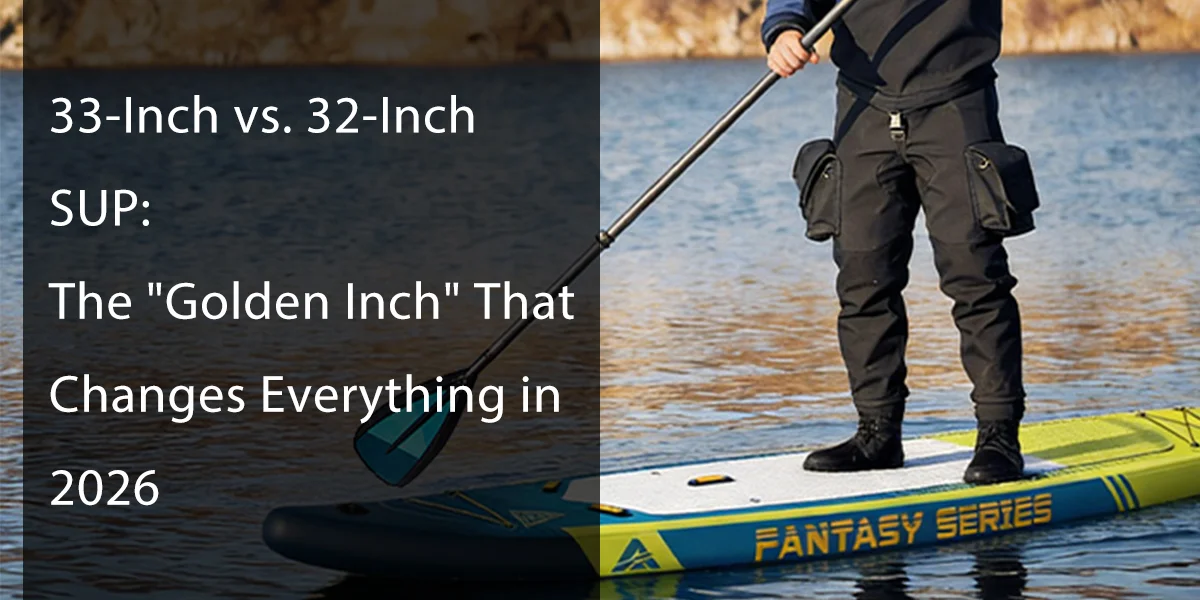
For the past ten years, the average width of inflatable paddle boards has been around 32 inches. That was the “safe” number. But something is changing as we enter 2026.
The 33-inch width is becoming more popular for both B2B orders and retail sales.
Why? One inch (2.54 cm) doesn’t seem like much on paper. That one inch might feel like a tenfold increase in stability on the water, especially for beginners and bigger riders.
Here is a technical explanation of why 33 is the new 32.
The Physics of Volume: Why Wider Means Steadier
We need to look at volume distribution to understand stability. Adding one inch of width to a 10’6″ board doesn’t simply make a stripe wider; it also makes the whole 320cm length of the rail thicker.
According to the Archimedes’ principle of buoyancy, this increased surface area displaces more water, creating a stronger upward force (Righting Moment).
- The “tipping point” is narrower on the 32-inch board. The rail instantly engages when a rider moves their weight.
- 33-Inch Board: The center of gravity has a wider base. That extra inch moves the “tipping point” farther out, giving you a “forgiveness buffer” that keeps things from swaying.
This lowers the number of returns that happen when customers say, “the board is too shaky.”
2026 Material Tech: Solving the “Drag” Problem
Back in the day (about 2020–2023), going broader meant going slower. A 33-inch board used to feel like a barge because it was hefty and pulled water.
But in 2026, technology has leveled the playing field. With the widespread adoption of MSL Fusion Technology, modern inflatable SUPs are 20-25% lighter than their glued predecessors.
- Old Tech: A 33″ board needed a lot of adhesive on both sides to be stiff.
- New Tech: We can now make a 33-inch board that weighs the same as a 30-inch board.
This implies that riders may glide quickly on a thin board while yet having the stability of a wide board. This “Hybrid Performance” is what makes 33-inch boards the most popular in the 2026 line.
Comparison of Ideal Rider Weight Capacity
| Feature | 32-Inch SUP (Standard) | 33-Inch SUP (New Standard) |
|---|---|---|
| Max Rider Weight | Ideal up to 95kg (209lbs) | Ideal up to 120kg (265lbs) |
| Stability Level | Moderate (Requires core strength) | High (Platform-like feel) |
| Best Use Case | All-Around, Light Touring | Yoga, Fishing, Pet Paddling |

The “Activity Factor”: Yoga, Fishing, and Pets
The demand for 33-inch paddles has gone up because of lifestyle paddling. People who paddle these days do more than just paddle. They bring their dogs, coolers, and perform yoga.
- SUP Yoga: That extra inch gives your hands and feet the room they need to move during positions like Downward Dog.
- Paddling with Pets: A 32-inch board might flip when a 60-pound Golden Retriever jumps from side to side. That kinetic energy is significantly better absorbed by a 33-inch board.
Who Should Stick to 32 Inches?
Is the 32-inch board dead? Absolutely not. It remains the perfect choice for:
- People who weigh less than 160 pounds (72 kg) might discover that 33 inches is too wide to paddle vertically without touching the rail.
- Speed Seekers: If your clients care more about going fast in a straight line than having fun, the slimmer profile makes it easier to go fast.
Conclusion: Making the Right B2B Choice
As an OEM manufacturer, Huale has seen a 40% increase in molds opening for 33-inch widths this year. The market is voting for stability.
If you are curating your 2026 product line, we recommend a mix: Keep the 32″ for your “Performance All-Around” series, but upgrade your “Entry-Level” and “Family” series to the 33″ width. That one inch is the difference between a frustrated beginner and a lifelong customer.


