
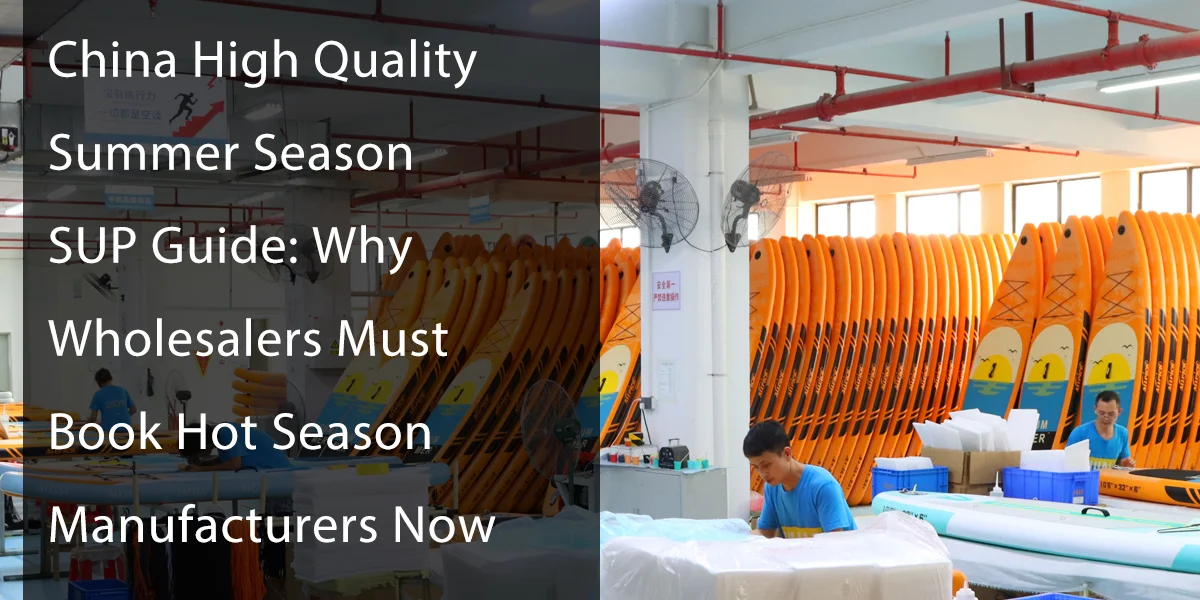
I’m Charlie, and I’ve run production lines for inflatable paddle boards for more than 15 years here in Guangzhou. Every year I watch the same mistake repeat itself: a wholesaler or brand waits until spring to place a SUP order, then finds out the lead-time math doesn’t work. By the time the boards clear customs, half the selling season is already gone.
If you sell inflatable paddle boards, the date you place your order decides whether you have stock when demand peaks. That isn’t a sales line — it’s the calendar. Let me walk you through the real numbers behind a wholesale SUP order, so you can plan backward from your sell-through date instead of gambling on it.
The 120-Day Rule: Do the Lead-Time Math
Plenty of new brands tell me the same thing: “I’ll order in April and sell in May.” That math does not work, and here is why.
You have to count backward from the date you need boards on the shelf or in your Amazon FBA warehouse — not from the date you place the order. Here is the realistic timeline we see on a standard wholesale inflatable paddle board run:
| Stage | Time | Notes |
|---|---|---|
| Production (incl. 72-hour test) | 35 days | Our confirmed mass-production lead time after sample sign-off. |
| Sea freight (China → EU/US) | 30–45 days | Varies by port and congestion — outside our control. |
| Last mile + customs | 10–15 days | Destination-dependent clearance and inland delivery. |
| Total | ~3–4 months | Deposit to warehouse. |
Add it up and you are looking at roughly 3 to 4 months from deposit to your warehouse. If you want boards selling in May, your order needs to be locked by January or February. Waiting until spring means betting against the shipping calendar — and the calendar usually wins.
“Factory” vs “Production Partner”: Why Reserved Capacity Matters
Every factory promises fast delivery in the slow season. The real test of a paddle board maker is how it behaves under the stress of peak season.
Smaller workshops — the kind sometimes called “garage factories” — routinely take on more orders than their lines can handle. When the spring rush hits, they cut corners: skipped quality checks, or your shipment pushed back to make room for a bigger client.
We run differently. We use a reserved-capacity model for our long-term partners — production lines set aside in advance against their forecast. No matter how busy the season gets, your 40ft container leaves our loading port on the day we committed to. If you want to understand how we structure that as a dedicated peak-season SUP manufacturing arrangement, that’s the model behind it.
Reliability isn’t a luxury in this business. It’s the thing that lets your own customers trust you.
The Front-Loading Inventory Strategy
Why do the biggest outdoor brands always seem to have stock when everyone else is sold out? They don’t run “just-in-time” on seasonal core items. They run safety stock — booking three to four months ahead.
You get three concrete benefits from front-loading:
- Lower logistics cost: Book early on sea freight and you avoid the air-freight panic fees that wreck your margin when you’re late.
- Early-bird sales: You catch the spring buyers planning their summer in March and April, instead of arriving after the first wave.
- Buffer against disruption: A port strike or raw-material shortage doesn’t sink you, because your boards are already in your warehouse. This is basic supply chain resilience.
What You’re Actually Booking: SUP Specs That Protect Your Margin
Lead time only matters if the boards that arrive are boards you can sell. Before you reserve a production slot, get these specs in writing — they are what separate a board that ships back as a warranty return from one that holds up for three seasons of rental abuse.
| Spec | Huale standard |
|---|---|
| Working pressure | 15 PSI |
| Construction | Double-layer composite drop-stitch PVC |
| Seam | HF (high-frequency) welded |
| QC test | 72-hour pressure-retention test (industry norm: 48h) |
| Defect rate | 3% |
| MOQ | 100 pcs / model (samples from 1 unit) |
| Sample lead time | 7 days |
| Certifications | CE · ISO 9001 · REACH · SGS |
A few of these are worth calling out. We build on double-layer composite drop-stitch PVC rather than single-layer — that is what lets the board hold a stiff 15 PSI without flexing under an adult paddler. Every board goes through a 72-hour pressure-retention test before it ships; the common factory standard is 48 hours, and that extra day is where we catch the slow seam leaks that would otherwise come back as warranty returns on your end.
Our seams are HF welded, not hand-glued — that removes the failure point behind most field delaminations. And for European buyers, the paperwork matters as much as the board: our SUPs ship with CE, ISO 9001, REACH, and SGS documentation. REACH is the one that can hold your shipment at an EU port if it’s missing, so we keep it current.
If you’re building your own brand, we run this as OEM/ODM custom paddle board production — your logo, colors, deck pad, and accessory kit. Our production MOQ is 100 pcs per model, and we run single samples on a 7-day lead time so you approve a real unit before committing to a full run.
Frequently Asked Questions
How far in advance should I order inflatable paddle boards for summer?
Plan for 3 to 4 months from deposit to warehouse. With a 35-day production run plus 30–45 days of sea freight and 10–15 days for customs and last-mile, an order for May sell-through needs to be locked in January or February.
What is the minimum order quantity for wholesale SUP boards?
Our production MOQ is 100 pieces per model. We also run single samples on a 7-day lead time, so you can approve a physical unit before placing the bulk order.
How long does it take to manufacture a custom paddle board order?
About 35 days for mass production once the sample is signed off. Custom logo, colors, and deck-pad artwork are handled inside that window; they don’t add a separate stage if artwork is approved up front.
What certifications should an inflatable paddle board manufacturer have for the EU market?
For Europe, look for CE, REACH, ISO 9001, and SGS. REACH matters most at the border — it governs the chemicals in the PVC, and a missing REACH file is a common reason shipments get held at an EU port.
What’s the difference between single-layer and double-layer drop-stitch boards?
Double-layer construction lets the board hold a higher, stiffer pressure (we run 15 PSI) without flexing under an adult’s weight. Single-layer boards are cheaper to make but flex more and tend to come back as returns in rental fleets.
Reserve Your Production Slot Before the Rush
Timing is often the only difference between a strong season and a bad one. You can’t change the weather, but you can control your supply chain — and that starts with booking your slot before everyone else does.
Send us your model, quantity, and target in-warehouse date, and we’ll map the production and shipping calendar backward for you. Contact our production team to lock in capacity.
MOQ starts from 100 pieces.
We will respond within 24 hours with a factory-direct quote.


