
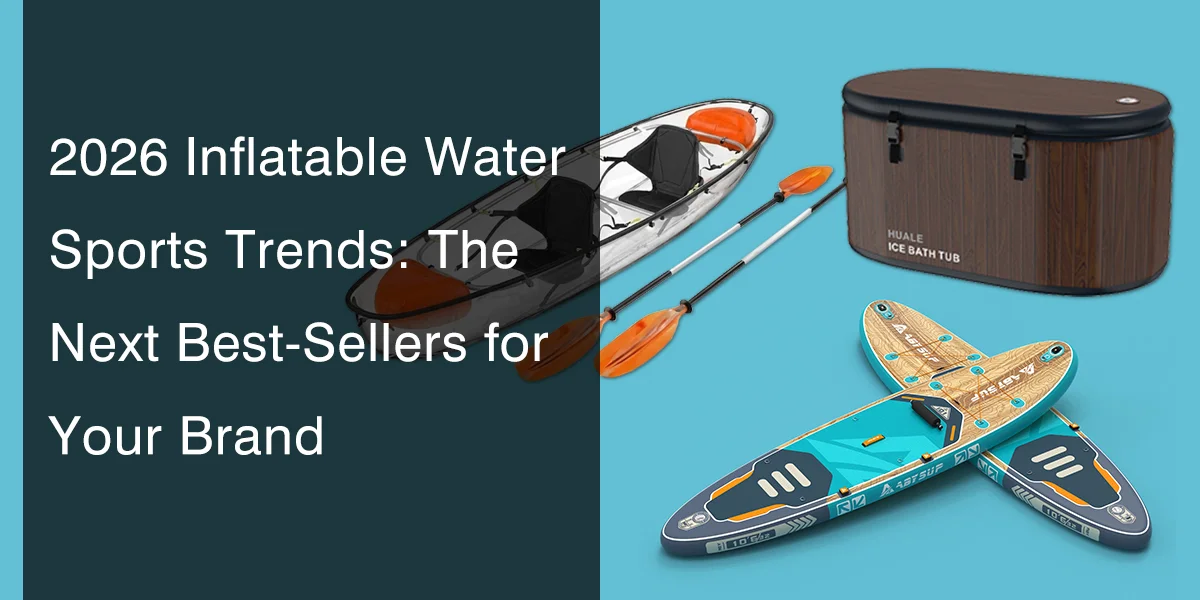
If you’re a brand owner or category buyer planning your 2026 inflatable water sports catalog, you’re probably running the same calculation right now: which products are still profitable, which are dying, and where the new margin is going to come from. Most catalogs I see in Q4 are still padded with the same all-around 10’6″ SUP boards and generic single kayaks every other brand is selling — and the gross margin on those SKUs has been compressing for two years running.
I’m Charlie, a senior industrial designer at Huale Inflatables with over 15 years on the factory floor producing OEM and ODM SUP boards, inflatable kayaks, ice bath tubs, air tracks, and floating docks. This guide is the conversation we have with brand owners every Q4 — what we’re actually shipping right now, what the order book tells us about 2026, and how to source these categories without burning cash on the wrong specs.
What Our 2025 Order Book Tells Us About 2026
Trends articles are written by marketers. Order books are written by buyers spending real money. So before talking about what’s “trending” for 2026, here’s what our production schedule actually looked like through 2025:
- Drop-stitch pools — One of our largest categories by volume. Demand is still expanding from European and Middle East importers, with custom sizing and color matching dominating the order book.
- Ice bath tubs — From a niche category two years ago to one of our fastest-growing lines in 2025. Order pattern shifting from generic black tubs to higher-spec, aesthetic-finish units priced 30–40% above commodity SKUs.
- Air track mats — Steady, predictable. Driven by gymnastics academies, BJJ schools, and the home fitness segment in the US, UK, Australia, and Germany.
- Inflatable docks and floating platforms — Lower volume, higher unit value. Marina operators, yacht clubs, and resort buyers, with custom dimensions on most orders.
- SUP boards — Volume up year-over-year, but unit price compressed. Generic all-around boards are now a price war. Specialized configurations (fishing, yoga, touring) hold their margin.
- Inflatable kayaks (single and tandem) — Strong rental fleet demand, modest growth in retail. Drop-stitch floor specifications now standard for any commercial-grade order.
If you’re sourcing for 2026, the takeaway is simple: generic categories compete on price; specialized configurations protect margin. The brands holding their gross margin right now are the ones that stopped competing in the all-around 10’6″ SUP segment and moved into fishing SUPs, transparent kayaks, premium ice baths, and similar specialized SKUs where the buyer comparison set is smaller and the price comparison less brutal.
Category-by-Category Sourcing Breakdown for 2026
Below is the practical version of “what to source” — what we’re actively producing, the spec floor that keeps you out of warranty hell, and the price tiers that decide whether your landed cost works for your retail price.
Ice Bath Tubs — The Category Most Brands Are Underestimating
Two years ago, almost every inflatable ice bath tub we shipped was a plain black drop-stitch barrel. In 2025, more than half of our ice bath orders specify some form of aesthetic upgrade: wood-grain UV print, marble pattern, custom color matching, or premium-look exterior finishing. The buyer profile is shifting from gym-and-garage to backyard-and-spa, and that shift is real, not marketing copy.
What to spec for a 2026 ice bath order:
- Drop-stitch wall thickness: 1.0mm minimum for retail-grade durability; 1.2mm for premium SKUs
- Working pressure: 6–8 PSI typical, with seam strength tested to handle pressure spikes
- Insulation layer: Optional EPE or PE foam liner if your retail position is “ice retention” rather than just “cold plunge”
- Cover: Insulated zippered cover should be standard, not upsell — buyers compare it on listing photos
- Print method: UV digital printing for wood-grain or marble looks; not heat transfer (peels at the seam over time)
Sourcing data:
- MOQ: 50 pcs for stock specs; samples available from 1 piece
- FOB Guangzhou price range: USD 95–180 per unit at the 100–500 pcs tier, depending on size, print finish, and accessory inclusions
- Lead time: 30–40 days production after sample approval; OEM custom prints add 7–10 days for graphics setup
- Landed cost in US: add 45–60% to FOB for ocean freight, Section 301 tariff, and customs clearance
Inflatable Kayaks — Drop-Stitch Floor Is No Longer Optional
The kayak market split into two segments in 2025, and the split is going to widen in 2026. Recreational buyers shopping by price are buying $99–$149 single-layer PVC kayaks from Amazon. Brands that want to survive the next two years are not in that segment — they’re selling 1.1mm DWF hulls with drop-stitch floors at $250–$450 retail, and that’s where the margin still exists.
For rental fleets, the spec is non-negotiable. Single-layer PVC floors flex under load, generate complaints, and fail within one season at 6–10 sessions per day. Drop-stitch construction with thousands of internal threads holding the floor at 10–15 PSI is the only spec that survives commercial use.
What to spec for a 2026 kayak order:
- Hull and side tubes: 1.1–1.2mm double-wall fabric (DWF)
- Floor: drop-stitch, minimum 15 threads per cm², rated 10–15 PSI
- Seams: high-frequency welded — hand-glued seams delaminate within 60–80 commercial sessions
- Valve: stainless steel or reinforced PVC body, rated for 300+ inflation cycles
- Pre-shipment QC: 48-hour pressure retention test on every unit, with 3–5% reject rate at this stage
Sourcing data:
- MOQ: 1 piece for samples; 10 pcs for bulk single kayaks; 10 pcs for tandem — see our kayak factory page for current production specs
- FOB price range: USD 65–145 per unit depending on volume tier and tandem vs single configuration
- Lead time: 25–35 days after sample approval; OEM branding adds 7–10 days
Specialized SUP Boards — Where the Margin Hides
The all-around 10’6″ SUP segment is a price war and getting worse. Generic boards are landing in US retail at $179–$229, and at that price point, your gross margin after Amazon fees, advertising, and returns is in single digits. The brands holding their margin in 2026 are the ones that stopped chasing volume in the all-around segment and moved into specialized SUPs where the buyer is less price-sensitive.
Three SUP configurations holding their margin:
- Fishing SUPs: 11’–12′ length, wider deck (34″+), built-in mounts for rod holders and coolers, weight capacity 350+ lbs. Buyers don’t price-shop the same way; a fishing SUP at $599 is competitive against fishing SUPs, not against $179 all-around boards.
- Yoga SUPs and yoga docks: Wider, more stable platforms with full-deck EVA pads. Studio operators and instructors form a B2B segment that buys in small fleets, not single units.
- Touring SUPs: Longer (12’6″+), narrower, displacement hull design. Margin is protected by the segment being smaller and more knowledge-driven.
Sourcing data:
- MOQ: 30–50 pcs for OEM specs; samples from 1 piece
- FOB price range: all-around boards typically USD 70–110 per unit at 100+ pcs; specialized configurations (fishing, yoga, touring) typically command 25–40% higher FOB
- Lead time: 30–40 days, longer for full custom graphics
- For our current SUP production specs, see our SUP board page
Drop-Stitch Pools — A Major Volume Category
Demand for drop-stitch inflatable pools kept expanding through 2025, with the strongest pull from European importers, Middle East distributors, and resort/hospitality buyers in the US. The category is winning against traditional metal-frame and steel-wall pools because of three things: install time (under 30 minutes), shipping efficiency (one carton vs a pallet), and storage at end of season.
What’s changed in 2026 sourcing: more orders specify custom sizes (not just standard 6×3m or 8×4m), color matching to brand or hospitality property, and integrated drop-stitch flooring as a standard feature rather than optional add-on.
Inflatable Docks — Low Volume, High Unit Value
If you’re sourcing for marina operators, yacht clubs, jet ski rentals, or resort waterfronts, inflatable dock platforms are not a high-volume category — but the unit value is 5–10× a kayak, and the customer relationship is repeat-business. We’re seeing steady orders for custom-dimension docks, branded surfaces, and modular configurations that link multiple platforms into larger floating decks.
Pricing Tiers and Lead Time Reality for 2026 Orders
If you’re planning a 2026 catalog, here’s the volume-vs-price-vs-lead-time math that actually drives sourcing decisions. The numbers below are FOB Guangzhou for our standard commercial-grade specs. Custom configurations and full-color OEM branding modify these tiers.
| Volume Tier | Production Lead Time | FOB Price Position | Best For |
|---|---|---|---|
| Sample (1–3 pcs) | 7–10 business days | Sample rate | Spec validation, retail buyer review, photo and video production |
| Small batch (10–50 pcs) | 25–35 days | Mid-tier, no volume discount yet | Boutique brands, Kickstarter launches, market testing new SKUs |
| Mid volume (100–500 pcs) | 25–35 days | 10–20% lower than small batch | Established Amazon brands, regional distributors, multi-store retailers |
| High volume (1000+ pcs) | 30–45 days with priority scheduling | 25–40% lower than small batch | Major retailers, national distributors, container-load orders |
Landed cost reality for US importers: add roughly 45–60% to FOB price to arrive at landed cost. Ocean freight from Guangzhou to LA/LB is currently running USD 2,100–2,700 per 40HQ container as of mid-2026, down significantly from the 2024 peaks but with seasonal swings around Chinese New Year and the Q3 pre-holiday peak. The Freightos Baltic Index tracks current spot rates if you want a live reference. Add Section 301 tariffs (typically 25% on inflatable boats and related products under HTSUS classification) and customs broker fees on top. EU importers should add roughly 40–50% to FOB depending on member state VAT and harmonized tariff for the specific product category.
One Q4 sourcing planning note: if you want product on shelf or in Amazon FBA by April 2026 (the start of the season), your deposit needs to land at the factory by mid-January at the latest. Sample approval, deposit, production, and 28–35 day ocean transit don’t compress well. Brands that wait until February to confirm orders typically miss the first peak weekend of the season — and Chinese New Year factory shutdowns from late January through mid-February make the timeline even tighter than the math suggests.
What Separates a Serious Manufacturer from a Trading Company
If you’re new to sourcing inflatables from China, the first thing to understand is that most listings on Alibaba aren’t factories — they’re trading companies adding 5–15% margin and shipping from someone else’s production line. That’s fine for some categories. For inflatable water sports products, where spec compliance directly determines warranty cost and brand reputation, you want to source from the factory directly.
Three filters that separate factories from traders:
- Ask to see HF welding equipment in the production area. Hand-glued seams are the #1 cause of warranty failures. A real factory has high-frequency welding machines on the floor and will show them on a video tour. A trading company can’t.
- Ask for the QC process documentation. A real factory rejects 3–5% of finished units at pre-shipment QC. Ask what their reject rate is and what test they use. PVC quality varies enormously across raw material suppliers, and a factory that doesn’t track its own reject rate is a factory that ships defects to your customers.
- Ask for the 48-hour pressure retention test data. Every unit we ship for commercial use is inflated to working pressure, logged at start, and rechecked at 48 hours. Any unit that drops measurable pressure is scrapped. A supplier that doesn’t run this test is a supplier whose returns rate becomes your problem in month three.
The brands that get hurt most by sourcing from trading companies are the ones launching premium-positioned SKUs. A $499 retail SUP that fails warranty inspection at 5% rate destroys the margin a price-competitive brand can absorb. The same SKU sourced direct from a factory with documented QC operates at a 1–2% warranty rate and protects the price position.
Frequently Asked Questions
What inflatable water sports products are best to source from China for 2026?
Based on our 2025 order book, the categories with the strongest forward demand and protected margin are: aesthetic-finish ice bath tubs (wood-grain or marble print), specialized SUP configurations (fishing, yoga, touring), commercial-grade inflatable kayaks with drop-stitch floors, and custom-sized drop-stitch pools. Generic categories (all-around 10’6″ SUPs, single-layer PVC kayaks) are still high-volume but the margin has compressed to a point where most brands struggle to stay profitable after Amazon fees and advertising costs.
What is the typical MOQ for inflatable water sports products?
MOQ varies by category and configuration. For our standard production specs, samples are available from 1 piece, small-batch OEM orders typically start at 10–50 pieces depending on the product (kayaks at 10, SUPs at 30–50, ice baths at 50), and full container-load orders deliver the best per-unit pricing. Custom branding (logo printing, color matching, custom packaging) is available from sample stage onward, with no minimum on graphics setup.
How long does it take to receive a bulk order from a Chinese inflatable factory?
Standard production lead time after sample approval and deposit is 25–35 days for most categories. Custom OEM branding adds 7–10 days for graphics approval and pre-production setup. Total timeline from first inquiry to product on a ship is typically 35–50 days. Add 28–35 days for ocean transit to the US West Coast, longer for East Coast or EU destinations. If you want product on the shelf by April, your deposit needs to land at the factory by mid-January — Chinese New Year shutdowns (late January through mid-February) make the timeline tighter than the math suggests.
How do I verify that a Chinese supplier is a real factory and not a trading company?
Three quick checks: ask for a video tour of the production floor showing high-frequency welding machines (the equipment is visible and distinctive); ask for the supplier’s pre-shipment QC documentation including reject rate and the 48-hour pressure retention test protocol; and check that their business license matches the manufacturing scope on the products they’re quoting. Trading companies will deflect on all three questions or provide stock photography. A real factory shows the floor on a 10-minute video call.
What’s the realistic landed cost for inflatable products imported into the United States?
Landed cost is typically 45–60% above FOB Guangzhou price. The components are ocean freight (currently USD 2,100–2,700 per 40HQ container to LA/LB as of mid-2026), the Section 301 tariff (25% on most inflatable boat and water sports SKUs under their HTSUS classification), customs broker fees, drayage and inland trucking, and any FBA prep or 3PL handling if you’re selling on Amazon. Brands targeting Amazon retail typically need a 3.5×–4× markup from FOB to retail to operate at a sustainable margin after Amazon fees and advertising spend.
Ready to Plan Your 2026 Sourcing?
Send us your category list, target MOQ per SKU, your destination port, and your in-stock target date. We will respond within 24 hours with a factory-direct quote covering FOB price by volume tier, production lead time, sample availability, and any spec recommendations specific to your retail position.
MOQ starts from 1 piece for samples — boutique brands, Amazon sellers, and rental operators all welcome. Bulk orders from 10 pieces depending on category. We currently produce inflatable kayaks, SUP boards, ice bath tubs, drop-stitch pools, and inflatable docks for brand owners, distributors, Amazon sellers, and rental operators across the US, EU, UK, Australia, and the Middle East.