
Picture this: You start selling your new SUP collection. The promotion is spot on, and the images are great. But then the first reviews from customers come in. “It’s a great board, but it pulls to the left,” or “When you blow it up, it looks like a corkscrew.”
For someone who owns a brand, a broken board is the end of the world. It undermines the fun of paddling, hurts your reputation, and cuts into your profits by making you return items.
A lot of purchasers think that a warped board is merely “bad luck.” No, it is not. It is a sign that the way things are made is old.
As a production engineer at Huale, I want to explain why this happens and how contemporary Computer Numerical Control (CNC) technology has fixed it. The main reasons are fabric bias and mistakes made when cutting by hand.
The Physics of the “Twist”: Warp and Weft
You need to know what the board is made of to understand why it twists. Drop stitch fabric is not a solid piece of plastic; it is a woven fabric.
Like any woven fabric, it has a “grain,” consisting of warp (longitudinal yarns) and weft (transverse yarns). You can read more about Warp and Weft structure to understand the basics of textile engineering.
This is the most important point of failure: If the drop stitch material is cut even 1 or 2 degrees off-axis from the grain, the internal threads will pull diagonally when the board is inflated to high pressure (15 PSI).
This causes torque, which literally twists the whole hull. It won’t get better no matter how often you inflate or deflate it. The board is broken for good.
The Culprit: Manual Hand Cutting
For decades, and still in many budget factories today, workers used big templates and electric shears to cut drop stitch rolls by hand.
The problem with the “Human Hand”:
- Fatigue: A worker who has cut 50 boards that day is not as precise as they were on their first.
- Visual Estimation: It’s almost tough to line up a template properly with the tiny grain of the fabric by eye.
- Shift: The cloth frequently moves a little as the knife cuts through thick material.
If you get your boards from a factory that cuts them by hand, you are accepting a 5% to 10% chance that some of them will be bent.
The Solution: Automated CNC Precision
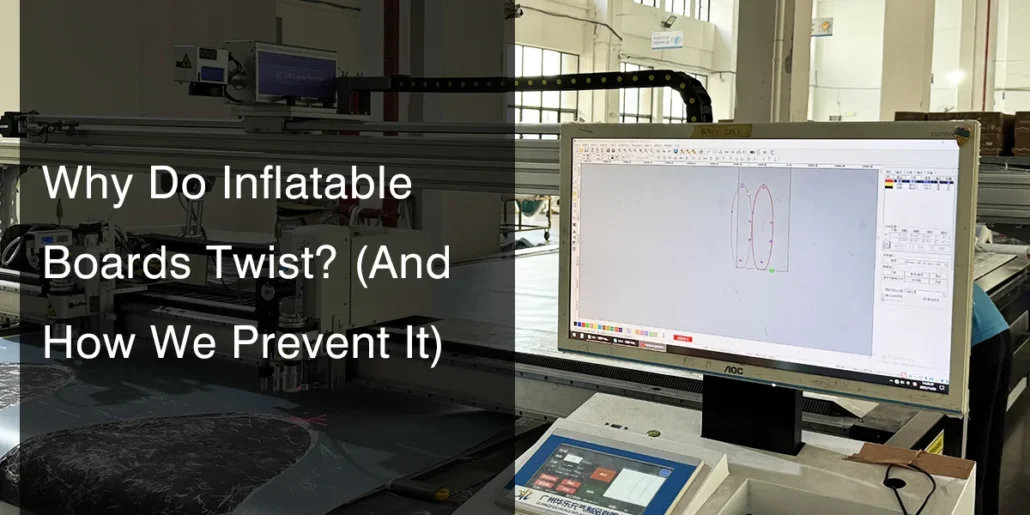
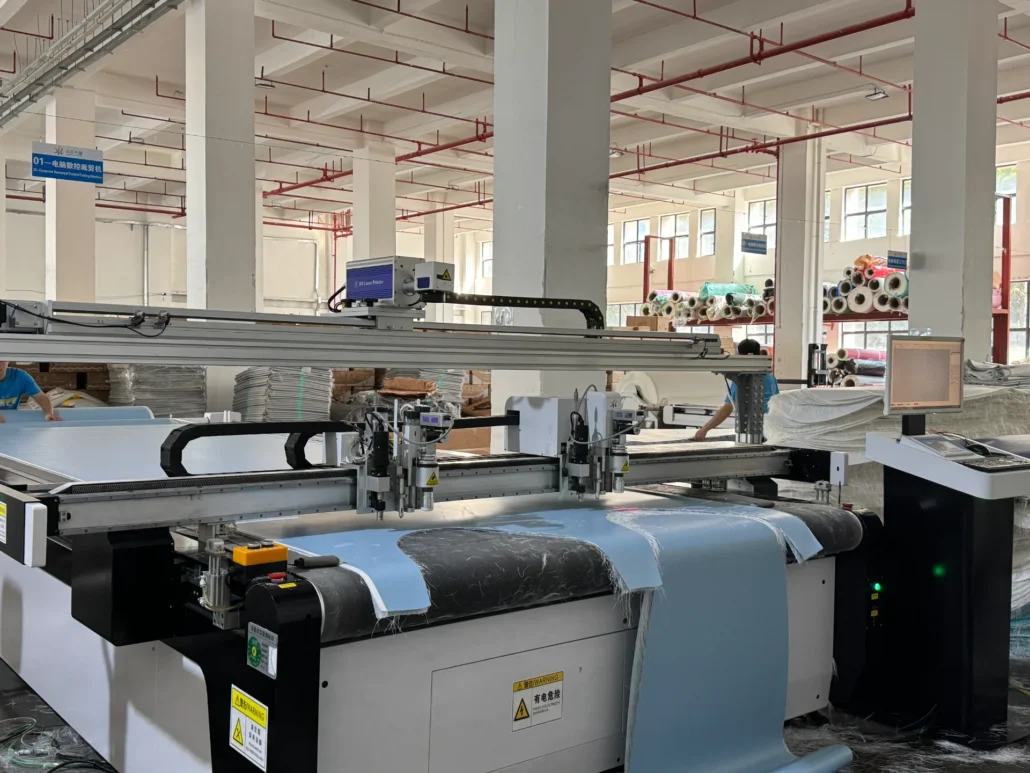
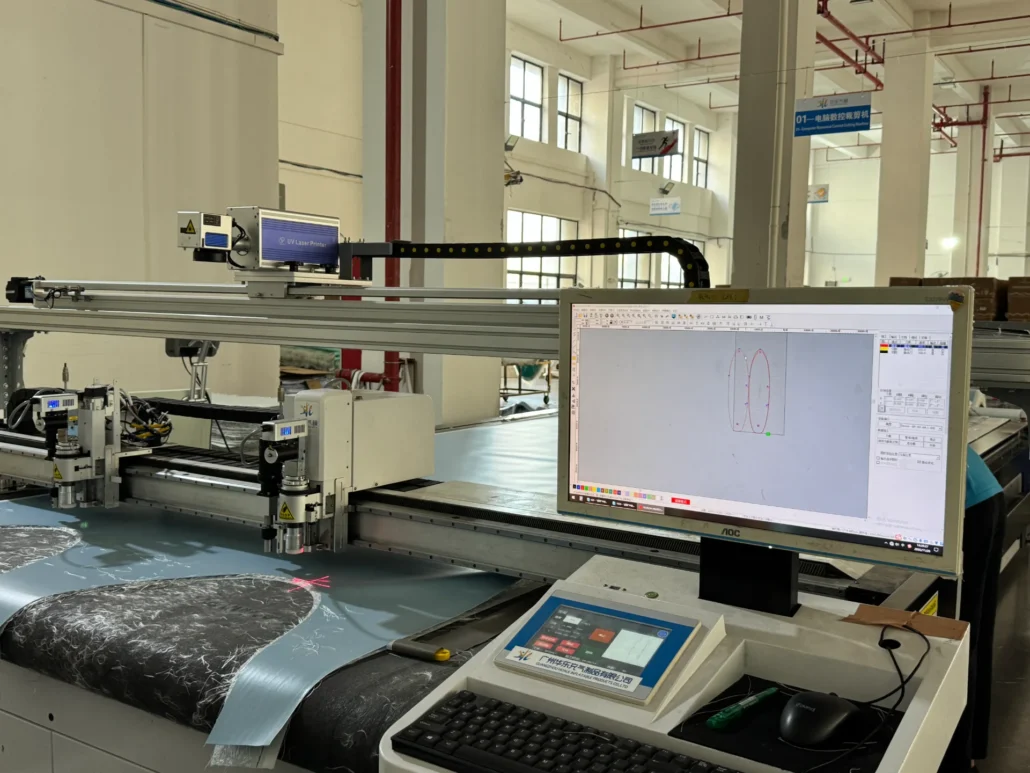
We got rid of the “human error” factor at Huale by buying Automated Flatbed Digital Cutters (CNC).
How it works: We put the drop stitch roll into the machine. A digital camera checks the alignment of the edges of the material. Then, a blade operated by a computer makes the cut according to the CAD file.
Why CNC changes the game for your brand:
- Zero Deviation: The machine cuts with a tolerance of plus or minus 0.1 mm.
- Perfect Symmetry: The left and right rails are the same in math. This makes sure that the tension is just right when it is inflated.
- Scalability: The 10,000th board is exactly like the first one, no matter how many boards we make.
Beyond Cutting: The Rail Assembly Factor
If the side rails (PVC bands) aren’t put on evenly, a board can still twist, even if the cut is excellent.
When a worker pulls the PVC rail band tighter on the left side than the right side during gluing, it makes the tension uneven. Huale uses Laser Alignment Guides on our assembly lines to fight this.Workers follow a projected laser line rather than guessing. Furthermore, our ISO 9001 Quality Management System mandates a tension check at every stage of the rail bonding process.
The Final Gatekeeper: The 72-Hour Inflation Test
We don’t ship because we believe; we ship because we have data.
We have to do a 72-Hour Inflation Test on every board before we put it in a box. We pump the board up to its highest PSI and put it on an examination table that is exactly level.
- The “Rocker Check”: We check the height of the nose and tail rocker.
- The “Twist Check”: If one corner of the board moves off the table while the others stay flat, it is not accepted right away.
Don’t Gamble with Geometry
In business-to-business (B2B), consistency is key. If 1 out of 10 buyers asks for a refund because the shape is wrong, the low unit price doesn’t matter.
By working with a manufacturer like Huale that uses CNC technology and strict quality control standards, you can protect your brand from the “Twist.”
Want to see our CNC machines in action? Schedule a Virtual Factory Tour with us today. We will show you exactly how we cut, assemble, and test our boards to guarantee straight, stable performance for your customers.


