
In the competitive world of stand-up paddleboarding, the difference between a podium finish and a fight against the current frequently resides in one key factor: Hull Design.
For professional sports businesses and distributors, knowing how inflatable boards move through water is important for putting up a successful product line.
It’s not only about the visuals or the accessories; it’s also about how the board works with the water.
As a top producer, we are experts at turning complicated hydrodynamic theory into inflatable items that work well.
Today, we’re going to talk about the engineering differences between Touring SUP forms and Racing paddle board designs. We’ll focus on how the shape of the nose and the rocker lines affect how well the board works.
The Nose Shape: Displacement vs. Planing
The shape of the nose is the most obvious difference between a touring board and a racing board.
The way the board is shaped affects how the water moves around it.
Racing Paddle Board Design: The Displacement Hull
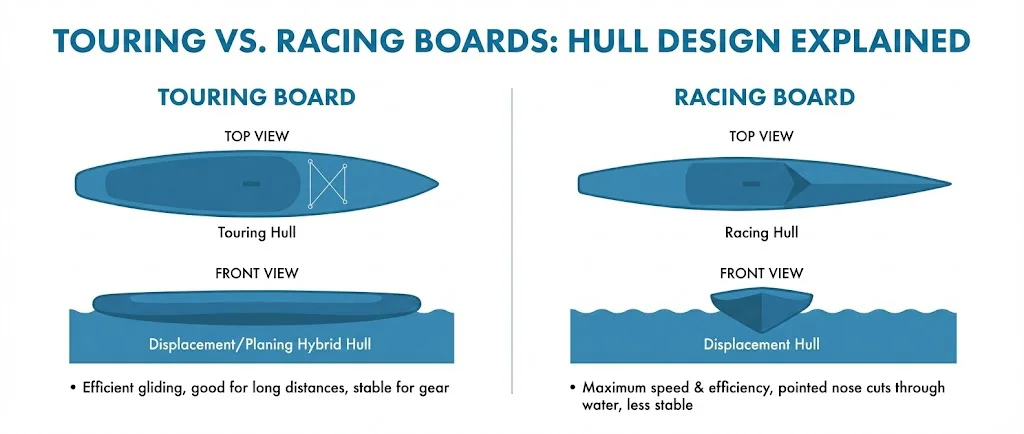
A racing board must reduce drag to have the fastest speed. Our racing shapes incorporate a needle-nose design (Displacement Hull).
- Function: The pointed nose isn’t meant to ride on top of the water; it’s meant to cut through it. This forces water to the sides instead than down, which makes it much easier to move quickly.
- Manufacturing Challenge: Creating a sharp, stiff nose on an inflatable board needs high-precision cutting and reinforced rail construction—an area where our business excels.
Touring SUP Shape: The Hybrid Planing Hull
Touring boards are the “grand tourers” of the sea—built for efficiency over long distances rather than sprinting.
- Function: They usually have a nose that is a little broader and tapers. This design combines the tracking ability of a displacement hull with the stability of a planing hull (flat bottom).
- Benefit: This lets the rider carry goods like coolers and dry bags without losing stability, which makes it perfect for the adventure market.
Rocker Lines: The Secret to Speed Control
The “Rocker” refers to the upward slope of the board from nose to tail. Getting the rocker profile properly is a must for OEM clients that want to make certain models.
Flat Rocker (Speed Focus)
Most designs for racing paddle boards have a flatter rocker profile.
- Why? A flatter board maximizes the waterline length. The more board that touches the water, the faster it tracks and glides.
- Trade-off: It requires skill to manage in choppy water, as the nose is closer to the surface.
Progressive Nose Rocker (Versatility Focus)
For a Touring SUP design, we engineer a progressive nose rocker—a visible upward curvature at the front.
- Why? This lift prevents the nose from diving (pearling) when paddling into chop or small waves. It ensures a smoother, drier ride for the consumer, which is a key selling point for recreational touring markets.
R&D Precision: Bringing Designs to Life
Many businesses worry that inflatable technology (iSUP) cannot match the sophisticated shape of composite hardboards. We show them they’re wrong.
Through our innovative High-Density Drop Stitch Technology, we can alter the internal structure to hold certain forms under high pressure (15-20 PSI).
- Custom Rocker Profiles: We employ precision heat-molding procedures to lock in the rocker curvature, guaranteeing it doesn’t flatten out when inflated.
- Reinforced Rails: Our double-layer rail structure keeps the sleek racing profile stiff, so every ounce of paddle power goes into moving ahead.
Conclusion: Partner with a Factory That Understands Performance
The quality of your products is what makes your company stand out, whether you’re making a record-breaking racing paddle board design or a best-selling touring SUP shape. We don’t just put PVC together; we design boats.
Ready to upgrade your product line with competition-grade hydrodynamics? Contact our R&D Team immediately to discuss your custom needs and request our latest catalog.


