
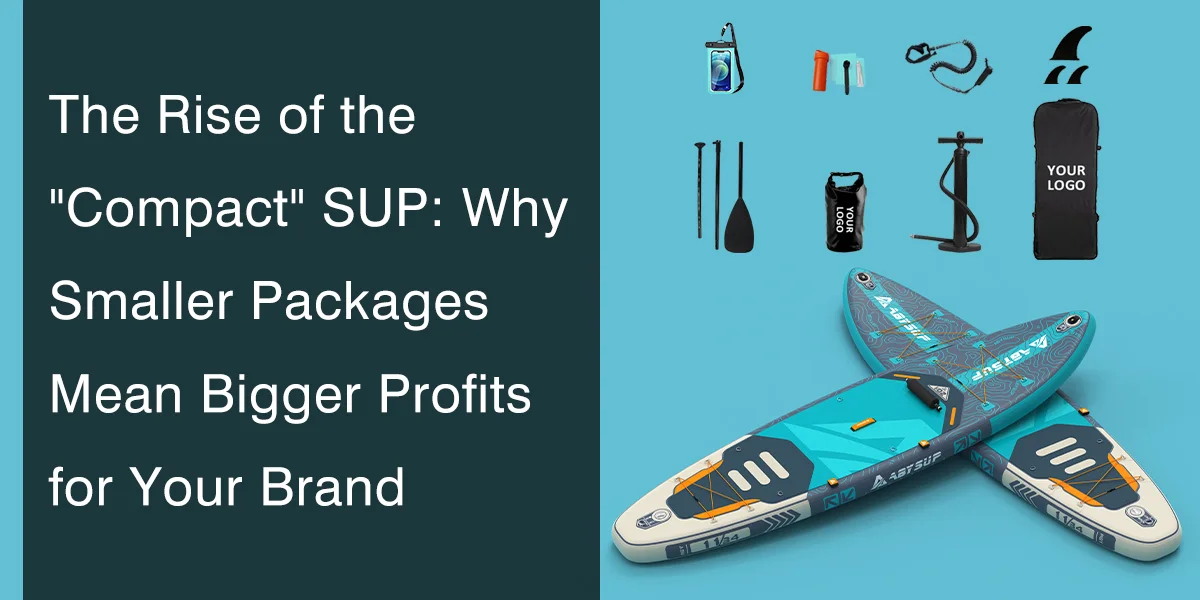
You will see a change if you look at the current state of the water sports market. The regular 10’6″ all-around board is still popular, but the Compact Inflatable SUP is where the major growth will happen in 2025.
I can see the backend data since I make things that help outdoor brands around the world. More and more OEMs are asking us about “ultra-light” and “pocket” boards.
Why? Because people today are different. They don’t only drive to the beach; they also hike to alpine lakes, fly to Bali, and live in camper trailers. They need a travel paddle board that can fit in their bags.
In this tutorial, I’ll explain the engineering behind this trend and, more crucially, how adding a Compact series to your catalog might help you with your largest problem: logistics costs.
The Engineering: How We Made It 50% Smaller
To make a board smaller, you can’t merely fold it tighter; you need to modify the materials it’s made of.
1. The Core: Woven Drop Stitch Tech “Knitted” drop stitch is what standard boards utilize, and it’s hefty and bulky. Woven Drop Stitch is what we use for our Compact range. This material has a stronger tensile strength but consumes less raw PVC. This makes the board around 30% lighter and much more flexible.
2. The Fold: Longitudinal vs. Lateral This is the secret ingredient. Standard boards fold up horizontally around a fixed fin box. The Split Fin Box or offset valve design is what makes our Compact boards special. This lets you fold the board in half lengthwise before wrapping it up.
- The end result is a package that is half the size of a normal SUP box.
The “Altruistic” Economics: Slashing Your Shipping Bill
This is why this is important for your business’s bottom line.
Global shipping carriers (FedEx, UPS, DHL) don’t just charge by weight; they charge by Dimensional Weight (DIM Weight)
A regular SUP box is big, which can lead to “Oversized” surcharges. A Compact Inflatable SUP box is about the same size as a small suitcase.
- Factory to Warehouse: A 40HQ sea container may hold 40% more units.
- Warehouse to Customer: You save a lot on delivery cost at the end of the route.
You’re not just adding a new product by switching some of your inventory to Compact versions; you’re also making your supply chain margins better.
Tapping into the “Adventure Tourism” Boom
The consumer demand is already there. According to recent reports on Adventure Tourism Market Trends, there is a surge in travelers seeking portable gear for “soft adventure” activities like hiking and kayaking.
A 12kg board is too hefty for a hike of 5 km. A 6kg Compact board fits in a bag with room for a towel and a water bottle.
Who is your new customer?
- The Digital Nomad: Needs items that will fit in an overhead bin.
- The Hiker: Wants to paddle on lakes that are far away and can’t be reached by car.
- The City Dweller: Lives in a small flat with no room for storage.
Building Your “Travel Series” Ecosystem
You need to make the accessories for your Travel paddle board line fit the board’s “Light & Small” philosophy in order to make it successful.
At Huale, we offer a dedicated Compact Accessory Kit for our OEM partners:
- 5-Piece Paddle: Shorter than the usual three-piece set, so it fits in the micro-bag.
- Nano Hand Pump: A small cylinder pump that saves space without losing pressure.
- The “Laptop” Backpack: A square bag with a sleek design that looks more like high-end luggage than exercise gear.
Conclusion: Future-Proof Your Catalog
The market is going toward things that are easy to use and work well.
The Compact SUP is not a gimmick; it is the answer to rising shipping costs and the needs of modern travel.
Don’t let your brand get burdened down by old, heavy stock.
Are you ready to make your own Compact Series? Get in touch with Huale Engineering immediately. We can send you a sample of our Woven Drop Stitch material and a price comparison that shows you just how much you can save on shipping with a Compact line.


