
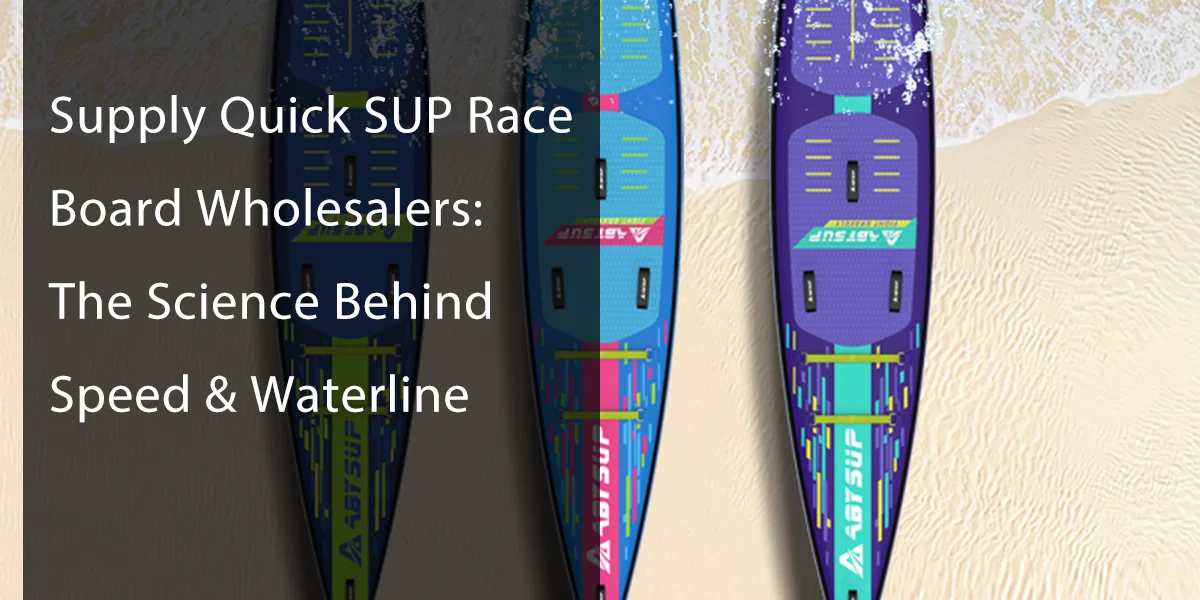
“Why is this board quicker than that one?”
People always ask me this when I meet with club directors and race organizers. They observe two 14-foot boards, both made of carbon fiber. One glides easily, while the other feels like it’s pulling a bucket of water.
As a manufacturer, my job isn’t only to glue PVC together; I also need to know a lot about how water moves. We need to stop focusing at “marketing specs” and start looking at the physics of the waterline if we want to give quick sup race board wholesalers what they need.
I want to talk about the design reasoning we use in our factory to make boards that win podiums and why one small “miniature” market isn’t getting enough attention right now.
The Golden Rule: Waterline Length Equals Speed
There is a reason why Olympic sprint kayaks are long and skinny. It comes down to a concept in naval architecture called Hull Speed.
In short, the longer the waterline, the faster the boat can go in theory. A paddle board makes a bow wave when it goes through the water.
If the board is too short, it gets stuck between the waves at the front and back. It has to literally go up a hill to go quicker.
This is why we make our quick sup race boards as big as the rules for the 14-foot class will allow.
We make the “effective waterline” as long as possible by making the nose longer and the tail square. This makes sure the board cuts through the water instead of pushing it.
Width vs. Drag: The “Tippy” Trade-off
A 28-inch broad race board was thought to be “narrow” ten years ago. You need to have boards that are 23, 21, or even 19 inches wide if you want to be a top-notch racing sup surfboard wholesaler nowadays.
Why go so thin? It makes the surface area that gets wet smaller (drag).
- 25-26 inches: Good for amateur club racing and choppy ocean conditions.
- 21-23 inches: The standard for elite flatwater sprinting.
We use a particular “recessed deck” design (dig-out cockpit) in our factory. This lowers the paddler’s center of gravity, which lets us make a very narrow 21-inch board that feels stable enough for an intermediate racer.
The Blue Ocean: Child Racing SUPs
This is where I think the market is missing the most. I go to clubs and watch kids that weigh 40 kg trying to race on 12’6″ adult boards.
The sound is too loud, the rail is too thick, and the child can’t bury the paddle properly. It ruins their shape.
We are one of the few factories that makes Child Racing SUPs on a regular basis. These aren’t simply little toys. They are smaller versions of technical race cars:
- Length: 10’6″ or 11′ (optimized for shorter stride frequencies)
- Width: 20-22 inches (narrow enough for small shoulders to reach the water vertically).
- Volume: Reduced thickness so the kid isn’t floating “on top” of the water like a cork, but “in” the water for better tracking.
Conclusion: Sourcing for the Podium
Speed isn’t an accident. It was made that way. You need gear that follows the laws of physics, whether you’re putting together a professional team or a junior development team.
If you’re ready to update your fleet and give quick sup race board wholesalers in your area real performance gear, Contact our Engineering Team. Let’s talk about custom rockers, nose cones, and the future of racing for young people.


