
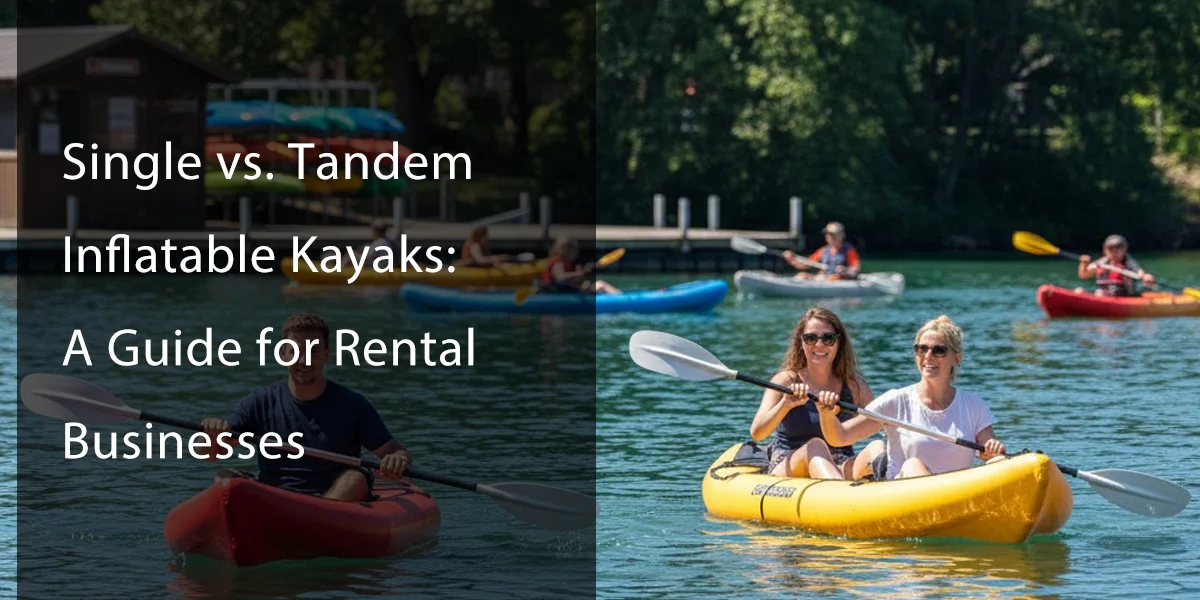
Rental operators ask us this question constantly: single or tandem? The answer changes depending on your location, your customer mix, and how you price sessions. What doesn’t change is the fact that most operators get the ratio wrong on their first order — and either turn away couples on peak days or end up with tandem inventory that sits unused on a Wednesday morning.
I’m Charlie, a senior industrial designer at Huale Inflatables with over 15 years on the factory floor designing and manufacturing inflatable kayaks for rental fleets, outdoor activity brands, and OEM customers worldwide. This guide gives you the commercial comparison and fleet ratio logic we walk every rental operator through before they place a bulk order.
Single vs Tandem Inflatable Kayak: The Commercial Comparison
The choice between a single-person inflatable kayak and a tandem inflatable kayak is not about which is better — it’s about which mix generates better returns for your specific operation. Here’s how they compare across the variables that matter for a rental business.
| Factor | Single Inflatable Kayak | Tandem Inflatable Kayak | Commercial Impact |
|---|---|---|---|
| Revenue per unit | Lower per session ($20–$30/hr typical) | Higher per session ($35–$50/hr typical) | Tandems earn more per unit but serve a narrower customer segment |
| Storage footprint | Smaller packed size, lighter, faster to handle | 30–40% larger packed volume, heavier — requires two staff to move | Singles allow denser storage; tandems increase per-unit labour cost |
| Customer fit | Solo paddlers, beginners, fitness users, experienced kayakers | Couples, families with children, guided tour groups | Tandems capture the family market, which books longer sessions and tips more |
| Wear rate | Lower — one paddler, less structural stress per session | Higher — two paddlers, heavier combined load on seams and floor | Tandems need higher-spec construction to match single lifespan at commercial use rates |
| Beginner performance | More forgiving — one person controls the kayak independently | Requires coordination — mismatched paddlers generate complaints | Singles produce fewer mid-session complaints; tandems benefit from a 2-minute pre-launch briefing |
| Versatility | Fixed — serves one paddler only | Can run as a roomy single with gear if removable seating is specified | Tandems with adjustable seating cover both use cases in low-demand periods |
Material Spec: What Rental Kayaks Need That Recreational Models Don’t
A kayak bought at a sporting goods store is designed for one owner using it 20–30 times a season. A rental kayak does 6–10 sessions per day, gets dragged across launch ramps, and is inflated by people who don’t read the gauge. The construction spec has to account for that difference.
Drop-Stitch Floor vs Standard PVC: Why It Matters for Rental
Drop-stitch inflatable fabric is constructed with thousands of internal threads connecting the top and bottom sheets, allowing the floor to hold rigid at high pressure without ballooning. For rental kayaks, a drop-stitch floor rated at 10–15 PSI provides a platform that holds its shape under a 120kg paddler — standard PVC bladder floors at 3–5 PSI flex noticeably and are unstable under any significant load.
For commercial rental use, we recommend:
- Hull and side tubes: 1.1mm–1.2mm double-wall fabric (DWF) — single-layer 0.9mm PVC shows abrasion wear within one rental season
- Floor: Drop-stitch construction, minimum 15 threads per cm², rated to 10–15 PSI
- Seams: High-frequency welded — hand-glued seams on a rental kayak will delaminate within 60–80 sessions at the side tube to floor junction
- Valve spec: Stainless steel or reinforced PVC valve body, rated for 300+ inflation cycles — budget valves develop micro-cracks and slow leaks within the first season
For tandem kayaks specifically: the combined paddler weight is 40–60% higher than a single, and the floor takes a larger share of that load. Any tandem used for commercial rental should have a drop-stitch floor — it’s not optional at this use frequency.
The 48-Hour Pressure Test
Every kayak we supply for commercial use — single or tandem, sample or bulk — passes a 48-hour pressure retention test before shipment. Inflated to rated PSI, logged at start and end. Any unit that drops pressure is scrapped. We reject 3–5% of units per production run at this stage. For rental operators, this test is the difference between a fleet that holds up through a peak season and one that generates slow-leak complaints in week three.
Fleet Ratio: How to Balance Singles and Tandems
There is no universal ratio — it depends on your customer profile and location. But based on fleet orders we’ve supplied to rental operations across lake resorts, coastal outfitters, and river tour operators, here’s the starting framework.
Location Type and Recommended Starting Ratio
- Lake resort or coastal family destination: 50% single / 50% tandem — families and couples dominate, tandem demand is high and predictable
- Urban riverfront or fitness-focused location: 70% single / 30% tandem — solo paddlers, commuters, and fitness users form the majority; tandem demand is weekend-concentrated
- Guided tour operator: 40% single / 60% tandem — guided groups skew toward tandems; couples book together and want to share the experience
- General mixed-use rental: 60% single / 40% tandem — the default ratio for a new operation that doesn’t yet have customer data
Track your own booking data through the first season and adjust your second order accordingly. Operators who start at 60/40 and review data at the end of peak season almost always move to a more informed ratio on the second order — sometimes significantly more singles, sometimes more tandems. The first season is data collection as much as it is revenue generation.
Fleet Size: How Many Units to Start With
Use your expected peak-hour demand as the baseline: the number of simultaneous paddlers on your single busiest day. Add 20% buffer for kayaks in the turnaround cycle — being inspected, inflated, or drying between sessions.
- Small operation (1 launch point, limited staff): 10–15 kayaks total
- Medium operation (resort, multiple launch windows): 20–40 kayaks total
- Large or multi-site operation: 50+ units, typically with dedicated fleet management staff
Most operators who start below 15 units hit capacity on their first busy weekend and place a mid-season top-up order at full retail pricing. Starting at a realistic peak-demand number, even if it feels like more than you need on a Tuesday, almost always pays back within the first season.
Wholesale Pricing and Lead Times for Rental Fleet Orders
Factory-direct pricing for commercial-grade inflatable kayaks runs on volume tiers. The following reflects our current FOB Guangzhou pricing for 1.1mm DWF hull construction with drop-stitch floors and HF-welded seams:
- Sample (1–3 units): Sample rate, 7–10 business days
- 10–30 units: $95–$145 USD per unit, 25–35 days production
- 30–80 units: $80–$120 USD per unit, 25–35 days production
- 80+ units: $65–$100 USD per unit, 30–40 days with priority scheduling
US-based operators should add 45–60% to FOB price to arrive at landed cost after freight, Section 301 import duties, and customs clearance. Custom branding — your logo on hull and seat back — is available from 1 unit at sample stage, no minimum on graphics setup.
Between-Session Maintenance for a Commercial Kayak Fleet
Rental kayaks that fail mid-session don’t just generate refunds — they generate reviews. A 60-second between-session check catches 90% of the issues before they reach the water.
- PSI check: Kayaks lose 1–2 PSI per hour in hot sun — top up before every rental, not just at the start of the day
- Seam inspection: Run your hand along the side tube-to-floor seam after every 5th session — early delamination is tactile before it’s visible
- Valve check: Depress the pin and listen for air loss — a slow valve hiss mid-session is the most common complaint
- Seat inspection on tandems: Adjustable seat straps loosen under use — check tension before each session, not just when a customer complains
For salt water locations: rinse hulls and seats with fresh water after every session. PVC degrades faster under repeated salt crystal abrasion than almost any other environmental factor. Operators who skip this step typically see measurable surface degradation within one summer season.
Frequently Asked Questions: Single vs Tandem Inflatable Kayak for Rental
What is the best inflatable kayak for a rental business?
For commercial rental use, the specification matters more than the brand. Minimum requirements: 1.1mm double-wall fabric hull, drop-stitch floor rated to 10–15 PSI, high-frequency welded seams, and a reinforced valve rated for 300+ inflation cycles. A kayak built to this spec — single or tandem — will survive 2–3 full rental seasons with standard maintenance. Entry-level recreational kayaks with 0.9mm PVC and glued seams typically show significant wear within the first season at commercial use rates.
How many tandem kayaks should I have in my rental fleet?
For a general mixed-use rental operation, a 60/40 split favouring singles is the standard starting point. Adjust based on your customer profile: family and resort destinations often run 50/50 or even tandem-heavy; urban fitness and river locations typically run 70% singles. Track your booking data through the first peak season and let that dictate your second order — the right ratio for your operation is in your own reservation system, not in a generic guide.
Are inflatable kayaks durable enough for commercial rental use?
Our commercial-grade inflatable kayaks — built to 1.1mm–1.2mm DWF spec with drop-stitch floors and HF-welded seams — are durable enough for 6–10 sessions per day across a full season. Recreational-grade inflatables are not, and the difference is primarily in floor construction and seam method. Ask any supplier whether their kayaks use drop-stitch floors and HF welding — if the answer is unclear, that tells you what you need to know.
Can a tandem inflatable kayak be used as a single?
Yes, if the seat configuration allows it. We offer tandem models with fully adjustable and removable rear seating, which lets the front paddler use the kayak solo with the rear seat space for gear storage. This is useful for low-demand periods where you want tandem inventory generating revenue as a solo “adventure” rental at a slight premium. Specify this requirement when ordering — not all tandem configurations support it cleanly.
How long does it take to receive a bulk inflatable kayak fleet order?
Production lead time for bulk fleet orders is 25–35 days after sample approval and deposit. For orders requiring custom branding — hull printing, seat colour matching, logo placement — sample approval adds 7–10 business days before bulk production starts. Total timeline from first enquiry to goods on a ship is typically 35–50 days depending on order complexity. We supply a production schedule with confirmed dates at order confirmation, not estimates.
Ready to Build Your Rental Kayak Fleet?
Send us your fleet size target, the single/tandem ratio you’re considering, your location, and your season start date. We will respond within 24 hours with a factory-direct quote, a recommended spec for commercial rental use, and a production schedule that fits your launch timeline.
MOQ starts from 1 piece for samples. Bulk fleet orders from 10 units. We supply single and tandem inflatable kayaks to rental operations across lake resorts, coastal outfitters, surf schools, and guided tour operators — the logistics and operational requirements of a rental fleet are not new territory for our production team.


