
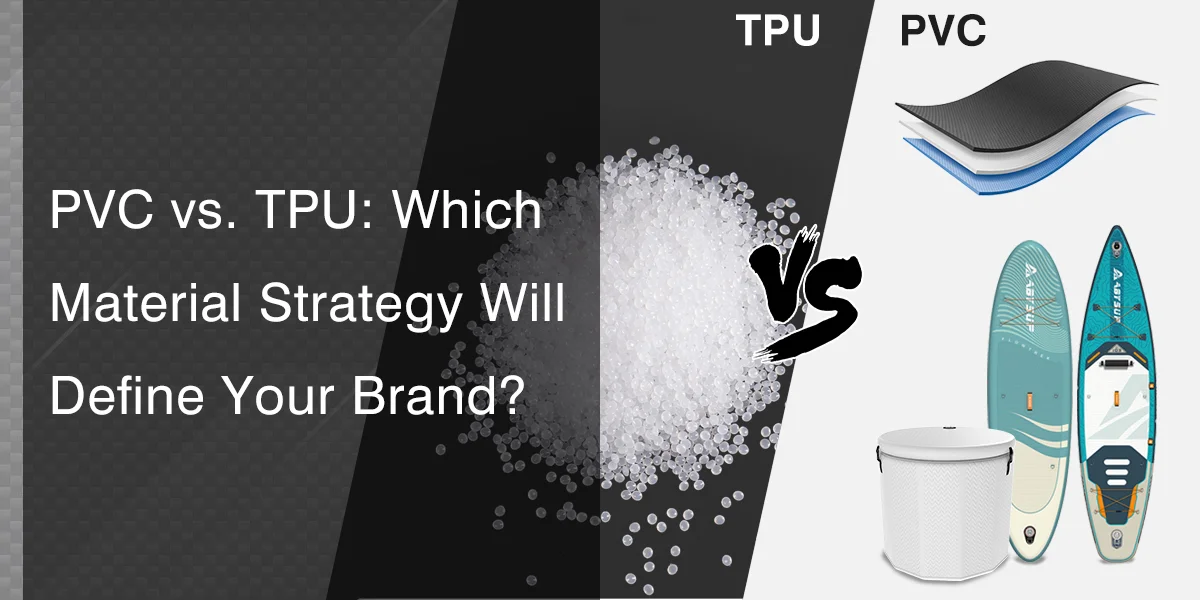
In the fifteen years I’ve spent making everything from white-water rafts to drop-stitch pools, the most typical argument I hear in the boardroom isn’t about color or design; it’s about the chemistry of the materials.
Choosing between Polyvinyl Chloride (PVC) and Thermoplastic Polyurethane (TPU) is more than simply a line on a spec sheet; it affects how much your product costs, how long it lasts, and how much it affects the environment.
I’ve seen firms grow quickly by switching to high-end TPU, and I’ve seen others go bankrupt by ignoring the facts of PVC’s economy. I’ve taken away all the marketing fluff so you can evaluate them side by side and make a decision.
At a Glance: The Specification Showdown
If you’re pressed for time, here’s a comparison of the two materials in real-world manufacturing scenarios:
| Feature | PVC (Polyvinyl Chloride) | TPU (Thermoplastic Polyurethane) |
|---|---|---|
| Cost | $ (Budget-Friendly) | $$$ (Premium) |
| Weight | Heavy & Robust | Ultralight (30-50% lighter) |
| Abrasion Resistance | Good | Excellent |
| Cold Weather | Becomes brittle below 0°C | Stays flexible down to -40°C |
| UV Resistance | Moderate (Needs coatings) | High (Naturally resistant) |
| Eco-Friendliness | Low (Hard to recycle) | High (Biodegradable options) |
| Best For | Mass Market, Family Pools, iSUPs | Packrafts, Expedition Gear, Eco-Brands |
PVC: The Industry Titan (Reliable & Affordable)
PVC is the smell that you will notice when you walk onto 90% of inflatable factory floors. Because it is mature and can grow, it is still the best inflatable in the world.
The Strategic Pros:
- Cost Efficiency: The supply chain for raw materials is huge, which keeps costs low and consistent. This makes it possible to offer competitive prices in markets that are already full (like Amazon).
- Stiffness: PVC is very stiff for a lesser price than other materials for high-pressure drop stitch goods like SUPs.
- Easy to Fix: Repair kits are cheap, and glue sticks to the material well.
The Hidden Cons:
- Plasticizer Migration: To make stiff PVC more flexible, we add chemicals called plasticizers. Over time, they move out, making the material weak and breaking.
- Environmental baggage: It has chlorine in it and is hard to recycle, which can be a problem for strict European markets.
TPU: The High-Performance Challenger (Light & Green)
Years ago, when I started using TPU to make prototypes, it felt like I was working with the future. It feels rubbery and stretchy, unlike PVC, which feels like plastic.
The Strategic Pros:
- Unmatched Durability: TPU is better at resisting wear and tear. You can pull a TPU raft over river rocks that would pierce PVC, and it will typically just shake it off.
- Packability: We may utilize thinner layers since it is stronger per millimeter. This cuts the weight by 30 to 50 percent and makes the rolled-up product much smaller, which is great for shipping expenses.
- The “Green” Story: TPU may be recycled and broken down by nature. For firms seeking to establish their eco-friendly reputation, this is the ideal marketing tool.
The Hidden Cons:
- Manufacturing Difficulty: It is well known that TPU is hard to weld. It needs cleaner spaces and exact temperature controls, which makes the cost of labor go significantly for each unit.
- Price Tag: Expect the cost of raw materials to go up a lot, which will make your retail price go up into the premium range.
The Verdict: Which One Should You Choose?
Choosing isn’t about which material is “better” in a vacuum; it’s about what works best for your business model.
Scenario A: Stick with PVC if…
- Your ideal consumer is price-sensitive, such as families that want to buy a pool for a lot of people.
- For a hard paddleboard feel, you need the most rigidity.
- You are launching a startup and need to conserve cash flow for marketing.
Scenario B: Pivot to TPU if…
- Weight is critical: People that buy from you are hikers, travelers, or packrafters.
- Sustainability is your brand’s core: it is not appropriate to use regular PVC to market “green” products.
- Commercial Use: You have a rental fleet, so durability and resistance to wear and tear will save you money on replacements in the long term.
Final Thoughts
In the end, the market can handle both. We run production lines at Huale that make PVC and TPU at the same time for different clients.
We don’t push you toward one or the other; we push you toward the one that makes the most money for you.


