
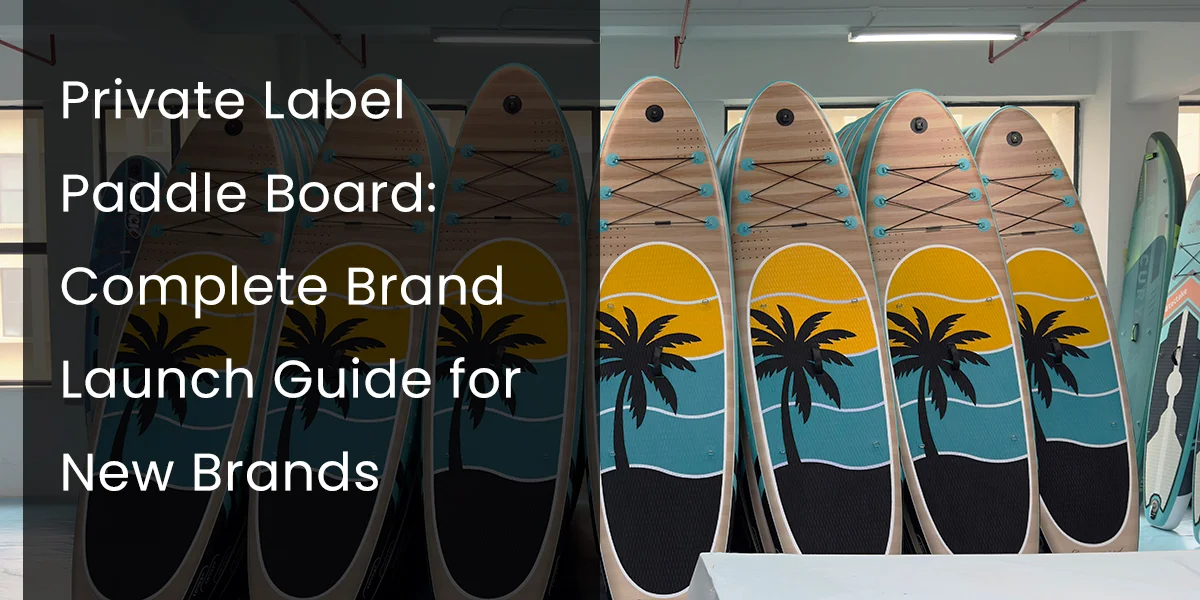
Most first-time brand owners come to us with the same problem: they have identified the paddle board market, they have capital ready, and they have no idea what happens next. The manufacturer conversation feels like a black box — unclear costs, vague timelines, and no way to verify who you are actually dealing with.
I’m Charlie, a senior industrial designer at Huale Inflatables. I have spent 15 years on the factory floor building stand-up paddle boards for brands across North America, Europe, and Australia. This guide gives you the exact numbers, timelines, and verification steps we walk every new brand partner through before they place their first order.
No fluff. Just what it actually takes to launch a private label paddle board brand from a factory that builds the product.
What Private Label Actually Means for a Paddle Board Brand
Private label — also called white label or ODM — means you take an existing, factory-engineered board design and apply your brand identity to it. You are not designing a board from scratch. You are selecting a proven shape from our paddle board factory, choosing your visual customization options, and launching under your own brand name.
This is the fastest and most capital-efficient way to enter the paddle board market. You skip the $5,000–$15,000 in tooling costs and the 3–4 month engineering cycle that custom OEM requires. You get a tested product with a known performance profile into your hands in weeks, not months.
What You Can Customize on a Private Label Board
This is the question I get every week from new brand owners. Private label is not just a logo sticker. Here is what we can apply to an existing board design:
- Logo and brand name: Printed directly onto the board deck via UV-resistant digital printing
- Color scheme: Full deck color customization within our existing print templates
- EVA traction pad: Custom shape, color, and texture pattern
- Carry bag: Branded print on the bag, custom colorway
- Accessories: Branded paddle, pump, leash, and fin set with your logo
- Packaging: Custom box or bag design for retail or DTC fulfillment
What you are not changing in private label: the board’s core dimensions, internal drop-stitch structure, and fin box system. Those are fixed in our existing molds. If you need to change those, that moves into custom OEM territory — a different conversation with different costs.
The Real Costs of Launching a Private Label Paddle Board
The number one reason brand owners stall is that they cannot get straight answers on cost from suppliers. Here are our actual numbers.
Sampling Phase Costs
- Sample MOQ: 1 piece — you do not need to commit to bulk before holding the product
- Sample lead time: 7–10 business days from design confirmation
- Sample cost: Priced at unit rate — no additional sampling fee for standard private label designs
- Revision rounds: We typically need 1 round for color and print adjustments, rarely 2
Bulk Production Costs
| Cost Item | Private Label (ODM) | Notes |
|---|---|---|
| Bulk MOQ | 50 pieces | Lower MOQ available on select designs |
| Tooling / Mold Cost | $0 | You use our existing molds |
| Unit Price Range | $85–$220 USD | Depends on board size, material spec, and accessories included |
| Branding Setup Fee | $0 from 1 unit | Logo and color applied from sample stage |
| Bulk Production Lead Time | 25–35 days | After sample approval |
| Shipping (Guangzhou → LA) | 18–28 days | Sea freight, varies by season and port |
Total timeline from first contact to product in your warehouse: 8–12 weeks on a standard private label order. Plan your launch date around that window, not around optimistic supplier promises.
How to Verify You Are Talking to a Real Factory
This is where first-time buyers get hurt most often. Trading companies operating as manufacturers are common in China’s inflatable industry. They will quote you, take your deposit, and then subcontract your order to a factory you have never vetted. Quality becomes unpredictable and your leverage disappears.
Four Things a Real Manufacturer Can Do That a Trading Company Cannot
- Show you their business license: A manufacturer’s license lists production scope. A trading company’s license lists trading scope. Ask for it before any money moves.
- Give you a live factory video tour: We do this on WeChat or Zoom for every serious inquiry. You should see drop-stitch cutting tables, high-frequency welding machines, and a QC inspection floor. If they hesitate, that tells you everything.
- Provide raw material test reports: We can supply PVC thickness certifications and drop-stitch fabric spec sheets on request. A trading company is reselling finished goods — they do not have these documents.
- Customize within specific engineering parameters: Ask them what drop-stitch density they use and what PSI their boards are rated to. A real factory engineer answers this in 30 seconds. A trading company goes quiet.
What Our Quality Control Looks Like Before Your Order Ships
Every board we produce — sample or bulk — goes through the same QC protocol. This does not change based on order size.
- Raw material inspection: Every roll of drop-stitch fabric and PVC sheet is tested for thickness and tensile strength before it enters production
- High-frequency welding on all structural seams: No hand-glued joints on load-bearing seams — the PVC layers are fused at a molecular level
- 48-hour pressure test: Every board is inflated to rated PSI and left standing for 48 hours. We log PSI at start and end — any drop means the board is scrapped, not shipped
- Pre-shipment visual inspection: Print alignment, traction pad adhesion, valve function, and accessory completeness are checked before packing
We reject 3–5% of units at the pressure test stage every production run. That rejection cost comes out of our margin, not yours.
Protecting Your Brand: NDA and IP for Private Label
Here is the honest answer to the question everyone is afraid to ask: on a standard private label design, another brand owner can order the same board shape from us. They will use their logo. You are protecting your brand identity, not the underlying product geometry.
If this is a concern for your business model, there are two options. First, invest in custom OEM — we engineer a proprietary shape under NDA, and that design is locked to your account. Second, compete on brand, not on hardware. Your packaging, community, content, and customer experience are the actual moat for most successful SUP brands — not the shape of the board.
For custom OEM clients, we sign a comprehensive Non-Disclosure Agreement (NDA) before sampling begins. Your engineering files and mold parameters are locked to your account and never shared.
Step-by-Step: From First Contact to First Shipment
Step 1 — Brief (Day 1–2)
Send us your target retail price, target market, and any design references you have. We come back within 24 hours with 2–3 board options from our existing range that fit your positioning, along with a preliminary price sheet from our paddle board manufacturing facility.
Step 2 — Sample Order (Day 3–15)
You confirm a design and branding brief — logo files, color references, and any accessory preferences. We produce a branded sample in 7–10 business days and ship it to you for physical review.
Step 3 — Sample Approval (Day 15–25)
You test the board. If print or color adjustments are needed, we do one revision round at no charge. Most clients approve on the first or second sample.
Step 4 — Bulk Production (Day 25–60)
You place the bulk order with a 30% deposit. Production runs 25–35 days. We send you photo and video documentation from the production floor at key stages — you are not blind during this period.
Step 5 — QC and Shipment (Day 60–90)
Every unit passes the 48-hour pressure test before packing. We send a pre-shipment QC report with photos. You pay the remaining 70% balance and the order ships. Sea freight to major ports takes 18–28 days.
Common Questions About Private Label Paddle Boards
What is the minimum order quantity for a private label paddle board?
We produce branded samples from 1 piece. Bulk production starts from 50 units on most private label designs. Some high-volume designs have lower bulk MOQs — ask us when you submit your brief and we will confirm the exact figure for the board you are interested in.
Can I sell private label paddle boards on Amazon?
Yes, and many of our brand partners do exactly this. For Amazon FBA, you will need a barcode, compliant packaging dimensions, and in some categories a safety certification. We can produce boards with ASTM or CE documentation on request. Confirm your target marketplace when you brief us and we will flag any compliance requirements upfront.
How do I choose the right board design for my target market?
Start with your customer profile and price point, not with the board spec. An all-around board at 10’6″ suits most recreational buyers and hits the broadest retail price range. A touring shape or a fishing-specific design serves a narrower audience but commands a higher margin. We will give you category-level sales data from our existing brand partners to help you make this call.
What artwork files do I need to provide?
We need your logo in vector format (AI or EPS preferred, high-resolution PNG accepted), your brand color codes in Pantone or CMYK, and a general direction on layout — centered logo, full-deck graphic, or panel design. Our in-house design team produces a print-ready mockup for your approval before any production begins. There is no design fee for standard private label layouts.
What happens if boards arrive damaged or defective?
Every order includes a pre-shipment QC report and packing documentation. If defects are discovered after arrival, we require photo evidence within 7 days of delivery. Confirmed manufacturing defects are replaced at our cost in the next production run. Shipping damage claims go through the freight insurer — we help you document and file the claim.
Ready to Launch Your Paddle Board Brand?
Send us your target retail price, your launch market, and any board references you are working from. We will come back within 24 hours with board options, a direct factory price sheet, and a realistic timeline for your first order.
Branded samples from 1 piece. Bulk production from 50 units. There is no reason to commit to inventory before you have held the product and tested it yourself.


