
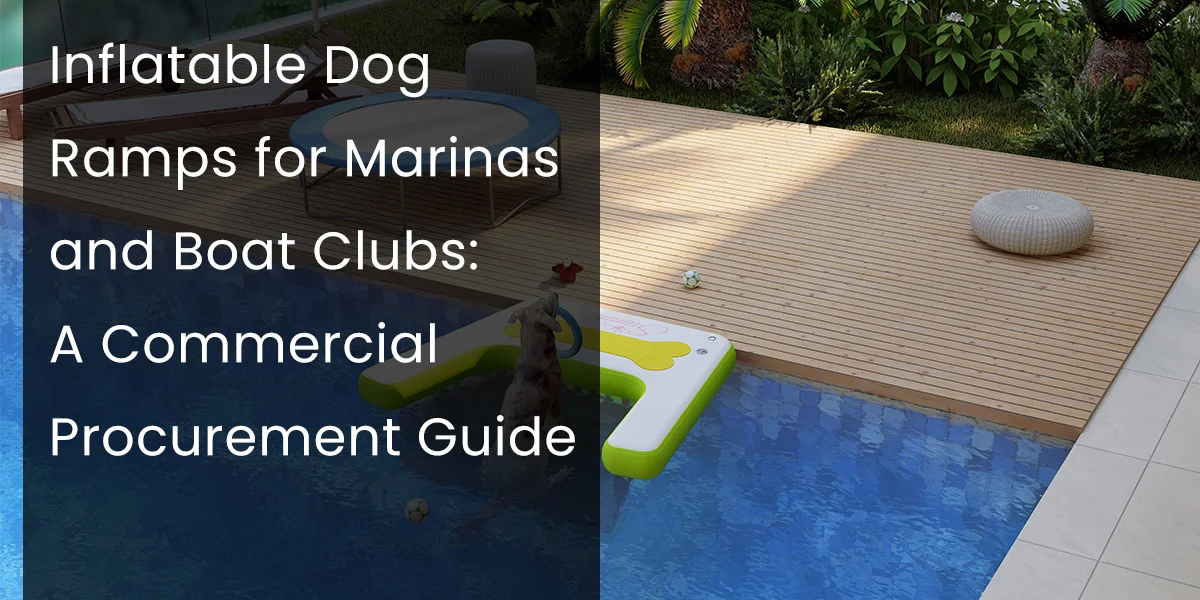
Marina managers and boat club operators are increasingly fielding the same request from members: a safe, reliable way to get their dog back on the dock or onto the vessel after a swim. The demand is real, the liability exposure from a dog injuring a joint trying to scramble up a dock edge is real, and the current market answer — a mix of consumer-grade foam ladders and DIY solutions — is not holding up under the daily demands of a commercial waterfront environment.
I’m Charlie, senior industrial designer at Huale Inflatables. We manufacture commercial-grade inflatable dog ramps for marinas, boat clubs, yacht charter companies, and waterfront hospitality operations. This guide covers the spec decisions that matter for commercial multi-dog use, the cost-per-unit economics at bulk volume, and the liability protocol that marina operators need in place before a ramp program goes live.
Why Pet-Friendly Infrastructure Is Now a Marina Differentiator
Dog ownership rates in the US and EU have increased significantly since 2020, and boat-owning demographics skew heavily toward active outdoor households — which means a high proportion of marina members are boat owners who also own dogs. A marina that actively accommodates dogs — with ramps, wash stations, and designated relief areas — is not just being friendly. It is addressing a specific operational gap that members notice and talk about.
The guest satisfaction impact is measurable. Marina members who bring dogs to the dock regularly are among the highest-engagement, highest-loyalty segments — they are there more often, they spend more in the chandlery and café, and they renew memberships at higher rates than seasonal-only users. Losing a member because a competitor marina offers better dog facilities is a retention failure that costs far more than the procurement cost of a dog ramp program.
What “Pet-Friendly” Actually Requires at a Commercial Marina
A consumer-grade dog ramp bought from Amazon is not a commercial solution. A marina deploying dog ramps needs products that survive multi-dog daily use across an entire boating season, handle dogs across the full weight range of typical marina membership (15kg terriers through 55kg retrievers and Labradors), attach securely to dock edges and vessel transoms without damaging infrastructure, and can be quickly deployed and stowed between uses. Those requirements rule out most of what is available at retail price points.
- Multi-dog daily use: A busy marina dock might see 20–40 dog uses per day across a fleet of ramps during peak summer months — the equivalent of commercial rental use intensity
- Mixed breed weight range: Marina dogs are not uniformly small — the Golden Retrievers and Labradors that are common in boating households can weigh 30–45kg, with larger breeds extending to 55kg+
- Saltwater environment: Every material spec decision — PVC grade, D-ring alloy, EVA adhesive, seam construction — needs to account for daily salt water exposure followed by UV exposure on the dock
- Staff handling: Ramps are deployed and stowed by marina staff who may not be careful with the equipment — the product needs to be genuinely durable, not just durable under careful owner use
Commercial Spec for Marina Dog Ramps: What the Numbers Need to Be
The specification gap between a consumer dog ramp and a commercial marina ramp is not subtle. Here is the comparison across every material parameter that determines whether a product survives a full marina season.
PVC Shell and Construction
- Minimum PVC thickness for commercial marina use: 1.1mm double-wall fabric (DWF) — consumer products use 0.6mm–0.9mm single-layer PVC that degrades under combined UV and salt exposure within one season. DWF construction sandwiches a polyester weave between two PVC layers, preventing material stretch under pressure and providing meaningful resistance to claw abrasion on the side rail surfaces
- UV stabilisation: mandatory — non-stabilised PVC chalks and loses surface flexibility within one outdoor season under direct Mediterranean or Atlantic coast sun exposure. UV-stabilised compound maintains surface integrity for 3–4 seasons under the dock conditions typical of European and US East/West coast marinas
- Seam construction: high-frequency welded structural seams throughout — hand-glued seams delaminate in saltwater within 30–60 days of commercial use. HF welding fuses PVC layers at a molecular level — the weld zone is as strong as the base material and unaffected by salt chemistry
- Operating PSI: 10–15 PSI — higher operating pressure increases ramp rigidity under dynamic load, which is the load profile a dog creates during the climbing motion. Under-inflated ramps at 60–70% of rated PSI flex under weight and lose surface stability
Mesh Surface and Traction
- Mesh denier minimum: 840D nylon or 1000D polyester — lower denier ratings fray at the mesh-to-tube bond edges within one commercial season. 1000D polyester is the correct spec for the 40kg+ dog weight range and has better chlorine resistance than nylon at equivalent denier, relevant if ramps are also used at marina swimming areas
- EVA traction surface: 8mm diamond-groove, full-surface bonded — the groove pattern channels water away from the climbing surface, maintaining friction between a wet dog’s paw and the ramp under the dynamic load of the climbing motion. Full-surface adhesive bonding (not perimeter-only) holds the EVA panel through 3+ seasons of wet-dry cycling in saltwater environments
- EVA adhesive spec: chlorine and salt-resistant formulation — standard EVA adhesives soften under repeated salt and UV exposure. Salt-resistant adhesive maintains bond strength across the operating life of the product
Hardware for Marine Environments
- D-ring material: 316-grade stainless steel only — 304-grade stainless corrodes visibly within one marine season in saltwater environments. 316-grade contains molybdenum which provides the corrosion resistance required for permanent saltwater exposure
- D-ring working load rating: minimum 200kg per ring — the 3:1 safety factor over the maximum rated dog weight accounts for dynamic load and lateral attachment force from current and vessel movement
- Valve specification: reinforced PVC or stainless steel valve body — rated for 500+ inflation cycles. At commercial marina deployment rates (daily inflation and deflation), a valve rated for only 80–100 cycles will fail within the first season
- Reinforcement patch at D-ring attachment: 3-layer construction — single-layer patches delaminate under the repeated mooring cycle loads of a commercial installation
QC Protocol: What We Run Before Shipment
Every commercial marina order goes through a documented QC protocol at our factory before shipment. Every unit passes a 48-hour pressure retention test — inflated to rated PSI, held 48 hours, PSI logged at start and end. We reject 3–5% of production at this stage. Additionally, D-ring attachment points are load-tested to 1.5× rated working load, EVA panels are peel-tested before the batch ships, and seam integrity is verified on random units from each production run through destructive seam testing. Documentation — test logs, production photos, inspection reports — is available for orders of 20 units and above.
Size and Weight Capacity: Specifying for Your Marina’s Dog Population
A marina serving a mixed membership will have dogs ranging from 8kg small terriers through to 55kg+ large working breeds. A single ramp size does not cover that range adequately — the ramp that is correctly sized for a 12kg Cocker Spaniel is too narrow for a 45kg Labrador to climb comfortably, and the ramp sized for the Labrador is cumbersome to stow in a locker designed for the smaller product. The practical solution for most commercial marinas is a two-size fleet covering small-to-medium and large breed ranges.
Recommended Configurations for Commercial Marina Deployment
| Configuration | Dimensions | Rated Capacity | Target Breeds | FOB Price (30+ units) |
|---|---|---|---|---|
| Standard | 140cm × 45cm | Up to 35kg | Spaniel / Collie / medium breeds | $22–$32 |
| Large Breed | 170cm × 55cm | Up to 60kg | Golden / Labrador / German Shepherd | $30–$42 |
| XL Breed | 200cm × 65cm | Up to 80kg | Rottweiler / Bernese / giant breeds | $38–$52 |
All prices FOB Guangzhou, 1.1mm DWF spec, 8mm diamond-groove EVA, 316-grade stainless D-rings, HF-welded seams. US marinas importing directly: add 40–55% for landed cost after ocean freight, Section 301 duties, and customs. EU marinas: add 25–35%.
Fleet Sizing for a Marina Deployment
The practical fleet size depends on your peak-period dog traffic and how many dock sections need coverage simultaneously. A working formula: estimate your peak-hour dog count across the entire marina, divide by 3 (average session length divided by 20-minute deployment window), and add 25% buffer for ramps in transit between sessions or undergoing a quick rinse.
- Small marina / yacht club (under 150 berths): 4–6 ramps total — 2–3 standard, 2–3 large breed
- Medium marina (150–400 berths): 8–12 ramps — deploy across 3–4 dock sections, with 2 reserve units in storage
- Large marina or waterfront resort (400+ berths or multiple facilities): 15–25 ramps — include XL configuration if membership includes Rottweilers, Bernese, or similar giant breeds
Attachment Systems: Securing Ramps to Dock Edges and Vessel Transoms
The attachment system is the most marina-specific aspect of the procurement decision. A ramp that drifts away from the dock edge while a dog is climbing is not a product defect — it is a liability incident. The correct attachment configuration depends on whether the ramp is being deployed from a fixed dock edge, a floating pontoon, or directly to a vessel transom.
Fixed Dock Edge Deployment
For fixed dock edges — concrete, timber, or aluminium dock faces — the primary attachment is a pool coping-style hook at the top of the ramp that sits over the dock lip and distributes load across 30–40cm of dock edge. The hook prevents the ramp sliding off the edge when the dog’s weight is concentrated at the top of the climbing stroke.
- Hook material: rigid PVC or aluminium extrusion — flexible plastic hooks deform under load and release without warning
- Contact surface: non-marking rubber or silicone pad — prevents dock edge scratching and improves grip on smooth aluminium dock profiles
- Secondary mooring: D-ring tie-off to dock cleat — for exposed dock positions where wind or wake creates lateral movement, a secondary webbing strap from the ramp’s side D-rings to a dock cleat prevents horizontal drift
Floating Pontoon Deployment
Floating pontoons present a different challenge — the pontoon moves with wave action, which creates a dynamic load on the attachment point that a fixed-dock configuration does not see. For pontoon deployment, the ramp needs a 4-point attachment: top D-rings tied to pontoon cleats, and bottom D-rings weighted or anchored to prevent the lower end drifting away from the vessel.
- Attachment hardware: 316-grade stainless carabiner clips — rated at 300kg minimum, quick-release for fast deployment and retrieval by marina staff
- Bottom anchor weight: 2–4kg rubber-coated weight bag — keeps the ramp base from floating up and angling the climbing surface dangerously steep
Vessel Transom Deployment
Yacht charter companies and boat clubs where members want to deploy ramps directly from their vessel transom need a configuration with inboard D-rings rated for the pull force of a dog climbing from the water. The inboard edge of the ramp sits against the vessel hull — the D-rings on this edge take the majority of the climbing load.
- Inboard D-ring count: minimum 4 on the top (hull-contact) edge, rated at 200kg working load each
- Hull protection: foam bumper strip along the inboard edge — prevents GRP or painted hull scratching during deployment and use. Available as standard on our commercial marina configurations.
- Deployment length for common vessel freeboards:
- Freeboard under 50cm (RIBs, small motorboats): 140cm ramp at standard angle
- Freeboard 50–80cm (sailing yachts, motorboats): 170cm ramp required
- Freeboard 80–120cm (large motor yachts, wide-beam cruisers): 200cm ramp or dual-ramp configuration
The Procurement Economics: Cost Per Unit vs Guest Satisfaction Lift
Dog ramps are one of the few marina amenity investments where the ROI calculation is straightforward. The cost is a defined one-time capital purchase with a 3–5 year lifespan. The return shows up in membership retention, positive online reviews, and word-of-mouth from dog owners who specifically sought out a pet-friendly marina — which is a growing and vocal segment of the recreational boating market.
Total Cost of Ownership Calculation
Taking a fleet of 10 ramps for a medium-sized boat club — 6 large breed units at $36 FOB landed at approximately $50–$55 each, and 4 standard units at $26 FOB landed at approximately $36–$42 each:
- Initial fleet investment (landed, US example): (6 × $53) + (4 × $39) = approximately $474 total
- Lifespan at commercial spec with correct maintenance: 3–5 seasons
- Cost per operating day (200-day season, 4-season lifespan): $474 ÷ 800 days = $0.59 per day for the entire fleet
- Cost per dog interaction (estimated 15 interactions/day across the fleet): $0.04 per use
Against those numbers, a single membership renewal driven by the dog ramp program — at typical US boat club membership rates of $800–$2,500 per year — returns the entire fleet investment in one transaction.
Branded Marina Program: Adding the Signage and Recognition Layer
Marinas and boat clubs that want to actively market their pet-friendly credentials can specify ramps with marina branding — logo printed on the EVA surface and hull, colour-matched to marina brand guidelines. A branded ramp deployed on the dock is a visible signal to visiting boats that this marina welcomes dog owners. It also appears in the member photos and social content that drives word-of-mouth referrals.
- Logo UV print on EVA deck surface: Available from 1 unit at sample stage. Fade-resistant ink, rated for 3+ outdoor seasons under direct UV.
- Custom PVC colour matching: Marina colour or club livery available from 30 units. Cost premium: $3–$6 per unit.
- Branded carry bag / storage bag: For ramps that are stowed between uses, a marina-branded carry bag keeps the equipment identified and reduces loss. Available from 20 units.
Bulk Ordering for Multi-Site Operators
Marina groups and yacht charter companies operating multiple sites benefit from consolidated ordering. Ordering 30+ units across configurations — rather than placing separate small orders for each location — achieves volume pricing, production schedule priority, and consistent spec and branding across the fleet. We can fulfil split-destination shipments: one consolidated production run shipped to multiple port addresses on a single commercial invoice.
Maintenance Protocol: Getting 4 Seasons From a Commercial Dog Ramp Fleet
The lifespan difference between a commercial dog ramp fleet that lasts 4 seasons and one that deteriorates in 18 months is almost entirely a maintenance protocol decision, not a product quality decision. The protocol for marina operations is straightforward — it requires 3 minutes per ramp per day and can be incorporated into the end-of-day dock check that most marinas already run.
Daily Protocol (3 Minutes Per Ramp)
- Fresh water rinse immediately after last use of the day: The single most impactful maintenance action. Salt crystals left on PVC overnight abrade the surface plasticiser and accelerate UV-degradation chemistry. A 30-second hose-down removes 90% of salt residue before it has time to deposit.
- PSI check before first deployment each day: Ramps lose 2–4% PSI overnight through thermal contraction and minor valve seepage — normal, not a defect. Top up to rated PSI before the first dog use. Under-inflated ramps at 70–80% PSI are not structurally dangerous, but they flex more under load and generate more complaints about instability.
- Visual inspection at retrieval: Check mesh bond edges, D-ring attachment patches, and valve base. Any visible separation or delamination — remove from service and flag for assessment. Catching failure early means repair, not replacement.
End-of-Season Storage Protocol
- Deflate completely — sustained inflation during storage compresses valve seals and places continuous tension on seam lines
- Rinse, dry completely, then roll — any trapped moisture in a rolled product promotes PVC surface degradation over a multi-month storage period
- Store in carry bags, out of direct UV — a covered equipment room or dry locker is adequate. No climate control needed, just UV exclusion.
- Log the storage date — scheduling the first-of-season PSI check and visual inspection becomes automatic if the storage date is recorded
Repair vs Replace Decision Framework
Minor punctures (under 5mm) are field-repairable with a standard PVC repair patch kit — deflate, clean the area, apply patch, cure 24 hours before returning to service. Structural seam separation or mesh delamination at the tube bond points is not field-repairable and requires the unit to be removed from the rotation. For commercial marina accounts, we supply a starter repair kit with each bulk order and offer replacement unit supply at reorder pricing for accounts with ongoing annual procurement relationships.
Frequently Asked Questions: Commercial Dog Ramps for Marinas and Boat Clubs
What weight capacity does a commercial inflatable dog ramp need to handle for marina use?
For a marina serving a general membership, the practical weight range runs from approximately 8kg small terriers through to 55kg+ large retrievers and working breeds. A 170cm × 55cm ramp at 1.1mm double-wall fabric and 10–12 PSI is rated for dogs up to 60kg — which covers the large majority of breeds commonly kept by boat-owning households. For marinas with members who own giant breeds (Bernese Mountain Dogs, Rottweilers, Great Danes), a 200cm × 65cm XL configuration rated to 80kg is available. The load capacity figure should always be interpreted as a dynamic load rating, not a static load — a dog climbing at speed applies 1.5–2× its body weight at peak during the climbing stroke. A ramp rated at 60kg static capacity should be marketed for dogs up to 40kg for conservative commercial compliance.
How do inflatable dog ramps attach to floating pontoons without drifting?
For floating pontoon deployment, the correct configuration is a 4-point attachment: top-edge D-rings clipped to pontoon cleats using 316-grade stainless carabiner clips rated at 300kg, and bottom-edge D-rings either clipped to a second pontoon cleat at the waterline or weighted with a rubber-coated anchor bag (2–4kg) that keeps the lower end from floating up. The carabiner clip attachment allows marina staff to deploy and retrieve the ramp in under 60 seconds — important for a facility where multiple dogs may be using the dock simultaneously. All commercial marina configurations we supply include the correct D-ring placement for both top and bottom pontoon attachment as standard.
What certifications are required for commercial dog ramps deployed in EU marinas?
For commercial marina deployment in the EU, the primary compliance documentation is REACH SVHC chemical compliance — covering phthalates in PVC, heavy metals in pigments, and PAHs in EVA foam — which we supply with all commercial orders. For marinas in EU member states that have specific waterway equipment regulations, confirm with your local port authority whether recreational pet equipment falls under any additional safety or product compliance requirements. We can provide physical test documentation covering seam strength, load capacity, and material integrity from our SGS-certified testing protocol for any commercial account that needs it for insurance or venue licensing purposes. Confirm your jurisdiction at sample stage and we will advise on the applicable documentation package.
How many dog ramps does a marina with 200 berths need to stock?
For a 200-berth marina during peak season, a starting fleet of 8–12 ramps across two size configurations is a workable baseline. Use this calculation: estimate your peak-hour concurrent dog count during busy summer weekends (a reasonable estimate for a 200-berth marina with 30% dog-owning membership is 8–12 dogs active simultaneously), divide by 3 to account for session overlap and rinse-turnaround time, and add 25% buffer for units in storage rotation. That typically produces a fleet of 6–8 active ramps plus 2–3 reserve units. For a marina that also serves visiting boats, add 20% to the calculated fleet size to account for visitor dogs whose size profile you cannot predict from membership data.
Can inflatable dog ramps be branded with marina or boat club livery?
Yes, from 1 unit at sample stage for logo UV printing on the EVA surface. For full branded programs — custom PVC colour matched to marina brand guidelines, logo on both EVA deck and hull, marina-branded carry bags — the practical minimum is 20–30 units to recover setup costs across the production run. The turnaround from logo file approval to branded sample is 7 business days. Bulk branded orders run 25–35 days from sample approval to shipment. For marina groups wanting consistent branding across multiple locations, we can run a single production batch and split-ship to multiple destination ports on one commercial invoice — no minimum per destination required, only a minimum for the total consolidated order.
Ready to Specify a Commercial Dog Ramp Fleet for Your Marina?
Send us your marina’s berth count, your estimated peak-season dog volume, your target breed weight range, your deployment environment (fixed dock, floating pontoon, or vessel transom), and whether you want branded units. We will respond within 24 hours with a factory-direct quote, a recommended fleet configuration, and a production schedule that fits your season start date.
MOQ starts from 1 piece for samples. We supply commercial inflatable dog ramps to marina managers, boat club operators, yacht charter companies, and waterfront hospitality groups across North America, Europe, and Australia. Unbranded evaluation samples available within 7 business days. Branded bulk orders from 10 units.


