
“Will it feel like a bouncy house?”
When I talk about an inflatable BJJ mat, this is the first question every gym owner asks me. I understand. To accomplish a double-leg takedown in Brazilian Jiu-Jitsu, you need a sturdy surface to push your toes into. The floor can’t take your energy away.
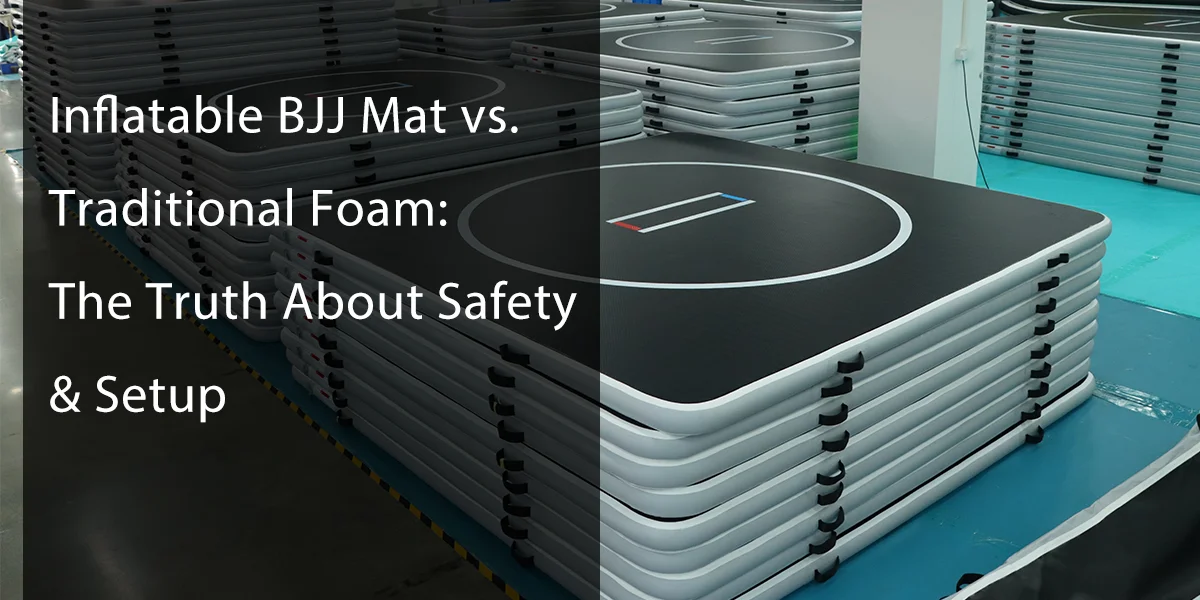
But the tech has changed. We are no longer talking about toys for the pool. We’re talking about Drop Stitch technology that is used in the military.
Today, I want to settle the argument between the new blow-up BJJ mat and the old EVA puzzle mats, especially for dojos that need to be able to move around.
The “Bouncy” Myth: Understanding Drop Stitch
Let’s talk about the big thing that no one wants to talk about. If an inflatable mat is soft, your ankles will roll. Professional inflatable BJJ mats, on the other hand, are made with High-Tensile Drop Stitch.
Think of it as having thousands of tiny threads that link the top and bottom layers of the mat. When you pump it up to 8–10 PSI, these threads strain tight, generating a surface that is as hard as a rock. It feels almost like a high-density Tatami mat, but it has one big difference: it absorbs shock.
When a pupil gets hit during a throw, the air spreads the impact energy across the mat right away instead of sending it back into the spine. It gives you the support you need for pivots and the softness you need for falls from a great height.
Setup Time: The “Puzzle” Headache
If you manage a mobile MMA clinic or a shared space, you know how bad “Puzzle Mats” can be. It takes 30 minutes to put together 50 different foam tiles. It takes another 20 minutes to take them apart. And what if you leave them down?The seams become a breeding ground for bacteria and Staph infections, which is the enemy of every grappling gym.
Here is the reality of the blow up bjj mat:
- Roll out: 1 minute.
- Inflate: 3 minutes (with an electric pump).
- Train: Immediately.
There are no seams that can hold perspiration or toenails. You let the air out of it, roll it up, and toss it in the back of a vehicle when class is over. For mobile academies, this efficiency means money.
Mat Burn and Surface Texture
People know that traditional tatami mats have a rough texture that can rub flesh bare (the dreaded “mat burn”). We put a special anti-slip PVC coating on the top of our inflatable mats.
It feels like the grip of high-end competition mats made of leather, but it’s nicer on the skin while grappling without a gi.
It has enough grip to keep you from slipping when you’re sweating, yet it doesn’t feel like sandpaper on your knees.
Conclusion: The Future of Mobile Dojos
If you have a permanent place where mats never move, classic high-density foam is still a fantastic choice. The inflatable BJJ mat is better, though, if you care about cleanliness, speed, and being able to clear your floor area in less than 10 minutes.
Stop using paid coaching time to build up puzzle tiles. Contact our Design Team to make an air mat that fits your gym’s exact size.


