
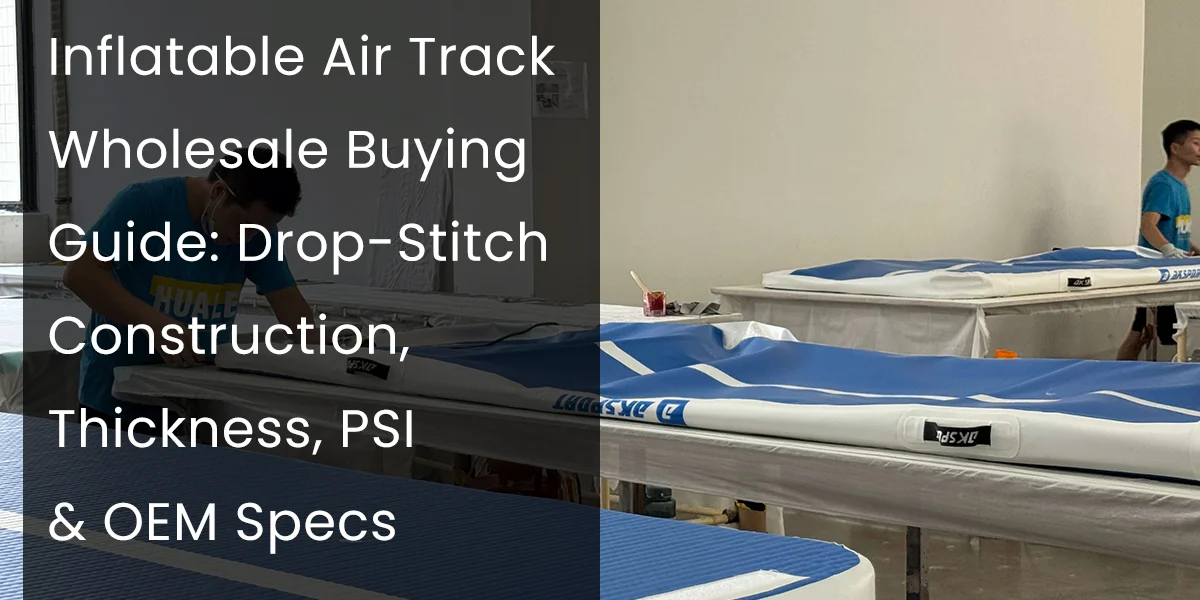
Most buyers I speak with at trade shows have the same problem: they’ve received samples from three different factories, all labeled “premium air track,” and they can’t figure out why one is priced 40% higher than the others. The data sheets look nearly identical. But once you know what to look for inside the construction, the difference is immediately clear.
I’m Charlie, a Senior Industrial Designer at Huale Inflatables — a Guangzhou-based OEM/ODM factory with over 15 years of experience producing drop-stitch inflatable products. We supply gymnastics equipment distributors, Amazon private label brands, fitness retailers, and sports school operators across North America, Europe, and Australia.
This is not a general overview. It’s what I’d tell a qualified buyer in a factory meeting — the actual spec decisions that determine whether your air track generates strong reviews and repeat orders, or creates headaches from the first production run.
Drop-Stitch vs. Single-Layer PVC: The Construction Decision That Defines Your Product
Before you choose thickness or surface type, you need to decide on construction method. This single decision determines your product’s price position, performance category, and the type of customer it can realistically serve.
Single-Layer PVC Air Tracks
Single-layer PVC tracks use two sheets of PVC film heat-welded around a basic air chamber. They inflate softly, typically holding 0.05–0.08 bar (0.7–1.2 PSI), and are suited for very light home use — young children doing basic tumbling or balance exercises. Standard material at this tier is 0.45–0.55mm PVC film. The problem is surface flex. Under body weight, sidewalls bow outward, the surface becomes unstable, and athletes lose confidence in the landing. Return rates on these products are high, especially on Amazon, where one-star reviews tend to cluster around “too bouncy” and “deflates mid-session.”
Drop-Stitch Construction
Drop-stitch construction uses thousands of internal polyester threads connecting the top and bottom PVC sheets. When inflated, those threads hold the surfaces parallel and prevent sidewall bulge. This allows operating pressures of 0.20–0.35 bar (2.9–5.1 PSI) — three to four times higher than single-layer — producing a genuinely firm, stable surface that supports adult athletes during back handsprings, aerials, and repeated impact landings. At Huale, all of our air tracks use drop-stitch construction with a minimum thread density of 6,500 threads per square meter.
We don’t produce single-layer tracks for B2B supply. The return rate on those products is too high for any brand with a long-term presence on Amazon, in retail channels, or supplying clubs that expect multi-year product life.
If a supplier quotes you a low price on an “air track” without specifying drop-stitch construction and thread density, ask directly. The omission is usually intentional.
HF Welding vs. Hand-Glued Seams
High-frequency (HF) welding bonds PVC seams at a molecular level using electromagnetic energy — the joint becomes as strong as the base material itself. Hand-gluing uses solvent adhesive, which degrades faster under UV exposure and repeated pressure cycles. At Huale, all perimeter seams are HF-welded. We test seam integrity at 1.5× operating pressure for a minimum of 4 hours before any unit passes QC. If a factory cannot tell you their seam welding method, that’s a meaningful gap in their quality documentation.
10cm vs. 20cm Thickness: Matching the Spec to Your Target Market
Thickness is the most-asked-about spec in buyer conversations — and also the most misunderstood. The right choice depends on your buyer’s actual use case, not on which number sounds more capable.
10cm (4-Inch) Air Tracks
Our 10cm drop-stitch tracks are built for space-constrained home users and beginner-level training: cartwheel practice, balance exercises, introductory tumbling. They inflate to 0.25–0.30 bar (3.6–4.4 PSI) and fold to approximately 50 × 35 × 20cm packed for a standard 3m × 1m configuration, with a unit weight of 4.5–6.5kg. They ship efficiently in a polybag or compact retail carton. FOB Guangzhou pricing at our factory runs approximately USD $38–$52 per unit at MOQ 50 pieces for a 3m × 1m size.
20cm (8-Inch) Air Tracks
20cm tracks are the club and school specification. The added depth improves impact absorption on backward roll landings, round-off entries, and aerial dismounts. They operate at 0.20–0.25 bar (2.9–3.6 PSI) — slightly lower than 10cm because the larger air volume distributes pressure differently — but surface firmness is comparable due to the increased thread count we use at this thickness tier. Packed weight for a 4m × 1m configuration runs 11–14kg. FOB Guangzhou pricing at MOQ 30 pieces: approximately USD $72–$95 per unit.
Thickness Comparison by Use Segment
| Spec | 10cm Drop-Stitch | 20cm Drop-Stitch |
|---|---|---|
| Operating Pressure | 3.6–4.4 PSI (0.25–0.30 bar) | 2.9–3.6 PSI (0.20–0.25 bar) |
| Packed Size (3m × 1m) | ~50 × 35 × 20cm | ~55 × 40 × 30cm |
| Unit Weight (3m × 1m) | 4.5–6.5kg | 8–11kg |
| Target User | Home use, beginners, children | Gymnastics clubs, schools, martial arts academies |
| FOB Price (MOQ 50 units, 3m × 1m) | ~USD $38–$52/unit | ~USD $72–$95/unit |
| Typical Retail Price (US Market) | $80–$140 | $160–$260 |
Custom lengths and widths are available with no tooling cost for sizes within our existing mold range — widths of 1m, 1.2m, and 1.5m; lengths from 2m to 10m in 1m increments. Sizes outside that range require a one-time mold fee of USD $300–$800 depending on complexity.
PSI Ratings and the 48-Hour Pressure Retention Test
PSI isn’t just a spec for your product listing. It directly affects how the track performs for the end user — and it’s one of the easiest figures for a factory to put on paper without actually verifying through proper testing.
What PSI Affects in Practice
At correct operating pressure, a drop-stitch air track should be firm enough that a 70kg adult’s foot depresses the surface no more than 1–2cm. An under-inflated track feels bouncy and unpredictable — which is genuinely dangerous for gymnastics skills that depend on precise takeoff angles and predictable landing response. An over-inflated track, run above rated maximum, stresses the seams and accelerates material fatigue at the thread attachment points.
Our 10cm tracks are rated for 0.25–0.30 bar (3.6–4.4 PSI). Our 20cm tracks operate at 0.20–0.25 bar (2.9–3.6 PSI). The maximum rated pressure for HF-welded seams across our production range is 0.50 bar (7.3 PSI) — we test to that ceiling, but we don’t design for or recommend sustained use above 0.30 bar.
The 48-Hour Pressure Retention Test
Any factory making quality claims should be running a 48-hour static pressure retention test at operating PSI as standard QC. Our process: inflate each batch sample unit to rated pressure, seal it, hold in ambient conditions at 20–25°C, and measure pressure loss at 24 hours and again at 48 hours. Acceptable pressure loss: under 3% at the 48-hour mark. Units that exceed that threshold are flagged, inspected, and either reworked or rejected before shipment.
Our current first-pass QC acceptance rate sits at 96–97%, meaning 3–4% of units are caught and reworked or rejected during QC. That figure is intentional — it reflects real testing, not cosmetic inspection. A factory that claims a 99.9% pass rate and doesn’t discuss rejection methodology is not running genuine quality control.
For volume orders, we provide full batch QC reports as part of our standard OEM air track manufacturing service. If your buyer requires third-party inspection (SGS, Intertek, or Bureau Veritas), we support that at your cost — our factory is open to pre-shipment inspection by appointment.
Surface Texture and Anti-Slip Coatings: A Direct Driver of Customer Return Rates
Surface texture is the spec most buyers overlook until they start seeing Amazon returns with notes like “too slippery for barefoot use” or “kids can’t do skills on this.” Once that feedback pattern starts, it’s difficult to recover a listing. This decision is much cheaper to make correctly at the factory stage.
Smooth PVC — What to Avoid
The most basic air track surface is smooth calendered PVC — the same flat film used on the track’s underside. It costs less but offers minimal friction, especially for bare feet or gymnastics shoes in a slightly humid training space. We don’t recommend smooth PVC top sheets for any product positioned above true entry-level. If a factory’s standard spec sheet doesn’t specify the top sheet texture, assume smooth.
Texture-Embossed PVC — The Standard Spec
Texture-embossed PVC adds a diamond or fine crocodile pattern to the top sheet surface during manufacturing. It improves grip meaningfully and is our default option for standard production runs. We use a 0.9mm embossed PVC top sheet — thicker than the 0.6mm sheet found on lower-priced competitor products — which resists scuffing from repeated footwear contact significantly better and holds its surface texture longer under club-level use.
Suede-Top Drop-Stitch Tracks — The Premium Option
For club supply and premium retail positioning, our custom air track range includes a suede (microfiber) bonded top surface. The soft texture grips bare skin and gymnastics hand grips effectively, photographs well for product listings, and eliminates the squeaking noise that embossed PVC can produce during floorwork or repeated foot contact. Suede-top tracks carry a price premium of approximately USD $8–$14 per unit over embossed PVC at equivalent size.
The suede layer is chemically bonded to the top PVC sheet during production — not adhesive-glued — so it does not peel or delaminate under normal use conditions. We test adhesion strength to ASTM F963 toy and sports equipment safety standards for all suede-top products destined for the US market.
Bottom Surface: Grip Matters Here Too
The underside of the track is equally important. We use high-grip ribbed PVC on the bottom sheet across all production tiers. This prevents the track from migrating under repeated round-off landings on hardwood gym floors, gymnastics hall carpet, and outdoor turf. Smooth-bottom tracks shift position mid-session — a consistent source of negative reviews and safety concerns that has nothing to do with the construction quality of the air chamber itself.
Pump Compatibility, Fold Dimensions, and Retail Packaging
These are the details that determine whether your product earns a 4.7 or a 3.9 on Amazon. They’re also where budget factories routinely cut corners — and where you, as the brand owner, absorb the customer service consequences.
Valve Type and Pump Compatibility
We use Boston valves (dual-action) as standard on all air tracks — the same valve type used on premium SUP boards and kayaks. A Boston valve allows high-speed inflation and deflation via a twist-open center pin. It’s compatible with standard double-action hand pumps, electric pumps (12V car-style or 240V/110V mains), and SUP board pumps your customer may already own.
Some factories use proprietary or spring-loaded valves that require a specific pump. That creates two downstream problems: you must bundle a matched pump SKU, and when customers lose or damage it, there’s no market replacement available. Boston valves eliminate that issue.
We include a configurable electric pump in all OEM kit packages. For Amazon US orders, we spec 110V pumps with ETL certification. For EU and UK orders, we configure 240V pumps with CE certification. This is handled at the factory level — you don’t need to source and quality-check pumps from a separate supplier.
Fold Dimensions and Container Planning
Folded dimensions affect your per-unit shipping cost, warehouse storage density, and retail shelf fit.
- 3m × 1m × 10cm track: folds to approximately 50 × 35 × 20cm, carton volume ~0.035 CBM. A 20ft container holds approximately 580–620 units at this size.
- 4m × 1m × 20cm track: packed size approximately 55 × 40 × 30cm, carton volume ~0.066 CBM. A 20ft container holds approximately 280–300 units.
These figures are useful for first-container planning. LCL (less-than-container-load) is available for orders under full container volume — we work with several Guangzhou freight forwarders who handle LCL consolidation to US West Coast, Rotterdam, and Sydney on a regular basis.
OEM Retail Packaging
We produce full retail packaging in-house: custom-printed carry bags, color instruction manuals (English, German, French, Spanish available), retail hang tags, and outer master cartons with your brand artwork. Minimum order for custom-printed packaging is 50 units. Below 50 units, we ship in white-label bags with your label pre-applied, or you can apply labels yourself after delivery. Sample orders (1–5 units) ship unbranded. Sample cost is applied as a credit toward your first production order above 50 units.
MOQ Tiers, Lead Times, and OEM/ODM Options at Huale
I’ll put the commercial terms upfront, because that’s what most buyers actually need in order to plan a sourcing decision.
Pricing and Lead Time by Order Volume
| Order Volume | 10cm 3m×1m (FOB GZ) | 20cm 4m×1m (FOB GZ) | Production Lead Time |
|---|---|---|---|
| 1–10 units (sample) | $58–$68 / unit | $105–$125 / unit | 5–7 days |
| 11–49 units | $48–$58 / unit | $88–$108 / unit | 12–18 days |
| 50–199 units | $38–$52 / unit | $72–$95 / unit | 18–25 days |
| 200–499 units | $32–$44 / unit | $62–$82 / unit | 20–30 days |
| 500+ units | $26–$38 / unit | $54–$72 / unit | 25–35 days |
All prices are FOB Guangzhou. Landed cost for US importers typically adds USD $4–$8 per unit for ocean freight on full container loads, plus applicable import duty. Inflatable gymnastics mats currently fall under HTS 9506.91 — verify the applicable rate with your customs broker before planning margins, as tariff schedules are subject to change. EU importers should budget approximately €3–€6 per unit for ocean freight to Rotterdam, plus applicable EU customs duties.
OEM Service (Your Brand, Our Standard Products)
For OEM orders, we handle the following in-house at no added charge for orders above 50 units:
- Custom logo printing or embossing on the track surface
- Color selection from our full PMS library (or custom color matching on orders above 200 units)
- Branded carry bags and pump bags
- Custom-printed instruction manuals (English + one additional language)
- Retail outer carton artwork to your supplied design files
ODM Service (Custom Construction or Dimensions)
For ODM projects — non-standard sizes, dual-thickness construction, integrated scoring markings, or bespoke surface bonding — we charge a development fee of USD $500–$1,500 depending on complexity, covering two rounds of sample revision. First samples typically arrive within 20–30 days from brief approval. Once a sample is signed off, production pricing follows the same OEM tier structure above.
Certifications Available
Our air track product range holds CE certification (EN 71-1, EN 71-2, EN 71-3) for EU market entry, and has been tested to ASTM F963 standards for US retail and Amazon. We also carry REACH SVHC compliance documentation for all PVC materials, and passed a BSCI social compliance audit in 2023 with no critical findings. Full test reports from SGS and Intertek are available to qualified importers upon request.
Frequently Asked Questions
What is the minimum order quantity for a custom-branded inflatable air track?
Our minimum order quantity starts at 1 piece for sample evaluation with no custom branding at that stage. For full OEM orders — custom logo, color, and retail packaging — the practical minimum is 50 units. Below that, per-unit setup costs for custom printing make OEM uneconomical. For orders under 50 units, we offer white-label production with your label pre-applied at the factory, which is a common choice for Amazon sellers validating a new SKU before committing to a full branded production run.
What is the real difference between a drop-stitch air track and a regular inflatable mat?
The difference is entirely in the internal construction. Drop-stitch uses thousands of polyester threads — typically 6,000–8,000 per square meter — connecting the top and bottom PVC sheets. This internal tension structure allows inflation to 0.20–0.35 bar (2.9–5.1 PSI), creating a firm surface stable enough for adult gymnastics and martial arts training. A regular single-layer inflatable mat lacks this structure entirely and can only hold around 0.05–0.08 bar (0.7–1.2 PSI), producing a soft, unstable surface that is not appropriate for anything beyond very light casual use by small children.
How long does a sample order take, and what is included?
Standard sample orders ship within 5–7 business days from receipt of payment. Each sample includes the air track, a double-action hand pump, a basic repair kit, and a carry bag. Custom color from our PMS library can be applied to samples at no added charge. Custom logo printing on a sample requires a minimum of 3 units and adds 3–5 days to the production timeline. Sample pricing reflects small-batch production cost and is not discounted — however, we credit the full sample cost toward your first production order above 50 units.
Can your air tracks meet CE or ASTM certification requirements for retail and Amazon listing?
Yes. Our drop-stitch air tracks carry CE certification covering EN 71-1 (mechanical safety), EN 71-2 (flammability), and EN 71-3 (chemical safety) for EU retail and marketplace listing. For the US market, products have been tested to ASTM F963 standards, and we hold full REACH SVHC compliance documentation for all PVC materials. Third-party test reports from SGS and Intertek are available to qualified importers. If you’re selling through a specific retailer or marketplace that requires documentation beyond these standards, let us know during your inquiry — we’ll confirm what existing reports cover your requirements before you place an order.
What size and thickness should I start with for a new Amazon private label air track listing?
Based on order patterns from our Amazon seller clients in the US and EU markets, the most consistent entry point is a 3m × 1m × 10cm drop-stitch track in a mid-range colorway — teal, navy blue, or purple have performed well in multiple markets. It ships at roughly 0.035 CBM per unit, fits comfortably in an LCL container at 50–100 units for a first order, and sits in the $80–$140 retail price range where a product with good photography, verified certifications, and a solid carry bag kit differentiates clearly from the lower-quality field. Starting with 20cm is viable if you’re specifically targeting gymnastics club operators or martial arts schools, but the higher price point requires stronger positioning to convert without an established review base.
Get a Factory-Direct Air Track Quote — Response Within 24 Hours
If you’re sourcing inflatable air tracks for a gymnastics brand, distribution network, or private label launch, the next step is a factory-direct quote with your target spec.
Send us your requirements — size, thickness, surface type, target market, and annual volume estimate — and we will respond within 24 hours with FOB pricing, available stock configurations, and a sample lead time.
MOQ starts from 1 piece. OEM branding available from 50 units. We will respond within 24 hours with a factory-direct quote.


