
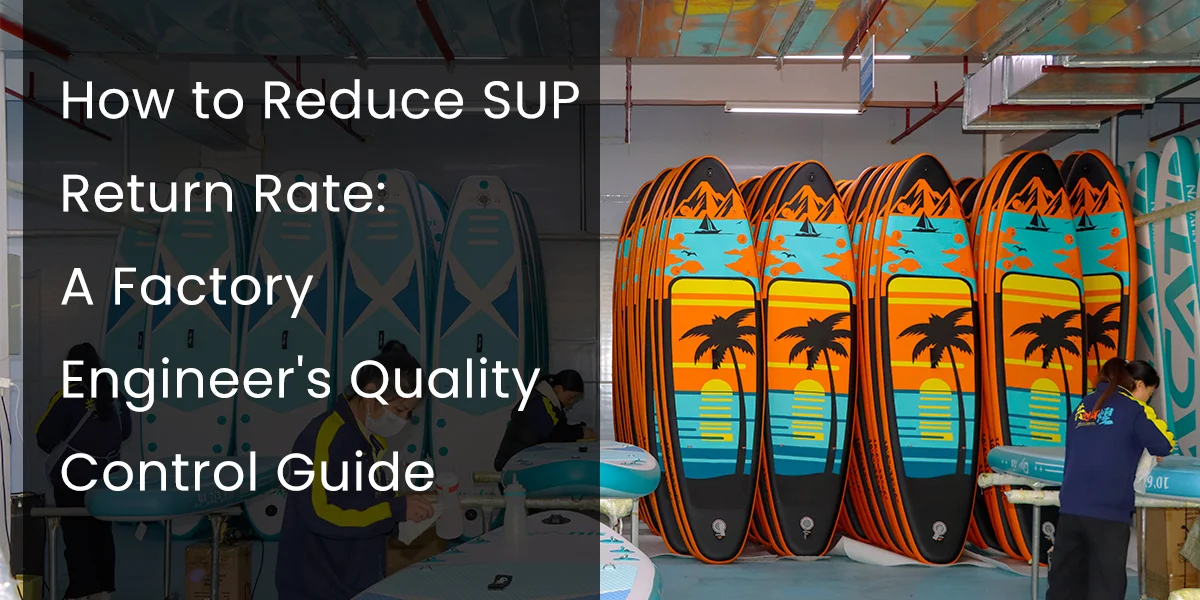
If your SUP return rate is above 3%, the problem is almost always manufacturing — not your marketing, not your price point, and not your customer demographic. I have seen brand owners spend months tweaking their Amazon listings while the actual defect is sitting in a welding protocol their factory has been cutting corners on since day one.
I’m Charlie, a senior industrial designer at Huale Inflatables. In 15 years of building inflatable stand-up paddle boards for brands worldwide at our paddle board factory, the same four manufacturing failures show up in return data over and over. This guide shows you how to identify which one is hitting your brand, and exactly what to demand from your factory to fix it.
Why Your Return Rate Is a Manufacturing Problem, Not a Marketing Problem
Most SUP returns fall into one of two categories: the board fails structurally within the first 1–3 uses, or it arrives with a cosmetic defect significant enough that the customer won’t accept it. Both categories are preventable at the factory level. Neither one is fixed by a better product description.
The challenge for brand owners is that your factory’s QC report says “passed” — and you have no way to challenge that without knowing what a real QC standard looks like. A cosmetic inspection with no pressure testing is not quality control. It is a paper trail that protects the factory, not your brand.
The Four Manufacturing Failures Behind Most SUP Returns
1. Seam Failure: The Most Common Structural Defect
The most frequent return complaint is a board that won’t hold air after 1–3 sessions. In 80% of cases, the failure point is a welded seam, not the PVC fabric itself. The cause is almost always hand-glued seams or under-welded joints on the structural rails.
Hand-glued seams use PVC adhesive that degrades under repeated inflation cycles, UV exposure, and contact with water. At Huale, we use high-frequency welding on all load-bearing seams. The PVC layers fuse at a molecular level — the weld point is stronger than the surrounding fabric. Ask your factory whether their main rail seams are machine-welded or hand-glued. If they hesitate, you have your answer.
What to demand from your factory:
- High-frequency machine welding on all structural seams — no hand-glued rail joints
- Weld strength test documentation — pull force per linear cm on seam samples
- 48-hour pressure retention test on every unit before packing
2. Material Spec Downgrade: The Invisible Cost Cut
When you switch factories or push your current factory on price, the first thing that gets quietly downgraded is PVC thickness. A board spec’d at 1.2mm double-wall fabric gets substituted with 0.9mm single-layer material. The board looks identical in photos. It fails in the field.
Single-layer PVC has no thermal barrier and deforms under sustained pressure load. In warm water conditions, the board walls soften and bow outward. Customers describe this as the board “going soft” during a session — and they return it. The fix is simple: write the material spec into your purchase order explicitly.
Minimum material spec for a commercial-grade inflatable SUP:
- Wall material: 1.2mm Double-Wall Fabric (DWF) minimum
- Drop-stitch core: High-density polyester yarn, minimum 20 threads per cm²
- Rated PSI: 15 PSI minimum for a rigid, performance-ready deck
- UV coating: Required on outer PVC layer for boards sold in high-sun markets
3. Valve and Port Failures
A leaking valve is the second most common return trigger after seam failure, and it is the most fixable. Budget factories use low-grade plastic Halkey-Roberts style valves that develop micro-cracks after 30–50 inflation cycles. The fix costs less than $2 per board at the manufacturing stage and eliminates an entire category of returns.
What to specify in your QC checklist:
- Stainless steel or reinforced PVC valve body — no brittle plastic components
- Valve torque test: each valve tightened to spec and tested individually before board inflation
- Post-inflation valve check: soapy water test on every valve after 48-hour pressure test
4. Packaging and Transit Damage
A board that passes factory QC and arrives damaged is a logistics problem, but the root cause is usually inadequate packaging spec. Inflatable SUPs shipped in thin polyethylene bags with no internal bracing get punctured by adjacent cargo or compressed by forklift handling. The customer receives a damaged product and blames the brand.
Packaging minimum standard:
- Double-wall corrugated carton with minimum 5-layer construction
- Internal foam corner protection on valve and fin box locations
- Compression-rolled board inside a sealed inner bag before carton packing
- Drop-test certification on carton spec if selling through Amazon FBA
How to Write a QC Spec Your Factory Will Actually Follow
Vague QC instructions produce vague results. “Good quality” is not a specification. Here is a QC checklist template you can send directly to your factory — written in the language manufacturers understand.
| QC Check | Standard | Method |
|---|---|---|
| PVC Wall Thickness | 1.2mm minimum (DWF) | Micrometer measurement on 3 wall sections per board |
| Seam Weld Integrity | No delamination under 20kg pull force | Manual pull test on rail seam samples |
| Pressure Retention | Zero PSI drop over 48 hours | Inflate, log PSI at 0h and 48h |
| Valve Function | No air loss at valve seat | Soapy water test after inflation |
| Print Alignment | Logo centered ±5mm tolerance | Visual inspection against approved sample |
| EVA Traction Pad Adhesion | No lifting at edges or corners | Manual peel test on 100% of units |
| Accessory Completeness | Per packing list — pump, paddle, leash, fin, bag | Count check before carton seal |
Send this checklist to your factory before production begins and ask them to confirm each item in writing. A factory that pushes back on the pressure retention test or the material thickness check is telling you something important about how they currently operate. If you are looking for a paddle board factory that meets these standards by default, that is what we built our QC protocol around.
What a 48-Hour Pressure Test Actually Looks Like
The 48-hour pressure test is the single most effective quality gate for inflatable SUP production. It catches seam failures, valve defects, and fabric micro-punctures that a 10-minute visual inspection will never find. Yet most budget factories skip it entirely because it ties up floor space and slows throughput.
At Huale, every board — sample or bulk — is inflated to rated PSI and left standing for a minimum of 48 hours. We log the PSI reading at the start and at the end. Any board that drops even a fraction of a PSI goes to the scrap pile, not into a shipping carton. We reject 3–5% of units at this stage every production run. That is the cost of a return rate that stays below 1%.
If your factory cannot show you a pressure test log for your last production run, they are not running a 48-hour test. Ask for it specifically — not a general QC report, but the individual board pressure logs.
The Cost of a High Return Rate vs. The Cost of Better Manufacturing
Most brand owners focus on the unit price when evaluating suppliers. The correct calculation includes the full cost of a return: reverse logistics, refund processing, Amazon restocking fees, review damage, and the cost of the replacement unit if you offer one. A single Amazon return on a $250 SUP typically costs $60–$90 in direct costs before you factor in ranking impact.
The manufacturing upgrade that prevents that return — switching from single-layer to double-wall composite fabric, adding a 48-hour pressure test, upgrading the valve spec — adds $8–$15 per unit at the factory level. The math is straightforward. The problem is that most brand owners are comparing unit prices, not total landed cost including returns.
Common Questions About Reducing SUP Return Rates
What is an acceptable return rate for inflatable paddle boards?
For a well-manufactured inflatable SUP sold through Amazon or DTC, a return rate below 2% is achievable and should be your benchmark. Rates above 5% almost always indicate a recurring manufacturing defect — seam failure, valve issues, or material downgrade — that needs to be diagnosed and fixed at the factory level, not managed through better customer service.
How do I find out which part of my board is causing returns?
Pull your last 20–30 return reason codes and look for patterns. If 60% cite “doesn’t hold air,” the issue is seams or valves. If returns spike after the first summer season, UV degradation of the PVC coating is likely. If you see damage on arrival, the problem is packaging. Each failure pattern points to a specific factory-level fix. If your return reasons are vague, add a post-return survey asking customers to describe exactly what failed.
Can I enforce a QC standard on my existing factory?
Yes, but you need to write it into your purchase order as a contractual condition, not a verbal request. Send the factory a written QC checklist and ask them to confirm acceptance before you place the order. For high-volume accounts, we recommend a third-party pre-shipment inspection on your first 2–3 production runs with a new QC standard — it signals to the factory that you will verify compliance, not just accept their self-reported results.
How much does it cost to upgrade my board’s material spec?
Upgrading from 0.9mm single-layer PVC to 1.2mm double-wall fabric typically adds $6–$12 per unit depending on board size. Adding a 48-hour pressure test protocol adds minimal direct cost but requires factory floor capacity. Upgrading the valve spec from budget plastic to reinforced PVC or stainless steel adds $1–$3 per unit. In total, a full material and QC upgrade rarely exceeds $15–$20 per board — a fraction of the cost of a single return.
Should I switch factories to fix my return rate?
Not immediately. Switching factories without a written material spec and QC checklist transfers the problem to the new supplier within one or two production runs. Before switching, define exactly what failed with your current factory, write a specific fix requirement, and give them one production run to demonstrate compliance with third-party inspection. If they cannot meet the standard after that, you have a documented spec to hand to a new factory — which is the only way to ensure the new supplier does better.
Ready to Fix Your Return Rate at the Manufacturing Level?
Send us your current return reason breakdown and your existing board spec. We will identify the most likely manufacturing cause within 24 hours and give you a direct comparison between your current spec and what our production standard delivers.
We support brand owners switching suppliers with full spec documentation, sample production, and a 48-hour pressure test report on every unit. MOQ starts from 1 piece for sampling — there is no reason to commit to bulk before you have verified the quality difference yourself. Visit our paddle board factory page to see our full production capability.


