
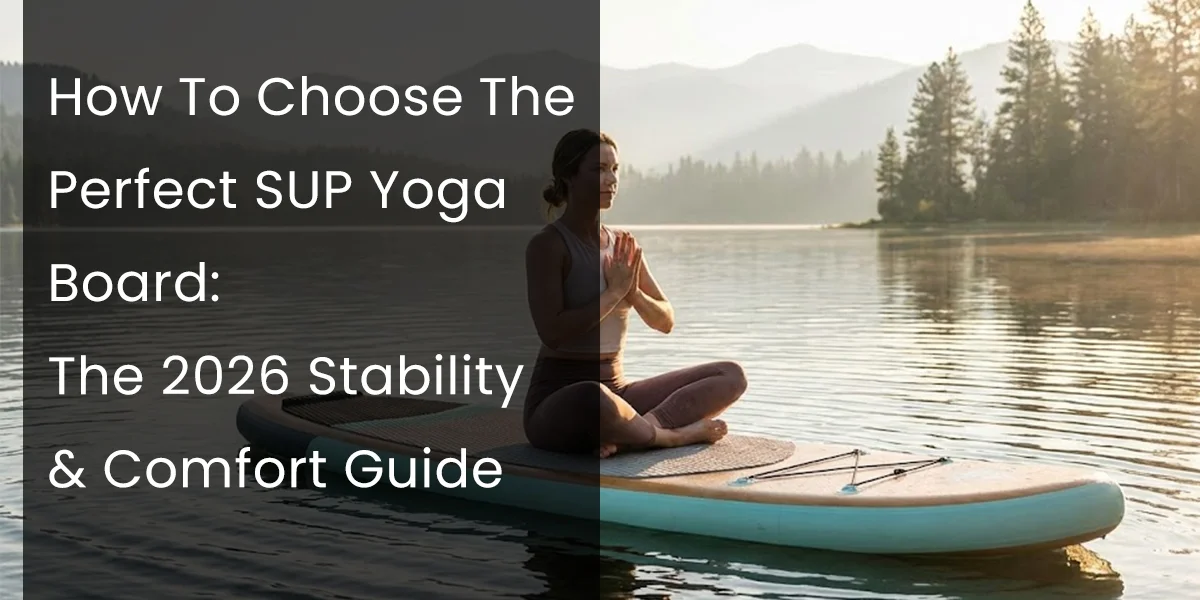
Moving your practice from the studio to the water changes everything. The birds, the gently swaying, and the fresh air make it “Savasana” on a whole other level.
But here’s the truth that most general manuals won’t tell you: Your regular all-around paddle board is probably not good for yoga.
Why? Standard boards include center handles that dig into your back, deck pads that stop midway, and shapes that are meant to be fast, not still.
SUP Yoga gear has changed as we get closer to 2026. As a manufacturer, we are now making boards that are expressly designed to be “floating yoga mats.”
This is exactly what you need to look for in a Zen platform, without the old recommendations.
Stability is King: Width & Volume
You don’t need a balance beam for yoga; you need a “floor.” People used to say that a 32-inch board was enough. We don’t agree in 2026.
The 34-Inch Sweet Spot
For a true floating studio experience, look for a board that is 33 to 34 inches wide (like our Yoga Series)
- Why: That extra inch makes it much easier to hold complicated poses like Headstands or Warrior II. It lets you concentrate on your breathing instead of trying to keep dry.
The Shape (Parallel Rails)
Don’t choose shapes that seem like teardrops with pointed noses and tails. You want a board that is the same width from nose to tail (a rectangle). This gives you the most space to use with your hands and feet.
- Fitness Fact: SUP Yoga engages stabilizing muscles that gym workouts miss. It improves proprioception (body awareness). Source: Read more about the benefits of unstable surface training from the American Council on Exercise (ACE).
The “Ouch” Factor: The Deck Pad & Handle
“These boards hurt me” is the most common complaint we receive from yogis who use generic boards.
The Flat Carry Handle
In the middle of standard boards, there is a rubber handle that sticks up. When you do the Cobra stance, try lying on that. It hurts.
- The 2026 Standard says that a dedicated Yoga SUP can only have a flush-mount flat handle or side-carry handles. The middle of the board needs to be smooth and free of any bumps.
Full-Length Traction Pad
You don’t stay in the middle of the mat when you do yoga. You do Downward Dog at the top and Child’s Pose at the bottom.
- A deck pad that covers over 90% of the board is what you want.
- Texture: Don’t use “Diamond Groove” because it’s harsh and sharp on knees. You should look for a texture that looks like “Brushed EVA” or “Crocodile Skin.” It’s gentle on the skin, but it still grips when it’s wet.
Paddle Management: Where Does It Go?
You’ve paddled out, dropped anchor, and are ready to go. But where do you place your paddle?
- The Old Way: Put it on a leash and throw it in the water (it floats away and smacks you).
- The 2026 Way: Find a board with a built-in Paddle Holder, which is usually Velcro loops or a magnetic clip on the rail. This keeps your paddle safe and out of the way in your “studio space.”
Stiffness: Inflatable vs. Solid
People used to think that hard boards were more stable. That story is no longer true.
Inflatable stand-up paddleboards (iSUPs) are presently the best choice for yoga for two reasons:
- Comfort: When you land on an inflatable board, it feels like falling on a hard mattress. It hurts to fall on a fiberglass hard board.
- Ride Height: New drop-stitch boards that are 6 inches thick sit high on the water. This stops your mat from getting wet. Old 4-inch boards tend to get wet, which makes your mat slippery.
Aesthetics: Finding Your Calm
This may seem like a small thing, but it is important. The design of Yoga SUP has changed since 2026. It no longer includes garish, fluorescent racing stripes. You want earth tones that are relaxing, wood grains, or mandala patterns. The design should assist you focus, not take your mind off of things.
- Mindfulness Tip: Being near water induces a meditative state known as “Blue Mind.” Source: Learn about the science of water and mental health from Psychology Today.
Conclusion: Your Floating Sanctuary
Picking the right SUP Details are what yoga board is all about. It’s about the flat handle that doesn’t hurt your back. It’s the extra width that makes you feel good about yourself. It’s the soft deck pad that feels like a high-end yoga mat.
Don’t just get a paddle board and try to do yoga on it. Buy a floating sanctuary that is made for the exercise.
Ready to find your flow? Explore Huale’s specialized Yoga & Fitness SUP Collection.


