
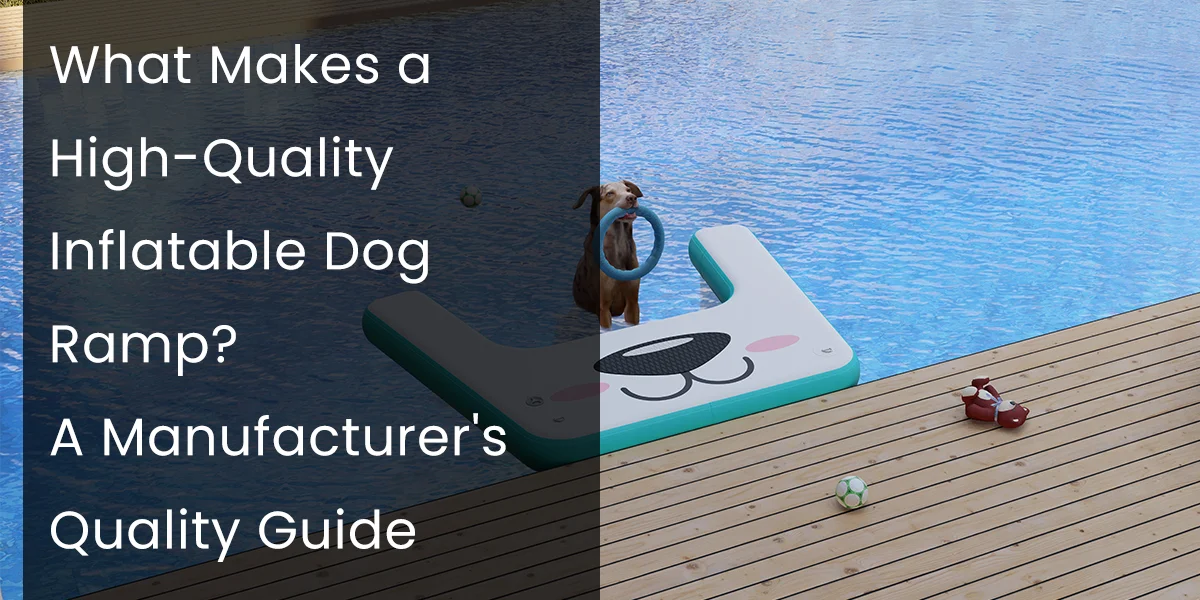
Here is what a bad inflatable dog ramp looks like in practice: a 35kg Labrador puts his front paws on the ramp, the mesh sags into the water, the surface offers no grip, and the dog slides back in. The owner returns the product, leaves a one-star review, and your brand takes the hit. The vet bill — if the dog injures a joint during the fall — is the version of this story that ends with a liability claim.
Every one of those failure modes traces back to a manufacturing decision made before the product shipped. I’m Charlie, senior industrial designer at Huale Inflatables. I’ve spent 15 years on the factory floor designing and testing inflatable products. This guide gives you the exact quality benchmarks — material grade, mesh construction, load capacity, seam integrity, and compliance documentation — that separate a product worth stocking from one that generates returns.
Quality Benchmark 1: PVC Material Grade
PVC thickness is the single number that most accurately predicts how long an inflatable dog ramp will last in real use. It controls pressure retention, resistance to claw abrasion, UV stability, and seam integrity under dynamic load. Here is what the numbers mean in practice.
The Three Tiers You Will Encounter in the Market
- 0.6mm–0.7mm single-layer PVC: The material used in the cheapest consumer dog ramps. At this thickness, surface micro-cracks develop under UV exposure within one season. The material cannot hold rated PSI under the dynamic load of a large dog climbing — the chamber softens mid-use and the ramp loses its shape. This is the spec behind most of the one-star “deflated immediately” reviews on Amazon.
- 0.9mm double-wall fabric (DWF): The minimum spec for a mid-market product that will survive a full season of regular use. DWF construction sandwiches a polyester weave between two PVC layers — the internal weave prevents the material from stretching under pressure, which is what maintains ramp rigidity under load. UV-stabilised compound at this thickness holds surface integrity for 2–3 seasons under outdoor use.
- 1.1mm DWF, UV-stabilised: The correct specification for premium pet brands and any product where large or heavy dogs are the target user. The additional thickness provides meaningful resistance to claw abrasion on the side rails — the exact area where a dog’s claws make repeated contact during the climbing motion. This is the spec we use for commercial-grade orders.
The Test That Exposes Substandard PVC
Ask any supplier for a material data sheet showing the PVC thickness in millimetres and whether the construction is single-layer or double-wall fabric. A supplier who cannot provide this document is either using unspecified material or does not know what they are sourcing. Both are disqualifying for a brand that will put its name on the product.
Quality Benchmark 2: Seam Construction
The seam is where inflatable dog ramps fail most often — and where the failure mode is most dangerous. A seam that separates while a dog is mid-climb does not fail gradually. It fails suddenly, dropping the dog into the water at an angle that risks joint injury. Seam construction is the quality variable with the highest safety implication in this product category.
HF Welding vs Hand-Glued: What the Difference Actually Is
High-frequency welding uses electromagnetic energy to fuse PVC layers at a molecular level. The weld zone becomes part of the base material — it does not have a separate adhesive layer that can soften, swell, or delaminate. Hand-glued seams use contact adhesive applied between the PVC layers. The adhesive softens progressively in pool chemical environments and under the heat of direct sun exposure. In saltwater, salt crystal abrasion accelerates the delamination process further.
- HF-welded seam failure mode: The base material tears before the weld line fails. This is the correct failure sequence — it means the seam is stronger than the material it joins.
- Hand-glued seam failure mode: The adhesive bond line separates. This typically happens at the edge of the bond, where peel force is highest — exactly where the dog’s weight concentrates during climbing. Typical failure timeline in pool or saltwater use: 30–60 operating days.
The Seam Locations That Matter Most for Dog Ramps
Not all seams carry equal load. The critical seam locations on an inflatable dog ramp are the side rail joints — where the inflatable tube chambers meet the ramp deck surface. During the climbing motion, a dog’s body weight plus forward momentum creates a peel force on these joints that is significantly higher than the static load. These joints must be HF-welded. Any other seam location is secondary.
Our standard production protocol: all structural seams are HF-welded. Every unit passes a 48-hour pressure retention test before shipment — inflated to rated PSI, held 48 hours, PSI logged at start and end. We reject 3–5% of production at this stage. That cost comes out of our margin, not yours.
Quality Benchmark 3: Mesh Grip and Traction Surface
The traction surface is the most reviewed feature in the inflatable dog ramp category. Positively when it works — dogs climb confidently, owners feel safe. Very negatively when it does not — a wet dog on a slippery surface is the exact scenario that generates both returns and vet bills. The mesh specification determines which outcome your product delivers.
Mesh Material: What the Denier Rating Means
Denier is the unit of measurement for the weight and thickness of the individual fibres in a woven mesh. Higher denier = heavier fibre = more resistance to tearing under load and abrasion from dog claws.
- 210D–420D mesh: Found in low-cost consumer ramps. Adequate for small dogs used occasionally. Shows visible fraying at seam edges within one season of regular use by medium or large breeds. The fraying starts at the mesh-to-tube bond line — the highest stress point.
- 840D nylon mesh: The minimum specification for a product marketed for dogs up to 40kg. Four times the fibre weight of 210D — the tensile strength difference under repeated loading is measurable. This is the specification we use as the baseline for mid-market private label orders.
- 1000D polyester mesh: The correct specification for large breed applications — dogs 40kg and above. Polyester has better chlorine resistance than nylon at equivalent denier ratings, which matters for pool re-entry applications where the mesh is in chlorinated water daily.
EVA Traction Surface: The Specification That Prevents Slipping
A mesh surface alone does not provide adequate traction for a wet dog on a ramp incline. The correct solution for an inflatable dog ramp is an EVA foam traction pad bonded to the climbing surface — the same material used on stand-up paddleboards and commercial dock platforms.
- 5mm flat EVA pad: The baseline option. Adequate traction for smaller dogs and shallow incline angles. Not adequate for large dogs on steeper angles — a fully wet 40kg dog on a 30-degree incline will find the limits of a flat 5mm pad.
- 8mm diamond-groove EVA: The correct specification for large breed applications and pool re-entry use. The groove pattern channels water away from the surface during use — the dog’s paw contacts a dry groove edge rather than a wet flat surface. Coefficient of friction improvement over flat EVA: measurable and consistent across wet conditions.
- EVA bonding method: Full-surface adhesive bonding — not perimeter-only. Perimeter-bonded EVA lifts at the corner edges within one season of wet-dry cycling. Full-surface bonding holds through 3+ seasons under normal use conditions.
Quality Benchmark 4: Load Capacity for Large Breeds
Load capacity claims on product listings are the most frequently overstated spec in the inflatable dog ramp category. A number printed on a spec sheet with no test data behind it is a marketing claim, not an engineering figure. Here is how to read load capacity claims correctly — and what realistic numbers look like for the breeds your customers are actually buying for.
How Load Capacity Is Actually Determined
In a correctly engineered inflatable ramp, load capacity is a function of three variables working together: PVC thickness (which determines the pressure ceiling before material deformation), operating PSI (which determines ramp rigidity under load), and mesh tensioning (which determines how much the climbing surface deflects under bodyweight). A change in any one of these variables changes the effective load capacity.
- 0.9mm DWF at 8–10 PSI, 840D mesh: Rated load capacity 30–40kg — covers most medium breeds including Cocker Spaniels (10–14kg), Border Collies (14–20kg), and Springer Spaniels (18–25kg)
- 1.1mm DWF at 8–12 PSI, 840D mesh: Rated load capacity 40–55kg — covers large breeds including Golden Retrievers (25–35kg), Labrador Retrievers (25–40kg), and German Shepherds (22–40kg)
- 1.1mm DWF at 10–15 PSI, 1000D mesh: Rated load capacity 55–70kg — covers giant breeds including Bernese Mountain Dogs (35–55kg) and Rottweilers (35–60kg)
The Dynamic Load Problem
Static load capacity — a weight placed on a stationary ramp — is not the relevant test for a dog ramp. The relevant test is dynamic load: a dog climbing at speed, with front and rear legs applying force at different points simultaneously, and the occasional lunge or scramble when the dog loses footing. Dynamic load can be 1.5–2× the static bodyweight at peak. This means a ramp rated at 40kg static capacity should only be marketed for dogs up to 25–28kg if dynamic load is accounted for honestly.
When evaluating a supplier’s load capacity claim, ask: “Is this a static load figure or a dynamic load test result?” A supplier who cannot answer this question has not tested their product under real use conditions.
Breed-Specific Weight Reference
| Breed | Typical Weight Range | Minimum Ramp Spec Required |
|---|---|---|
| Cocker Spaniel | 10–14kg | 0.9mm DWF, 840D mesh, 8 PSI |
| Border Collie | 14–20kg | 0.9mm DWF, 840D mesh, 8 PSI |
| Golden Retriever | 25–40kg | 1.1mm DWF, 840D mesh, 10 PSI |
| Labrador Retriever | 25–40kg | 1.1mm DWF, 840D mesh, 10 PSI |
| German Shepherd | 22–40kg | 1.1mm DWF, 840D mesh, 10 PSI |
| Rottweiler | 35–60kg | 1.1mm DWF, 1000D mesh, 12–15 PSI |
| Bernese Mountain Dog | 35–55kg | 1.1mm DWF, 1000D mesh, 12–15 PSI |
Quality Benchmark 5: Attachment System and Structural Safety
A ramp that drifts away from the vessel while a dog is mid-climb is not a product defect — it is a safety incident. The attachment system is what keeps the ramp stationary under the combined load of a climbing dog and water movement. It is also the component most commonly underspecified in lower-quality products.
D-Ring Specification for Marine Use
- 316-grade stainless steel only: D-rings in saltwater environments must be 316-grade stainless — 304 grade shows surface corrosion within one marine season. For a product marketed to boat owners, a corroded D-ring after one season is a one-star review waiting to happen.
- Minimum working load rating: 150kg per D-ring for a ramp rated to 50kg dog weight — the 3:1 safety factor accounts for dynamic load and the lateral force component when a dog climbs at an angle
- Reinforcement patch construction: 3-layer PVC reinforcement at each D-ring attachment point — single-layer patches delaminate under repeated loading cycles within one season of regular use
Pool Coping Hook System
For pool re-entry applications, the pool coping hook is the critical attachment point. A well-designed hook distributes the load across 30–40cm of pool edge rather than concentrating it at a single point. This prevents both the ramp slipping off the coping and damage to the pool edge surface. The hook geometry needs to account for standard pool coping profiles — a hook designed for a bullnose coping will not sit correctly on a flat coping, and vice versa.
- Material: Rigid PVC or aluminium extrusion — flexible plastic hooks deform under load and release the ramp at the worst possible moment
- Contact surface: Non-marking rubber or silicone pad on the pool-contact face — prevents coping scratching and improves grip on smooth surfaces
- Load distribution width: Minimum 25cm — narrower hooks concentrate stress on the pool edge
Valve Specification
The valve is the component that fails most predictably in low-quality inflatable products — and the one most easily upgraded at minimal cost. Budget plastic valves develop micro-cracks at the base after 60–80 inflation cycles — less than one full season for a regularly used dog ramp. A reinforced PVC or stainless steel valve body rated for 500+ inflation cycles adds less than $2 per unit at the manufacturing stage and eliminates the valve failure complaint entirely.
Quality Benchmark 6: CPSC Compliance and Safety Documentation
Certifications do not make a product safe — the manufacturing spec does. What certifications do is document that the spec has been independently verified. For pet product brands selling through Amazon US, major retail chains, or any channel where a product liability claim could occur, that documentation is not optional. Here is what applies to inflatable dog ramps and what each document actually covers.
CPSC Requirements for US Market
The Consumer Product Safety Commission regulates products sold to US consumers. For inflatable dog ramps sold as recreational water products:
- ASTM F1972: Standard specification for inflatable recreational products used in water — covers buoyancy, structural integrity, and physical performance. Test reports from a CPSC-accepted laboratory are required for retail compliance and are increasingly requested by Amazon US at the listing stage for water recreation products.
- General Certificate of Conformity (GCC): Required for all products subject to CPSC rules. Must be based on third-party testing by a CPSC-accepted laboratory — a factory self-certification is not a GCC.
- Prop 65 (California): California’s Safe Drinking Water and Toxic Enforcement Act requires a warning label on products containing listed chemicals above threshold levels. PVC products frequently trigger Prop 65 requirements for phthalates. Confirm whether your product requires a Prop 65 warning before listing in California.
EU Market Requirements
- REACH SVHC compliance: Required for EU market entry. Covers phthalates in PVC, heavy metals in pigments, and PAHs in foam components including EVA. A current report from an accredited lab — SGS, Bureau Veritas, or Intertek — is required. The REACH candidate list updates twice per year; any report more than 18 months old may be outdated.
- EN 71 toy safety: May apply if the product is marketed for use by children alongside dogs. Confirm with your EU compliance adviser before listing.
The Documentation Request That Filters Suppliers
Ask any supplier: “Can you provide your ASTM F1972 test report with the lab name, report number, and test date?” A supplier with genuine compliance documentation sends this within 24 hours. A supplier who responds with “we can arrange it” has not been tested. A supplier who sends a certificate with no report number or an unrecognised lab name is providing documentation that cannot be verified — and that will not protect you if a liability claim occurs.
Quality Benchmark 7: Factory QC Protocol — What Happens Before Your Order Ships
A product spec on paper is not the same as a product spec in production. The QC protocol is the system that ensures the production batch matches the approved sample. For pet product brands that have been burned by inconsistent batches, this is the part of the factory evaluation that matters most.
The 7-Point QC Protocol We Run on Every Dog Ramp Order
- Incoming material inspection: PVC thickness and DWF construction verified against spec sheet before cutting begins. Any material batch that measures below specification is rejected before production starts — not after.
- Seam weld integrity check: Random units from each production run undergo destructive seam testing. HF-welded seams must fail in the base material, not at the weld line. Any batch where seam failures precede material failure is rejected.
- 48-hour pressure retention test: Every unit inflated to rated PSI, held 48 hours, PSI logged at start and end. Units that drop pressure are scrapped. We reject 3–5% of production at this stage per run.
- EVA adhesion test: EVA deck panels tested with a standardised peel force before the batch ships. Panels that delaminate at the perimeter under test are rebonded and re-tested.
- D-ring pull test: Each D-ring attachment point load-tested to 1.5× rated working load. Reinforcement patches that fail under test are replaced before the unit ships.
- Valve cycle test: Random units from each batch inflation-cycled 20 times before final inspection. Valves that show pressure loss after cycling are replaced.
- Visual and dimensional check: Final inspection against buyer’s confirmed spec sheet — dimensions within ±2cm, print alignment, EVA coverage, valve function, D-ring alignment.
What Documentation We Provide With Commercial Orders
For orders of 20 units and above: QC inspection report with test logs, production photos at each stage, batch inspection summary, and measurement records against the approved spec sheet. Third-party inspection by SGS, Bureau Veritas, or Intertek can be arranged at buyer’s cost for orders entering regulated markets. We welcome pre-shipment inspection on all commercial orders — a supplier who resists third-party inspection access has something to protect.
Frequently Asked Questions: High-Quality Inflatable Dog Ramp Manufacturing
What PVC thickness is best for a dog ramp designed for large breeds like Golden Retrievers?
For Golden Retrievers and Labradors in the 25–40kg weight range, the minimum specification is 1.1mm double-wall fabric (DWF) with HF-welded structural seams running at 10–12 PSI. At this spec, the ramp maintains rigidity under the dynamic load of a large dog climbing — which can peak at 1.5–2× static bodyweight during the scramble phase of re-entry. A 0.9mm DWF ramp will handle dogs up to approximately 30kg at a static load, but the dynamic load margin is significantly smaller. For brands specifically marketing to large breed owners, 1.1mm DWF is the correct baseline specification — the FOB cost difference over 0.9mm is $3–$6 per unit, which is recoverable at retail with accurate breed-specific marketing.
How do I test whether an inflatable dog ramp’s seams will hold before placing a bulk order?
When your sample arrives, perform a manual peel test at each seam junction — grip the seam edge firmly with both hands and apply sustained peel force for 30 seconds. An HF-welded seam will show no separation. A hand-glued seam will show edge lifting within this test. Additionally, inflate the sample to rated PSI and submerge the seam line in water — any air bubbles indicate a seam gap that will grow under use. Then leave the inflated sample for 24 hours and check PSI at the start and end. A well-built ramp should lose no more than 5% PSI over 24 hours in a controlled indoor environment. Any supplier who objects to you performing these tests on a sample is telling you something about their production confidence.
What is the difference between 840D and 1000D mesh for dog ramps?
Denier (D) measures the weight of the individual fibres in the mesh — higher denier means heavier, thicker fibres with higher tensile strength and abrasion resistance. 840D nylon mesh is adequate for dogs up to approximately 40kg with regular use — the fibre weight provides sufficient resistance to claw abrasion at the seam edges and carries the tensile load of a large dog without elongation under sustained weight. 1000D polyester mesh is the correct specification for dogs above 40kg or for high-frequency commercial use. Beyond the weight difference, polyester at 1000D has better chlorine resistance than nylon at equivalent denier — relevant for pool re-entry ramps that are in chlorinated water daily. The cost difference between 840D and 1000D mesh at the manufacturing stage is approximately $2–$4 per unit FOB.
Does an inflatable dog ramp need CPSC certification to sell on Amazon US?
Amazon US is increasingly enforcing CPSC compliance documentation for water recreation products at the listing stage. For inflatable dog ramps, ASTM F1972 test reports from a CPSC-accepted laboratory and a General Certificate of Conformity are the relevant documentation. A listing suspension on a water recreation product for missing compliance documentation is more common than most first-time importers realise — and it typically happens after you have paid for inventory and FBA inbound shipping. Confirm the compliance requirements for your specific Amazon product category before placing a bulk order, not after the goods arrive at FBA. We supply ASTM F1972 test reports with commercial orders for the US market — confirm at sample stage and we include the documentation with your shipment.
What is a realistic price range for a high-quality OEM inflatable dog ramp from a Chinese factory?
A commercial-grade inflatable dog ramp at 1.1mm DWF, HF-welded seams, 840D mesh, 8mm diamond-groove EVA, 316-grade stainless D-rings, and branded carry bag runs FOB Guangzhou at $30–$42 per unit at 30–80 unit orders. Below $20 at this spec is not achievable without material substitution — if a supplier is quoting significantly below this range for a “high quality” product, ask for the material data sheet before proceeding. US importers should add 40–55% for landed cost after ocean freight, Section 301 duties, and customs clearance. EU importers add 25–35%. At a US retail price of $75–$95 for a correctly branded large-breed product, the landed margin at 30-unit order volume is workable — and improves significantly at 80+ units.
Ready to Source a Dog Ramp You Can Actually Stand Behind?
Send us your target breed size range, your preferred spec (PVC grade, EVA type, D-ring configuration), your target retail price, and your channel. We will respond within 24 hours with a factory-direct quote, a spec recommendation matched to your use case, and the full QC and compliance documentation list for your target market.
MOQ starts from 1 piece for samples. We supply high-quality OEM inflatable dog ramps to pet product quality managers, premium pet brands, and importers who have been burned by substandard product and need a factory that can document every spec decision. Sample lead time: 7 business days. Bulk orders from 30 units.


