
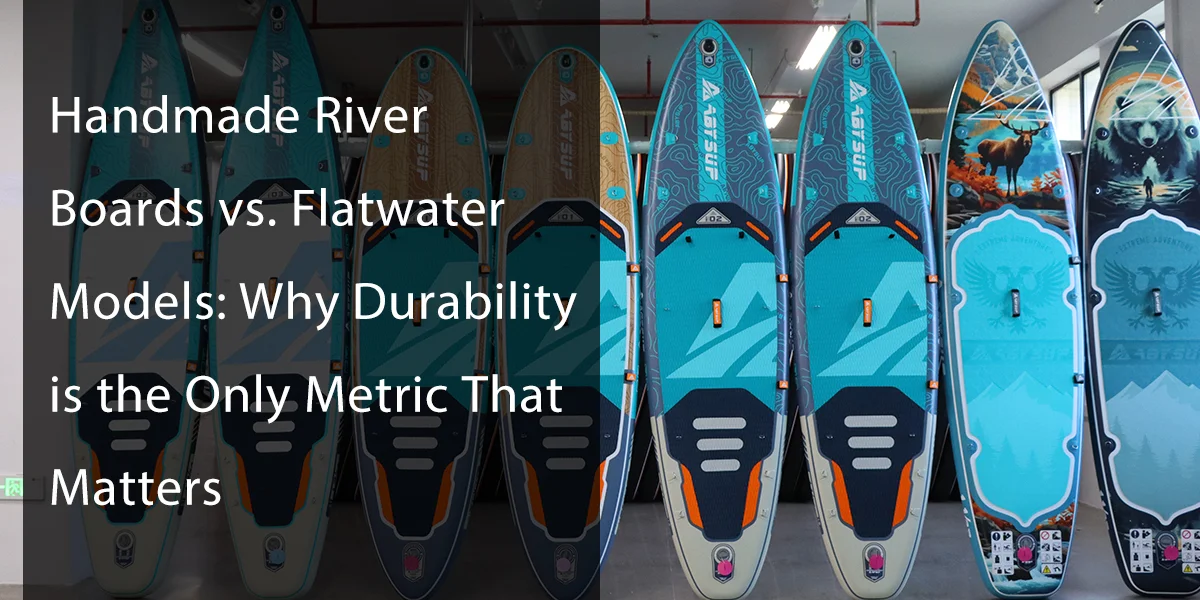
I recognize that sound. The horrible CRACK that happens when a paddle board hits a rock that is underwater in a Class III rapid.
If you hire a flatwater board on a quiet lake, a popped board is a pain. A popped board is a nightmare for an outdoor adventure firm that runs river tours. It implies getting your money back, being saved, and having your reputation tarnished.
As a manufacturer, I regularly see people trying to save money by ordering “All-Around” boards that are meant to be used in rivers. This is wrong. Today, I’m taking you inside our facility to show you why custom-made river boards aren’t a luxury; they’re a way to protect your business.
The Anatomy of a Survivor: It’s All in the Rails
Flatwater boards are made to glide. River boards are made for battle.
We toss away the usual production manual when we make a board for the river.
It’s not only the density of the PVC that makes it work; it’s the Reinforced Rails.
We put an extra layer of 0.9mm PVC tape around the whole rail band on our assembly line. Why? 90% of river failures occurred in the seam where the board hits the wall of a canyon.
Standard machine-glued rails can’t take that kind of friction. Senior craftsmen finish our handcrafted river boards by overlapping the layers by hand to make sure there are no weak spots.
Stability in the Chaos: Streamline Paddle Reception
Durability is about staying alive, while performance is about having control.
The current in white water is not always the same. A cyclist needs to put their paddle down and turn right away.
We make our rivers broader and shorter (typically 9’6″ x 36″) to get the most out of what we call “streamline paddle reception.”
This design philosophy makes sure that while the water is swirling against the nose, the board doesn’t “fight” the stroke of the paddler.
The water flows smoothly around the rail, so you can make quick, responsive repairs without the board wobbling or tipping.
It allows your clients to focus on the Whitewater classification ahead, rather than fighting their own equipment.
Double Layer Fusion: The Rock Shield
Don’t believe in “Single Layer” marketing for rivers. It’s killing yourself. We use either MSL (Monocoque Structural Laminate) or Double Layer Fusion technology.
Imagine a sandwich.
- Flatwater Board: One slice of bread (PVC) that holds the drop stitch.
- Our River Board: Two pieces of bread stuck together when heated, making a tough, puncture-proof skin.
I have seen our river boards hit sharp granite rocks and keep going. Yes, they are a little heavier, but in the river industry, weight means dependability.
Conclusion: Build Your Fleet for the Worst-Case Scenario
Your customers are going to go down. They’re going to pull the boards over the gravel bars. They are going to hit some rocks. You can’t change your customers, but you can change your tools.
If you are tired of patching cheap vinyl every weekend, it’s time to switch to professional gear. Contact our Factory Team today. Let’s discuss specs for your river fleet and keep your season puncture-free.


