
Let’s be honest for a moment.
The inflatable kayak business had a bad reputation for a long time. You sell a customer a regular PVC kayak, and then they go to the lake and complain. Why? Because it “tacos” (bends in the middle). It feels like paddling a wet mattress. It goes slowly, doesn’t track well, and feels cheap.
As a dealer, you don’t want to deal with those returns anymore. You’re weary of having to explain why a $200 boat works like a $200 boat.
Drop Stitch Technology transformed the game. We’re not just talking about a “better” inflatable; we’re talking about a whole new type of boat. If you don’t have high-pressure kayaks in stock yet, you’re going to lose.
This is a technical explanation of why Drop Stitch is taking over the PVC market.
The Physics of PSI: 2 PSI vs 10 PSI
The biggest difference between a cheap kayak and a high-end kayak is that you can’t see it. The pressure in the air.
The “Low Pressure” Trap: Most traditional PVC inflatables (with tubular I-beam floors) can only hold 1.5 to 2 PSI. Think of a toy for the pool. It’s not hard. The hull doesn’t move water very well when a 180-pound paddler sits in it. The boat is in the water, which makes it very hard to move.
The “High Pressure” Advantage: You can inflate Drop Stitch floors (and whole Drop Stitch hulls) to 10–12 PSI (some even more). Thousands of polyester threads hold the top and bottom layers together, keeping the shape in place. It gets hard as a rock when you blow it up.
According to a technical analysis on Dropstitch Fabric Mechanics, this structure allows the vessel to maintain its hydrodynamic shape under load, mimicking the performance of a hard-shell kayak.
Hull Shape & Speed: Planing vs. Plowing
This is where your customer feels the difference in their arms.
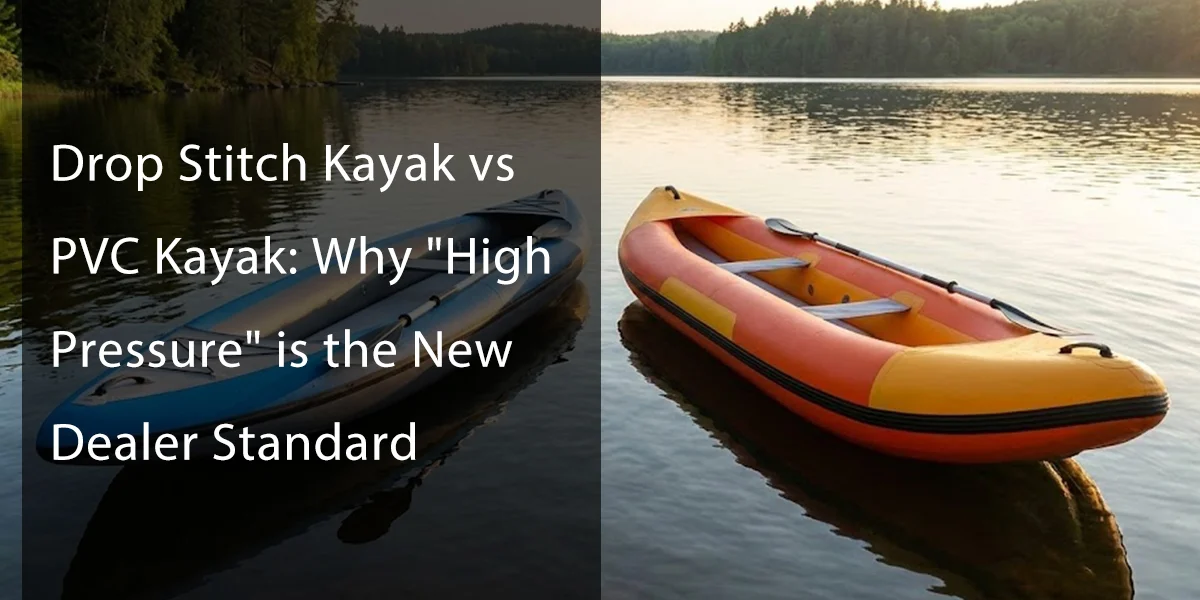
- Low Pressure (PVC): The hull is bulging. It’s soft and spherical. It doesn’t cut through the water; it pushes through it. The “wetted surface area” is very big, which suggests that there is a lot of friction.
- High Pressure (Drop Stitch): We can change the shape of Drop Stitch. We can make it have a V-hull, a sharp nose, and hard chines.
You get Glide when you paddle a Drop Stitch kayak. You stroke the boat, and it keeps moving. When you stop paddling, it goes straight. It’s just basic physics: a stiffer hull makes waves drag less. For a deeper dive into hull speed dynamics, check out this discussion on Planing vs Displacement Hulls. Your customers want to go fast with less effort. Drop Stitch delivers that.
The Dealer’s ROI: Why “Cheap” is Expensive
Every day, dealers tell me, “But Allen, the PVC boats are easier to sell because they are cheap.”
Are they?
Let’s have a look at how that sale goes.
- Sale A (Low Pressure): You sell a boat for $300. $100 in profit. The customer uses it twice, doesn’t like the “sag,” and leaves a poor review. Or, even worse, they send it back.
- Sale B (High Pressure): You sell a Drop Stitch kayak for $800. $350 in profit. The customer takes it out, it tracks perfectly, and they tell their friends.
The market data supports this shift. According to the Inflatable Kayaks Market Report 2025, the fastest-growing segment is high-performance inflatables driven by consumers upgrading from entry-level models.
Conclusion: Stop Selling Toys, Start Selling Gear
No more “soggy” inflatables. Your customers are smart. They look at reviews on YouTube. They know what a drop stitch is.
If you want people to think of you as a professional outfitter, you need to sell professional gear. Drop Stitch kayaks are the best of both worlds when it comes to mobility and performance. Hard-shell kayakers will only appreciate these inflatables.
Ready to upgrade your showroom? Contact Huale Factory today. Let’s get some sample Drop Stitch units in your hands so you can feel the rigidity yourself.


