
The question I get most often from gymnastics club operators and school PE buyers isn’t about price — it’s about durability. They’ve seen cheap inflatable mats fail mid-session, watched a seam split under a round-off landing, or dealt with a product that held pressure for the first week and deflated slowly for the rest of the season. By the time they contact us, they’re not asking whether inflatables can work in commercial settings. They’re asking how to tell which ones actually will.
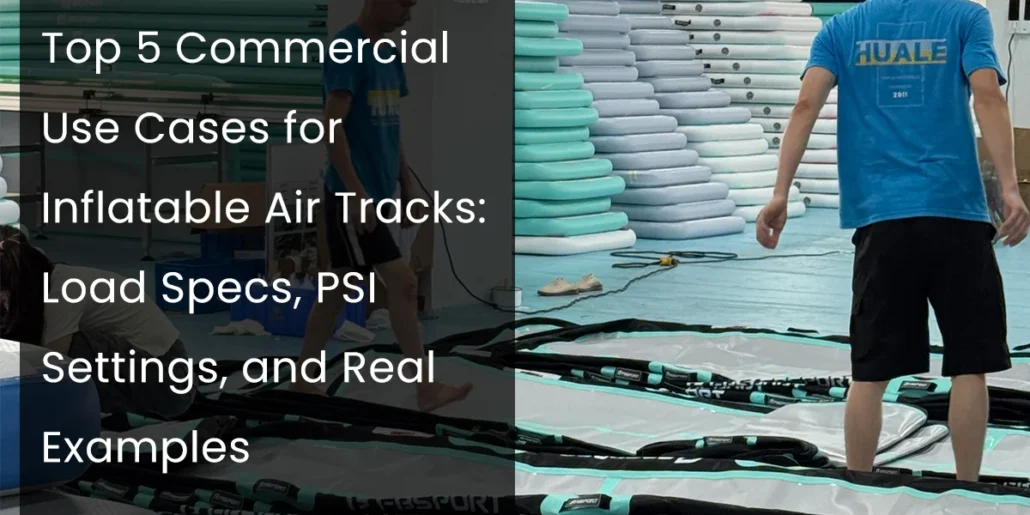
I’m Charlie, Senior Industrial Designer at Huale Inflatables, a Guangzhou factory producing drop-stitch inflatable products for commercial buyers across North America, Europe, and Australia. We supply gymnastics clubs, school PE programs, martial arts academies, cheerleading organisations, and event rental operators. In each of those verticals, the spec requirements are different — and getting the spec wrong in a commercial environment is significantly more expensive than getting it wrong in a home use context.
What follows is a breakdown of five commercial use cases we regularly supply, with the actual PSI settings, material specifications, load data, and certification requirements for each. This is not a generic overview — it’s the kind of brief I’d write for our own production team before we started manufacturing for a new commercial account.
Use Case 1: Competitive Gymnastics Club Training
Competitive gymnastics clubs are the most demanding commercial environment we supply into. Sessions run 4–6 days per week, athletes range from 25kg recreational students to 80kg senior competitors, and the skills being trained — back handsprings, aerials, round-off combinations — produce high-impact repetitive landings concentrated on specific zones of the track surface. A product that performs acceptably for home use will show measurable degradation within weeks at club training intensity.
Recommended Specification for Club Gymnastics
- Thickness: 20cm drop-stitch (not 10cm — the additional air volume improves impact absorption on backward skill landings and provides more consistent PSI stability across a session)
- Material: 0.9mm double-wall woven PVC top sheet; 0.9mm ribbed PVC base sheet
- Thread density: minimum 6,500 internal polyester threads per square metre
- Operating PSI: 0.20–0.25 bar (2.9–3.6 PSI) for adult athletes; 0.22–0.28 bar (3.2–4.1 PSI) for junior athletes under 45kg
- Surface: suede-top bonded (preferred for bare foot and gymnastics grip contact) or embossed diamond PVC (acceptable)
- Seam construction: HF-welded perimeter seams — not hand-glued. Clubs running daily sessions cannot afford seam failures mid-season
- Recommended size: 6m × 1m or 8m × 1m for tumbling runs; 4m × 1.5m for skill training stations
Load and Pressure Data
Our 20cm drop-stitch tracks are load-tested to a maximum static load of 200kg per square metre at rated operating pressure. For a 1m-wide track, that means the surface handles a single 80kg athlete with substantial safety margin across the contact zone. Surface deflection under a 70kg foot-contact load at 0.22 bar measures approximately 1.2–1.8cm — within the range competitive coaches consider appropriate for skill training (not so firm as to increase impact stress on joints; not so soft as to compromise takeoff precision).
Pressure Retention in High-Use Environments
For competitive club supply, we run a 48-hour static pressure retention test on all production batch samples. Acceptable pressure loss at 48 hours is under 3% at rated PSI. We also test seam integrity at 1.5× operating pressure for a minimum of 4 hours before any unit leaves QC. Our first-pass acceptance rate on production batches sits at 96–97%. Clubs running two or three training sessions per day should expect to re-inflate tracks to operating PSI at the start of each session — normal thermal PSI variation of 5–8% occurs with ambient temperature changes between morning and afternoon. This is material behaviour, not a product defect, and it’s covered in our instruction documentation.
Certifications Required for Club Supply
Gymnastics clubs supplying training environments for minors in the EU require CE certification covering EN 71-1, EN 71-2, and EN 71-3. Clubs in the US should confirm ASTM F963 compliance with their insurance provider — most gymnastics liability policies now include equipment compliance clauses. We hold both certifications and can provide full third-party test reports from SGS and Intertek to club operators or their procurement managers upon request.
Use Case 2: School Physical Education Programs
School PE procurement sits at a different point on the spec curve from competitive gymnastics — the performance requirements are lower, but the safety and compliance bar is often higher because the product is used by children across a wide age and weight range, often supervised by non-specialist staff. Budget constraints are real, lead times need to align with academic purchasing cycles, and the procurement officer asking for quotes is frequently not the end user.
Recommended Specification for School PE
- Thickness: 10cm drop-stitch for primary school (ages 5–11, typical weight range 18–45kg); 20cm for secondary school programs with older students doing more advanced skills
- Material: 0.9mm embossed diamond PVC top sheet (embossed surface is appropriate for shoe and bare-foot contact in PE environments; suede-top is not necessary at this tier)
- Operating PSI: 0.22–0.28 bar (3.2–4.1 PSI) for primary; 0.20–0.25 bar (2.9–3.6 PSI) for secondary
- Surface: Embossed PVC — easier to wipe clean between classes than suede-top, more resistant to scuffing from sports shoes
- Recommended size: 3m × 1m or 4m × 1m for individual use stations; 6m × 1.2m for tumbling circuit layouts
- Kit inclusion: electric pump (240V CE for UK/EU schools; 110V ETL for US schools) — staff without pump experience will default to whatever is easiest, and an electric pump eliminates the under-inflation problem that drives most school setting safety incidents
Safety Documentation for School Procurement
School procurement in the UK, EU, and Australia typically requires a full CE test report (not just the CE mark — the underlying test documentation) before a product can be approved for school use. US school district procurement offices increasingly require ASTM F963 compliance documentation alongside a General Certificate of Conformity. We provide both, along with REACH SVHC chemical compliance documentation covering all PVC materials, which is mandatory for any product used by children in EU jurisdictions. REACH restricts substances of very high concern in consumer and children’s products — your school procurement officer will likely ask for this explicitly.
Budget and Procurement Cycle Alignment
School PE equipment budgets in most markets are allocated annually, with purchasing windows typically in Q1 (January–February) and Q3 (July–August) ahead of academic terms. For distributors supplying school accounts, this means having stock available — or a confirmed production timeline — that delivers 6–8 weeks before term start. Our ready-stock white-label inventory of 3m × 1m × 10cm tracks can ship within 3–5 business days, which fits most school procurement timelines even for late-cycle decisions. For branded or custom-spec orders, a production lead time of 18–25 days at 50–199 units means a July order brief produces September delivery without pressure on logistics.
Durability in Multi-User School Environments
A single air track in a school PE context may be used by 200–300 students per week across multiple class groups. The critical durability variable in this environment is not the air chamber — it’s the valve and the surface. Our Boston valves are rated for 3,000 inflation/deflation cycles. If a school is inflating and deflating a track daily for a full academic year, that’s approximately 190 cycles — well within rated valve life. Surface abrasion from sports shoes on the embossed PVC top sheet shows minimal visible wear at the 12-month mark in our field feedback from school accounts. The seam integrity holds under school-level use without issue when correct PSI is maintained.
Use Case 3: Martial Arts Schools — BJJ, MMA, Taekwondo, and Judo Applications
Martial arts schools came to inflatable training surfaces later than gymnastics, but the adoption rate has accelerated sharply since 2020. The primary driver is takedown and throw training — specifically, the need for a portable, impact-absorbing surface that can be added to an existing mat layout without permanent installation, and stored efficiently when not in use. Tatami and foam puzzle mats remain the standard for grappling and groundwork, but air tracks have found a clear niche for standing throw entries, breakfall practice, and aerial kick training.
Recommended Specification for Martial Arts Schools
- Thickness: 20cm drop-stitch — throw and breakfall training generates significantly higher impact forces per unit area than gymnastics tumbling, and the additional air volume provides more effective energy dissipation on uncontrolled landings
- Material: 0.9mm embossed PVC top sheet — suede-top is not recommended for martial arts use because the fibre surface retains sweat and requires more intensive cleaning protocols than a PVC wipe-down surface
- Operating PSI: 0.18–0.22 bar (2.6–3.2 PSI) — slightly lower than gymnastics club settings to increase surface compliance on throw landings; the softer landing response reduces injury risk for students learning breakfall technique
- Width: 1.5m preferred over 1m for throw and breakfall use — the additional width provides landing margin for practitioners thrown off the track centre line
- Length: 4m × 1.5m or 6m × 1.5m for dedicated throw training stations
- Surface: High-grip ribbed underside (standard on all our production) — essential on sprung wood or smooth vinyl mat flooring common in martial arts schools
Load Data for Throw and Breakfall Training
A controlled judo O-soto-gari throw of a 90kg practitioner generates impact forces of approximately 3–5× body weight at landing depending on technique quality — equivalent to a 270–450kg instantaneous load distributed across a 0.3–0.5 square metre contact area. Our 20cm drop-stitch tracks at rated PSI absorb this force profile without seam stress when the practitioner lands in a standard breakfall position. We do not recommend our tracks for high-amplitude slamming techniques (common in submission wrestling competition scenarios) without first testing a sample in your specific training environment — the physics are at the upper end of what drop-stitch construction is designed to handle at standard operating pressure.
Hygiene and Cleaning for Martial Arts Environments
Sweat contact is heavy in martial arts training environments, and surface hygiene matters for athlete health and facility standards. The embossed PVC surface we use on martial arts spec tracks is fully wipe-clean with standard mat disinfectant solutions — isopropyl alcohol at up to 70% concentration, quaternary ammonium compound solutions at standard dilution. CDC surface disinfection guidance for sports facilities is a useful reference for school operators setting cleaning protocols. Do not use bleach-based cleaners above 3% concentration — this accelerates PVC surface degradation and voids material warranty.
Portability for Multi-Location Martial Arts Programs
Martial arts academies operating across multiple locations — or running seminar programs and competition warm-up areas — value portability as a primary feature over and above raw performance specs. A 6m × 1.5m × 20cm track packs to approximately 65 × 45 × 35cm and weighs 18–22kg — fits in the boot of a standard saloon car and can be carried by two people. Setup time from bag to inflated at operating PSI using an electric pump is under 4 minutes. No installation, no tools, no floor attachment required. For academies running off-site seminars or competition preparation events, this is a capability foam or tatami systems simply can’t replicate at comparable cost.
Use Case 4: Cheerleading Training Programs and Stunt Preparation
Cheerleading programs — particularly All-Star competitive cheer and college-level squads — have been early and consistent adopters of inflatable air tracks for stunt and tumbling training. The technical requirements overlap significantly with competitive gymnastics, but there are specific differences in how the tracks are used that affect the right spec choice. Stunt training involves overhead partner work, basket tosses, and cradle catches — high-amplitude airborne skills where the flyer’s landing position is less controlled than in individual gymnastics tumbling.
Recommended Specification for Cheerleading Programs
- Thickness: 20cm drop-stitch for stunt and tumbling training; 10cm acceptable for conditioning and warm-up use only
- Operating PSI: 0.18–0.22 bar (2.6–3.2 PSI) — the lower end of the pressure range increases surface compliance, which is appropriate for cradle catch landings where the flyer’s body position on contact is variable
- Surface: Suede-top bonded — cheerleaders train in bare feet and tumbling shoes; the suede surface grips both better than embossed PVC and eliminates the squeaking noise that occurs on smooth PVC under rapid footwork patterns
- Width: 1.5m minimum for stunt training; 1m acceptable for individual tumbling
- Length: 6m × 1.5m for full tumbling runs with stunt entry; 4m × 1.5m for individual skill work stations
- Quantity: All-Star programs typically run 4–8 tracks simultaneously across a training floor — consider volume pricing tiers at 50+ units for full program kitting
Stunt Safety and Surface Behaviour Under Multi-Person Load
Cheerleading stunt work places simultaneous multi-person loads on the track surface — a base, a backspot, and a flyer may all contact the track within a 1-metre zone during a cradle catch. Three athletes with a combined weight of 160–210kg landing within a 0.6 square metre area at the same moment is within the load tolerance of our 20cm drop-stitch construction at rated PSI, but it’s at the upper end of what we design for in standard commercial specifications. For programs running level 5 and above stunt work with heavier athletes, we recommend a pre-purchase consultation to discuss the specific skills being trained and whether a reinforced seam specification is appropriate for your program.
All-Star Program Procurement: Volume and Branding
All-Star gyms tend to have strong visual brand identities — team colors, logo programs, and uniform systems that extend to training equipment. Our custom-branded air track manufacturing service covers full PMS color matching on orders above 200 units, logo surface printing in up to four colors, branded carry bags and pump bags, and custom color EVA foam or PVC trim on accessories. For All-Star programs ordering 10–20 tracks per facility build-out, the OEM pricing tier at 50+ units applies — multiple SKUs across the same order combine for volume pricing purposes. A program kit of 10 × 6m × 1.5m × 20cm tracks in custom colors and branding runs approximately USD $1,150–$1,600 per track FOB Guangzhou at 10-unit volume.
Use Case 5: Event Rental Companies and Water Park Activation
Event rental is the use case that most air track factories don’t specifically design for — and it shows in the field. Rental operators inflate and deflate equipment daily or multiple times per day, handle it by non-specialist staff, transport it in vehicles without climate control, and deploy it on surfaces ranging from manicured grass to outdoor concrete. The product requirements are meaningfully different from club or school use, and the consequences of a product failure in a rental context — mid-event deflation, valve failure during setup — are more commercially damaging than a failure in a fixed facility.
Recommended Specification for Event Rental and Water Park Activation
- Thickness: 10cm for compact event activation (easier to transport and faster to inflate for single-event setups); 20cm for water park or multi-day festival deployments where performance depth matters more than logistics speed
- Material: 0.9mm UV-stabilised PVC — outdoor rental equipment is exposed to sustained direct sunlight. Standard PVC without UV stabilisation yellows and becomes brittle within a single outdoor season. Specify UV stabilisation explicitly when quoting with any supplier
- Operating PSI: 0.22–0.28 bar (3.2–4.1 PSI) — slightly firmer than indoor club settings because outdoor surfaces (grass, turf, sand) provide less resistance uniformity than indoor flooring, and the firmer track compensates for surface variability
- Valve type: Boston valve — dual-action, compatible with high-flow electric pumps. For rental operators running multiple setups per day, Boston valve compatibility with high-volume electric pumps (flow rate above 300L/min) reduces inflation time to under 3 minutes per 6m track
- Anchor points: We include D-ring anchor points at 8 positions on all tracks above 4m — essential for outdoor deployment in wind conditions above Beaufort 3. Specify this at order stage; D-ring configuration can be customised for rental operator requirements
Valve Cycle Durability for Rental Operators
Our Boston valves are rated for 3,000 inflation/deflation cycles. A rental operator running 5 events per week, 50 weeks per year, completes approximately 250 cycles annually — meaning rated valve life exceeds 12 years of operational use at that frequency. Valve failure in the field is almost always caused by debris contamination of the valve seat (sand, grass, grit) or physical impact damage to the valve body during transport. We include a valve replacement kit with all commercial-order track deliveries — two replacement valve cores and a valve seat cleaning tool — at no added cost for orders above 20 units.
Water Park and Aquatic Activation Specs
Inflatable air tracks used in water park or aquatic activation environments — floating on pool surfaces, used as launch platforms, or deployed on wet pool surrounds — require one specification adjustment from standard land-based tracks: the underside base sheet PVC must be confirmed as non-slip when wet. Our standard ribbed base sheet provides adequate grip on dry surfaces, but we produce a diamond-grip base sheet variant for aquatic deployment that maintains traction on wet pool coping and tile surfaces. Specify “aquatic deployment” in your brief. This variant adds approximately USD $4–$6 per unit to the base price.
Boston valves are the industry standard for high-cycle inflatable applications precisely because the dual-action mechanism allows rapid inflation and complete deflation without partial air retention — a meaningful operational advantage for rental operators who need to fold and pack equipment immediately after an event.
Pricing for Rental Fleet Builds
Rental operators typically build initial fleets of 10–30 units and expand based on booking demand. Our pricing at commercial fleet volumes:
| SKU | 10–49 units (FOB GZ) | 50–199 units (FOB GZ) | Lead Time |
|---|---|---|---|
| 6m × 1m × 10cm (UV-stabilised PVC) | $72–$92 / unit | $58–$76 / unit | 18–25 days |
| 6m × 1.5m × 20cm (UV-stabilised PVC) | $145–$185 / unit | $118–$155 / unit | 20–28 days |
| Aquatic variant (diamond-grip base) | +$4–6 / unit premium | +$4–6 / unit premium | Same as above |
All prices are FOB Guangzhou, inclusive of electric pump (voltage matched to your market), hand pump, repair kit, carry bag, D-ring anchor kit, and bilingual instruction documentation. Landed cost for US importers: add approximately USD $6–$10 per unit on LCL freight to West Coast at 10–30 unit volumes.
Commercial Buyer Checklist: What to Specify Before You Contact a Factory
Every commercial inquiry we receive that moves quickly to sample and production has one thing in common: the buyer arrives with a clear brief. The ones that stall — sometimes for weeks — are the ones where we’re waiting for answers to basic specification questions that should have been resolved before outreach. If you’re a gymnastics club operator, school buyer, martial arts school owner, or rental company evaluating your first commercial air track order, work through this list before you contact any supplier.
Specification Variables to Confirm Before Requesting a Quote
- Intended use: Gymnastics, martial arts, cheer, school PE, event rental, aquatic deployment — each drives different thickness, PSI, and surface spec choices
- User weight range: Under 45kg (primary school children), 45–80kg (secondary/adult recreational), 80kg+ (competitive adult athletes) — this determines whether 10cm or 20cm is appropriate
- Surface type preference: Suede-top (bare foot / gymnastics grip), embossed PVC (multi-footwear / easy clean), smooth PVC (entry-level only)
- Deployment environment: Indoor on sprung floor, indoor on concrete, outdoor on grass, outdoor on paving, aquatic/poolside — affects base sheet spec and anchor point requirements
- Required dimensions: Length, width — work from your training space dimensions, not from a catalogue
- Quantity: First order volume and likely reorder cadence — determines which pricing tier applies and whether OEM branding is cost-effective at your volume
- Certification requirements: CE (EU), ASTM (US), REACH, BSCI — know what your procurement, insurance, or marketplace requires before you ask
- Branding requirements: Plain white-label, branded label only, full OEM logo print and custom packaging — determines minimum order quantity at each tier
- Delivery timeline: When does the product need to be in use? Work back from that date to determine whether ready-stock or production is the right path
Questions to Ask Any Commercial Air Track Supplier
- What is the thread density of your drop-stitch fabric, and can you provide a third-party test report confirming it?
- Are seams HF-welded or hand-glued, and what is your seam pressure test standard?
- Do you run a 48-hour pressure retention test on production batch samples, and what is your acceptable pressure loss threshold?
- What is your production batch QC first-pass acceptance rate, and what happens to units that don’t pass?
- What certifications do you hold, and are full third-party test reports available to qualified buyers?
- What is your warranty policy for manufacturing defects, and how are replacement units handled?
If a factory can’t answer those questions specifically — with numbers, not generalizations — that’s meaningful information about the rigor of their QC process. At our factory, the answers to all of the above are documented and available to commercial buyers with a confirmed order or signed NDA.
Frequently Asked Questions
Can inflatable air tracks handle daily use in a commercial gymnastics club without degrading?
Yes — with the correct specification. The key variables are drop-stitch construction with a minimum thread density of 6,500 threads per square metre, 0.9mm PVC material, and HF-welded seams rather than hand-glued construction. A correctly specified 20cm drop-stitch track running 4–6 training sessions per week in a club environment has a realistic field lifespan of 4–7 years with normal care — re-inflation to rated PSI before each session, correct storage (loosely rolled, not tightly folded), and periodic surface cleaning. The most common cause of premature degradation in commercial settings is sustained over-inflation above rated PSI, which stresses seams at the thread attachment points. We include PSI guidelines calibrated to user weight range in all commercial supply documentation.
What PSI should a commercial air track be inflated to for different sports?
PSI varies by application and user weight. As a general factory reference: competitive gymnastics with adult athletes (60–80kg): 0.20–0.25 bar (2.9–3.6 PSI); school PE with primary-age children (18–45kg): 0.22–0.28 bar (3.2–4.1 PSI); martial arts throw and breakfall training: 0.18–0.22 bar (2.6–3.2 PSI); cheerleading stunt work: 0.18–0.22 bar (2.6–3.2 PSI); outdoor event rental on variable surfaces: 0.22–0.28 bar (3.2–4.1 PSI). These ranges are our production recommendations — individual coaches and instructors should adjust within the range based on the specific skills being trained and the athlete’s skill level. Lower pressure increases compliance and reduces joint stress on landings; higher pressure increases surface firmness and takeoff precision.
What certifications do commercial buyers need for school and club supply in the US and EU?
For the EU market: CE certification covering EN 71-1 (mechanical safety), EN 71-2 (flammability), EN 71-3 (chemical migration) is the baseline for children’s sports equipment. For sports mats used by adults in club settings, EN 12503 (sports mats) is the relevant standard. REACH SVHC compliance documentation covering all PVC materials is mandatory for EU entry at commercial volumes. A BSCI social compliance audit is required by most major European sports retailers and distributors. For the US market: ASTM F963 compliance documentation for products used by minors; confirmation of CPSC General Certificate of Conformity requirements with your customs broker. We hold CE, ASTM F963, REACH, and BSCI documentation and provide full third-party test reports from SGS and Intertek to qualified commercial buyers.
How many air tracks does a typical gymnastics club or All-Star cheer gym need?
This depends on the training floor layout and the number of simultaneous training stations your program runs. As a reference: a club running 3 simultaneous training groups of 8–10 athletes typically deploys 4–6 tracks in a rotation system — two tracks for tumbling runs, two for skill stations, and one or two for conditioning. An All-Star cheer gym with 4 simultaneous stunt groups typically runs 6–10 tracks of mixed sizes (4m × 1.5m for stunt, 6m × 1m for tumbling). School PE departments purchasing for a standard gymnasium typically start with 4–6 tracks of 3m × 1m × 10cm for a class of 30 students split into rotation stations. Our commercial pricing tier at 50+ units combined across SKUs applies to program orders — you don’t need 50 units of a single size to access volume pricing.
What is the minimum order quantity for a commercial air track supply program?
Our absolute minimum order is 1 piece — sample evaluation with no custom branding. For white-label commercial supply from ready-stock inventory, the minimum is 20 units with a delivery window of 3–5 business days. For OEM-branded production runs — custom logo, color, and packaging — the minimum is 50 units with a production lead time of 18–25 days. Commercial buyers who need to evaluate the product before committing to a program order can place a sample order of 1–5 units at small-batch pricing; the full sample cost is credited toward the first production order above 50 units. For program orders of 50+ units, we provide a dedicated account contact, batch QC documentation, and post-delivery technical support at no additional charge.
Get a Commercial Air Track Quote — Factory Response Within 24 Hours
Whether you’re fitting out a single gymnastics club, building a rental fleet, or sourcing for a school PE program across multiple sites, the next step is a factory-direct spec and pricing conversation.
Send us your use case, required dimensions, quantity, and target market — and we will respond within 24 hours with FOB pricing, a recommended specification for your application, and sample availability. If you’re not sure on spec, describe the skills being trained and the athlete profile — we’ll recommend the right construction from there.
You can also review our full commercial air track manufacturing capabilities before reaching out.
MOQ starts from 1 piece. Commercial program pricing from 50 units. We will respond within 24 hours with a factory-direct quote.


