
I’m Charlie, and after fifteen years on the factory floor here at Huale, I’ll give you a number most suppliers keep quiet about: the majority of boards that come back to us under warranty never met a rock or a reef. They failed because of how they were stored between sessions.
If you run a rental fleet, a dealership, or a private label, that distinction is your margin. Every avoidable failure is a replacement unit, return freight, and an end customer who blames your brand — not their storage habit.
So this is the same protocol we hand our distributors and rental clients. It keeps boards stiff into their fifth season, and it cuts the “dead on arrival in year two” claims that quietly eat your reorder profit. We build with double-layer reinforced PVC over a drop-stitch core, but no material is unbreakable — there is always a weak point, and storage decides where it shows up.
Why Most iSUP Failures Start in Storage, Not on the Water
When a board lands back at our QC bench, we log the root cause before anything else. After thousands of these inspections, the pattern is consistent: impact damage is the minority. Heat, salt, repeat-fold fatigue, and loose valves account for most of what gets labeled a “defect.”
That matters for your numbers. A board that physically lasts five seasons but gets stored badly will generate the same return as a genuine factory fault — except the cost lands on you. Below is how we map the failures we actually see, and where each one gets prevented.
| Failure Mode | Root Cause | When It Appears | Prevented By |
|---|---|---|---|
| Delamination | Heat / over-pressure on glued layers | Season 1–2 | Shade + burp technique |
| Seam blowout | PSI spike in direct sun | Any hot day | 15 PSI limit + venting |
| Abrasion / pinholes | Dried salt crystals when rolled | Season 2–3 | Rinse + dry protocol |
| Mold / odor | Rolled while damp | Storage | Full dry before folding |
| “Mystery” valve leak | Vibration-loosened valve nut | Anytime | 6-month wrench check |
None of these need a workshop to fix. They need a routine — and a board that was welded properly in the first place. We’ll get to that material difference at the end, because it changes how forgiving the board is to all five of these.
Heat and UV: The 30-Minute Killer
Thermal expansion, not a collision, is the fastest way to destroy a premium board — sometimes in under 30 minutes. I see paddlers leave a fully inflated board on hot sand while they grab lunch. For a materials engineer, that’s painful to watch.
The physics is simple and it doesn’t negotiate. As the air inside heats up, pressure climbs — the same thermal expansion that engineers design around in every pressurized product. That 15 PSI you pumped in a cool morning can reach 20–22 PSI under midday sun. The load pushes on the glue and seams from the inside out, and that’s where delamination or a blowout starts.
Our UV-treated coating slows color fading and surface breakdown, but coating doesn’t stop photodegradation if a board bakes inflated for hours, day after day.
The Expert Fix
- Shade first. Off the water, move the board out of direct sun. No shade? A towel over it buys you real margin.
- The “burp” technique. Press the valve pin for one second to release pressure. Two seconds of work takes the tension off the seams and can add seasons of life.
- For fleets: brief your rental staff to vent boards at the rack, not just at end of day. It’s the single cheapest thing that lowers your replacement rate.
Rinsing vs Real Cleaning: Where Saltwater Damage Hides
Most riders pull the board out of the ocean, blast it with a hose for ten seconds, and head home. For fresh water that’s fine. For saltwater, it’s a slow-motion problem.
Salt leaves microscopic crystals behind as it evaporates. Roll the board up without washing it properly and those crystals act like fine sandpaper, grinding at the PVC coating and sealant from inside the roll. You won’t see it for a year or two — then a fleet shows abrasion across half its inventory at once.
The Cleaning Protocol We Recommend
- Every few sessions, give the board a real wash with a soft sponge and a mild, chemical-free soap — harsh cleaners strip the UV layer.
- Pay attention to the fin box and EVA deck pad; both trap grit and bacteria.
- For rental operations, log a deep clean on a fixed schedule, not “when it looks dirty.”
One material note: our deck-pad adhesive and the base PVC are rated for repeated saltwater exposure, but that rating assumes the salt actually gets rinsed off. Need brushes, cleaners, and replacement fins for a fleet? We stock SUP accessories alongside the boards so you order from one supplier.
Folding and Rolling Without the “Dead Crease”
Even experienced paddlers make this mistake: folding the board into a tight, perfect square, hitting the exact same fold lines every time. It looks neat. It also fatigues the fabric.
Bend thick PVC at the same sharp angle over and over and the structure weakens right at that crease — the same way a paperclip snaps after enough bends. On a fleet, this is what turns a two-year board into a one-year board.
A Better Way to Pack
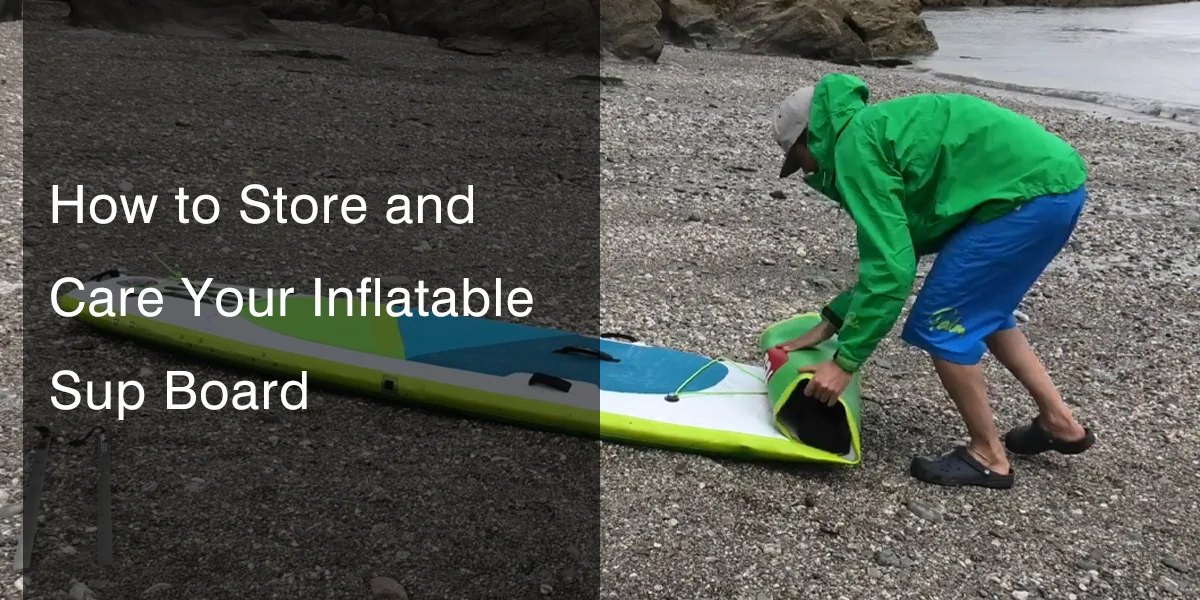
- Loose roll, not tight fold. Start at the nose and roll gently toward the tail valve to push air out.
- Don’t choke it. If your bag has room, leave the board slightly rounder — less stress on the rails.
- Dry completely first. That old-gym-sock smell is mold eating the deck-pad adhesive. Once it starts, you can’t reverse it.
Off-Season Storage: The 5 PSI Rule
When the season ends, where and how you store the board decides what condition it’s in next spring. Two things kill boards in storage: permanent creases, and rodents. Mice and rats like the feel of PVC — I’ve seen boards written off from gnaw marks after a winter in a garage corner.
The Storage Standard We Use
- Best case — store inflated at ~5 PSI. If you have wall space, keep the board unrolled and lightly inflated. That 5 PSI gives it shape, keeps the material relaxed, and stops permanent creases. This is what we recommend to rental operators with off-season racks.
- If you must roll it: keep it in the bag, on a shelf or in a sealed plastic bin — never loose on a concrete floor.
- Mid-winter: unroll it once to let the material breathe.
For a dealer holding seasonal stock, the same logic applies to your warehouse. Boxed boards stored flat and out of heat hold spec; we run seasonal inventory programs so you’re not sitting on aging inflated stock between peak windows.
The 10-Second Valve Check That Stops 90% of “Mystery Leaks”
Last, the little black plastic wrench everyone tosses in a drawer and forgets. It isn’t a toss-away — it’s the tool that prevents most warranty calls I get.
The inflation valve clamps two layers of PVC together. Over time, travel vibration plus the inflate-deflate cycle can loosen that mechanical joint. A faint hiss at the valve usually doesn’t mean a puncture — it means a loose nut.
The 6-Month Checkup
- With the board flat, press the valve basket from underneath to hold it in place.
- Use the wrench to turn the valve nut gently clockwise until snug.
- That’s it — ten seconds. This single check resolves about 90% of the “mystery leaks” customers report to us.
For fleet managers: add this to your pre-season checklist across every unit. It’s cheaper than one return shipment.
What Material and Welding Quality Mean for Your Return Rate
Every habit above helps, but a board’s tolerance for abuse is decided at our factory before it ships. This is the part that separates a supplier you reorder from one you replace.
How We Build to Survive Bad Storage
- HF-welded seams, not hand-glued. We use high-frequency welding on the rails. Hand-glued seams rely on solvent adhesive that’s the first thing to fail under the heat and pressure described above — usually in season 2–3. Welded seams remove that failure point.
- Double-layer reinforced PVC over a drop-stitch core, standard 6″ (15 cm) board thickness.
- 15 PSI working pressure, with a structural margin well above it.
- 48-hour pressure retention test on every production batch — boards that lose more than roughly 1 PSI over 48 hours at 15 PSI don’t pass.
- QC rejection rate held at 3–5% before boxing, logged per batch.
MOQ, Lead Time & Indicative FOB Pricing
Below is how our order tiers typically run. Pricing is indicative FOB Guangzhou and moves with board size, layer count, and print complexity — your exact quote comes from your spec.
| Order Tier | MOQ | Indicative FOB (per board) | Lead Time |
|---|---|---|---|
| Sample | 1 piece | $60 – $110 | 7 – 15 days |
| Trial / Stock test | 50 – 100 pcs | $55 – $90 | 25 – 30 days |
| Volume OEM | 300 – 500 pcs | $48 – $75 | 30 – 35 days |
| Container / 1000+ | 1000+ pcs | $42 – $65 | 35 – 45 days |
For US and EU importers, a rough landed-cost rule: add roughly $12–$28 per board for sea freight (consolidated vs full container), plus your local duty and clearance. We’ll break this down for your port on request.
If you’re speccing a fleet or a private label run, start at our inflatable SUP board range, or go straight to custom OEM/ODM paddle boards for branded artwork, sizing, and packaging. Buying for resale by the pallet? See wholesale paddle board pricing.
Frequently Asked Questions
How should a rental operator store inflatable SUP boards in the off-season?
If you have rack space, store them unrolled and inflated to about 5 PSI — enough to hold shape and take tension off the seams without stressing the rails. No space for that? Keep each board loose-rolled in its bag, inside a sealed bin off the floor, and unroll once mid-season to let the material breathe.
What PSI should an inflatable paddle board be inflated to?
Our boards run a 15 PSI working pressure. The catch is heat: a board left inflated in direct sun can climb to 20–22 PSI on its own, which is what damages seams. Inflate to 15, then vent slightly or move to shade when it’s not in use.
Does saltwater really damage inflatable SUP boards?
Yes — not the water itself, but the salt crystals left when it dries. Roll a board up unrinsed and those crystals abrade the PVC and sealant from inside the roll over time. A proper freshwater rinse and full dry before storage prevents it.
What’s the difference between welded and glued SUP board seams?
Hand-glued seams use solvent adhesive that degrades under heat and pressure, often failing in season 2–3. We use high-frequency (HF) welded seams on the rails, which fuse the material and remove that adhesive failure point. For a fleet or a brand, welded construction is the single biggest driver of a lower return rate.
What is the MOQ and lead time for OEM SUP boards at Huale?
Samples start at 1 piece (7–15 days). Branded OEM production typically runs from 50–100 pieces per design, with bulk lead times of 25–45 days depending on quantity and artwork. Send us your spec and target market and we’ll return exact MOQ, FOB, and timeline.
Get a Factory-Direct Quote
If you’re sourcing inflatable SUP boards for a brand, a rental fleet, or resale, send us your specs — board type, sizing, artwork, target quantity, and destination port. We’ll come back with material options, the right construction for your market, and a clear price.
We will respond within 24 hours with a factory-direct quote.
MOQ starts from 1 piece.


