
Most rental operators make the same two mistakes. They either buy too few boards and lose revenue on peak days, or they buy the cheapest boards available and spend the entire season patching leaks and issuing refunds. Neither outcome is inevitable — but avoiding both requires making the right decisions before you place the order, not after.
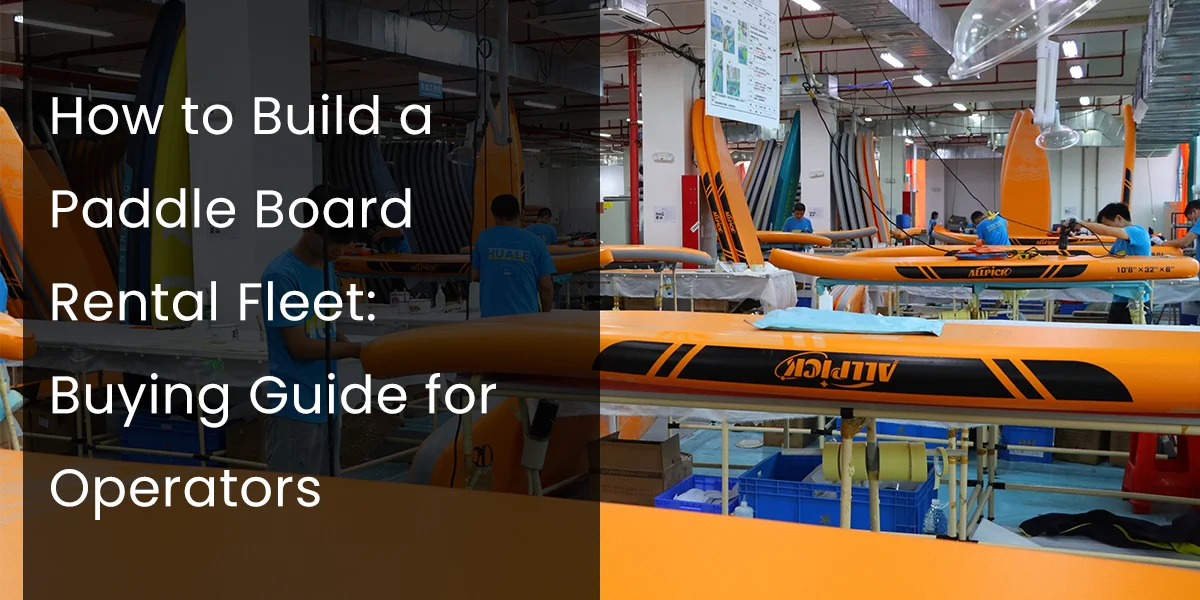
We’re the engineering and sales team at Huale Inflatables, a China-based inflatable stand-up paddle board factory with 15+ years supplying commercial rental fleets across North America, Europe, and Southeast Asia. This guide gives you the exact framework we walk fleet buyers through — fleet sizing, commercial-grade specs, wholesale pricing logic, and storage systems — so your first season runs on boards, not on luck.
How to Calculate the Right Fleet Size Before You Buy
Fleet size is a business math problem, not a gut feel decision. Overbuy and you have capital sitting in a storage unit. Underbuy and you turn away bookings on your three busiest weekends of the year — which is where most small rental operations make or lose their annual margin.
The Peak Demand Formula
Start with your expected peak hour — the single busiest hour of your busiest day. Estimate how many simultaneous renters you realistically expect. Multiply that by your average session length in hours, then add 20% buffer for boards in transit, drying, or undergoing a quick inspection between sessions.
- Example: 15 simultaneous renters × 1.5-hour sessions = 22.5 board-hours needed per 90-minute window
- Add 20% buffer: 22.5 × 1.2 = 27 boards minimum for that peak window
- Practical starting fleet for a new operation: 20–30 boards covers most small-to-medium rental setups in the first season
Don’t build your fleet around your average day. Build it around your peak day — that’s where the revenue is and where equipment failures cost you the most.
Which Board Sizes to Stock for a Rental Fleet
For a general rental fleet serving mixed adult and beginner users, a 10’6″ all-around board at 32″–33″ width is the workhorse. It handles the widest range of user heights and weights, stable enough for first-timers, and short enough to store efficiently.
- 70–80% of fleet: 10’6″ all-around, 32″–33″ wide, 200–220L volume
- 15–20% of fleet: 11′ boards for taller or heavier users (85kg+)
- 5–10% of fleet: Kids’ boards (8’–9′) if your location serves families
Commercial-Grade Specs: What Rental Boards Need That Recreational Boards Don’t
A recreational board is designed for one owner who stores it carefully and uses it 20–30 times per season. A rental board gets used 8–12 times per day, handled by strangers, dragged across gravel launching areas, and inflated by users who ignore the pressure gauge. The construction spec has to account for all of that.
Material Specification for Commercial Rental Use
- PVC thickness: 1.2mm double-wall fabric (DWF) minimum — single-layer 0.9mm PVC degrades within one rental season under daily use
- Drop-stitch density: 20+ threads per cm² — lower density boards develop deck flex under repeated heavy loads; drop-stitch construction determines the board’s rigidity at rated pressure
- Seam construction: High-frequency welded structural seams only — hand-glued rail joints fail under sustained commercial use, typically within 60–90 rental sessions
- Valve spec: Reinforced PVC or stainless steel valve body — budget plastic valves develop micro-cracks after 50–80 inflation cycles
- Rated PSI: 15 PSI minimum — boards rated below 12 PSI feel soft and unstable under heavier users, generating complaints and returns
- EVA traction pad: Full-adhesive bonding, not perimeter-only — rental users step on pad edges constantly; perimeter-bonded pads start peeling within weeks
The 48-Hour Pressure Test: Non-Negotiable for Fleet Orders
Every board we supply for commercial use passes a 48-hour pressure retention test before it ships. The board is inflated to rated PSI and left standing. PSI is logged at the start and end. Any board that drops pressure is scrapped, not shipped.
We reject 3–5% of units per production run at this stage. That rejection cost comes out of our margin, not yours. For rental operators, this test is the difference between a board that holds air through an entire season and one that generates a slow-leak complaint on day three. Ask any supplier you’re evaluating whether they run a 48-hour retention test. The answer tells you a lot about their QC process.
Wholesale Pricing: What to Expect When Buying 20–50 Boards
Wholesale paddle board pricing has three main tiers, and which tier you access depends on your order volume and whether you’re buying through a distributor or directly from a factory. Direct factory pricing is almost always 25–40% lower than distributor pricing at the same volume.
| Order Volume | FOB Unit Price (USD) | Branding | Lead Time |
|---|---|---|---|
| 1–5 units (sample) | Sample rate | Logo from 1 piece | 7–10 business days |
| 10–30 units | $110–$160 | Full color + logo | 25–35 days |
| 30–80 units | $90–$130 | Full custom branding | 25–35 days |
| 80–200 units | $75–$110 | Full custom + priority scheduling | 30–40 days |
These are FOB Guangzhou prices for a commercial-grade 10’6″ all-around board at 1.2mm DWF spec with branded printing. For a US-based operator, total landed cost typically runs 45–60% above the FOB price after freight, import duty, and customs clearance.
Factory Direct vs Distributor: Which Route Makes Sense for Your Bulk Paddle Board Order
For orders under 10 units, a local distributor is usually easier — less administrative complexity, faster delivery, and a return process that doesn’t involve international shipping. For orders of 20+ units, factory-direct pricing is almost always worth the additional logistics effort.
The per-unit saving on a 30-board order at factory-direct pricing versus distributor pricing typically covers the cost of a freight forwarder and customs broker with margin to spare. The breakeven point for most operators is around 15–20 units — below that, the distributor’s convenience is worth the premium; above it, it isn’t.
Paddle Board Fleet Management: Storage and Operational Logistics
Inflatable boards have a significant logistical advantage over hard boards for rental fleets: packed storage volume is roughly 85% smaller than the inflated footprint. A 30-board inflatable fleet stored deflated and rolled fits in the space of 3–4 hard boards laid flat.
Inflation Turnaround: Planning for Peak Operations
The practical constraint for rental operations is turnaround time between sessions. A single electric pump inflates a board from 0 to 15 PSI in 4–6 minutes. With one pump per staff member, a 10-board turnaround takes 40–60 minutes — a real bottleneck during back-to-back 90-minute sessions.
- Recommended ratio: One electric pump per 8–10 boards in active rotation
- High-volume operations: Dual-stage electric pumps pre-inflate to 8 PSI quickly then top up to 15 PSI — cuts per-board time to 3–4 minutes
- Pre-inflation strategy: Keep a portion of the fleet pre-inflated in shaded storage between sessions to reduce peak turnaround pressure
Between-Session Board Inspection Protocol
Every board coming off the water should go through a 60-second check before the next rental. This is not a full QC — it’s a quick condition sweep that catches issues before they become mid-session failures.
- PSI check: Boards lose 1–2 PSI per hour in hot sun due to thermal expansion — top up before every rental
- Seam visual: Look for separation at rail seams near the nose and tail — early delamination signs are visible before air loss begins
- Valve check: Press and listen for air loss with the valve pin depressed
- Fin check: Snap-in fins dislodge during use — a missing fin means the board won’t track straight, which generates an immediate complaint
Branding Your Commercial Paddle Board Rental Fleet
A branded fleet protects against board theft and turns every rental session into a marketing impression. Renters post photos. If your logo is on the board, your brand is in the photo.
We apply UV digital printing directly onto the PVC deck and hull — fade-resistant for 3+ seasons under daily sun exposure. Logo, colorway, and deck design are confirmed at sample stage and applied consistently across the entire fleet. For rental operations, we recommend a high-contrast two-color design with the operator’s logo centered on the deck — high visibility in photos, consistent across large production runs, and straightforward to update between seasons. Custom branding from 1 unit at sample stage; bulk fleet orders from 20 units.
Frequently Asked Questions: Building a Paddle Board Rental Fleet
How many paddle boards do I need to start a rental business?
For a new operation, 15–20 boards covers most small to medium launch scenarios. Start by calculating your expected peak-hour demand — the number of simultaneous renters on your busiest day — and add 20% buffer for boards in turnaround. Most operators who start with fewer than 15 boards hit capacity constraints within their first peak season and end up placing a second order mid-season at full retail pricing, which eliminates most of the margin they saved by starting small.
What are the best inflatable paddle boards for rental fleet use?
For rental fleets, the spec matters more than the brand name. The minimum commercial-grade requirements: 1.2mm double-wall fabric construction, high-frequency welded rail seams, a reinforced valve rated for 500+ inflation cycles, and a maximum rated PSI of 15. A board meeting these specs will typically survive 2–3 full rental seasons with standard maintenance. A board built to recreational spec — 0.9mm PVC, hand-glued seams, plastic valves — will show significant wear within the first season under daily commercial use.
How much does it cost to buy wholesale paddle boards for a rental operation?
At factory-direct pricing, commercial-grade inflatable SUPs for rental use run $90–$160 USD FOB depending on spec and volume. For a US-based operator, landed cost after freight, import duty, and customs fees typically runs $130–$230 per board. A 20-board starter fleet at the lower end of that range represents a total landed investment of approximately $2,600–$4,600 USD — before pumps, fins, leashes, and storage equipment.
How do I manage maintenance for a large paddle board rental fleet?
Three priorities cover 90% of fleet longevity: rinse boards with fresh water after every salt water session to prevent PVC degradation from salt crystal abrasion; store deflated boards out of direct UV exposure when not in rotation; and run a morning seam and valve inspection at the start of each operating day rather than waiting for a mid-session failure. Boards that develop slow leaks mid-season almost always show early warning signs 2–3 days before the failure becomes obvious to a renter.
Can I get paddle boards custom branded for my rental fleet?
Yes, from 1 unit at sample stage. For fleets, we recommend a two-color design with the operator’s logo on the deck — high visibility in photos, consistent across large production runs, and straightforward to update between seasons. Full custom graphics including hull printing and custom colorways are available from 20 units. Sample lead time is 7–10 business days; bulk fleet production runs 25–35 days after sample approval and deposit.
Get a Factory-Direct Quote for Your Rental Fleet
Send us your fleet size target, board spec requirements, destination port, and your launch timeline. We will respond within 24 hours with a factory-direct quote, a recommended spec for your use case, and a production schedule that fits your season start date.
MOQ starts from 1 piece for samples. Bulk fleet orders from 20 units. We’ve supplied wholesale paddle boards for rental operations in lake destinations, coastal surf schools, resort activity programs, and outdoor event setups — the logistics and operational requirements of a rental fleet are not new territory for our team.


